Synthesizing Patterns Across Hundreds of UX Sessions
AI synthesis scales pattern-finding across hundreds of sessions human teams can't manually analyze.

I've run synthesis on session data long enough to know where the actual bottleneck sits: arithmetic. AI changes the math by letting teams pull themes, sentiment, and behavior out of every session they run, more than the twenty or thirty an analyst can realistically get through before a deadline hits.
Most teams still work off an old assumption, that running more sessions means learning more. That's backwards, or at least it skips a step. Learning is capped by how fast a person can read a transcript, code it, and hold it against the last twenty they read that week. A senior researcher can manage maybe five or six moderated interviews before synthesis eats the rest of their hours, close to an hour of manual work per session, sometimes more if the transcript's messy. Sample size doesn't get set by what the question needs, then. It gets set by what one or two people can chew through before Friday, and the sessions nobody gets to aren't blank. They just never get a chance to say anything.
What happens to insight quality when sample size stays small by necessity
Small-sample qual works fine, even good, when you want depth on one person's path through a checkout flow. It falls apart once the goal shifts to spotting a pattern across two hundred people.
Here's the mechanism: an analyst reviews thirty out of two hundred sessions, and whatever they find describes only those thirty. It says nothing about the other hundred seventy. The one user who talked the most, or said something quotable enough to survive into the deck, ends up shaping the whole readout. The behavior sitting quietly in half the sessions, meanwhile, the one nobody flagged because it wasn't dramatic, never gets mentioned at all.
I sat in on a roadmap call once where the team made a real bet on a finding that would've looked completely different with fifty more sessions in the pile. Nobody in that room was wrong to trust their data. There just wasn't enough of it. You can hear the strain in the language people use during a thin readout: more "directionally," more "we think," more requests for a follow-up study before anyone puts their name on the recommendation. That hedging reflects a capacity problem wearing a methods costume.
How AI reads across sessions rather than within them
Human review happens one session at a time, then the next, then a synthesis pass at the end where you try to remember what session fourteen had in common with session sixty-two. Most people can't hold that much in their head, so a lot gets lost between sessions instead of within them.
AI reads the whole set at once. It catches three users hesitating at the same screen even when those sessions ran in different weeks with different moderators. A few pieces do the heavy lifting. Theme extraction clusters repeated language and behavior into named opportunity areas across hundreds of transcripts in a single pass. Sentiment mapping tracks emotional tone across the full arc of a session, not just the moment someone raised their voice. Behavioral clustering groups people by what they actually did, which diverges from what they said more often than anyone likes to admit. Timestamp tagging makes every surfaced moment retrievable, so an analyst can jump to the clip and check the model's work instead of taking it on faith.
That kind of cross-referencing used to eat weeks by hand. It's probably why synthesis is the one corner of research where AI adoption moved fastest; that's where the hours and the delay hurt most.
The anomaly problem: what AI synthesis tends to suppress
AI synthesis finds what's common. That's the whole design of the underlying models, built to recognize what repeats across a dataset, which means the outlier, the one user whose behavior breaks the pattern everyone else follows, is exactly what gets missed.
That outlier is where qualitative work has always beaten quantitative work. Researchers at MIT Sloan call this the "average response" problem: a model-generated synthesis lands close to a weighted mean, not the edge case that reveals a design failure no majority of users would ever bother naming out loud.
I've traced this back through session data more than once. A navigation failure hitting a small but real slice of users doesn't clear the bar to become a named theme. A workaround power users invented on their own gets coded as a positive, "task completion," when it's actually a red flag signaling a gap somebody needs to fix. Demographic or cultural edge cases get smoothed into the aggregate and quietly vanish.
So AI synthesis needs a human layer built to hunt for exactly what the model is least likely to surface on its own. Treat the themes AI hands you as a floor, not a finished report.
Designing a workflow where AI handles volume and researchers handle judgment
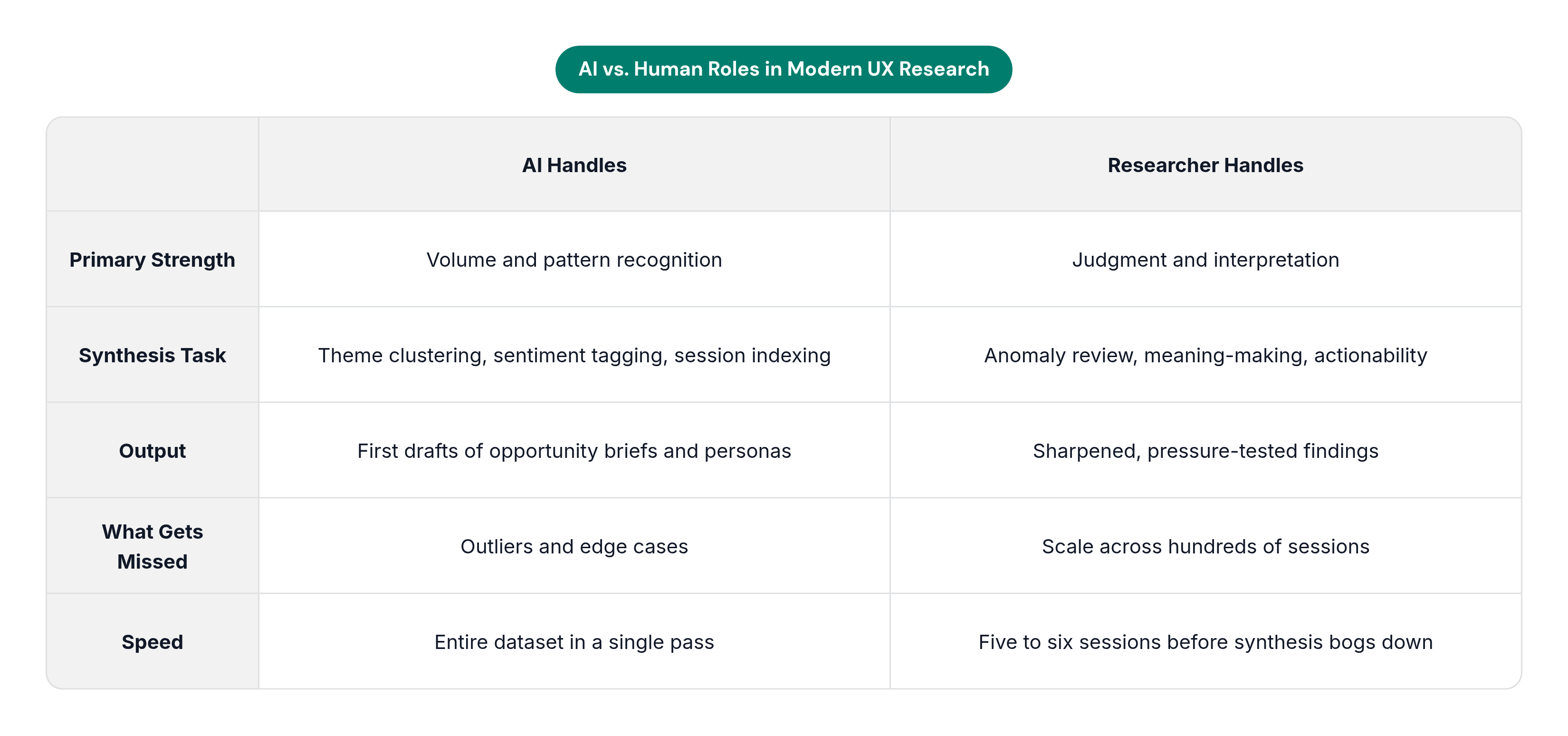
The teams doing this well match each tool to the part of the job where it actually removes friction. They don't pretend the two roles are interchangeable.
AI handles transcript processing, theme clustering, sentiment tagging, session indexing, and first drafts of things like opportunity briefs. Researchers handle anomaly review, deciding what a pattern actually means, why it exists, and how to turn a finding into something a product manager can act on by Monday.
That's a real shift in the job description. The researcher used to read everything and hunt for patterns by hand; now the job is interrogating the patterns AI already found and pressure-testing whether they hold up. One habit worth stealing: after synthesis runs, ask specifically for the sessions that didn't fit the dominant themes. Those are the ones worth pulling up and watching yourself. AI-drafted personas and briefs solve the blank-page problem well, but they still need a researcher's judgment to sharpen them and check them against reality. And when AI processes recordings or transcripts, participants need to know at the point they give consent, before anything else happens. That part isn't optional, and it isn't negotiable just because the tooling got easier.
How AI-moderated sessions change what gets collected in the first place
The old synthesis bottleneck assumed data collection itself was capped by how many interviews a human moderator could physically sit through in a week. AI-moderated interviewing removes that ceiling.
An AI interviewer runs an adaptive, conversational session, following up when someone gives a vague answer, probing when something unexpected comes up, across many participants running at once instead of one after another. This matters because what you can synthesize depends entirely on what got collected in the first place. A static survey gives you flat, thin data with nowhere for a follow-up question to go. A conversational session gives you the dense, specific language theme extraction actually needs to have something to chew on.
The cost gap between AI-moderated and human-moderated qualitative work has widened enough that teams now run studies they'd have skipped before purely on budget grounds. The Insights Association has reported that AI-moderated interview volume among its member vendors passed human-moderated volume faster than most people in the industry forecast.
Panel quality matters more here, not less. Fraud rates in unmanaged commercial panels run high enough that all this new volume only counts for something if the people answering are real, verified humans. Seda pairs a verified human panel with AI-moderated interviewing and cross-session synthesis. I've watched teams treat volume and quality as separate problems to bolt together after the fact, and it rarely holds up; the ones that build them as one layer from the start end up with fewer surprises later.
What continuous session synthesis makes possible that periodic research cannot
Traditional UX research runs in cycles. A study gets approved, run, synthesized, written up, and everyone waits for the next approved project to kick the cycle off again.
Once synthesis stops being the bottleneck, research doesn't have to work that way. Sessions pile up and the patterns update as new data lands, which sounds small until you see what it unlocks. A product manager can run a standing "what's breaking right now" signal against active users, refreshed weekly instead of once a quarter. A design team can check whether something shipped two weeks ago actually moved behavior in the session data, instead of guessing. A researcher can answer a new stakeholder question by querying a library that already exists instead of commissioning a fresh study and waiting a month for it to clear.
The deliverable changes shape too. A static report goes stale the week it's published. A living surface, always-on, with a narrative layered on top only when someone needs the story spelled out, keeps working long after. The Insights Association's own data shows client expectations for continuously updated insight have climbed sharply the past few years, tracking closely with the rise of AI synthesis. Decisions stop happening whenever the study wraps up and start happening whenever the question comes up.
Where synthetic session data fits alongside real-session synthesis
Real sessions aren't always available fast enough. Hard-to-reach populations, concepts too early for any real user to exist yet, markets where recruiting alone eats three weeks: these are real constraints, not excuses researchers hide behind.
Calibrated synthetic panels, trained on real behavioral data, can fill that gap by generating session-equivalent responses at whatever volume pattern detection needs. Recent accuracy studies show these panels perform well on concept tests, pricing tests, and positioning tests, the stuff with some precedent already sitting in the training data. Accuracy falls off hard once you're testing something genuinely new, something the model has nothing to draw on.
Used carefully, synthetic sessions work well for early directional signal before a team commits to a full real-session study, for topping off sample sizes so a pattern actually stabilizes, and for simulating segments too slow or expensive to recruit fresh every round. The risk shows up when synthetic output gets treated as a substitute for real synthesis on something genuinely novel, and that's exactly where synthetic and real responses stop tracking each other; the gap can run wide. I've seen the alternative play out too: teams rebuilding a behavioral panel from scratch for every study, paying the recruitment cost over and over instead of building it once and reusing it as a standing asset across future decisions.
The practical case for treating synthesis infrastructure as a strategic investment
The teams that fixed the synthesis bottleneck are running more studies, at bigger sample sizes, faster than before, and none of them got there by hiring a bigger analyst bench. They got there by changing what the analysts they already had spend their hours doing.
You can see the budget shift in real numbers. Spend on AI research tools has climbed sharply the past few years, while spend on traditional panel providers and static survey tools has gone the other direction. That reflects reallocation, not new money stacked on top of the old budget. The case for it isn't mainly about cutting cost, though that's a nice side effect. It's about decision confidence showing up at the speed a product team actually moves.
A study that finishes after the decision already got made amounts to a writeup of something that already happened.
The teams pulling ahead treat their session library as a permanent, queryable asset, not a folder of closed projects nobody reopens. Every session added sharpens the next round of pattern detection a little more, and every theme surfaced becomes something to check the next round against, a kind of running memory the team didn't used to have. The real question was never whether to collect more sessions. It's what system processes, synthesizes, and makes every one of them retrievable months later, since that's the thing deciding whether your research compounds over time or starts from zero with every project you run.