Synthetic Panels for Concept Testing
Speedy AI respondents handle structured testing while real panels still own emotional depth.

Concept testing has a math problem. Recruiting and managing a real sample eats up roughly 60% of a project's total time, and by the time results land, four to eight weeks after fielding starts, the product team has already moved on or made the call without them. It is not uncommon for a team to wait weeks on panel recruitment for a feature concept that ships, in a different form, before the results even come back. Synthetic panels exist because of that gap. Below is what these tools actually are, how they get built, and how to run them next to real people without kidding yourself about what each one can and can't do.
Panel fatigue makes this worse every year. Response rates keep dropping, costs keep climbing, and GDPR and CCPA limit how much consumer data a company can hold onto in the first place. That shrinks the pool of people you can reach right when you need more of them, not fewer. What's left is a process that's slow, pricey, and skewed toward whoever's easiest to find rather than whoever actually matters to the decision. So teams skip early testing, or they bet real budget on a concept nobody's stress-tested.
What synthetic panels actually are, and what distinguishes them from a chatbot prompt
A synthetic panel is a set of AI-built virtual respondents made to act like a defined consumer segment: same demographics, same general behaviors and preferences. They're built from real inputs; past survey answers, customer reviews, behavioral data, CRM records, public opinion trends.
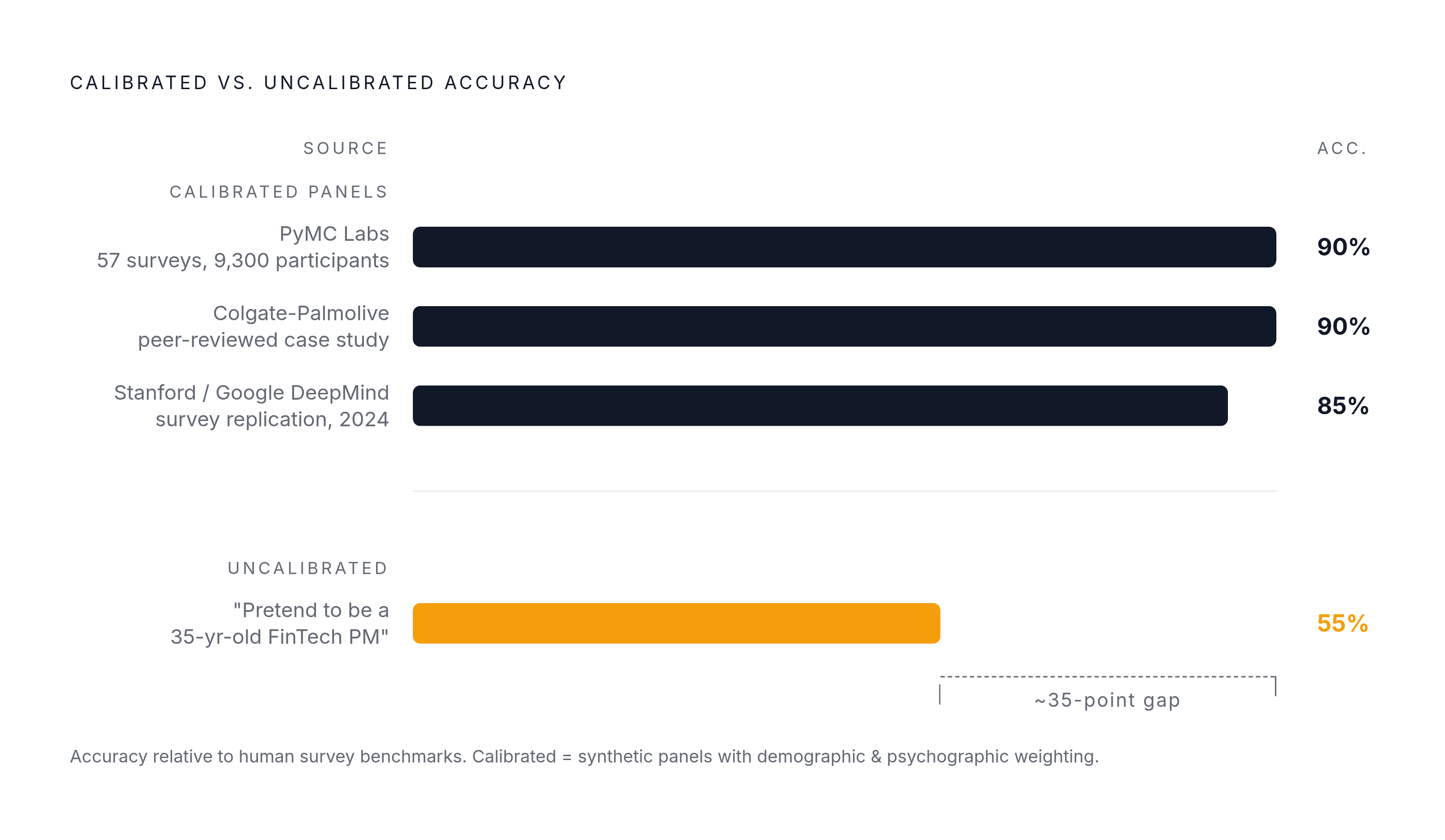
Calibration is what separates a real research tool from a party trick, and I mean that literally. A synthetic panel trained and checked against real human data hits accuracy in the mid-to-high 80s on structured tasks, which is the gap that platforms like Seda, an AI-powered customer research tool that runs interviews and UX tests against a verified panel of human respondents across 130-plus countries, are designed to close through ongoing validation rather than one-time setup. Ask a general chatbot to "pretend to be a 35-year-old FinTech product manager" with no calibration behind it, and accuracy drops to around 55% on those same tasks, according to neuroflash.com.
Conjointly founder Nik Samoylov ran into this directly. The same demographic profile, run through an uncalibrated system with slightly different wording, produced mean household income estimates ranging from $111,348 to $272,014. That's not a model reasoning about income; it's a system pattern-matching on whatever phrasing you typed in, echoing whatever's in its training data and shuffling the answer depending on how you ask. Know this before you sit down with a vendor.
How a synthetic panel is built from real human data to a queryable simulation
Building one right takes three stages. Skip any of them and it shows up in the output, usually fast, and usually in a way that's hard to catch until someone's already acted on bad numbers.
Data grounding comes first: every persona gets anchored to real-world inputs, internal CRM data, past surveys, market studies that already ran. Nobody should build a synthetic consumer off a guess about what that consumer looks like.
Demographics alone don't make a believable respondent, though. You need consumer behavior frameworks and domain know-how layered on top, so the panel doesn't just resemble the segment on paper. It has to reason the way that segment actually reasons, which is a much harder bar to clear.
Then comes the part nobody skips twice after getting burned: ongoing validation against real panel data and official numbers from sources like Kantar, the US Census Bureau, and Eurostat. Until a model passes that check, its outputs stay suspect.
None of this holds still, either. New data comes in, models get retrained, and the panel tracks shifts in culture and market conditions instead of freezing at whatever moment it got calibrated. A panel's quality is a direct function of how good and how recent the data under it is. Once it's built, the payoff shows up fast: submit a concept question and the panel returns 10,000-plus distinct responses in under an hour. No live recruitment process touches that.
How accurate synthetic panels are, and where the honest limits sit
When calibration is done right, the numbers hold up better than most skeptics expect. Across 57 real consumer surveys covering 9,300 participants, synthetic respondents using the Semantic Similarity Rating method hit 90% of human test-retest reliability, according to PyMC Labs. A 2024 Stanford and Google DeepMind study found 85% accuracy on survey replication and 98% correlation on behavioral tasks. Colgate-Palmolive published a peer-reviewed case study showing 90% correlation between synthetic and real panel results. All of that comes from calibrated systems, so hold onto that 55% uncalibrated baseline as the contrast, because vendors won't always bring it up on their own.
Here's where it falls apart, though. Genuinely novel products, not sequels, not line extensions, but actually new ideas, show only a 0.3 correlation between synthetic and real responses, per a Marketing Science study. That's close to useless. Synthetic panels also miss the unprompted comment, the offhand remark that reframes the whole brief; open-ended discovery is still a human strength. Edge cases and minority preferences inside a segment get underweighted systematically, and anything tied to a first-time purchase, a major life transition, or crisis-driven behavior is still hard to model well.
Even with those limits, practitioners who push through the calibration work tend to find it pays off. The 2025 GreenBook GRIT report put user satisfaction at 87% among research teams actively using synthetic data. Structured, preference-based work in familiar categories: synthetic panels handle that well. Genuinely new problems and emotionally loaded decisions still need a human in the room.
Where synthetic panels fit in the concept testing workflow, and where they don't
The strongest fit is anything structured and measurable, where preferences get ranked, rated, or compared side by side: concept rankings across variants, feature importance ladders, price sensitivity curves, message believability, packaging comparisons, competitive positioning.
That's not a small slice of the work. A large share of a team's total research volume tends to be concept testing, message validation, and feature prioritization, which happens to be exactly what synthetic panels do best. The remaining portion still needs human depth, and no shortcut changes that math.
There's a real opening for hard-to-reach segments, too. Recruiting enterprise decision-makers, niche technical specialists, or people with a low-incidence health condition can take months and run thousands of dollars per respondent through traditional recruitment. A synthetic panel can simulate those segments right away, turning an early read on a niche audience into something realistic instead of a budget-buster.
Some sectors moved faster than others. FinTech got there early because affluent segments cost a lot to recruit and compliance rules limit live testing anyway; Pricing sensitivity and churn prediction are exactly the kinds of structured, measurable tasks where synthetic panels have shown strong results. Pharma and healthcare stay cautious, and they're right to. Synthetic panels have no business in patient-facing decisions, though HCP messaging and non-clinical market research are starting to open up. Keep synthetic panels away from emotionally loaded purchase decisions, truly novel categories, and any regulatory submission that needs a real-respondent audit trail.
The sequencing model that makes synthetic and human research work together
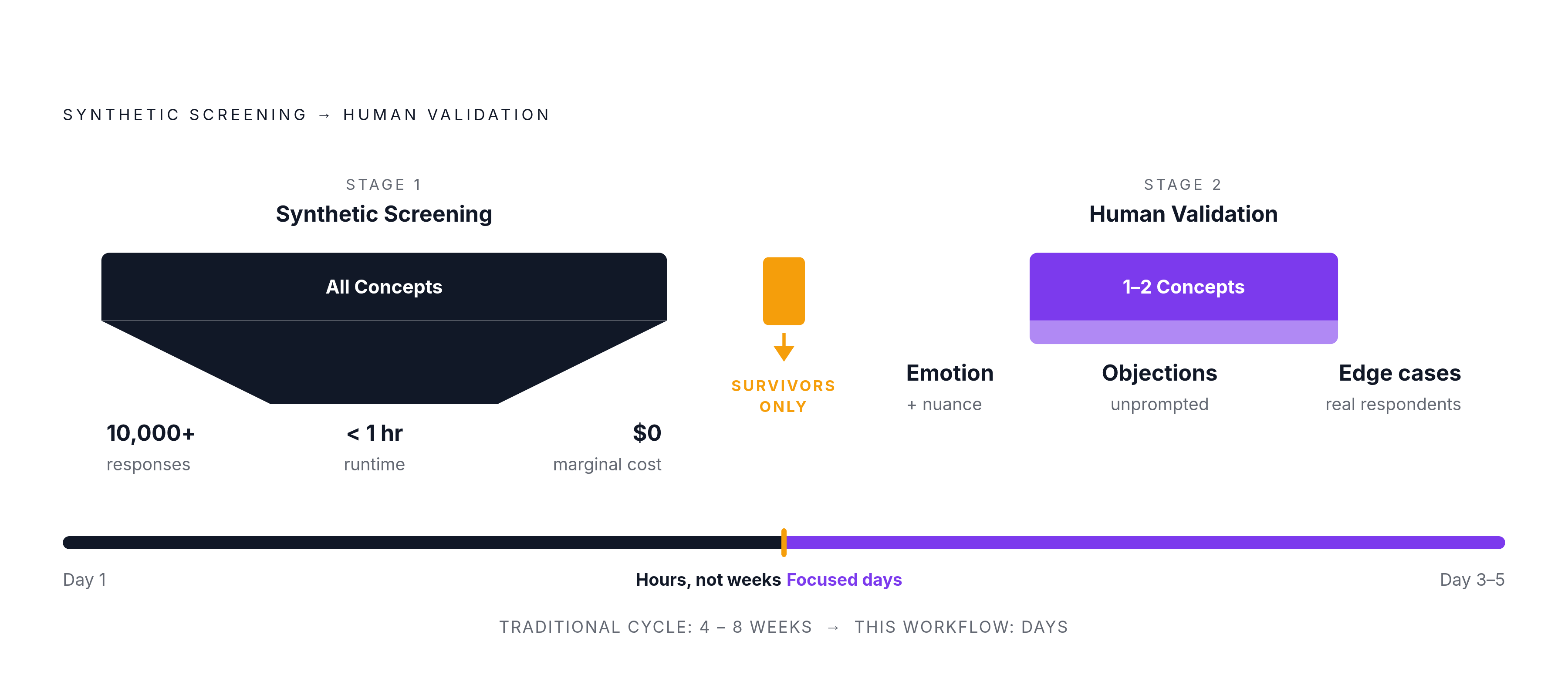
Teams that stick with this long enough land on the same pattern: synthetic panels for screening and iteration, human panels for final validation and the texture only real people bring.
Stage one is synthetic screening. Run every concept variant through the synthetic panel before spending a dollar on live recruitment. Find out which variants clear a preference threshold, which ones die on price, which ones have a credibility problem with the message, and kill the weak ones now, while it costs nothing to do so.
Stage two is human validation, and it's narrow on purpose. The live study focuses on the one or two concepts that survived the synthetic round. Real respondents bring the emotional detail, the objection nobody scripted for, the edge case a model can't generate on its own. The human study stops being an exploration exercise and turns into a confirmation step, smaller, faster, sharper.
This doesn't shrink the human research budget so much as it aims it better, putting that spend where only humans can do the work. And the loop keeps running: insights from a synthetic screen feed the next round of concept refinement, which runs through another synthetic check, compressing what used to be sequential months into parallel days. Platforms that support both synthetic screening and human validation within a single workflow make this practical. The verified panel handles final validation; the synthetic layer absorbs the high-volume screening in front of it.
The speed and cost reality when teams run this in practice
The timeline difference isn't incremental. Cycles that take four to eight weeks with a traditional panel take hours with a synthetic one, according to neuroflash's read on product-market fit workflows. Qualtrics reported one pilot that delivered insights 98% faster and at roughly half the cost, matching the human panel data it was tested against. Published reporting has found companies using AI market research tools cutting research timelines by up to 80% while cutting costs by 60–70%.
There's a line I've heard practitioners use that sums up the trade-off: 80% accurate insights in minutes beat near-perfect accurate insights in months. Consumer behavior moves fast enough that a perfect study arriving late is worth less than an imperfect one that arrives on time.
What that speed buys goes beyond saved hours. Assumptions get tested before the roadmap locks in, not after it's too late to change course, and multiple concept directions run side by side instead of waiting in a queue. Decisions that used to need a dedicated research budget now happen inside a normal sprint, and weak concepts die cheap, before they've eaten any development time. The whole cost structure flips: instead of one expensive study a quarter, teams run lightweight synthetic screens all the time and save the human research spend for the decisions that actually need it.
What to look for in a synthetic panel platform before committing to one
Start with calibration transparency. Ask the vendor what real-world data trained the panel and how it gets checked against actual respondents; if they can't answer clearly, treat every accuracy number they quote as unverified, because it probably is.
Validation method matters just as much. You want comparisons against real panel benchmarks and official demographic sources, not internal testing the vendor ran on itself.
Human respondent access, built into the same platform, is what makes the sequencing model workable in practice. Tools that offer both synthetic and verified human panels in one workflow let you screen synthetically and validate with real people without switching vendors mid-project. A verified human panel with broad geographic coverage matters here too, especially if you're testing concepts across multiple markets.
Segment flexibility is worth testing directly rather than taking on faith. Can the platform model a niche or hard-to-reach segment with the right training data behind it, or is it only built for mass-market consumer profiles? And can you tweak a concept and rerun the synthetic screen right away, instead of restarting a whole setup cycle every time you change something small?
Reusability counts, too. Once a synthetic audience is built around a target segment, it should stay queryable for future decisions rather than getting rebuilt from scratch on the next project. Check the interview depth as well: platforms whose synthetic agents actually probe and follow up produce far richer insight than ones that just spit back static survey-style answers.
Platforms that combine a large verified human panel with proprietary synthetic agents, covering a broad range of country markets, earn their keep here. Running high-volume synthetic screening and real-respondent validation inside one system removes the coordination headache that would otherwise make this whole sequencing model too heavy for a smaller team to pull off.