Testing Messaging and Positioning with Consumers
Five testing methods reveal whether your message actually lands with the buyers who matter.

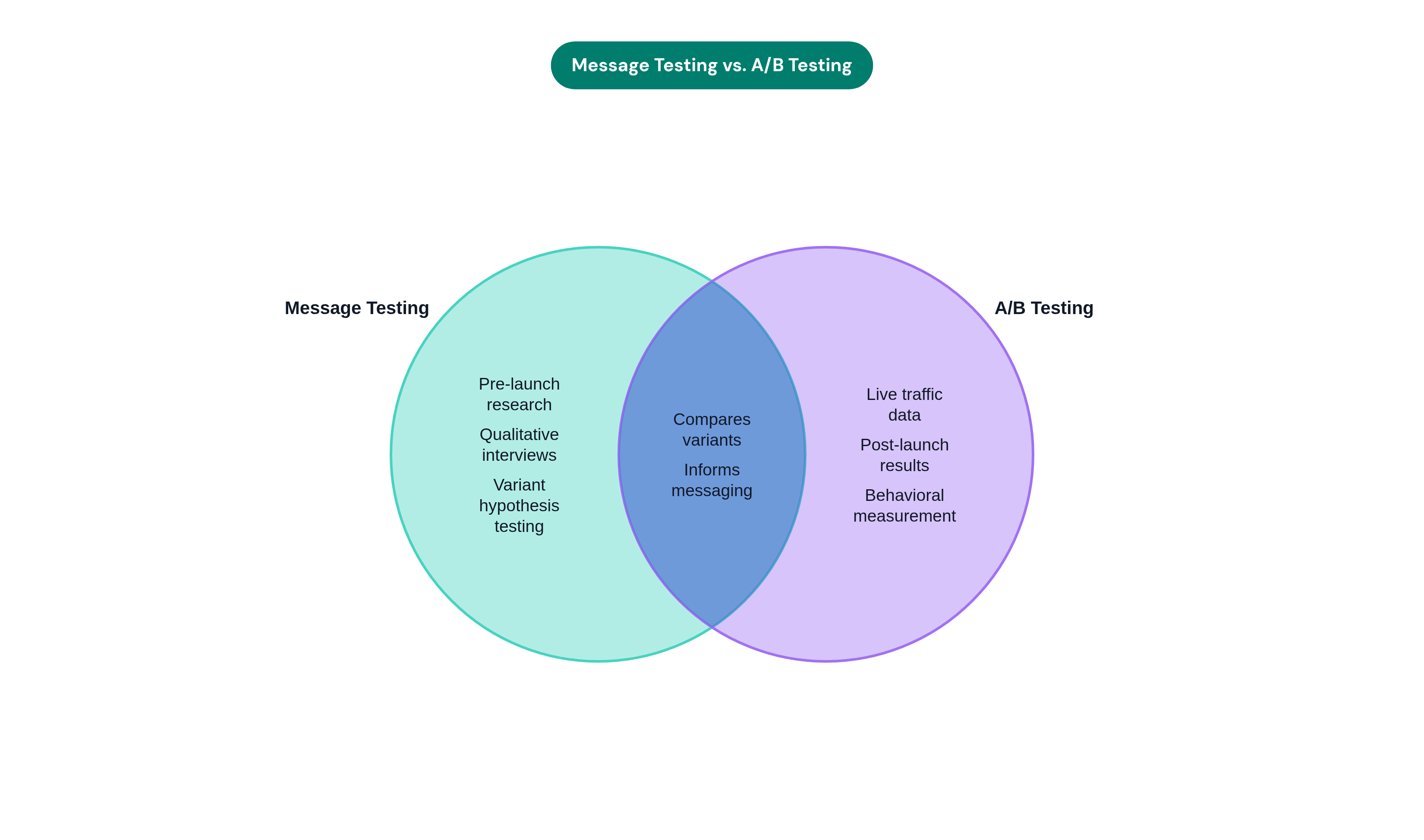
Message testing is pre-launch consumer research designed to evaluate whether a message lands before it's committed to. It is not A/B testing on live traffic, which tells you what happened after the fact and arrives too late to change course. It is not a creative review, which measures internal aesthetic preferences rather than consumer reactions. And it is not a one-time approval gate. If you're using it as one, you're leaving most of its value on the table.
Any message that earns its place in market has to perform on five dimensions. Clarity: does the audience understand what's being said without effort? Relevance: does the message connect to something they actually care about? Value: does it communicate a benefit that matters to them, not just a feature the company is proud of? Differentiation: does it say something competitors aren't saying, or at least aren't saying as well? Brand fit: does it sound like this company, not a generic version of the category?
Information hierarchy matters as much as the words themselves. The right message in the wrong order still fails. A prospect who encounters the value proposition before she understands the problem it solves will not connect the two, and she'll move on.
Product-market fit and message-market fit are not the same thing. A product can be genuinely valuable and still lose in market because the messaging fails to convey that value to the right people. Message testing answers one specific question: does this message do what the team thinks it does, for the people the team is actually trying to reach? That question sounds obvious. It almost never gets asked rigorously enough.
Choosing the right audience before choosing any method
The most common message testing failure is testing on the wrong population. Validation from people who aren't the actual buyer is reliably more positive and substantially less useful than feedback from a genuine target customer who has real stakes in the category. It feels like research. It isn't.
Consumer and B2B audiences require fundamentally different targeting criteria. For consumer products, the relevant filters are age, income, gender, education, interests, purchase behavior, and geography. For B2B products: job title, seniority, company size, industry, and buying authority. A VP of Engineering and a Director of Product are not interchangeable respondents, even at the same company. Their evaluation criteria differ. Their objections differ. Their language for describing the problem differs. A message that resonates with one will actively underperform with the other, and if you collapse them into a single audience, you won't know which is which.
Hard-to-reach segments create special design challenges. Niche professionals, whether rural healthcare specialists, C-suite executives in regulated industries, or small-business operators in specific verticals, have traditionally taken weeks to recruit and cost significant amounts per respondent. These are often the exact audiences whose feedback is most consequential for positioning decisions. Their inaccessibility has historically been the reason teams substitute more convenient populations, and that substitution is precisely how misaligned messaging gets validated and shipped.
Audience definition has to happen before instrument design, not alongside it. A working ICP or persona is an input to message testing, not an output. The format, length, and appropriate depth of a test all depend on who is being asked and in what context. Testing can refine your understanding of an audience, but it cannot substitute for doing the definitional work first.
The core methods and what each one is built to reveal
No single method answers all five dimensions of message performance. Most rigorous programs combine at least two. The choice of method should follow from what you actually need to know, not from what's fastest or cheapest to execute.
Quantitative preference testing
This method shows respondents two or more message variants and asks which performs better on specific dimensions. It's statistically reliable at scale, fast to execute, and easy to act on when one version clearly wins. What it won't tell you is why. A losing message may have failed for a reason that, if you'd understood it, would have produced a better winner than the one you selected. Use it for headline comparisons, value proposition variants, call-to-action language, and claim prioritization. Don't use it as your only method.
Qualitative moderated interviews
Conversational in format, moderated interviews let a researcher or AI moderator probe reactions, follow unexpected threads, and surface the logic behind a response. The value here is the anomalous reaction: the buyer who found a claim confusing, the use case the team hadn't anticipated, the competitor framing a message accidentally reinforces. These are the insights that change strategy rather than just confirm a preference.
Traditionally, this method has been expensive enough to skip. The all-in cost per completed 60-minute moderated interview was significant enough that n=200 fieldwork approached $100,000. AI moderation has changed the economics substantially. Quirk's 2025 Researcher SaaS Report puts the all-in cost of AI-moderated conversational interviews at roughly $22 per completed session, which makes scale that was previously cost-prohibitive accessible for most teams. Best for early-stage message exploration, surfacing objections, understanding emotional register, and testing with niche professional audiences.
Five-second and first-impression tests
These expose a respondent to a message for a brief window, then ask what they retained and what they felt. This measures clarity and immediate emotional response, not considered judgment. The findings can be humbling. Best for landing page headlines, ad creative, packaging copy, and any message that has less than a few seconds to earn attention in context.
Cloze and comprehension testing
This asks respondents to complete or paraphrase a message, revealing whether they understood it on their own terms. It reliably surfaces jargon that feels precise internally but lands as noise externally. Teams consistently underestimate how much of their internal vocabulary has no purchase with the actual buyer. This test has a way of making that embarrassingly clear, quickly.
Sentiment and reaction tagging at scale
NLP-driven analysis of open-ended responses, customer reviews, and interview transcripts can identify consistent patterns across large response sets. The limitation to keep front of mind: this approach identifies patterns, but it should not substitute for reading individual responses. The outlier that breaks the pattern is often the most valuable signal in the set.
How to design a message test that produces usable findings
Test design determines whether results are actionable. A poorly constructed test can produce strong-looking data that points in the wrong direction, which is worse than no data because it creates false confidence. This is where most teams underinvest.
Start by testing existing messaging on the target audience to establish a baseline. Most teams skip this entirely and have no benchmark to measure against. Then develop two to three alternative versions that each make a structurally different argument, not just wording variations on the same claim. Run a preference test to identify a winner on key dimensions. Use qualitative follow-up to understand why the winner worked. That understanding is what makes the next test better, and it is the step most commonly dropped when timelines compress.
Variant construction requires discipline. Each variant should test a distinct hypothesis about what the audience cares about. Testing too many variants simultaneously makes it difficult to isolate what drove the result. If three things change between two messages, a preference for one of them doesn't tell you which of the three things mattered.
Some instrument design traps show up constantly. Leading questions that confirm the message the team already prefers are pervasive and hard to catch from inside the organization that wrote the message. Asking respondents to predict their own behavior, "would you buy this?", produces unreliable data; asking them to react to what they've read produces better signal. Context collapse is also underestimated: showing a message without surrounding context strips it of the conditions under which it will actually be encountered, producing reactions that don't transfer to real-world performance.
Sample size should be calibrated to decision stakes. A headline test guiding a landing page rewrite doesn't require the same sample as a brand positioning study governing a large media investment. Twenty to fifty respondents can surface directional insight in early-stage qualitative work. Larger samples are necessary when the decision requires statistical confidence across segments. Match rigor to consequence.
Platforms like Seda, which runs AI-conducted interviews and UX tests with verified human respondents across 130+ countries and auto-synthesizes findings into structured reports, let teams run those iterative rounds quickly, compressing the cycle considerably. Appcues improved visit-to-signup conversion by 73% after structured message testing. Cognism boosted visit-to-demo-booking rates by over 40%. Both results trace back to iterative testing against target audiences, not single-round validation.
Where synthetic consumers fit into message testing and where they don't
Synthetic consumer panels are AI-generated personas trained on real-world datasets: historical survey data, behavioral records, customer reviews, public opinion trends. They are not fabricated responses. They are modeled approximations of how real populations respond, calibrated against empirical data.
What they're genuinely good for is specific and valuable. They enable rapid first-pass screening across many variants before committing to human fieldwork. They can simulate hard-to-reach audiences at a fraction of the cost and timeline. They allow repeated tests against the same synthetic population over time, enabling longitudinal comparison without re-recruitment. The 2025 GreenBook GRIT Report found calibrated synthetic panels achieving strong parity with real panels on concept, pricing, and positioning tests.
Here is the limitation that message testers specifically need to sit with. A language model asked to respond as a target persona produces a weighted average of everything it has learned about people matching that description. It is built to suppress the anomalous, the unexpected, the contradictory response. Qualitative message testing derives its value precisely from those outlier reactions: the buyer who read the headline as a threat, the objection the team never anticipated, the misread that reveals a structural flaw in the argument. Synthetic panels, by design, underrepresent exactly those responses.
Generic generative AI prompts without calibration produce real-panel parity well below the threshold that would justify messaging decisions, per the same GreenBook report. For genuinely novel positioning, a new category or a radical reframe of an existing one, a Marketing Science study found only a 0.3 correlation between synthetic and real responses. That number is not a rounding error. It's a reason to be careful about where you rely on synthetic data and where you don't.
Use synthetic panels for fast directional screening and variant elimination. Use human respondents to validate finalists and surface the unexpected reactions that produce real strategic insight. Synthetic outputs should always be benchmarked against real human data before being acted on.
Running message tests continuously rather than at launch gates
The traditional model is a single major messaging study per product cycle, commissioned when a launch is already scheduled, used to validate decisions that have often already been made. This produces diminishing returns for a predictable reason: messaging needs to evolve as competitive context shifts, as the audience's category awareness grows, and as the product itself changes. A static message validated once decays.
A large majority of B2B buyers purchase from their Day-1 shortlist, per 2025 research. The messaging that reaches a buyer before active evaluation begins is more consequential than what appears in late-funnel materials. That early-stage messaging also changes fastest, because it operates in the highest-competition environment and is most exposed to category-level shifts. A launch-gate testing model is structurally misaligned with where the highest-leverage messaging decisions actually live.
Continuous message testing looks different in practice. Small, frequent tests tied to specific decisions rather than large omnibus studies tied to launch calendars. A synthetic panel modeled on the target audience that can be run against any new variant without the latency of re-recruitment. Qualitative check-ins when market context shifts: a new competitor enters, a macro event changes buyer priorities, a product update changes the core value proposition.
Teams using continuous discovery practices run faster release cycles and achieve materially higher feature adoption, per recent ProductBoard research. The same compounding dynamic applies to messaging. The organizational shift required is treating a tested and validated audience model as a persistent asset, not a one-time research engagement. Most teams never make that shift, which is why they keep starting from scratch.
What to do with message testing results once you have them
The most common failure point after a test is not misreading the results. It's that the results get reviewed, a winner gets declared, and the underlying insight never gets translated into principles the team can reuse. The next messaging decision starts from scratch, again.
Reading results requires going beyond the winning variant. Which specific claim or phrase drove preference, and why, is the signal that informs the next iteration. Where the losing variants lost is equally instructive: a message that scored poorly on relevance failed differently than one that scored poorly on differentiation, and each implies a different revision strategy. Segment-level variation is often the most actionable finding of all. A message that works for one audience tier will actively underperform with another, and understanding that shapes how messaging gets tailored across channels without diluting the core argument.
Translating test findings into documented positioning decisions is the step that creates organizational compounding. Capture what the audience cares about in their language, not the internal articulation of value but the actual words and frames that showed up in responses. Document which claims earned credibility and which triggered skepticism. Build a record of the objections that surfaced in qualitative sessions and the hypotheses that failed, because knowing what doesn't work is as strategically valuable as knowing what does. This sounds like overhead. It's actually the only way to get smarter over time instead of just busier.
Results should also feed backward into audience modeling. A test that reveals segment-level divergence is telling you something about the audience definition itself, not just the message. If one version resonates strongly with mid-market buyers and underperforms with enterprise, that's a positioning insight with implications for targeting, channel strategy, and product packaging, not just copy revision.
The teams that extract the most value from message testing are not the ones running the most sophisticated individual studies. They're the ones treating every test as a contribution to a cumulative body of knowledge about how their audience thinks, what they value, and what language closes the distance between product and customer. The headline is the visible artifact. The knowledge underneath it is what's actually hard to build.