Psychographic Segmentation in B2C Marketing Campaigns
Five psychographic dimensions reveal who your customer is and why they actually buy.

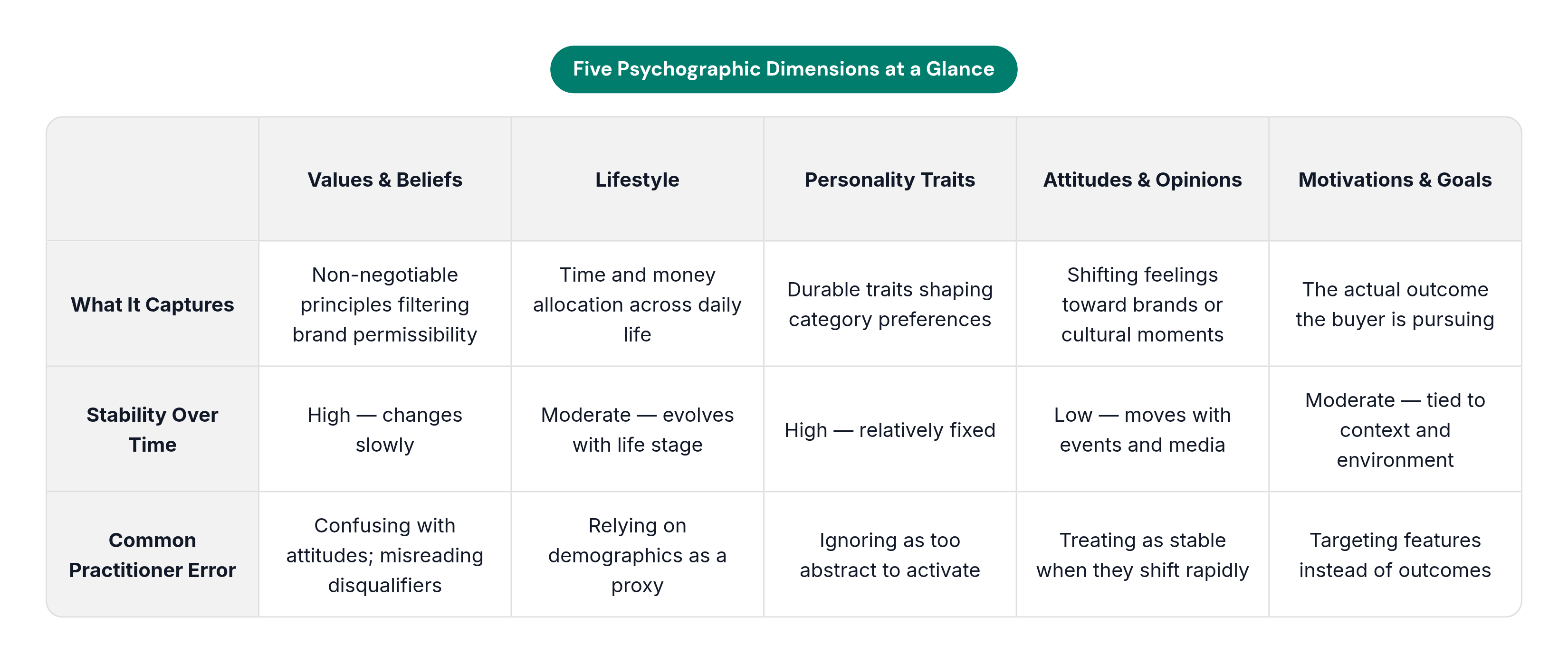
Five dimensions show up consistently in applied B2C psychographic work. None operates in isolation, and the ones most practitioners underweight are usually the ones that matter most.
Values and beliefs are the principles a consumer treats as non-negotiable: sustainability, independence, family loyalty, social status. These filter which brands feel permissible before a consumer ever consciously evaluates a product. A brand that violates a core value gets disqualified early, often invisibly, before the consumer can articulate why. A running shoe brand positioning itself around individual achievement speaks to self-determination. One that leads with community and belonging is addressing something structurally different, even if the shoe is identical.
Lifestyle is how people actually allocate time and money: leisure patterns, daily routines, consumption habits. A consumer who spends weekends at farmers markets, cooks from scratch, and takes annual camping trips is telling you something about priorities that no survey question needs to ask directly. The behavior pattern reveals the values underneath.
Personality traits predict category-level preferences with reasonable stability across time. Risk tolerance shapes how someone engages with financial products, technology, even food. Openness to novelty drives early adoption. Need for social belonging influences brand affiliation. Because these traits are relatively durable, they make useful anchors when defining a segment.
Attitudes and opinions are where things get slippery, and most practitioners don't adequately distinguish them from values. Attitudes shift. How someone feels about a category, a brand, or a cultural moment can move in response to events, media, and social context. A consumer can hold a stable value around health and wellness while carrying an attitude toward a particular food category that changes as scientific consensus evolves. Think of values as the climate and attitudes as what the weather's doing this week — they're related, but one changes a lot faster than the other, and confusing the two is a common reason campaigns misfire.
Motivations and goals are what the buyer is actually pursuing, which is almost never what the product feature listing describes. A person buying a premium gym bag is solving a logistical problem. Or they're signaling membership in a lifestyle cohort, to themselves and to others. Same product, structurally different reason. A campaign built around one of those motivations can feel tone-deaf, or actively alienating, to someone driven by the other.
No single dimension produces an actionable segment on its own. The campaigns that actually perform address two or three in combination: a lifestyle anchor, a motivational driver, a values filter layered together until the message feels, to the person receiving it, like being understood rather than targeted.
How brands translate psychographic insight into campaigns that resonate
Four examples, examined not as inspiration but as operating principles.
Harley-Davidson built its brand around rebellion and freedom as identity, not around engine displacement or ride quality. Product specs are secondary. The values are the entry point. Buyers self-select because the identity match is made explicit; the campaign functions as a signal to a specific self-concept. People who don't share those values are actively repelled, and that's intentional. Broad reach was never the goal.
Patagonia operates through a different lever: shared worldview. The customer journey begins with an environmental and ethical stance the audience already holds. Patagonia doesn't try to construct new beliefs about sustainability; it finds people who already hold those beliefs and positions the purchase as consistent with who they already are. The transaction becomes an act of self-expression. That is a fundamentally different relationship than persuading someone to care, and a lot of brands still try to do the latter when their audience would respond better to the former.
Tropicana's health positioning illustrates motivation-led messaging. Rather than targeting adults in a particular age bracket, the brand connects orange juice to a motivational state: the desire to do something marginally better for yourself today. The product becomes a small, accessible act of identity-consistent behavior. The demographic slice matters less than the motivational moment being addressed.
Spotify's Discover Weekly uses listening behavior as a proxy for mood and lifestyle, building psychographic relevance without asking users to describe themselves at all. The personalization is derived from behavior, not self-report. Between its 2015 launch and 2020, Discover Weekly generated over 2.3 billion hours of streaming by Spotify's own reporting. Relevance at scale, achieved without a single attitudinal survey.
The common thread across all four: each of these campaigns works by reflecting something the customer already believes about themselves, not by constructing a new belief about the product. The consumer sees their own self-concept confirmed, and the purchase follows from that recognition rather than from persuasion.
Where psychographic data actually comes from in a B2C research program
Multiple sources, layered together. No single source is sufficient, and programs that treat one method as definitive produce segments that are theoretically coherent but operationally brittle.
Primary qualitative methods are valuable for surfacing motivational structure that people can't easily articulate. In-depth interviews can push past surface-level rationalization to reach the actual drivers underneath. Focus groups let you observe how values and attitudes interact socially, though groupthink is a genuine confound that has to be actively managed rather than hoped away. Psychographic survey frameworks like VALS, developed by SRI International, give you scalable attitudinal data, but they depend on self-report, which has known reliability limits. People describe the version of themselves they prefer to present, not necessarily the one making the purchasing decision.
Behavioral and secondary signals often reveal more than self-report does, precisely because they bypass the editing. Social media content analysis, looking at language patterns, imagery choices, and community affiliations, surfaces values and lifestyle signals people express without consciously articulating them. Purchase history shows revealed preferences that are harder to rationalize away than a survey answer. What someone repeatedly buys over time tells you what they actually prioritize. Sentiment analysis on reviews, forum discussions, and customer comments extracts attitudes at a scale no interview program can approach.
Where research programs succeed or fail is in the layering. A segment defined only as "eco-conscious" is not actionable. It becomes usable when overlaid with purchase frequency, income band, and digital engagement patterns. The psychographic dimension is the lens; behavioral and demographic data give it resolution.
One point that gets underemphasized: psychographic profiles are not permanent. A segment motivated primarily by cost efficiency in 2022 can shift toward risk reduction by 2025 if the economic environment changes sufficiently. Treating one-time research as enduring truth means targeting an audience that has already moved on. Research cadence matters as much as research quality, and a continuous program, however lightweight, will outperform a comprehensive one-time study over any meaningful time horizon.
What AI-powered research methods add to psychographic discovery
The core capability shift is scale and speed. AI can process social posts, browsing behavior, and purchase data to identify patterns that correlate with psychographic traits, building profiles at an individual level considerably faster than traditional methods. That operational change affects what is even feasible to attempt.
Natural language processing and sentiment analysis extract attitudes and motivations from text at a volume no human analyst team can replicate. Running sentiment analysis across customer reviews and industry forums gives you attitudinal data from many touchpoints simultaneously, surfacing what people actually say when they're not in a research context and don't know anyone is watching. That's different data than what you get from a survey, and often more useful.
A research framework published in the Journal of Strategic Marketing in December 2025 integrates large language models with established psychological value theory, organizing nearly 500 distinct values into a structured semantic space. The framework was demonstrated on large-scale textual data from the Porsche Brand Community Rennlist and is designed specifically to guide AI-based analysis of qualitative data at scale. It represents serious methodological progress.
AI-moderated interviews can probe and follow up the way a skilled qualitative researcher does, but run simultaneously across many participants. The 2025 GreenBook GRIT Report noted that median sample sizes for AI-moderated qualitative studies reached 312 that year, up from 17 in 2022. Qualitative depth has historically been constrained by sample size: you get richness or scale, not both. That tradeoff has loosened considerably, which changes what kinds of questions you can realistically pursue with a qualitative budget.
Predictive psychographics extend things further: algorithms trained on historical and real-time data can identify attitude shifts before they manifest in sales data, giving campaign teams the ability to reposition ahead of a shift rather than after it has cost them. In fast-moving categories, that advantage compounds.
One gap worth naming: AI-generated psychographic segments still require message testing before separate creative tracks are committed to. Two segments that respond identically to the same stimulus are not actually different segments, regardless of how distinct their profiles appear in the data. The segment must predict differential response to justify the investment in differentiated creative. Skipping that validation is a surprisingly common and expensive mistake.
How synthetic consumer panels extend psychographic research beyond traditional sample limits
Synthetic consumer panels are AI-generated personas built from real-world datasets: historical survey responses, customer reviews, behavioral data, and public opinion trends. They can respond to research stimuli at speed and scale that traditionally recruited panels cannot approach.
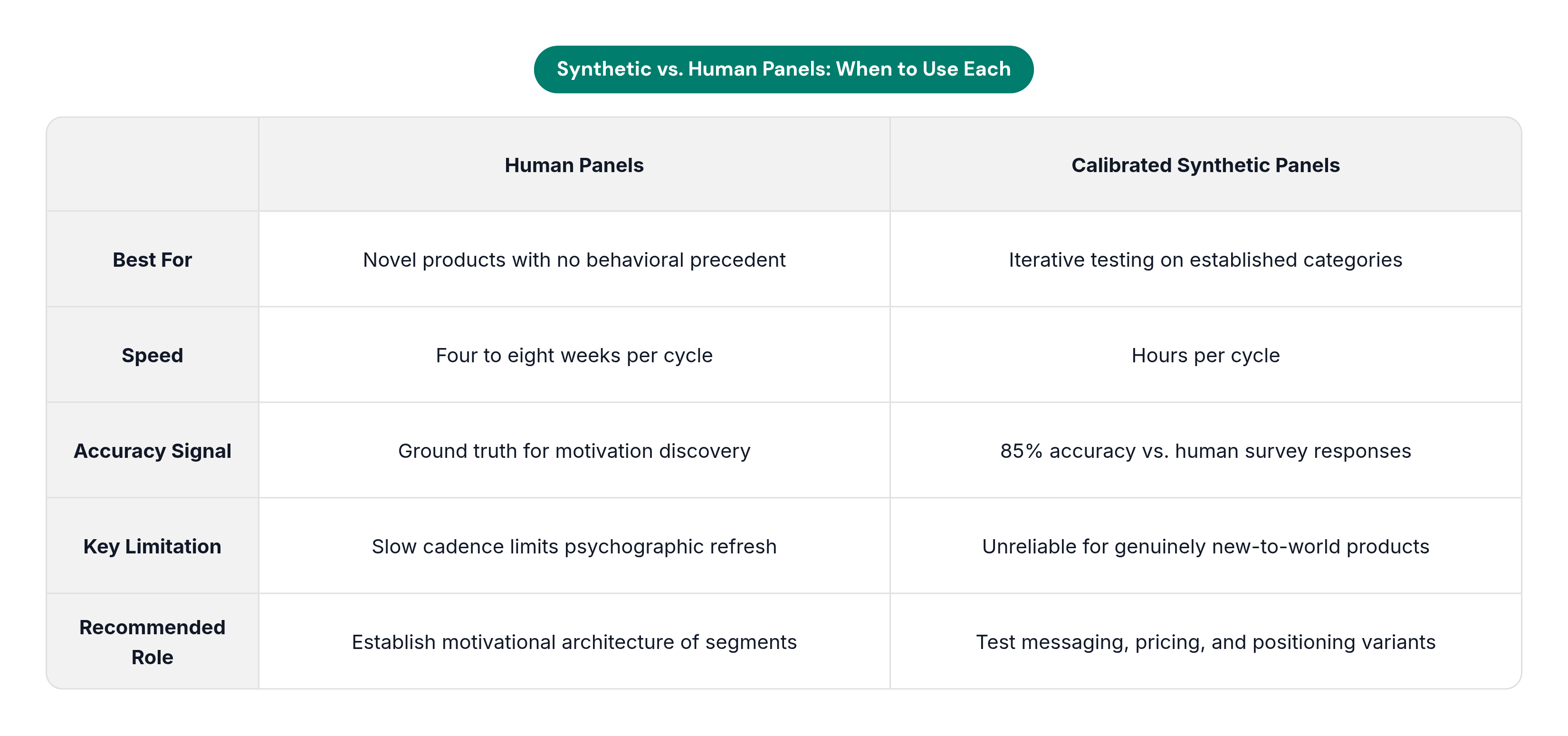
A 2024 study by researchers at Stanford and Google DeepMind involving 1,052 participants found that calibrated AI digital twins replicated human survey answers with 85% accuracy and social behavior with 98% correlation. Off-the-shelf generative AI prompts, uncalibrated, performed around 55% parity. Calibration is the variable that separates useful synthetic research from noise, and it's where a lot of teams underinvest because the tool feels like it should work out of the box.
The speed implication connects directly to the psychographic refresh problem. According to the 2025 GreenBook GRIT Report, concept-to-signal cycles that take four to eight weeks with traditionally recruited panels take hours with a calibrated synthetic audience. Quarterly psychographic refresh becomes operationally realistic.
The honest constraint: a study published in Marketing Science found only modest correlation between synthetic and real responses for genuinely novel products, specifically non-sequels and non-extensions to existing categories. Synthetic panels are strongest for established categories, known segments, and iterative testing. They are not reliable for predicting how consumers will respond to something that has no behavioral precedent in the training data. If you are launching something genuinely new to the world, recruit humans.
The practical use case is a hybrid: run initial discovery with human respondents to establish the motivational architecture of your segments, then use a calibrated synthetic panel to test messaging variants, pricing tiers, and positioning language against those segments repeatedly, without recruiting a new sample each time. Human research for structure; synthetic panels for iteration.
Forrester data shows 42% of consumer insight leaders have implemented some form of synthetic data. The 2025 GRIT Report found only 13% of brand-side practitioners report satisfaction with AI-powered research quality. That gap between adoption and confidence reflects something the field hasn't fully worked out yet, not a problem that's been solved.
Turning psychographic segments into campaign structure and message hierarchy
Before any creative investment, confirm that your proposed segments actually respond differently to identical stimuli. This step gets skipped because it feels like a delay. It is not a delay; it is the step that determines whether everything downstream is built on something real. Skipping it means spending creative budget constructing distinctions that exist only in the segmentation model, which is a particularly painful way to waste money because you won't know it happened until the campaign underperforms.
Message hierarchy follows from which psychographic dimension is doing the heaviest lifting in a given segment.
For values-led segments, lead with worldview alignment before product. The brand stance is the entry point. The consumer needs to see their values reflected before they will evaluate the offer. Leading with product in this context is a sequencing error that even good creative cannot recover from.
For lifestyle-led segments, lead with context and aspiration. Show the product inside the life the customer is working toward, not the one they currently have. Aspirational placement does more work than product description here.
For motivation-led segments, lead with the outcome. What will actually be different after the purchase? The feature is evidence for the outcome, not the headline. Consumers are not buying the feature; they are buying what the feature makes possible for them.
Channel selection follows directly from psychographic behavior rather than sitting as a separate planning decision. A values-driven segment active in niche communities requires different placement than a lifestyle segment reachable through aspirational visual platforms. The psychographic profile tells you where the audience is having the conversations you want to be adjacent to.
Psychographics also function as a pricing input, and this is consistently underutilized. Price-conscious segments respond to transparency and control: tiered options, visible value trade-offs, a sense of agency in the decision. Identity-motivated segments will pay a premium if the price itself signals membership or quality. The pricing structure communicates a value proposition as surely as the copy does, and treating the two as separate decisions leaves money behind.
Research supports the operational value of psychographic activation. Experian found that emails customized with psychographic information generate 29% higher open rates. Research cited by the Data & Marketing Association found that campaigns engaging emotional triggers drive 18% more conversions. McKinsey has found that companies excelling at personalization and segmentation achieve revenue growth rates above industry averages. These gains compound when psychographic activation becomes a consistent practice rather than a one-time exercise.
Keeping psychographic segments current as markets and motivations shift
Psychographic profiles decay. Economic events, cultural shifts, and category disruptions change what motivates a segment, sometimes gradually and sometimes faster than any quarterly research cycle can track. A profile built in one market environment will quietly become inaccurate in another if no one is actively monitoring it, and the campaigns built on that profile will keep running against an audience that has already moved on.
Lightweight refresh research on a quarterly cadence, or following major market events, is the practical standard. The goal is not rebuilding the segmentation from scratch each quarter. It is detecting which segments are most vulnerable to drift, specifically those closest to cultural or economic friction, before the targeting built on them diverges from actual consumer behavior.
Several signals are worth monitoring between full research cycles. Language drift in customer reviews and support conversations is one of the earlier indicators: attitudes surface in word choice before they appear in purchase behavior. Engagement pattern changes by segment are another; a segment historically responsive to a particular message type that suddenly goes quiet is telling you something worth investigating before the next reporting cycle. Category-level events, new entrants, regulatory changes, controversies that touch the values a segment holds, can shift segment motivation rapidly and without warning.
AI-moderated synthetic interviews make quarterly refresh operationally realistic without the multi-week turnaround of traditional research. Seda, a platform that runs AI-conducted interviews and UX tests against a verified panel of human respondents across 130+ countries and auto-synthesizes findings into structured reports, is one tool teams use to keep that cadence without rebuilding a research program from scratch each quarter.
Psychographic segmentation done once is a campaign asset. Done continuously, it becomes something more durable: an accumulating organizational understanding of what actually motivates your customers, and how that motivation is changing. The brands that sustain psychographic relevance over time are not necessarily the ones with the sharpest initial insight. They are the ones whose understanding of customer motivation keeps pace with the customers themselves.