Consumer Research for Retail and Store Experience Decisions
Match research rigor to how easily you can undo each retail decision.

Not every retail decision carries the same irreversibility cost. Some can be unwound in a weekend. Others require a capital expenditure request, a contractor, and a temporary store closure. Where your decision sits on that spectrum is what determines how much research investment is actually justified, and most teams get this calibration wrong.
Store Layout and Physical Environment
Floor plans, fixture placement, traffic flow, department adjacency. Once built, these require capital and downtime to change. And yet they are routinely determined by design teams working from competitor benchmarking, internal intuition, and whatever sales data survived the last layout. Consumer input, when it happens at all, comes through post-opening complaint analysis. That's backwards. Where shoppers go first, where they stall, which category adjacencies drive cross-purchase behavior: these questions are answerable before the first fixture moves.
Assortment and Category Decisions
Which SKUs to carry, how deep to go in a category, which to cut. Wrong assortment decisions produce dead inventory, stockouts in preferred items, and lost basket size simultaneously. The financial exposure compounds fast. This decision type is particularly high-stakes in categories where consumer preference is fragmented or shifting quickly, which increasingly describes most categories. Assortment decisions are also where research gets cut first when timelines compress, because they feel intuitive. They aren't.
Pricing Architecture
Price point setting, promotional cadence, value-tier strategy, private label positioning. Deloitte's 2026 Retail Industry Global Outlook identifies value-oriented consumers as one of the primary forces reshaping how the industry competes. Pricing decisions made without understanding how specific segments define value are increasingly dangerous, because "value" is not a synonym for "cheapest" — in fact, treating it as one is a bit like confusing a price tag for a price story. Getting this wrong at the architecture level means months of promotional correction, margin erosion, and confused consumer signaling before the problem is even fully diagnosed. PwC has observed that the era of blanket pricing strategies is ending; category leaders are moving from periodic optimization to continuous simulation. That is a research posture, not a once-a-year exercise.
In-Store Service Design
Associate roles and touchpoints, self-checkout ratios, in-store technology, returns experience. The IBM-NRF global study from Q3 2025, conducted across more than 18,000 consumers in 23 countries, found that 72% of consumers still shop in stores. That number matters because it means the in-store service layer continues to operate at genuine scale. Service design failures, the experience that feels slow, indifferent, confusing, or untrustworthy, produce traffic and loyalty consequences that show up in transaction data weeks or months after the damage is already done.
These four categories share a common property: the human behavior driving each one is largely predictable in advance, if you ask the right questions in the right way, before the commitment is made.
What Traditional Retail Research Gets Right, and Where It Fails the Decision Timeline
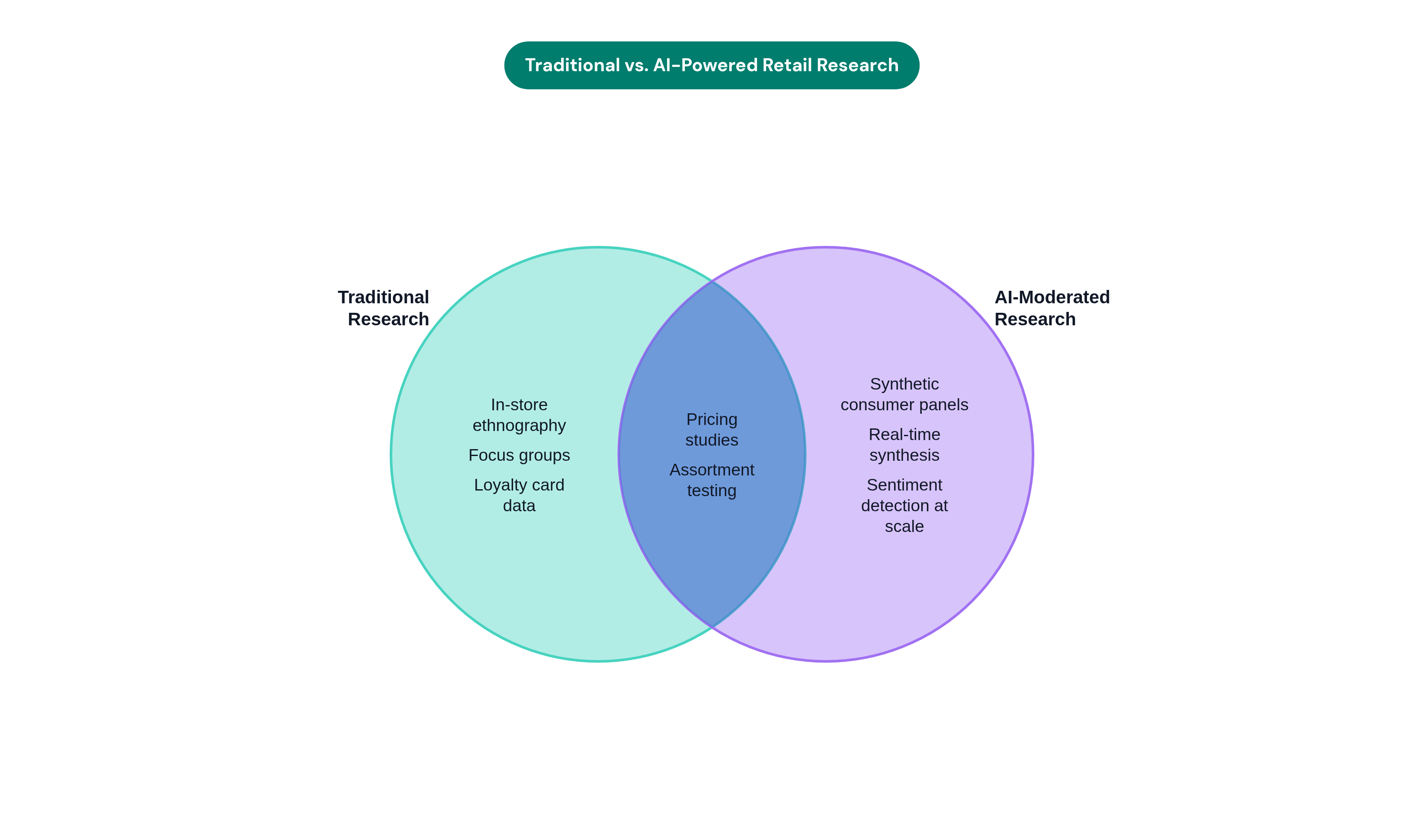
Traditional methods are not bad. They are often well-constructed, rigorous, and genuinely illuminating. The problem is structural, not methodological, and it's worth being specific about where the structure breaks.
In-store ethnography and shopper observation catches real behavior. It is one of the few methods that can surface what shoppers actually do, as opposed to what they say they do, and the gap between those two things is frequently significant. But it is slow to recruit, resource-intensive to run, and produces findings too late for early-stage decisions. By the time a proper observational study concludes, the layout decision it was meant to inform has often already been made.
Focus groups for assortment or concept testing are useful for surfacing language and consumer framing. They give you words, metaphors, and objections you wouldn't have generated internally. Small samples, high moderator influence, and social desirability bias limit their reliability on sensitive decisions like pricing, though, where what people say in a group setting diverges meaningfully from what they actually do at the shelf.
Loyalty card and transaction data is excellent at describing what happened. It is blind to why. And it is useless before a new format or product exists, because there is nothing to measure yet.
Planogram testing in lab store environments is valid. It is also extremely expensive and slow, viable primarily for well-capitalized chains with dedicated research infrastructure. Not a realistic option for most retail operators facing a decision this quarter.
The structural failure here is timing. Traditional agency-run studies take weeks to design, field, and report. Most retail decisions, especially reactive ones driven by competitive moves or trend shifts, do not wait that long. Consumer goods teams are dealing with shrinking product lifecycles and quickly shifting consumer preferences, a reality Microsoft's 2025 retail AI research makes explicit. A research process calibrated to a slower era does not serve these teams.
The result is predictable: decisions get made without research, or research arrives as post-hoc justification rather than genuine input. That is not a failure of any specific method. It is a mismatch between how long research takes and how short the decision window actually is — like getting a weather report after the storm has already passed.
How to Match Research Method to Retail Decision Type
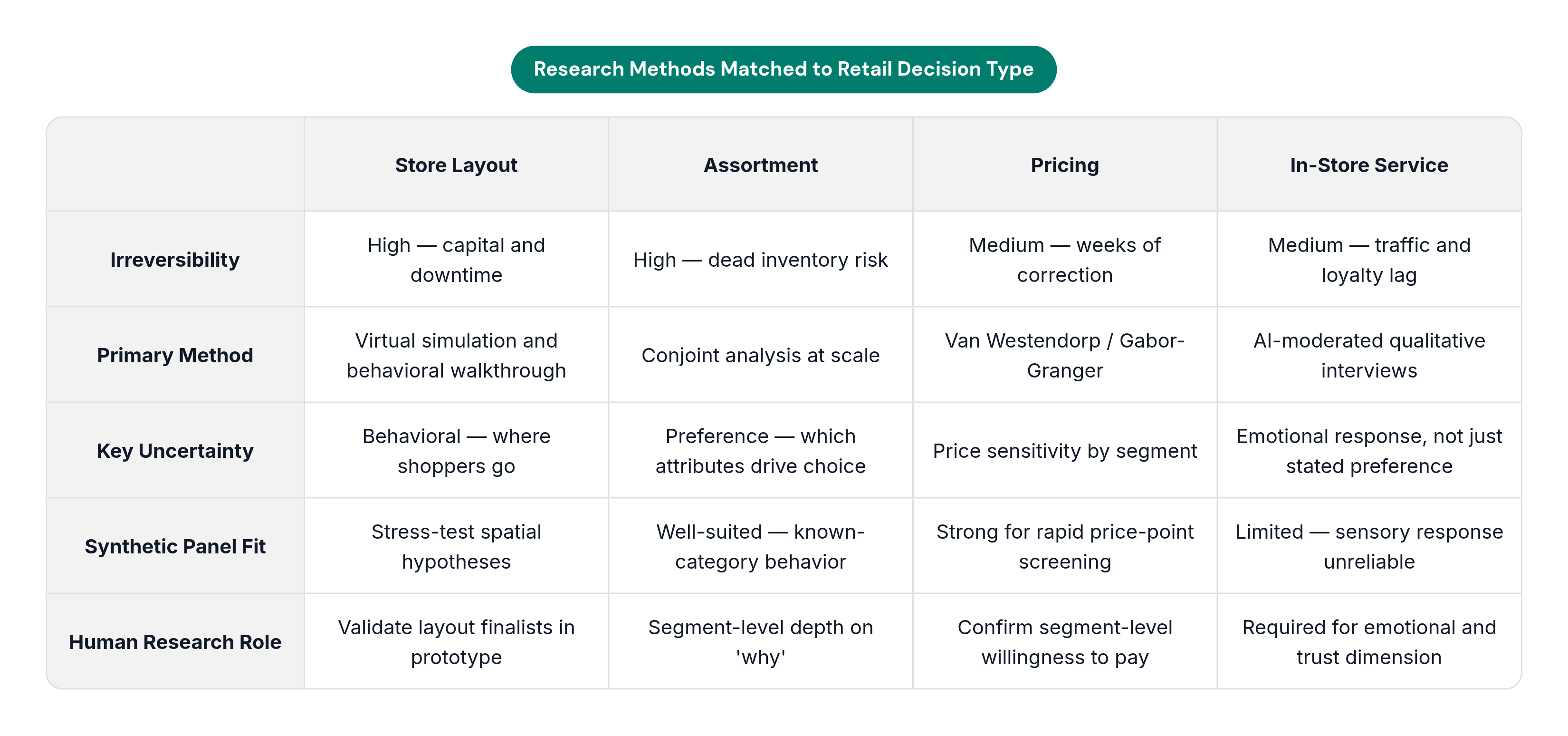
Method choice should be driven by irreversibility level, decision timeline, and what kind of uncertainty is actually in play. Preference uncertainty, behavioral uncertainty, and price sensitivity uncertainty are different problems. They require different tools, and conflating them is one of the more consistent ways retail research budgets get wasted.
Store Layout: Behavioral Simulation and Virtual Environment Testing
Virtual store tools and synthetic consumer walkthroughs can test traffic flow hypotheses before a single fixture moves. They are best used to stress-test spatial assumptions: where do shoppers navigate first, where do they stall, which department adjacencies create cross-category purchase behavior. The goal at this stage is to eliminate the obvious wrong answers before committing to anything physical. Once you have narrowed to two or three layout options, moderated intercept research with real shoppers in a prototype space validates the finalists.
Assortment: Large-Scale Preference Research and Conjoint Analysis
Quantitative preference data at scale answers the core assortment question: which attributes drive choice, and which SKUs are genuinely differentiated versus functionally redundant. Conjoint analysis is particularly useful because it forces respondents to make real trade-offs rather than rate everything favorably. AI-moderated interviews at scale, which the next section addresses in detail, allow deep "why" probing across a sample large enough to segment meaningfully by geography, household type, or purchase frequency. Synthetic panels are well-suited to assortment decisions specifically because these are known-category problems; the behavior being modeled has historical precedent, which is where synthetic accuracy is highest.
Pricing: Price Sensitivity Modeling and Willingness-to-Pay Studies
Van Westendorp and Gabor-Granger methods remain standard for pricing research, and they work. The question is how fast they can be run and at what sample size. Simulated purchase scenarios surfaced to synthetic consumers allow rapid iteration across price points and tier structures before committing to a pricing architecture. The IBM Institute for Business Value has documented a 31% average improvement in customer satisfaction and retention from AI over the last 12 months. Pricing that reflects actual segment-level value perception, not blended averages, is part of how that improvement materializes.
In-Store Service Design: Concept Testing and Emotional Response Research
Service design involves both rational preference and emotional response, and research designs that capture only one will produce incomplete findings. A 2026 SOTI-sourced report found that 58% of U.S. consumers say retailers should use AI to improve product recommendations in-store, and 61% say they would like image-based in-store search. Those figures reveal where consumer appetite already exists. But they don't tell you whether the experience will feel helpful or intrusive, fast or confusing, trustworthy or surveillance-like. Qualitative depth is required: AI-moderated interviews that probe the emotional dimension, not just stated preference.
Running Large-Scale Qualitative Research on Retail Decisions Without a Six-Week Timeline
The economics here are where the real shift has happened, and it took me a while to fully internalize how significant the change is.
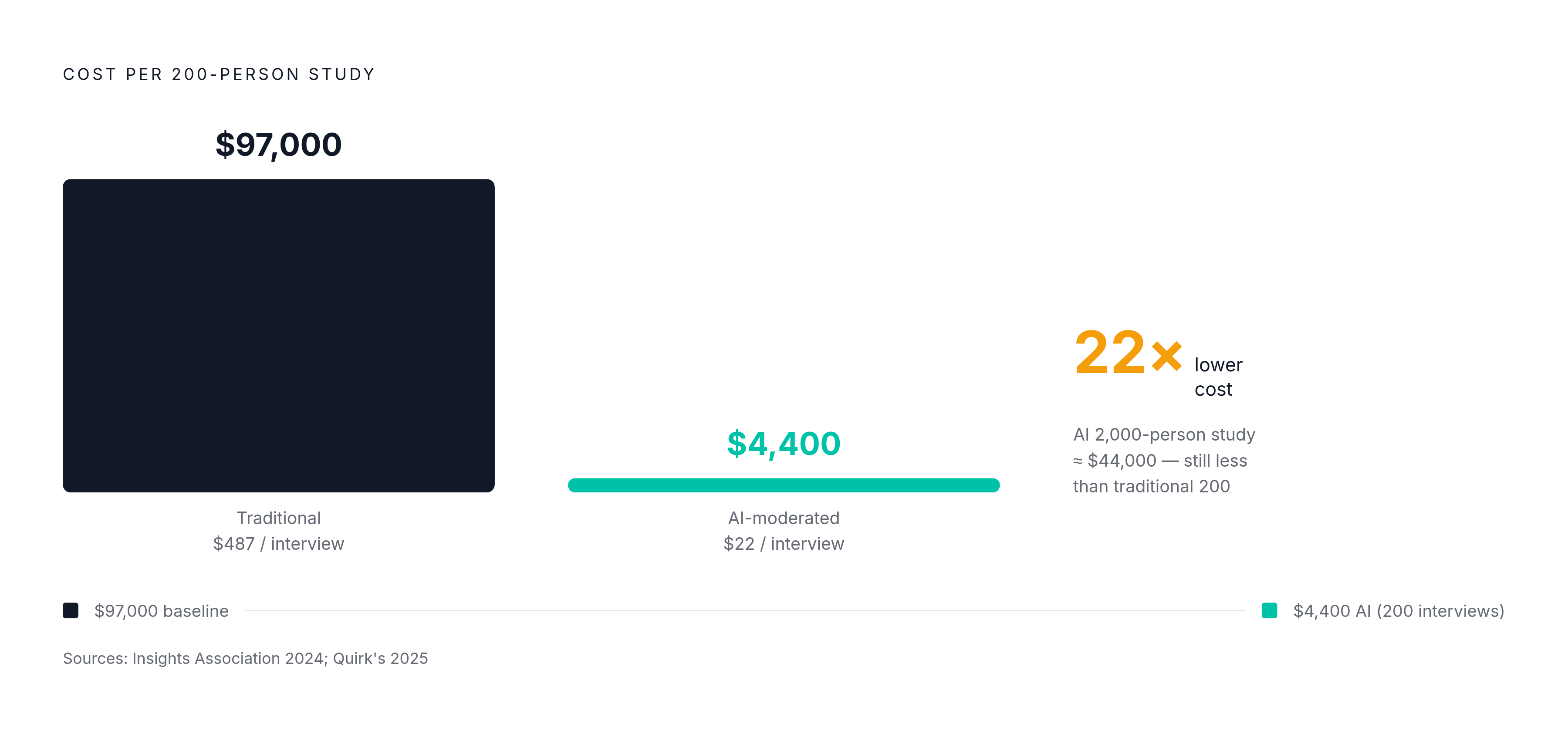
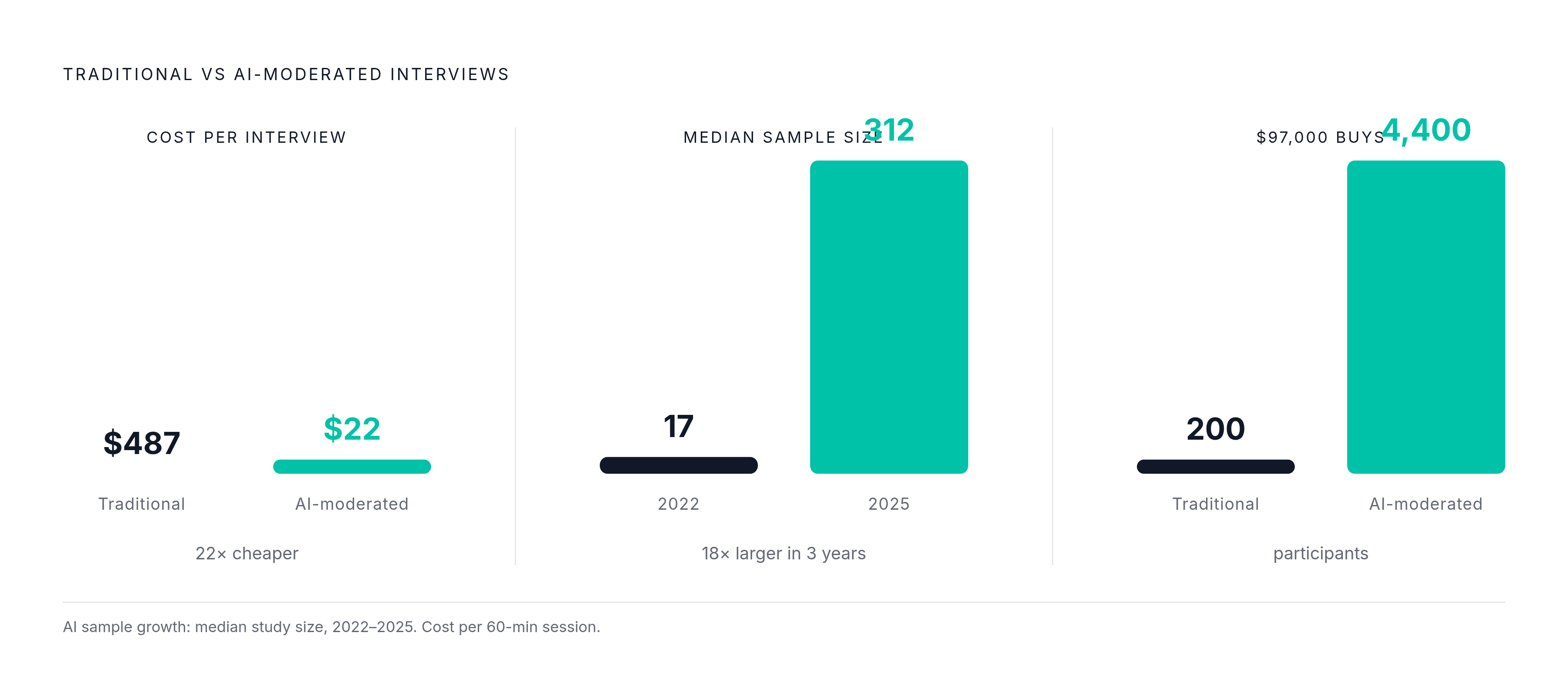
The Insights Association's 2024 Industry Pricing Study put the all-in cost of a single 60-minute moderated interview at $487. A study at 200 participants runs to roughly $97,000 for fieldwork alone, before analysis. That cost structure is why qualitative research gets cut from retail decision processes. Not because teams don't value the insight, but because the price relative to the decision timeline makes it genuinely impractical.
AI moderation drops the per-interview cost to roughly $22 per completed conversational interview, according to Quirk's 2025 Researcher SaaS Report. At that price, a sample of 2,000 participants costs less than a traditional sample of 200. That is not a marginal efficiency gain. It is a structural change in what qualitative research can do — you could say the old model was expensive by design, and the new one is affordable by default.
The median qualitative sample for AI-moderated studies has shifted accordingly. Greenbook's 2025 GRIT report documented a median sample size of 312 for AI-moderated studies, up from 17 in 2022. An approximately 18-fold increase in three years. FuelCycle's 2025 data found that 78% of businesses using AI in UX research report faster decision-making without sacrificing insight quality. Speed and rigor are not traded against each other here; they are separate gains.
What AI-moderated interviews do differently from surveys is worth understanding precisely. They follow up on unexpected answers, which is how you catch the reasoning behind the reasoning that static surveys miss entirely. They synthesize across hundreds of transcripts in real time, so themes surface during fieldwork rather than three weeks after it closes. They detect sentiment at scale, mapping emotional valence across segments without manual coding.
The practical implication: a layout concept test, an assortment preference study, or a pricing sensitivity interview series can now be completed and synthesized within hours. Fast enough to inform a decision still in flight.
Where Synthetic Consumer Panels Fit Retail Research, and Where They Don't
Synthetic panels are AI-generated personas constructed from real-world datasets: historical survey responses, behavioral data, customer reviews, public opinion trends. They are not random fabrications. They respond to study stimuli based on learned patterns derived from real human behavior, and that distinction matters when evaluating where to trust them.
A 2024 study conducted by researchers at Stanford and Google DeepMind, with more than 1,000 participants, found that AI digital twins replicated human survey answers with 85% accuracy and social behavior with 98% correlation. The critical qualifier is that this performance holds for known-category behavior. It does not extend reliably to genuinely novel concepts. A Marketing Science study found only a 0.3 correlation between synthetic and real responses for truly novel, non-extension products. That number should give any researcher pause, and I've seen teams learn it the hard way.
Calibration quality matters enormously. Calibrated synthetic panels reach 85 to 95% parity with real panels on concept, pricing, and positioning tests. Generic generative AI prompts sit much lower, closer to 55%. The difference is not the method; it is the quality of calibration.
Where Synthetic Panels Are Well-Suited for Retail Decisions
Rapid price-point iteration is the clearest use case. Synthetic panels can screen out obviously wrong options fast, before you spend human-study budget confirming what you could have eliminated algorithmically. They are also well-suited to hard-to-reach segments: high-income shoppers, niche demographic groups, geographically dispersed consumers who would take months and significant spend to recruit at scale. And once a behavioral model of a target shopper segment is built, it can be run against any future retail decision without re-recruitment. That reusability is one of the most underappreciated advantages in continuous research programs.
Where Human Respondents Remain Necessary
Novel store formats with no comparable category precedent cannot be reliably tested through synthetic panels alone. Any decision where the research will be cited publicly or used to justify major capital investment also warrants human validation. Forrester has found that 42% of consumer insight leaders have implemented synthetic data, but Greenbook's 2025 GRIT Report found only 13% brand-side satisfaction with AI-powered research quality, signaling that confidence in synthetic-only outputs remains genuinely limited. And in-store emotional and sensory response, the feel of a space, the friction of a checkout flow, the reassurance of an associate interaction, is territory synthetic models cannot yet represent accurately.
Use synthetic panels to pressure-test hypotheses and screen options, then deploy human respondents to validate the finalists. They are complementary tools, not substitutes, and treating them as the latter is how teams end up defending embarrassing research failures.
How Consumer Behavior Shifts Are Changing What Retail Research Needs to Measure
The shopper arriving in-store in 2025 has often already interacted with AI before entering. The IBM-NRF global study from Q3 2025 found that 45% of consumers turn to AI for help during their buying journeys, and 41% use it to research products specifically. The in-store visit is no longer the beginning of the decision for a substantial portion of shoppers. It is frequently the final confirmation step — think of it as the last chapter of a book that was mostly written before the customer walked through the door — and that shift has real consequences for what research needs to ask.
Layout and assortment research can no longer stop at "which products do shoppers want to find." The more precise question is which products shoppers arrive already decided on, and what discovery still means for the remainder of the basket. Those are different research questions requiring different study designs, and teams still running the old question are getting incomplete answers.
Value orientation is intensifying, but the construct is more nuanced than it appears. Deloitte's 2026 Retail Industry Global Outlook identifies value-seeking behavior as a central competitive force. Research that conflates "value" with "cheapest" will produce wrong pricing and assortment conclusions. How specific segments actually define value, whether through unit price, perceived quality, convenience, brand trust, or some weighted combination, requires research that gets below stated preference to the underlying priorities driving it. Stated preference is where people tell you what sounds reasonable. Underlying priorities are where they actually spend money.
Consumer anxiety about AI-driven retail is real and segment-specific. The IBM-NRF study found that 54% of U.S. consumers say they would stop shopping with a retailer if they believed the company was using AI to monitor their purchases. A self-checkout kiosk with image recognition that works perfectly and feels invasive has a real problem. Research that measures only performance metrics will miss it entirely, and the traffic consequences will show up well before anyone connects them to the service redesign that caused them.
Building a Continuous Retail Research Practice Rather Than Running One-Off Studies
The one-off study model is structurally mismatched with how retail decisions actually accumulate. Layout decisions trigger assortment questions. Assortment changes surface pricing tensions. Pricing moves prompt service redesign. Decisions are continuous; research should be too, and the gap between those two realities is where most of the preventable mistakes live.
IBM's IBV Summer 2025 survey found that 84% of retail and CPG executives believe AI will significantly enhance their ability to respond rapidly to market trends and evolving customer needs. The organizational intent is clearly there. The research infrastructure to support it frequently is not.
A continuous retail research practice has three practical components.
First, a standing synthetic panel of target shopper segments that can be queried against any new decision without re-recruitment. This eliminates the setup time that makes one-off research feel prohibitively slow. When a competitive move requires a rapid pricing response, you have a testable audience ready.
Second, a library of baseline preference and sensitivity studies by category that new decisions are tested against rather than rebuilt from scratch. Every new study builds on prior context. This is how institutional research knowledge compounds over time instead of evaporating after each project report is filed, and the compounding effect is real: teams with three years of accumulated baseline data make materially faster and more accurate decisions than teams starting fresh each time.
Third, lightweight AI-moderated pulse studies with smaller samples and fast turnaround, attached to seasonal planning cycles rather than reserved exclusively for major capital decisions. Most of the value in retail research comes not from the one enormous study run before a flagship store remodel, but from the accumulation of smaller, faster signals that keep decision-makers calibrated to actual consumer reality throughout the year.
The economics now support this model in a way they did not five years ago. The remaining barrier is organizational: treating research as a cost center associated with individual projects rather than as an ongoing capability that depreciates every decision made without it. Seda, an AI-powered customer research platform that runs AI-conducted interviews and UX tests against a panel of verified human respondents across 130+ countries and auto-synthesizes findings into structured reports within hours, is one concrete infrastructure option for retail teams trying to close that gap.