Competitive Perception Research at Speed
Speed lets research influence strategy before decisions lock in, not after.

Product cycles in fast-moving categories are now measured in weeks. Campaign decisions get made daily. A single competitor's repositioning, if it generates enough media traction, can shift category perception within a news cycle. The six-week study was already a compromise when markets moved slowly. Now it's a structural liability.
The perception gap, the space between what customers believe about your brand and what you need them to believe, can open and close before a traditional study even reaches fieldwork. That's not a metaphor. It's a practical description of how category narratives move in environments with continuous media, active social conversation, and competitors who launch and iterate fast.
The damage from stale competitive perception data is specific, and it plays out in predictable ways. A team launches a campaign built around an attribute a competitor quietly claimed three weeks prior. A product holds its price point because last quarter's research confirmed premium perception, but a rival's repositioning has since eroded that standing. A brand enters a new market with a differentiation story consumers there no longer find distinctive. In every one of these cases, the research was credible when it was conducted. The problem was the lag between insight and action, and that lag is getting more expensive as categories move faster.
Cost compounds the timing problem in ways that rarely get discussed honestly. A well-designed qualitative study is not cheap, and for most mid-market organizations, budget constraints mean only a handful of studies per year. When fresh data doesn't exist, teams don't stop making decisions. They default to assumptions, anecdote, or research that everyone in the room knows is outdated but no one wants to formally disqualify. That is the actual operating condition for competitive perception research at most organizations: episodic, expensive, and perpetually behind the moment it's supposed to illuminate.
What Changes When the Same Research Runs in Hours Instead of Weeks
Speed changes what research is actually for. That only becomes clear when you work through what it changes in practice, not in the abstract.
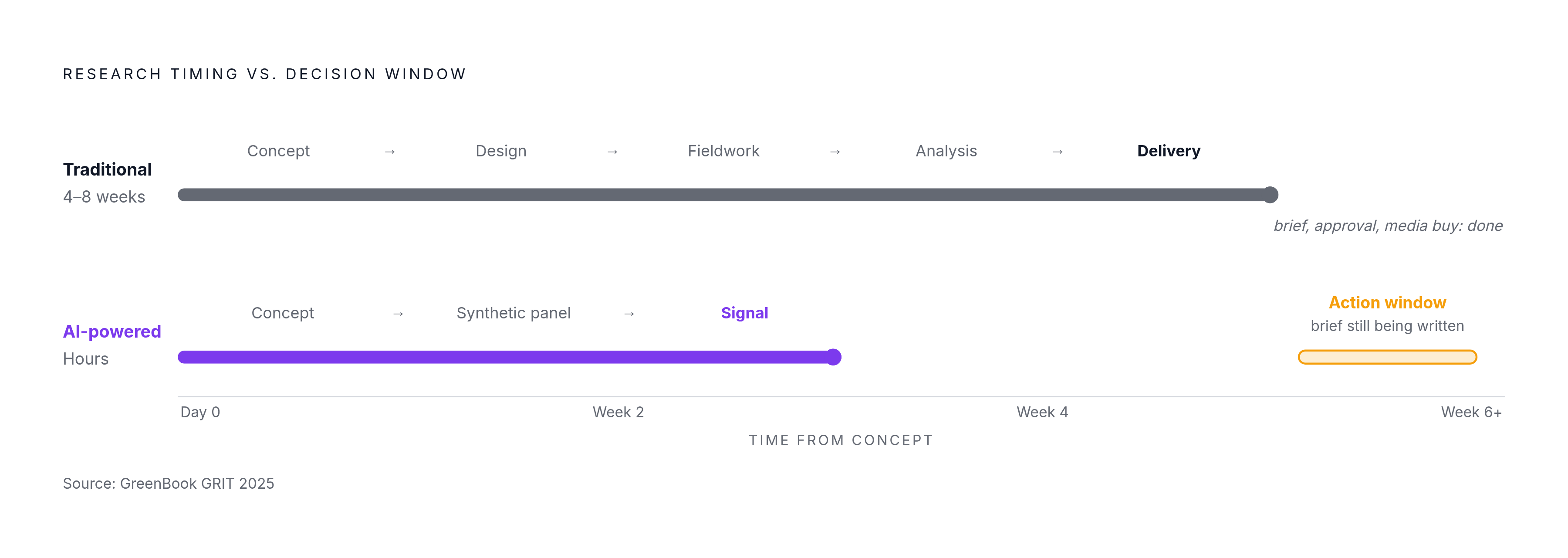
A finding delivered in hours can influence a campaign brief that is still being written. That same finding delivered in six weeks arrives after the brief, the internal approval, and often the media buy. The information is identical. Its utility is completely different. Fast competitive perception research turns insight into an input rather than a post-mortem, and that single shift reorganizes how strategy actually gets made.
Certain postures become available when the timeline compresses that simply weren't on the table before. You can detect that a competitor is making a perception move and test counter-messaging before that move solidifies in the category. You can run a perception check against a target segment in the days before a campaign goes live rather than discovering post-launch that the message landed differently than intended. You can treat competitive perception as a live signal you monitor and act on rather than a quarterly data point that arrives by surprise. None of this is theoretical. It's what happens when the research cycle actually fits the decision cycle, which is a condition most organizations have never experienced.
The 2025 GreenBook GRIT report found that concept-to-signal cycles requiring four to eight weeks with traditional panels now take hours with calibrated synthetic audiences. When cost and time barriers fall, the research doesn't have to funnel exclusively through a centralized insights function. Product managers, marketers, and growth leads can run perception checks at the moment they're making decisions rather than waiting for a report to clear internal review.
Speed without validity is noise, though. The efficiency gains mean nothing if the outputs can't be trusted, which is why the accuracy question is the one that actually determines whether fast methods are worth using.
The Accuracy Question: What Fast AI-Powered Methods Get Right and Where They Fall Short
The market conflates two things that are genuinely not the same: calibrated synthetic panels built on real-world behavioral data, and generic large language model prompts dressed up as market research. The gap between these approaches is not marginal. It determines whether you're working with usable signal or sophisticated-sounding fabrication.
Calibrated synthetic panels, when built on actual behavioral data and refined over time, can predict consumer choices with accuracy reaching into the low 90s, per BCG's published findings on this methodology. Generic AI prompting without calibration sits significantly below that. If you're evaluating fast research tools for competitive perception work, the calibration question is the first one to ask, and the answer should come with evidence, not assurance.
Where fast AI-powered methods genuinely hold up: attribute ranking and relative positioning, specifically identifying which brand owns a dimension like trust or innovation in a given category; concept and messaging tests against established category territory; directional sentiment on pricing, value perception, and switching intent. These are the core outputs of competitive perception research, and calibrated synthetic methods handle them with reliability adequate for strategic decision-making.
The limits are real and worth knowing before you're in the middle of a decision. Research on synthetic responses has found a notably low correlation between AI-generated and real responses when the product or category is truly novel, where there is little historical data for the model to draw on. For established category competitive perception work, this usually isn't the operative concern. Teams probing entirely new competitive territory, where no behavioral anchors exist, should ground their findings with real respondents before leaning on synthetic signal.
There is also a flattening problem baked into how large language models work architecturally. The model is disposed to produce responses that reflect central tendency, which means it suppresses the anomalous answer, the outlier who defects to a competitor for an unexpected reason, the early adopter whose logic doesn't match the majority's. For competitive perception work, those outliers are often the earliest signal of a shifting market. MIT Sloan Review analysis has noted this dynamic. Synthetic methods are not designed to catch the edge cases that sometimes turn out to be leading indicators, and the faster you move and the more you rely on synthetic output, the more deliberately you need to build in ways to catch what the model misses.
The practical guidance here is not complicated: fast synthetic methods are most reliable when calibrated to your actual target segment, used for directional competitive work, and paired with periodic human-respondent validation. They are not a wholesale substitute for qualitative depth on high-stakes decisions. They are, increasingly, a legitimate tool. The GreenBook 2025 GRIT report found that the overwhelming majority of insights buyers now use generative AI in at least one research stage, a number that was a small fraction just two years prior. The direction of adoption is unambiguous.
How to Structure Competitive Perception Research for Speed Without Losing Strategic Value
Fast execution without careful design produces fast garbage. The design choices you make upstream determine whether rapid competitive perception research generates genuine strategic signal or averaging noise that misleads your team, and most of the structural errors happen before a single respondent is fielded.
Anchor on specific competitive dimensions rather than broad brand health. Fast research cycles reward precise questions. "Who owns 'reliable' in this category, and how has that shifted over the past 90 days?" produces actionable output. "How is our brand perceived generally?" produces mush. Specificity is what allows speed and quality to coexist; without it, you're just getting to your confusion faster.
Segment before you field. Competitive perception varies significantly by customer type, and a rapid run against an undifferentiated audience produces averaged signal that obscures the segments where your competitive risk is actually highest. The customer most likely to switch is not the average customer. If your research design doesn't surface that person, your findings are directionally misleading even if technically accurate.
Build stimuli for comparison, not absolute measurement. Competitive perception data derives meaning from relative position, which means you need to structure sessions so respondents evaluate multiple brands against the same attributes in a single pass. A respondent telling you your brand scores 7 out of 10 on trust is not useful. A respondent telling you your brand scores lower on trust than a named competitor who entered the category six months ago is a finding you can act on immediately.
The living-model approach changes the structural economics of this work in a way most teams haven't fully internalized yet. A synthetic panel built on a well-defined target segment can be run against new competitive questions repeatedly, and each run refines the model. Tracking becomes cumulative rather than episodic, which changes its strategic value significantly. You're not starting from scratch each time. You're building something.
Triggering research from competitive events rather than calendar schedules is the other structural shift worth making. A competitor launches a campaign: run a perception delta test within 48 hours. A pricing change moves through the category: run an immediate willingness-to-switch signal. A new entrant maps into the space: run rapid attribute mapping against incumbents. Research triggered by events stays materially closer to the decisions it's supposed to support. Quarterly scheduling is a budgeting convention, not a research logic.
AI-moderated interviews, tools that conduct dynamic one-on-one conversations with follow-up questions that adapt to what the respondent actually says, are adding genuine qualitative depth to fast research in ways that weren't possible a few years ago. Sweetgreen achieved five times the scale at one-third the cost using this model, per reported findings. The qualitative layer matters for competitive perception work because attribute rankings tell you what customers believe; the conversational layer tells you why, and the "why" is what generates messaging strategy, not the rank order.
For high-stakes positioning pivots, categories with limited behavioral calibration data, and any research where outlier reasoning will drive the final decision, route the work to human respondents. That routing logic should be explicit and decided in advance, not improvised under deadline pressure.
The Organizational Shift From Periodic Research Projects to Continuous Competitive Perception Monitoring
The deepest change here is not about running individual studies faster. It's about replacing the project model with a monitoring posture, and the distinction matters more than it sounds. Even if a single study takes hours instead of weeks, commissioning studies episodically still leaves long gaps where decisions are made without fresh competitive context. That is where research debt accumulates, quietly, until it shows up as a campaign that misses, a pricing call that doesn't hold, a differentiation story that fails to land because the category moved while you were looking elsewhere.
Continuous competitive perception monitoring looks like this in practice: a baseline synthetic panel calibrated to your target segment, maintained and updated as market data evolves; lightweight pulse checks triggered by competitive events, campaign launches, or category news; and periodic human-respondent validation studies that serve as a quality anchor for the synthetic model. The validation piece is not optional. It's what keeps the model grounded as the market changes in ways the training data doesn't fully capture, and skipping it is how organizations end up confident in findings that have quietly drifted from reality.
The ProductBoard Product Excellence Report from 2024 found that teams using continuous discovery have significantly faster release cycles and meaningfully higher feature adoption. That logic is not exclusive to product development. Continuous competitive perception feeds the same decision velocity into positioning, pricing, and marketing. The advantage is not the individual insight; it's the organizational capacity to make well-informed decisions consistently rather than periodically, which compounds over time in ways that episodic research simply cannot.
Ownership of this work is also shifting. As tooling democratizes, competitive perception monitoring no longer requires a dedicated insights function to commission and manage every study. Product managers, marketers, and growth leads can run perception checks at the moment a decision is being made. That distribution of access changes how quickly competitive intelligence reaches the people who need it, and it changes the kinds of questions that get asked in the first place. People ask different questions when they know they can get an answer today versus in six weeks.
The reusable panel is perhaps the most underappreciated asset this model creates. A well-calibrated synthetic model of your competitive audience doesn't depreciate with each use; it gets more accurate. What was previously a one-time research cost becomes permanent infrastructure, a continuously improving representation of your competitive segment that can be queried whenever a question emerges. Most organizations have never had that kind of relationship with market research. It's a different operating assumption entirely, and it's the version of competitive perception monitoring that actually keeps pace with the markets it's designed to interpret.