Market Entry Research Without a Local Agency
Synthetic panels and AI interviews replace costly local agencies for market entry discovery.

Market entry research is not a single study. It is a set of distinct questions, each demanding a different method, and the conflation of those questions is how you end up with a report that looks comprehensive and tells you very little. I've watched teams burn through six figures on agency deliverables and still walk into a launch without a credible answer to the questions that actually mattered.
The first question is whether demand exists at all: category awareness, unmet needs, willingness to consider. Straightforward in concept, genuinely difficult to answer with fidelity in an unfamiliar market. The second is who the buyer actually is in this specific geography, not who your current buyer is at home. Demographic, psychographic, and behavioral segmentation behaves differently across markets. Assuming equivalence is one of the more expensive mistakes a market entry team can make.
Third is how the category works locally: competitive framing, pricing norms, distribution expectations. What signals premium in one market can communicate inaccessibility in another. It determines whether you position yourself into a viable segment or an invisible one.
Then there is value proposition translation, which is emphatically not linguistic. The benefit hierarchy that resonates with buyers at home can be irrelevant or actively off-putting somewhere else. Closely related is the pricing question: what is the ceiling, and what does price signal? Premium and discount carry different cultural connotations locally, and those connotations are rarely predictable from first principles.
Finally, adoption barriers. Trust deficits, entrenched habits, regulatory perception, switching costs. These are the questions that determine whether a market opportunity that looks viable on paper actually converts.
Secondary data can tell you market size and competitor presence. It cannot tell you why a consumer in that market would or would not choose your product. For hard-to-reach segments, the problem compounds considerably. Pediatricians in rural Japan, C-suite executives in an unfamiliar geography, small-business owners in an emerging market: traditional recruitment for these profiles can take months and costs thousands per respondent. This question map is what local agencies were hired to answer. It is the same map against which AI-powered methods must be evaluated, honestly and without sentiment.
How AI-moderated interviews now cover the qualitative core of market entry research
An AI interview agent is not a survey with branching logic. It asks open-ended questions, pursues contextual follow-ups based on what the respondent actually says, adapts tone across demographics and cultures, and registers intent signals from how something is phrased, not just what is said. It conducts a conversation, and the output is qualitative in the substantive sense.
The language capability is what makes this viable across markets without a local moderator. Current systems can analyze sentiment simultaneously across more than twenty languages, including Chinese, Spanish, Hindi, Arabic, and Japanese. Cultural sensitivity at the edges is imperfect, but it is sufficient for generative discovery, which is precisely where agencies used to charge a premium.
Async delivery restructures the completion rate equation in ways that matter for cross-market work. Participants no longer need to block sixty minutes on a calendar and show up live. Async qualitative completion rates ran at roughly 31% versus 8 to 12% for live moderated sessions, per a 2025 Quirk's benchmark. For research spanning multiple time zones, that changes who you can reach and how many, structurally, not operationally.
The volume crossover is worth flagging. The Insights Association reported that by Q4 2025, AI-moderated interviews exceeded human-moderated interviews by volume across its member vendors. That crossover had been projected for 2028.
What AI moderation does not yet replicate: an experienced local moderator reading group dynamics live, or recognizing a culturally specific evasion pattern that no training data has categorized. Human judgment in study design remains consequential. But the generative discovery interviews that agencies once delivered as a premium capability can now be run at the team level, at scale, before a market commitment is made.
What synthetic consumer panels can and cannot tell you about a new market
Synthetic panels are AI-generated virtual respondents built from real-world datasets: historical survey responses, behavioral data, consumer reviews, public opinion. They are not random fabrication. They are calibrated models of how a defined population responds, which is a meaningfully different thing.
The accuracy picture requires honest nuance. A 2024 study involving Stanford and Google DeepMind researchers, with 1,052 participants, found that AI digital twins replicated human survey answers with 85% accuracy and social behavior with 98% correlation. Calibrated synthetic panels hit 85 to 95% parity with real panels on concept, pricing, and positioning tests. Generic generative AI prompts, without calibration, sit closer to 55%. The calibration step is not optional. It is the difference between a useful instrument and a confident-sounding fabrication. BCG reported in 2026 that synthetic panels, refined over time, can predict actual consumer choices with 92% accuracy.
Where synthetic panels are especially useful for market entry: rapid concept screening across multiple market configurations before committing fieldwork budget; pricing sensitivity modeling across simulated local consumer segments in hours rather than weeks; reaching hard-to-recruit demographics where live recruitment is prohibitively slow; running the same concept through synthetic populations in five markets simultaneously to identify where real-respondent validation will earn the most.
The critical limit deserves plain statement. A Marketing Science study found only a 0.3 correlation between synthetic and real responses for genuinely novel products: things without behavioral analogs in the training data. Synthetic panels cannot anchor a market entry study for a new category. They reflect the weighted mean of what has already been learned about a population type. Articulate. Coherent. An insight from a real person in that market, they are not.
The MIT Sloan Management Review captured the dynamic usefully in 2026: an LLM given a persona produces a response that is the weighted mean of everything it learned about people fitting that description. It is like a researcher who has read every survey, ethnography, and consumer segmentation study ever conducted on French shoppers, but has never actually been to France. Impressively informed, genuinely not the same as talking to someone who buys groceries in Lyon every week.
On adoption: Forrester reports that 42% of consumer insight leaders have implemented synthetic data in some form. Yet the 2025 GRIT Report found only 13% brand-side satisfaction with AI-powered research quality. That gap means validation discipline is not a precaution. It is a requirement, and teams that skip it are the reason the skepticism exists.
The workflow: which questions go to synthetic panels first, and which require real respondents
The core principle is simple. Synthetic panels compress and focus the problem before human research budget is spent. Real respondents validate, deepen, and surprise.
Stage one is synthetic screening. Run the full concept, messaging, and pricing question set against calibrated synthetic populations in the target market. Identify where signals are strong, where they are ambiguous, and where they contradict your assumptions. This is the diagnostic layer. It tells you where your real-respondent investment will earn the most, which is the only question that should determine where you spend it.
Stage two is targeted AI-moderated qualitative research with real respondents. Deploy async AI interviews from a verified panel to probe the ambiguous zones and adoption barrier questions that synthetic panels cannot resolve. You are not running broad discovery here; you are going deep on the specific tensions the synthetic phase surfaced.
Stage three is quantitative validation on high-stakes decisions. Use human surveys to confirm pricing and positioning conclusions before committing entry investment. This is the layer that carries the evidentiary weight for a board, a joint-venture partner, or a capital allocation decision.
When to skip stage one entirely and go directly to human respondents: genuinely novel product categories with no analog in the target market; segments where behavioral training data is thin, particularly in emerging markets with limited digitized consumer history; any question whose answer will directly determine a large capital commitment. The sequencing model is a default, not a doctrine. Knowing when to override it is part of the judgment.
The access problem that verified global panels solve is structural, not cosmetic. Per the 2025 GreenBook GRIT report, concept-to-signal cycles that take four to eight weeks with traditional panels take hours with calibrated synthetic audiences. Teams can now run multiple rounds of iteration within the time window a single traditional study would have consumed.
The specific market entry questions that AI research handles better than a local agency
Multilingual sentiment analysis across the full competitive landscape is the clearest example. AI can process consumer reviews, social content, and forum discussion across more than twenty languages simultaneously. A market entry team gets a real-time read on category sentiment and competitor perception that no agency fieldwork timeline can match, at any price point.
Pricing sensitivity across multiple configurations is another. Running a van Westendorp or conjoint-equivalent test across several price points and market segments with a synthetic panel takes hours. The same exercise with agency-recruited live respondents takes weeks and costs multiples more. When you need to understand what premium positioning signals locally before you commit to it, the speed differential determines whether the insight arrives before or after the decision.
Iterative message testing is where the operational difference becomes most pronounced. Because AI-moderated interviews can be redeployed rapidly, a team can test three positioning variants, read the output, revise, and re-test within days. With a traditional agency, each iteration is a new project with a new fee and a new timeline. The practical consequence was that most teams historically tested one positioning and hoped it was right.
Segment discovery in a new geography benefits as well. Synthetic panels can surface which demographic and psychographic configurations show the strongest signals, allowing real-respondent recruitment to be targeted rather than broad. This reduces both cost and noise in the human research phase.
The aggregate effect on market entry velocity is meaningful. Data on AI-driven market entry tools from 2025 indicates that mid-market companies using these methods can expand internationally up to three times faster while saving up to 60% on market entry costs. The precise magnitude will vary by category. The directional claim is consistent with what the individual cost and timeline benchmarks suggest when you apply them to actual research programs.
Where local and human expertise still earns its place in market entry research
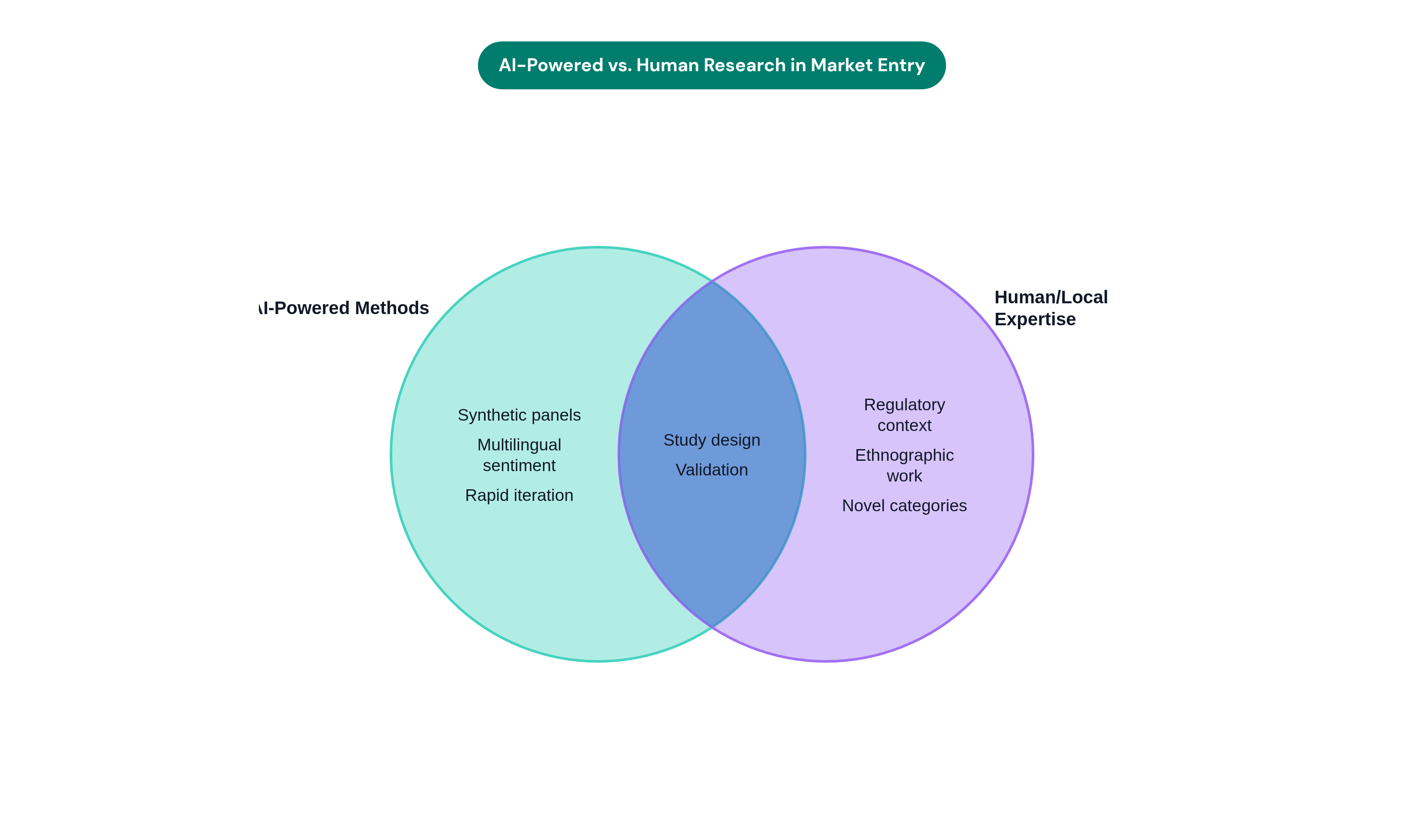
Regulatory and legal context is the clearest case. Understanding what claims can legally be made, which distribution channels are available, and what compliance requirements shape the consumer relationship is not a research question. It requires practitioners with jurisdiction-specific knowledge, and no synthetic panel substitutes for that.
Deeply embedded cultural frames that are underrepresented in training data are a second firm boundary. Markets where digitized consumer behavior is thin, where oral culture dominates, or where the relevant consumer segment has historically been excluded from online panels: here, local expertise is not a luxury. The model has nothing meaningful to calibrate against, and you will not know it until the real-world results contradict everything the synthetic phase told you.
Ethnographic and observational work occupies its own category. Watching how consumers interact with a category in their physical environment, in-home, in-store, in-context, produces insight that no interview format fully replicates. People describe what they think they do. Ethnography shows what they actually do.
The novel product problem recurs here. The 0.3 correlation finding is the clearest published signal that when there is no behavioral analog to learn from, synthetic research should not carry the evidentiary weight. For genuinely new categories, human primary research is not a supplement; it is the foundation.
Stakeholder credibility is worth naming honestly. In some organizations and some markets, presenting AI-only research to a local joint-venture partner or a board considering a major geographic investment will invite legitimate skepticism. Knowing when to supplement with human validation is a judgment call, not a failure of nerve. AI-powered tools eliminate the dependency on local agencies for the large majority of market entry research tasks. They do not eliminate the need for human judgment in study design, in interpreting surprising findings, or in recognizing which questions require in-person, in-market presence.
What it costs and how long it takes to run market entry research without an agency today
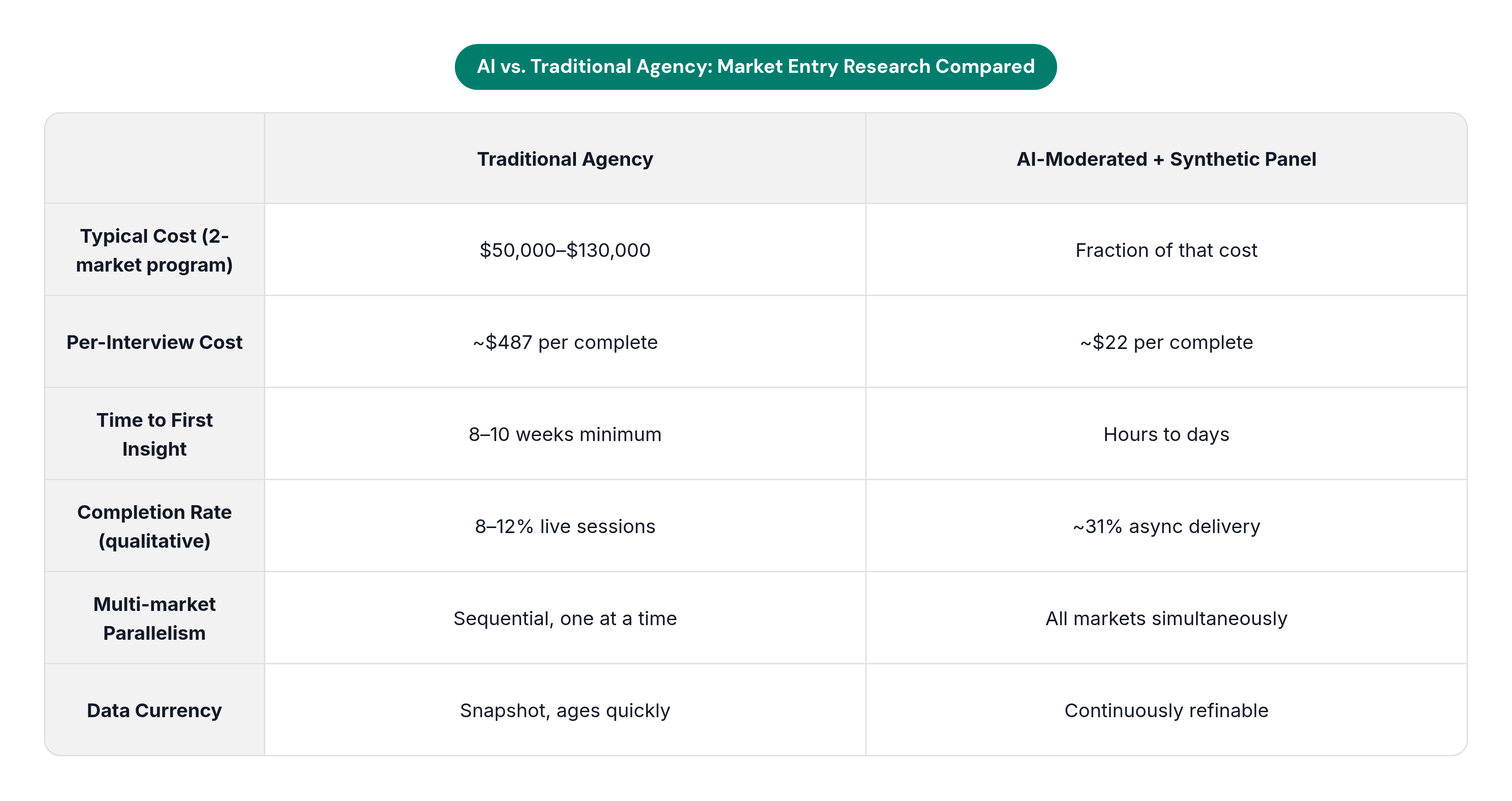
The per-interview economics are the most direct illustration of what has changed. The Insights Association's 2024 benchmark placed per-complete costs for qualitative interviews at approximately $487. The Quirk's 2025 SaaS Report put the comparable figure using AI-moderated platforms at approximately $22. That is roughly a 95% reduction at the unit level. The magnitude of that gap is the kind of number that tends to make people suspicious, but both figures come from industry benchmarks, not vendor marketing materials.
Applied to a market entry research program: a traditional agency package covering two markets, qualitative and quantitative combined, would typically run $50,000 to $130,000 and take 10 to 14 weeks. The same question set, run with AI-moderated interviews and a verified global panel, compresses to days at a fraction of that cost.
Forrester documented a case where a single brand was spending $2.6 million annually on traditional agency research before switching to an AI-moderated model. The scale illustrates what cumulative agency dependency looks like across an enterprise research portfolio.
The timeline comparison is concrete. Traditional: roughly two weeks design, two weeks recruitment, two weeks fieldwork, two to four weeks analysis; eight to ten weeks minimum before a first insight informs anything. AI-moderated with a verified panel: study design to initial findings in hours to days, full synthesis in under a week for most market entry question sets.
A team evaluating three potential markets can now run parallel research across all three simultaneously and have comparative data before the entry window closes. The sequential agency model structurally prevented this. You got one market at a time, one study at a time, and by the time the third study delivered, the assumptions underlying the first were already aging. That is a structural problem baked into how the work was funded and sequenced, not a research quality problem. AI-powered methods dissolve it.
How to build a reusable market intelligence foundation rather than a one-time entry study
The agency model had a structural problem beyond cost. A research project ends. The market does not. Consumer attitudes shift, competitive positions change, and the entry-phase research that informed the launch is outdated within months. Teams that treated market entry research as a discrete project rather than a foundation consistently made subsequent decisions with data that no longer reflected current conditions.
A reusable foundation works differently. A calibrated synthetic panel for the target market, built once during the entry phase, can be run against any subsequent product, pricing, or positioning decision indefinitely. Each real-respondent study that runs afterward adds data that refines the synthetic model. The panel becomes more accurate over time, not static. Post-launch behavioral signals, usage data, support contacts, review sentiment: all of it feeds back into the model and keeps it current in a way that a quarterly agency check-in never could.
The direction the industry is moving is unambiguous. Greenbook's 2025 forward-looking survey found that 64% of insights buyers expect to have replaced their annual brand-tracking study with always-on conversational research by the end of 2027.
For market entry specifically, the research investment made to enter a market does not have to depreciate. It becomes the behavioral baseline against which every subsequent decision in that market is tested. The entry study funds the foundation. The foundation pays back across every decision that follows.