AI Interviewer Capabilities vs Static Surveys
AI interviews capture the hesitations and reasoning that surveys miss entirely.

The defining moment in any research conversation is never the answer to the question you prepared. It's the hedge. The hesitation. The "kind of," the "I almost didn't." Those are the entrances to the real answer. A static survey treats them as a completed field and moves on.
AI-moderated interviews are one-on-one qualitative conversations. The AI asks prepared questions, yes, but it also registers when an answer is vague, probes the reasoning behind a number, and follows an unexpected thread if the respondent introduces one. Three behaviors separate it from any form-based instrument: probing ambiguity, pursuing the unanticipated, and knowing when to stop asking. A question set is locked before the respondent opens their mouth — no amount of careful question writing changes what happens after.
The number that actually matters isn't completion rate. A 2024 Glaut study found AI-moderated interviews produced 129% more words per response than traditional surveys, with 66% of transcripts rated higher quality by independent reviewers (Glaut, "AI-Moderated Research Quality Benchmarks," 2024). What mattered was specificity and explanatory detail, exactly the dimensions that survey fatigue guts first. When someone tells you an experience was "kind of confusing," a well-built AI moderator asks what the confusing part was. A survey logs "kind of confusing" and advances to the next scale item.
To place this instrument correctly: AI moderation sits between fully unmoderated tools like self-serve usability platforms and fully human-moderated sessions run by a senior researcher on video. It doesn't replace either. It occupies the middle space where qualitative depth is needed but the logistics of human moderation make that impractical. Both ends of that spectrum get misapplied regularly, yielding neither the rigor of a trained moderator nor the scale of a proper survey — an expensive place to end up.
How Declining Survey Response Rates Turn a Data Quality Problem Into a Data Integrity Problem
Even if surveys could ask follow-up questions, they would still be contending with a participation crisis that compounds every year. Linked email surveys now convert between 6% and 15%, with the overall channel average around 33%, according to SurveyMonkey's industry benchmarks. Rates have been declining one to two percentage points annually since 2019 (Pew Research Center, "Assessing the Risks to Online Polls from Bogus Respondents," 2023). That's a trend line, not noise.
The people who do respond are increasingly unrepresentative of anyone you actually want to understand. Professional survey-takers optimizing for incentives, respondents straight-lining every scale item, open-ended fields answered with five words: the signal degrades from both directions simultaneously: low volume and low quality. Independent audits of commercial panels have flagged fraud rates between 15% and 30% in unmanaged samples, including AI-generated respondents who pass basic attention checks (Pew Research Center, "Assessing the Risks to Online Polls from Bogus Respondents," 2023). The panel you're paying for does not consist of the people you think it does.
Here's a benchmark that clarifies how serious this has gotten. Government employment surveys, the kind that underpin major economic indicators, fell from response rates around 60% before the pandemic to below 45% afterward. The Federal Reserve Bank of San Francisco flagged declining survey response rates as affecting macroeconomic data accuracy in a 2024 working paper (Bracha and Stark, "Reconsidering Survey-Based Inflation Expectations," Federal Reserve Bank of San Francisco Working Paper 2024-05). If deteriorating participation is compromising official government data, the implications for the commercial panels most product and marketing teams rely on without scrutiny are not small.
There's also a format-specific trap built into the instrument itself. Surveys that most need depth — those with multiple open-ended questions — see completion rates drop sharply past seven or eight minutes. Shortening surveys protects completion at the expense of explanatory richness. Inbox overload, mobile friction, and privacy concern are all worsening, and none of them respond to a better subject line.
The Research Questions That Belong to Conversations, and the Ones Surveys Still Own
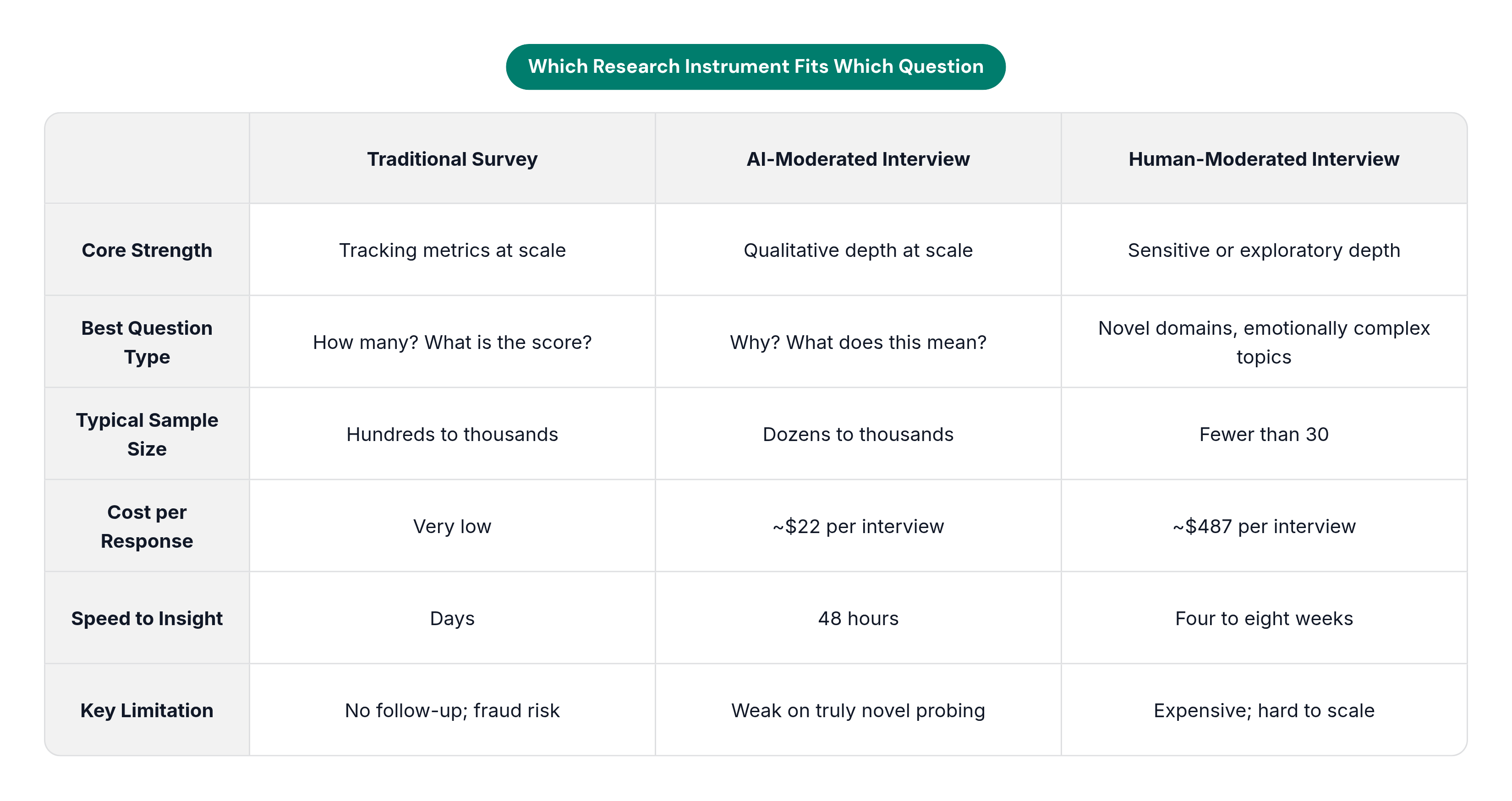
Surveys are genuinely excellent tools. The problem isn't that they're broken — it's that each instrument owns a specific class of question, and misapplying either produces wasted effort and misplaced confidence.
Surveys win when you are tracking a single metric over time at scale: NPS trends, satisfaction indices, usage frequency, anything where the question stays fixed and comparability across waves is the point. They're fast, inexpensive, and statistically defensible for the questions they're designed to answer. A longitudinal benchmark study built on conversational interviews would be expensive, slow, and analytically unwieldy. Nobody should do that.
The moment the research question shifts from "how many" to "why," or from "what is the score" to "what does this actually mean to them," the survey runs out of instrument. Conversations own the reasoning behind a number, the emotional logic of a churn decision, the exploratory work in genuinely unfamiliar territory. These aren't add-ons to what a survey measures. They are a different category of knowledge entirely, and treating them as interchangeable is where teams consistently make expensive errors.
One honest caveat on AI moderation: human-moderated interviews remain stronger for emotionally sensitive topics, for founder-level customer development where the researcher's own pattern recognition is load-bearing in the method, and for domains so new that nobody yet knows what the right follow-up questions are. In those sessions, the moderator's intuition carries the whole thing in ways that are not replicable algorithmically. Presenting AI moderation as the answer to every qualitative need is how the technology gets oversold and then dismissed.
The practical decision rule starts before you pick a tool: ask what the decision-maker needs to understand. Does the answer require explanation, or does it require a count? That single question determines the instrument. Everything else follows from it.
One persistent confusion worth naming directly: AI interview platforms are categorically different from survey tools that add branching logic or sentiment analysis to a static form. They're also distinct from recruited-panel platforms, session-recording tools, research repositories, and product-feedback aggregators. These categories blur constantly in sales conversations, leading teams to buy the wrong tool for the question they're actually trying to answer — a more common failure mode than most research buyers realize.
What the Speed Difference Actually Means for When Insight Reaches a Decision
Traditional agency-led qualitative studies take four to eight weeks from brief to report. Question development and pressure-testing can consume the first week alone; recruiting and scheduling add weeks more. The insight is real when it arrives; it just arrives after the decision it was supposed to inform has already shipped.
A 30-respondent AI-moderated discovery study can complete in as little as 48 hours. Teams using AI-assisted research report faster time-to-insight, and researchers have noted that respondents often engage more readily in a conversational format than in a grid of radio buttons.
Speed isn't a convenience feature. Speed determines whether research shapes a decision or merely documents one that has already been taken. A deliverable that arrives three weeks after the product team shipped is a historical artifact. The team nods politely. The document gets filed. Nothing changes.
What this actually enables is continuous discovery: weekly or biweekly customer touchpoints owned by the product team rather than scheduled as a quarterly event by a centralized research function. Customer understanding becomes infrastructure that runs continuously rather than a project someone kicks off when they finally get anxious enough to ask for one.
How Scale Changes Once the Bottleneck Is Removed
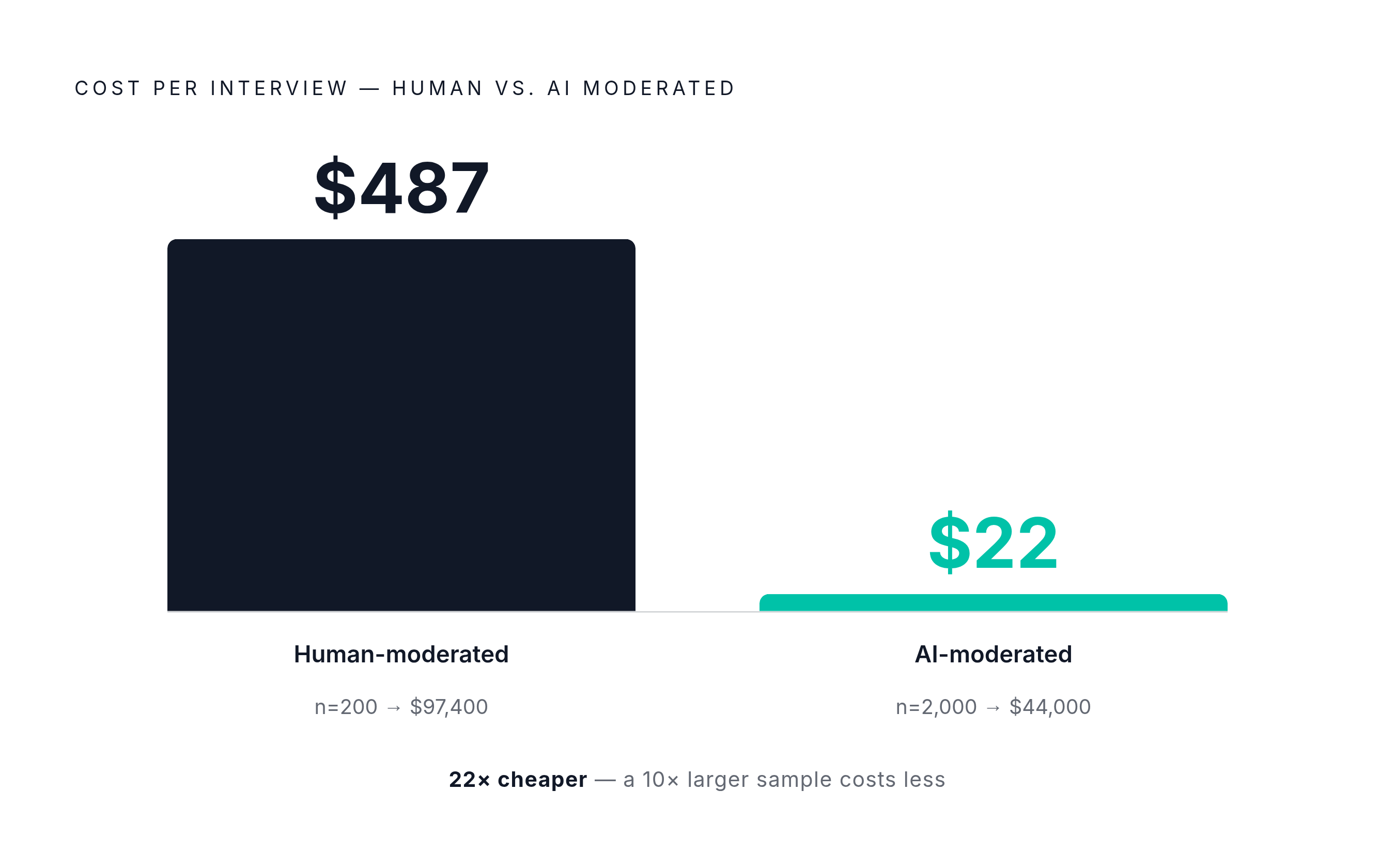
The traditional ceiling on qualitative sample sizes is neither arbitrary nor unnecessarily conservative. The Insights Association's 2024 Industry Pricing Study put the all-in cost of a 60-minute moderated interview at $487 (Insights Association, "2024 Industry Pricing Study," 2024). At that rate, an n of 200 costs nearly $100,000 in fieldwork alone, before analysis, synthesis, or reporting. Most budgets hit their limit well before 250 respondents, which is why qualitative findings have historically been framed as directional and illustrative rather than statistically defensible. That framing is honest, but it limits the organizational weight those findings can carry.
AI moderation changes the cost structure substantially. Quirk's 2025 Researcher SaaS Report put the all-in cost at approximately $22 per completed conversational interview (Quirk's, "2025 Researcher SaaS Report," 2025). At that price, an n of 2,000 costs less than a traditional n of 200. The median qualitative sample size for AI-moderated studies rose to 312, per Greenbook's 2025 GRIT report, up from 17 in 2022 (Greenbook, "GRIT Business & Innovation Report," 2025). Eighteen times larger in three years.
What changes isn't just the number. Pattern recognition across 2,000 transcripts surfaces minority segments and edge cases that a sample of 20 never reaches. Findings that were previously hedged appropriately become statistically defensible. The sharp boundary between qualitative and quantitative work begins to soften in a genuinely useful direction.
In UX research specifically, AI-moderated usability testing with prototype sharing allows teams to run studies with hundreds of participants inside 48 hours. Microsoft's Copilot team has used Outset for AI-moderated UX evaluations; according to Outset's published case study, the team attributed a 5% retention lift to insights surfaced through the process (Outset, "Microsoft Copilot Case Study," 2024).
Adoption is well past the early-adopter stage. According to User Interviews' State of User Research 2025, 80% of researchers now use AI tools in some form, and 56% report improved team efficiency (User Interviews, "State of User Research 2025," 2025). The question for most teams is no longer whether to adopt but how to evaluate which platforms actually deliver the core capability the category promises.
What to Actually Look for When Evaluating Whether an AI Moderator Probes
Adaptive follow-up quality is the single capability that separates a genuine AI moderation platform from a survey tool with a conversational interface bolted on. Distribution, synthesis, dashboards: all of it is secondary. If the moderator doesn't probe, nothing else in the stack matters enough to justify the purchase.
The only reliable test is to run a pilot and read the transcripts yourself. Not a summary. Not a dashboard. The actual transcripts. Does the moderator follow up on "kind of"? Does it notice when a respondent introduces something unexpected and pursue it? Does it stop asking when it has what it needs, rather than mechanically exhausting every question on a predetermined script? You can tell within a handful of transcripts whether the probing is real or decorative.
Distribution flexibility matters more than vendors typically emphasize. The moderator needs to reach respondents where they already are: email, SMS, an in-product prompt, a post-onboarding sequence. Anything requiring a separate login or an unfamiliar link adds friction that suppresses the completion rates AI moderation otherwise genuinely improves.
One consistently underweighted factor in platform evaluations: 71% of organizations now have non-researchers running studies, per User Interviews' State of User Research 2025 (User Interviews, "State of User Research 2025," 2025). The product manager running their first customer interview is not going to catch a bad probe the way a senior researcher would. A platform that produces incisive follow-ups for an expert but incoherent transcripts for a novice is not a reliable research instrument. The guardrails matter as much as the capability ceiling — maybe more.
Per Gartner's 2025 Hype Cycle for Customer Service, conversational AI for research has moved from the Innovation Trigger into the Slope of Enlightenment (Gartner, "Hype Cycle for Customer Service and Support Technologies," 2025). The category is no longer speculative. Due diligence is now required, not optional.
Before selecting any research instrument, name the question you are actually trying to answer. If that answer requires explanation, the instrument needs to be able to ask why. Seda, an automated market research platform that runs AI-conducted interviews and UX tests with verified human respondents across 130+ countries and auto-synthesizes findings into structured reports, is one platform built around that core requirement. If it can't, you will accumulate data without understanding, and those are not interchangeable outcomes.