ICP Research for Early-Stage Startups
Define your ideal customer by who actually stays, grows, and refers—not just who looks like a fit.

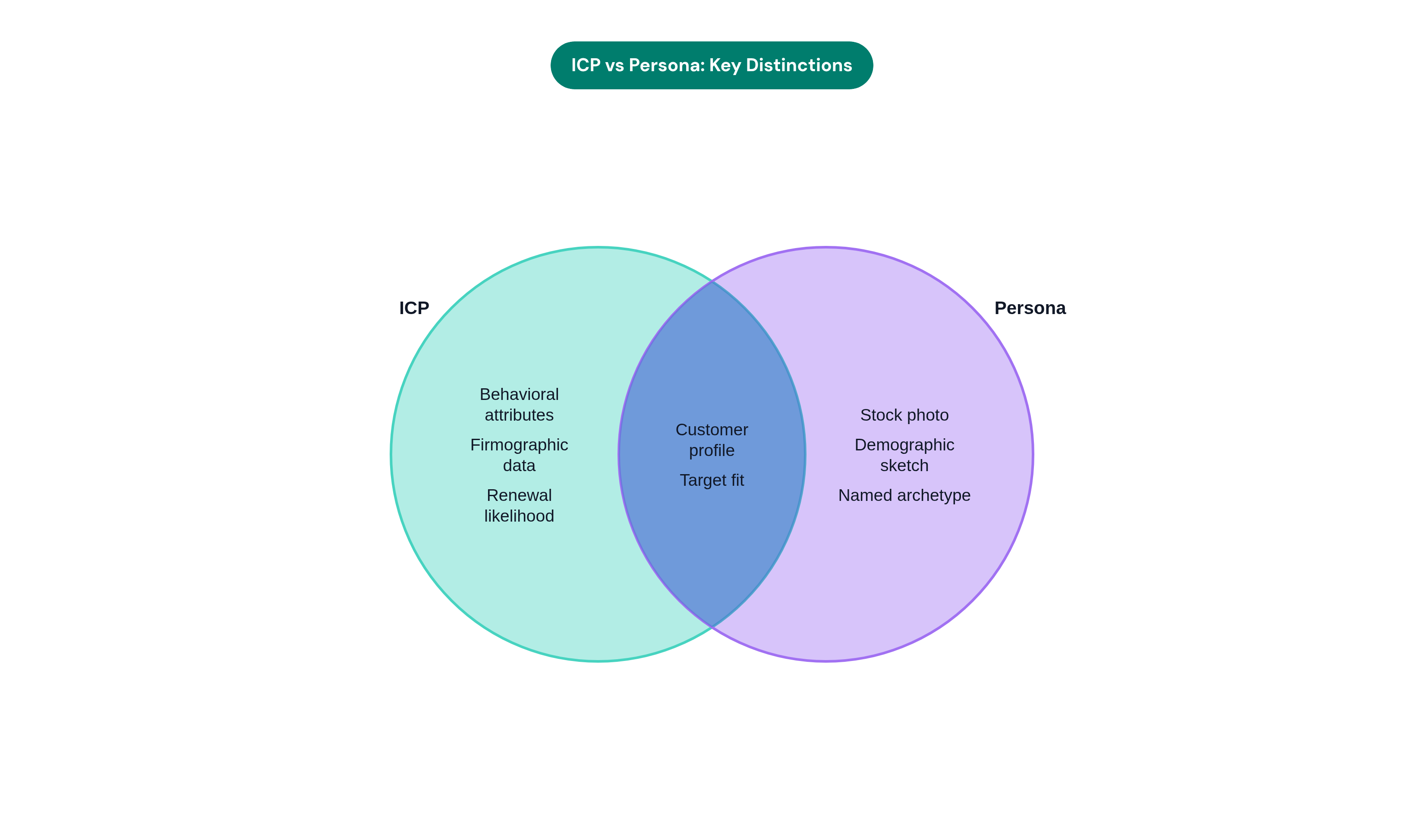
The ICP is not a persona. A persona is a demographic sketch with a stock photo and a name like "Marketing Mary." The ICP describes the type of customer most likely to buy, retain, expand, and refer. That distinction shifts the frame from "who looks like a good fit" to "who actually behaves in ways that sustain the business."
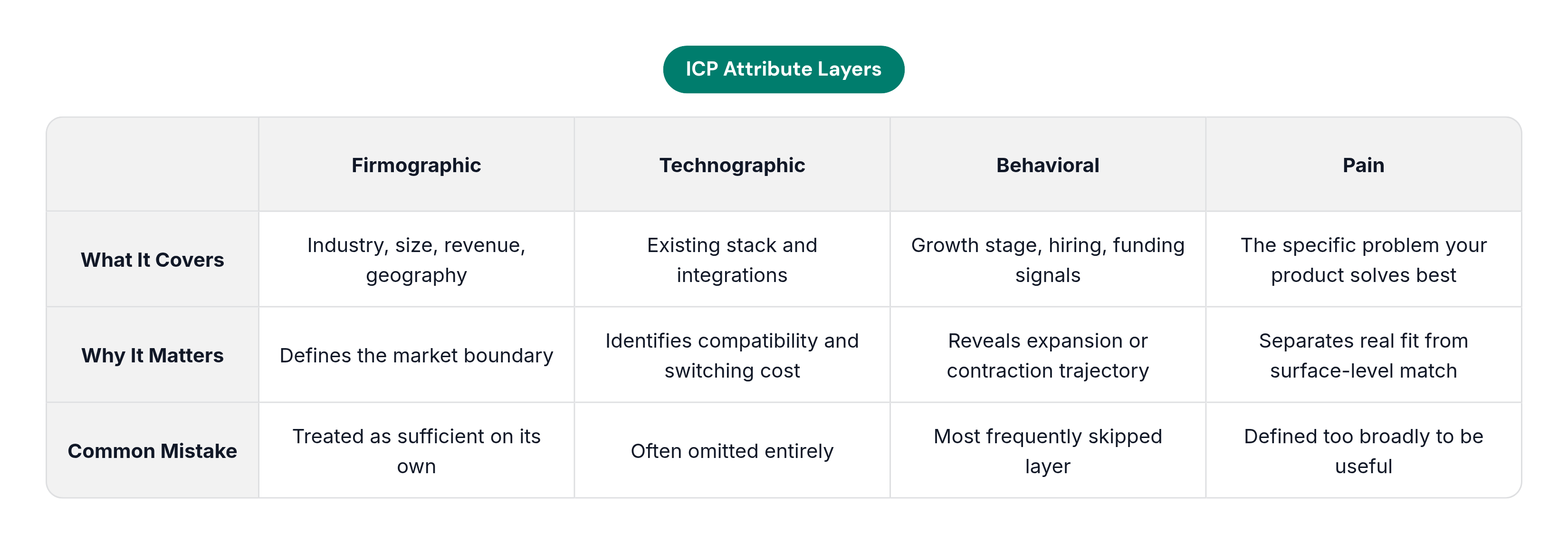
A definition worth building has four attribute layers. Firmographic attributes cover industry, company size, revenue range, and geography. Technographic attributes describe the existing stack: what tools they're already running, what integrations they depend on. Behavioral attributes are the ones most teams skip, and they're often the most predictive: growth stage, recent hiring patterns, funding signals, whether the organization is expanding or contracting. Then there's the pain layer, where the real specificity lives. The particular problem your product solves better than any alternative they can actually access.
Here's where teams consistently get the operational definition of "ideal" wrong: they optimize for contract size. A customer who pays a lot but drains the customer success team and churns at renewal is not ideal, whatever the invoice says. The better signal is a combination of time-to-value, support burden, and renewal likelihood. Revenue volume is one input, not the conclusion.
For early-stage teams: one ICP. Multiple segments at this stage usually means building fundamentally different products for different problems, which fragments the roadmap and fractures the team's attention. The temptation to keep multiple options open feels like prudence. It's diffusion. Pick one segment, prove you can execute for it, then expand.
One discipline separates useful ICPs from decorative ones: every attribute in the profile should be something you can verify or falsify through research. If you can't test it, you can't improve it.
Why Traditional Research Timelines Don't Fit a Startup's Decision Window
A standard user study, run the traditional way, takes six to twelve weeks. Outsourced market research rarely finishes under four weeks, even at the lean end. These timelines aren't dysfunction. They're the natural result of manual, human-dependent workflows: recruiting, scheduling, moderating, transcribing, coding, analyzing.
The problem is that your ICP question cannot wait eight weeks. Secondary research alone, reviewing existing reports and publications, consumes between 40 and 60 percent of total research time in conventional engagements. Meanwhile, every week without a working ICP hypothesis is a week where product, pricing, and messaging decisions are being made against assumptions nobody has tested.
What makes this genuinely urgent is the compounding. ICP assumptions don't sit idle while you wait for results. They're embedded in every hire, every feature prioritized, every conversation with a prospective investor or customer. Eight weeks of drift on a wrong assumption is costly in a way that's hard to unwind, because by the time you get the research back, the assumption has already shaped decisions you can't easily reverse.
This is an argument for methods that are rigorous and fast, not an argument against rigor. Those methods exist, and there's no longer a good excuse for avoiding them.
How to Run the First Round of ICP Research With Almost No Budget
Start with what you already have. If any customers exist, interview the three to five who retained longest, expanded fastest, or referred others. These people are the signal. Everyone else is noise at this stage.
The questions that surface useful data are not complicated. What were they doing before your product? What made them start looking for a solution? What almost stopped them from buying? What would make them leave? Four questions, asked without steering, will produce more actionable ICP intelligence than most template-based research frameworks ever do. The trick is to actually stay quiet after asking them. Most founders jump in too fast.
If you're using a CRM or conversation intelligence tool, pull the language from your winning sales calls. Look for patterns: the specific phrases customers used to describe the problem, the objections they raised and then overcame, the triggers that moved them from interest to decision. That language is raw material and it's already paid for.
If there are no customers yet, identify ten to fifteen people who match your assumed ICP and run problem-discovery interviews. The goal is to validate the pain, not pitch the product. The moment you start describing your solution, you've stopped learning, because every response you get after that point is colored by what you just said.
Sourcing without a panel budget is a real constraint, and it's solvable. LinkedIn outreach works when the message is specific and the ask is small. Founder networks move faster than cold outreach. The communities where your target ICP already gathers, Slack groups, niche forums, relevant subreddits, are often the most efficient access point because participants have already self-selected around the problem you're investigating.
What you're listening for: the specific language people use to describe the problem, the workarounds they've built, and the moment they decided the status quo was no longer acceptable. That last one is particularly valuable. It tells you when someone becomes a buyer, not just someone who suffers from the problem. There's a meaningful difference between "this is annoying" and "I can't run my business like this anymore." — and that difference, to put it plainly, is revenue.
The output of this first round is a short list of hypotheses. Not a finished ICP profile, but a set of claims about who the customer is and why. Those claims are what you test next.
How AI-Moderated Interviews Let a Small Team Test ICP Hypotheses at Scale
The traditional qualitative research tradeoff is well-worn: interviews give depth but don't scale; surveys scale but can't ask "why." AI-moderated research breaks that tradeoff, and the practical implications for early-stage ICP work are significant enough that ignoring them is now a competitive disadvantage, not a stylistic preference.
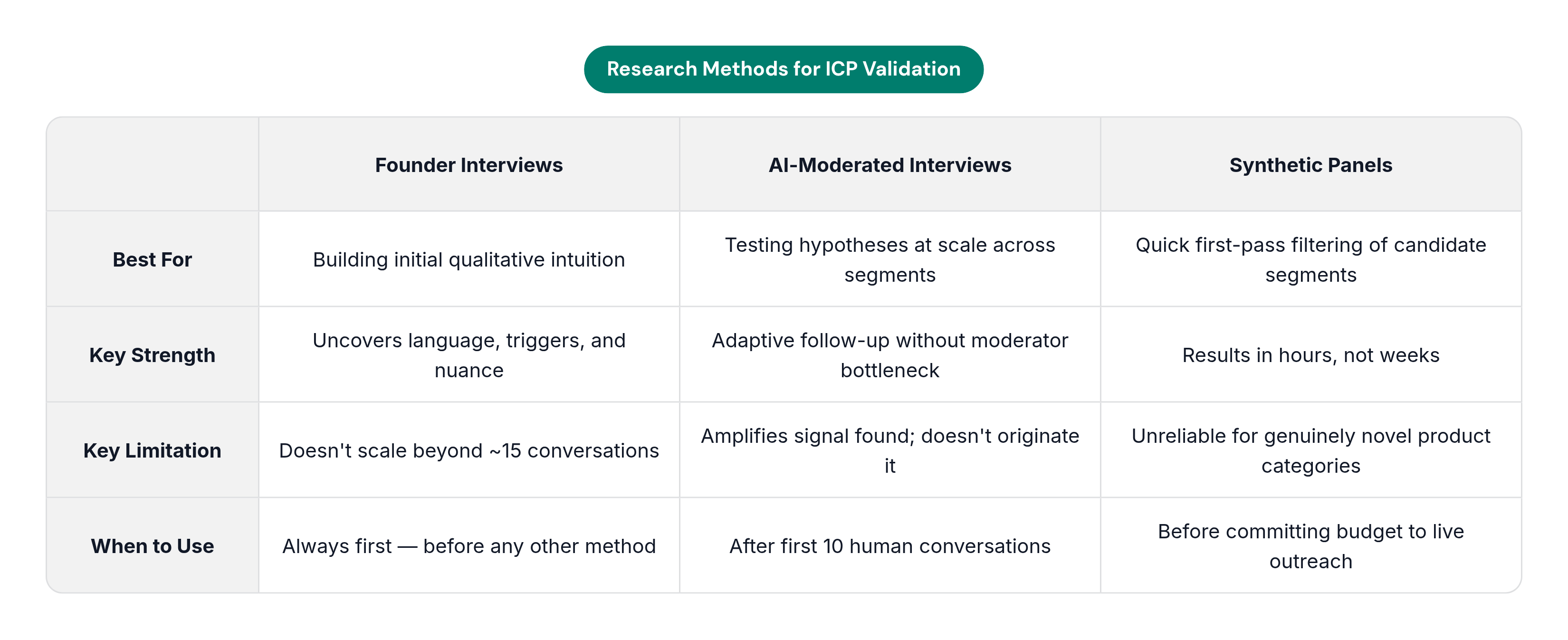
Tools in this category conduct interviews at scale, with the AI dynamically probing each participant based on their prior responses. This mimics the most valuable part of human interviewing, the adaptive follow-up, without requiring a trained moderator in every conversation. Anthropic ran 1,250 AI-moderated user interviews in a single research effort (Anthropic, 2024). No human team conducts and synthesizes that volume in a comparable window. That's not a marginal improvement; it's a different category of capability.
For ICP research specifically, the application is direct. Run interviews across several candidate segments simultaneously. Let the AI probe on pain intensity, existing workarounds, and buying triggers. Then compare which segment's responses most closely match the ICP criteria you defined. You're collecting data and running a comparative test across segments with the same instrument, something traditional qualitative research rarely allows.
The adoption curve has moved quickly. A substantial majority of researchers now plan to invest in AI for research, according to recent practitioner surveys. This is no longer experimental methodology.
One important caveat: AI interviews amplify a signal you've already found. They don't find it from scratch. The qualitative intuition a founder builds from the first ten human conversations is irreplaceable. Run those first. Then use AI-moderated interviews to test and scale what you've learned.
Where Synthetic Consumer Panels Fit Into Early ICP Validation
Synthetic panels are AI-generated virtual respondents built from real-world datasets: historical survey responses, behavioral data, and public opinion research. The distinction from fabricated data matters here. Calibrated synthetic panels can reach parity in the mid-to-high eighties, percentage-wise, with real panels on concept, pricing, and positioning tests. Generic large language model prompts sit considerably lower. The calibration work, training the synthetic panel on relevant behavioral data, is what creates that gap, and it's why not all synthetic panels are equivalent.
A 2024 study from Stanford and Google DeepMind researchers found that AI digital twins replicated human survey answers with 85% accuracy and social behavior with a 98% correlation (Park et al., 2024). The study involved over a thousand participants. These aren't marginal results; they suggest synthetic panels have crossed a threshold where they're genuinely useful for filtering decisions, not just directional gestures.
The specific use case for ICP validation is this: if you have three candidate segments and want to know which responds most strongly to your positioning before spending on live outreach, a synthetic panel can rank them in hours. You're making a first-pass filter decision, not a final one. You're eliminating the weakest candidates before you commit real budget.
Where synthetic panels break down: genuinely novel products with no comparable category. A Marketing Science study found only a 0.3 correlation between synthetic and real responses for truly novel, non-extension products (Jain et al., 2024). When a product creates a new category rather than extending an existing one, synthetic panels trained on historical behavioral data have limited predictive power, because the behavior they're modeling hasn't existed yet. For those situations, human interviews remain essential.
The correct frame is sequential. Use synthetic panels to eliminate weak ICP candidates quickly. Then spend your real interview budget on the one or two segments that survive the filter.
How to Synthesize What You've Learned Into an ICP You Can Act On
After the interviews and panel tests, the synthesis question is this: which segment had the most acute pain, the shortest path to value, and the clearest reason to pay? Answer that honestly and you have the foundation of your working ICP.
The most reliable signal in interview data is unprompted convergence. When customers across separate conversations describe your product's value using the same language, without being coached toward it, something real is happening. That convergence is qualitatively different from patterns you induced by asking leading questions. It's the moment where you stop constructing a narrative and start recognizing one.
The working ICP document should be brief and operational. A one-sentence description of who the customer is. The specific trigger that makes them start looking for a solution. The criteria they use to evaluate their options. And a list of red flags that indicate bad fit. That last element matters as much as the profile itself. It's the mechanism that prevents the team from chasing every lead that shows interest, and without it, the ICP document just becomes aspirational wallpaper.
AI synthesis tools are useful at this stage. Clustering interview transcripts by theme and surfacing language patterns is well within the capability of current tools, and it's faster than manual coding. That said, editorial judgment is irreplaceable. The tool surfaces patterns; a human decides which patterns matter and why. Those are not equivalent operations, and treating them as such is where teams get into trouble.
Share the synthesized ICP across product, sales, and marketing before it's "finished." Misalignment between those teams on who the customer is compounds fast at early stage. A product team building for one segment while sales pursues another is an organizational problem masquerading as a strategy problem, and it almost always shows up in the data before anyone names it out loud.
Why the ICP Needs a Review Cycle Built In From the Start
The ICP you build at pre-revenue will be wrong in at least one material way. Not because you did the research poorly, but because you're learning a market in real time, and the market is also changing. The question is whether you have a process to discover where it's wrong before that error costs you a cohort of churned customers or a wasted product cycle.
A reasonable review cadence is semi-annual in the first two years: often enough to catch drift, infrequent enough to let the data accumulate between evaluations. The loop itself isn't complicated. Define based on current understanding. Test through customer conversations. Refine based on who actually succeeds with the product. Realign the organization to the updated definition. Repeat.
The signals that warrant an earlier review are specific. Rising churn in a particular segment. Sales cycles lengthening without an obvious external cause. Customer success costs climbing. A new cohort showing faster time-to-value than the segment you originally targeted. Any of these should trigger a review before the scheduled date, because by the time the scheduled date arrives, the drift has already done damage.
The compounding advantage of running ICP research continuously is structural. A team that revisits the ICP regularly builds a behavioral model of their target market that grows more accurate with each cycle. This is fundamentally different from a one-time research engagement that produces a report and then ends.
The practical commitment: schedule the next ICP review before the current one is finished. A review without a follow-up date is just a document, and a document is not a process.