Behavioral vs Demographic ICP Attributes
Behavioral signals beat demographics because they reveal who's actually ready to buy.

Behavioral attributes describe what customers do, not what category they belong to. Purchasing cadence, product usage depth, content consumption sequence, technology adoption patterns, brand switching history: these are observable actions. In a B2B context, the signals extend further — hiring velocity in specific departments, competitive tool evaluation activity, organizational restructuring, website engagement depth. All of it indicates whether an account is moving toward a purchase or sitting comfortably with the status quo.
Teams under-index on behavioral data not out of ignorance but because of where it lives. Demographic data occupies a clean field in a database. Behavioral data is scattered across CRM records, conversation intelligence platforms, intent data providers, and product analytics systems. Pulling it together requires deliberate infrastructure and interpretive judgment, and that friction is real. It explains why the easier, tidier demographic layer keeps getting promoted to primary status even when the people making that call know better.
Behavioral and psychographic attributes are worth separating, because the conflation runs rampant. Psychographics describe values, attitudes, beliefs. They are inferred. Behavioral attributes describe actions taken. They are observed. Both carry signal, but behavior is the more reliable foundation because you do not have to guess what someone thinks. You can see what they did.
In B2B, there is a compounding complication most frameworks quietly ignore. Research on enterprise purchasing consistently finds that major decisions involve a substantial number of stakeholders — often a dozen or more across functions. That means behavioral signals cannot be read at the level of a single contact. They have to be interpreted at the account level, aggregating actions across multiple roles to understand whether an organization is genuinely in motion or whether one curious person was browsing your category without any mandate behind them. One engaged contact is not a pipeline. It is a data point.
How Behavioral Precision Changes Conversion and Retention Outcomes
The conversion problem is structural, not tactical. Programs that enforce tight ICP criteria at the MQL stage, including behavioral and intent signals, report meaningfully higher conversion rates than those applying only demographic filters. That delta does not come from better copywriting or a retrained SDR team. It comes from a fundamentally different definition of who enters the pipeline in the first place.
The downstream consequences compound. Generic messaging attracts low-intent visitors. Sales cycles lengthen because reps spend time on accounts that were never genuinely ready. Customer success onboards accounts that churn within months because fit was approximate, not actual. The retention problem, in many cases, originates at acquisition — not in any failure of the post-sale team.
I have watched this play out more times than I care to count: a company hits its pipeline number, misses its revenue number, and diagnoses the problem as sales execution. They retrain the team, adjust the process. Same thing happens next quarter. The demographic ICP looked fine. The list was real. But fit is not readiness, and no amount of process improvement closes that gap.
Demographic-only ICPs create an illusion of discipline. The criteria are real, the list is bounded, but the filter is shallow. Behavioral criteria deepen it in ways that have measurable downstream consequences because they select for accounts that are not just categorically similar to past customers but behaviorally consistent with them. That is a different kind of resemblance entirely.
The Fit-vs-Intent Distinction That Most ICPs Collapse Into One Score
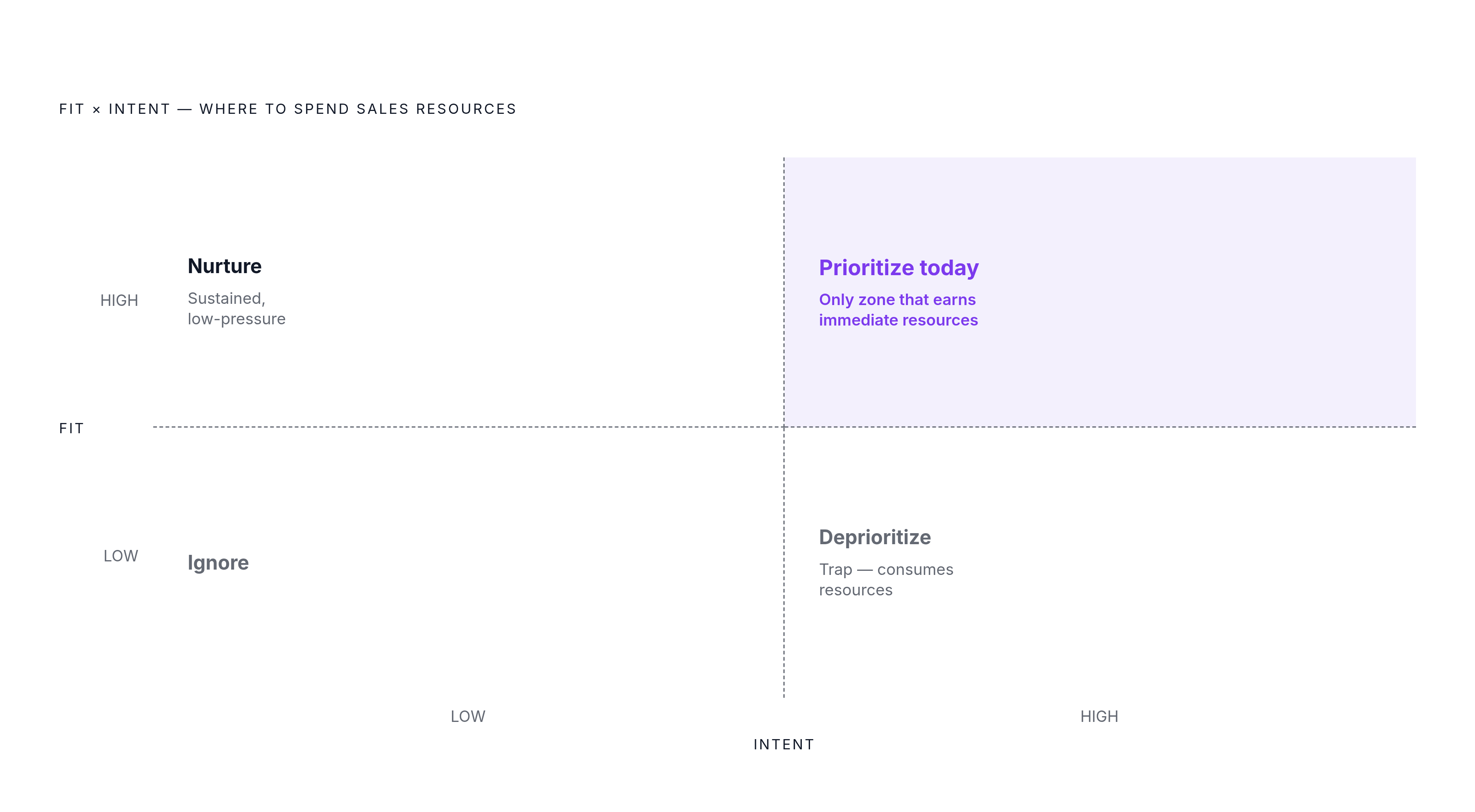
Fit and intent are different questions. Fit asks whether a company should buy from you. Intent asks whether it is looking right now. Most ICP frameworks treat these as a single dimension, producing a composite score that obscures which problem a given account actually has.
A perfect-fit account with no intent is a nurture target. It deserves sustained, low-pressure engagement over time. A high-intent account with poor fit is a trap. It can consume the better part of a rep's quarter, still never close, and if it does close, churn before the first renewal. Collapsing both dimensions into one score hides the failure mode you are actually facing. And unlike most problems in sales, it gets worse the harder you push.
Demographic and firmographic data largely answers the fit question. Industry, company size, geography, job title: useful, but static. Intent signals are behavioral by definition. Content consumption patterns, search activity in your solution category, vendor evaluation behavior, product trial engagement — none of these appear in a demographic field.
The practical implication is two filters operating in sequence, not one composite score. The first establishes whether an account is the right type. The second, built from behavioral data, establishes whether that account is moving. Where both scores are high, prioritize today. Where fit is high and intent is low, run a different motion entirely. Where intent is high and fit is low, deprioritize before those accounts consume resources that belong elsewhere. Most people nod when they hear this, then go back and build the composite score anyway.
Where Behavioral Data Comes From and How to Build It Into an ICP
Three sources do the most work: closed-won analysis, conversation intelligence, and intent data providers. They are most valuable in combination.
Closed-won analysis is the most underutilized of the three, which is genuinely frustrating because the data already exists. Your best customers signed contracts, and before they did, they did things. They engaged with specific content in a specific sequence. They asked particular questions during the sales process. They came from particular channels and evaluation contexts. Pulling those patterns from deals already won reveals the actual behavioral triggers that preceded purchase, not assumptions about who should buy based on title and company size. The answers are sitting in your own system. Most teams never go looking.
Conversation intelligence surfaces something different. What did winning customers say about their situation, their timeline, their alternatives? The language customers use to describe their problem is behavioral context that never appears in a CRM field. It reveals the conditions that made them ready to move, and that language becomes the raw material for messaging that reflects how buyers actually think.
Intent data providers show which accounts are actively researching your category right now. This is the most direct behavioral signal for timing, though it requires calibration because intent data carries noise. An account appearing in an intent report has shown some signal; whether that signal is meaningful depends entirely on how it layers with fit data.
The ICP built from these sources has a property that demographic ICPs lack: a trigger component. It does not just describe who your ideal customer is — it identifies the conditions under which a fit account becomes a ready-to-buy account. That is what makes a behavioral ICP actionable at the rep level rather than legible only in a strategy deck. And because behavioral patterns evolve as markets mature, the ICP should be treated as a running record of what is currently true, not a founding artifact that gets laminated and filed.
What Research Methods Can Actually Surface Behavioral Attributes at Scale
Internal data tells you what customers did. Research tells you why. The "why" is where behavioral ICP attributes acquire their predictive texture. Knowing that converted customers had previously evaluated three competitors before engaging your sales team is useful — but knowing what almost stopped them from converting despite that evaluation is more useful, because it reveals the moment of maximum friction and maximum leverage.
Surfacing that level of insight at scale has historically been the bottleneck. Traditional qualitative research, the kind with recruitment, a moderator, and a proper analysis phase, takes weeks and costs tens of thousands of dollars per engagement. That structure means most companies commission it once or twice a year, if at all, and make dynamic decisions from static findings. I have sat in strategy reviews where the "customer insight" slide was eighteen months old. Nobody flagged it. We just kept going.
AI-powered interview infrastructure is changing that constraint in a meaningful way. Adaptive, conversational AI interviewers can conduct open-ended follow-up conversations at scale, capturing the emotional reasoning and decision-making context that static surveys reliably miss. Research that once took months can now run in days. That volume matters because behavioral patterns are statistical: the triggers, hesitations, and decision sequences that actually predict purchase become visible across a large sample in ways they simply cannot across a small qualitative one.
The behavioral insights most relevant to ICP refinement, what triggered the search, what almost stopped the purchase, what made the customer stay, require open-ended conversation to surface. A multiple-choice survey cannot capture the nuance of how a buyer actually made their decision. At scale, AI-moderated conversation is now the most practical instrument for collecting that signal systematically.
Where Synthetic Consumer Panels Fit When You Need Behavioral Signal Before Real Customers Exist
The closed-won analysis approach assumes you have customers who have already closed. For a company entering a new market or launching a new product category, that data does not exist. The ICP must be built prospectively, which means either accepting a high degree of assumption or finding a different source of signal. Most teams accept the assumption without saying so explicitly — they call it a hypothesis and move forward.
Calibrated synthetic panels, trained on real human data rather than generic language model outputs, have emerged as a credible option in that context. A Stanford and Google DeepMind study found 85% accuracy on survey replication and 98% correlation on behavioral tasks for well-calibrated synthetic panels. Those are not perfect numbers. But they are directionally reliable enough to stress-test assumptions before committing real budget to real recruitment.
The use cases where synthetic panels earn their place are specific. Testing which behavioral triggers resonate with a simulated target segment before building messaging infrastructure. Reaching hard-to-access profiles, CISOs in fintech, IT directors actively evaluating cloud migration, without the logistical overhead of sourcing and scheduling those individuals. Pressure-testing pricing and positioning hypotheses against a modeled audience before the product is live.
Most new products miss their launch targets, and a substantial share of startup failures trace back to building something the market did not need. Both failure modes share a root cause: teams committed resources before testing behavioral assumptions. Synthetic panels cannot close that gap entirely, but they can narrow it during the period before real customer data exists, which is often when the most consequential bets get made.
The limitation should be stated plainly. Synthetic panels surface directional behavioral patterns. They do not replace the signal that comes from actual customer conversations once a product is live. Once real customers exist, real behavioral data takes priority. The quality gap between calibrated synthetic audiences and uncalibrated prompting is also meaningful; generic AI prompting without calibration produces results closer to fifty-five percent parity with traditional panels, which is not a threshold most teams should be making ICP decisions from.
How a Behavioral ICP Changes What Product and Go-to-Market Teams Actually Build
A demographic ICP tells the product team who to build for in the abstract. A behavioral ICP tells them what triggers, workflows, and moments of friction actually shape whether those customers adopt, engage, and stay. That difference determines which features get prioritized, which onboarding flows get designed, which use cases get positioned as primary. It is the difference between building for a category and building for a person in a specific situation, at a specific moment, with a problem they have already tried to solve another way.
Messaging built from behavioral attributes reflects the language customers use to describe their own situation, because it is drawn from what real customers said during research or what simulated customers surfaced through synthetic inquiry. This is categorically different from messaging built from internal assumptions about what the product does. The former meets buyers in their own cognitive frame; the latter asks them to translate before they can engage, and most do not bother.
Go-to-market targeting built on fit-plus-intent logic directs budget toward accounts that are ready, not accounts that merely look right on a spreadsheet. That specificity reduces waste in paid acquisition, improves outbound conversion, and shortens the time a rep spends on accounts that should have been deprioritized before the first call.
The compounding advantage comes from treating the behavioral ICP as infrastructure rather than a one-time deliverable. A behavioral model of a target audience applies to future product decisions, pricing changes, new market entries, and competitive positioning shifts. Research accumulates signal rather than expiring. Teams that build this way make better decisions faster, not because they are smarter, but because they are operating from a richer, more continuously updated model of how their best customers actually behave.
The alternative is revisiting the ICP when a strategy fails and rebuilding it from the same demographic foundations that produced the shortfall. Most teams caught in that cycle do not recognize the pattern until they are already back in it.