Translating ICP Research into Persona Documents
Four ICP research layers unlock persona depth most organizations unknowingly leave on the table.
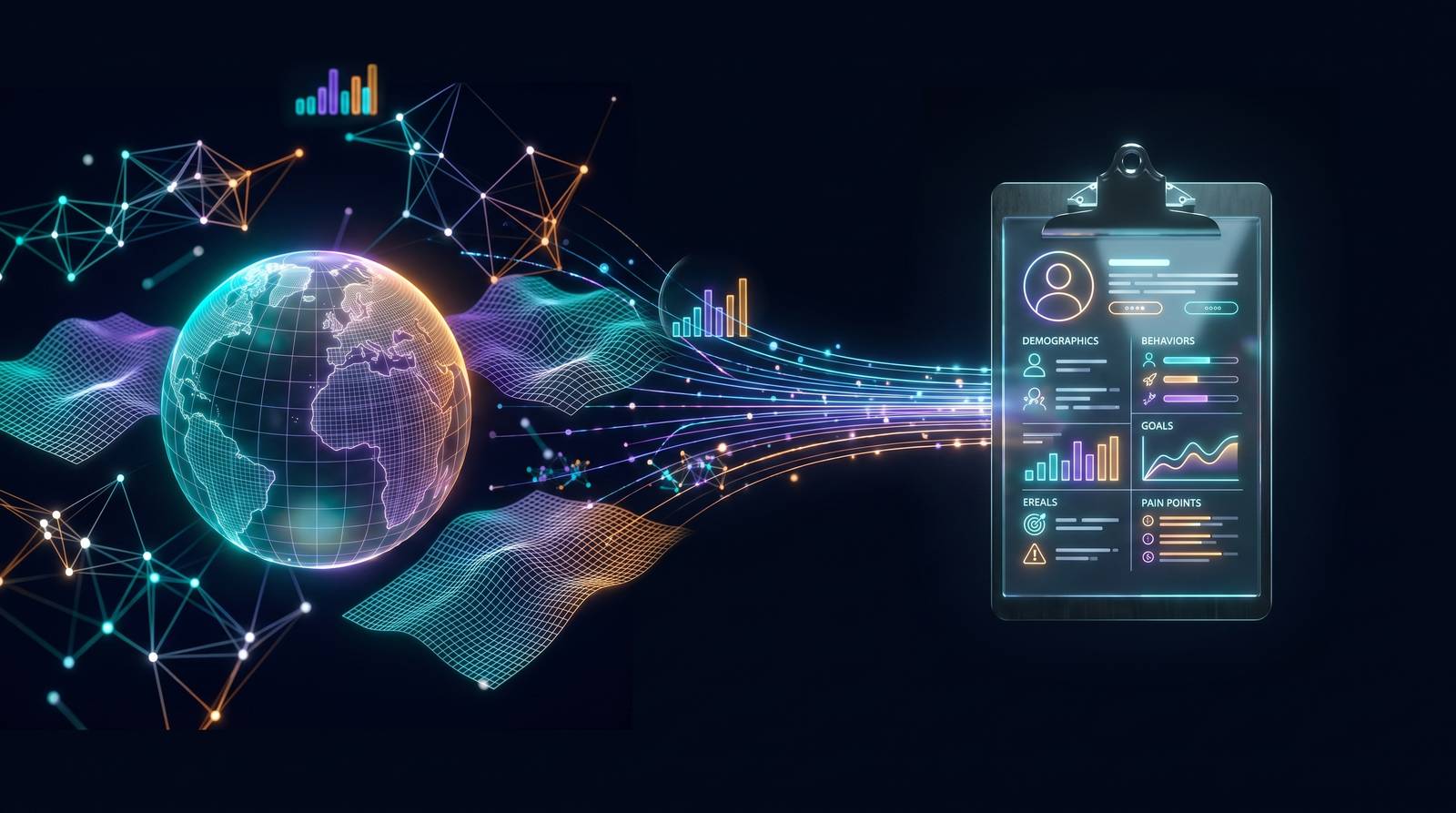
ICP research, done rigorously, contains four distinct layers of information. Most organizations only fully exploit one of them, and the cost of that neglect accumulates quietly until it shows up as a deal you can't close or a message that used to work and suddenly doesn't.
The first is the firmographic layer: company size, industry vertical, geography, revenue band, organizational structure. Teams know this layer well because it's the easiest to acquire and the easiest to put in a slide. For persona work, firmographic data establishes organizational context, the budget authority your persona likely holds, the procurement process they probably navigate, the risk tolerance their company's size and stage produce. A VP of Revenue Operations at a 200-person SaaS company operates inside a structurally different reality than the same title at a 5,000-person enterprise. That difference shapes everything downstream, including how they evaluate a vendor and who they need to convince before they can say yes.
The second is the technographic layer: the tools an account runs, their integration complexity, their general disposition toward adopting new technology. For persona work, technographic data maps to something psychologically significant. Someone who has spent three years inside a heavily customized Salesforce environment has built switching-cost sensitivity that a person on a lighter stack simply does not carry. That sensitivity shows up in objections, in evaluation timelines, in the proof types that build trust versus the ones that trigger defensiveness.
The third is the behavioral layer: buying signals, content consumption history, engagement patterns, prior vendor relationships. This is the most underused layer in most ICP research, partly because it requires more sophisticated data infrastructure to collect and partly because it doesn't compress neatly into a spreadsheet column. For persona work, it maps directly to how a person actually seeks information when they're trying to make a decision. Where do they go? What do they read, watch, or forward to a colleague at 7 PM? Behavioral data answers those questions in ways that self-reported survey responses rarely can, because it captures what people do rather than what they claim to value — and those two things diverge more than most marketers want to admit.
The fourth is the pain-point layer: the business problems that qualified the account for the ICP in the first place. This is the layer most naturally associated with persona work, but the translation from account to individual is not automatic and it is not trivial. "We have high customer churn" is an organizational problem. Converting that into persona territory means identifying who inside that account feels that pain most acutely, what it costs them specifically, and what they fear will happen if it persists. That conversion is the actual work of persona development.
The quality ceiling on your persona document is set by the quality of your ICP research. Shallow inputs produce shallow personas, and no amount of persona-document craftsmanship reverses that.

Identifying Which Roles Inside the Target Account Need Their Own Persona
B2B purchases involve buying groups, not individual buyers. The composition varies by deal size, industry, and organizational structure, but the pattern holds: multiple people with meaningfully different agendas influence the decision, and messaging that tries to address all of them at once resonates with none of them.
The practical starting point is mapping the typical buying group inside your ICP-fit accounts. Who initiates the conversation? Who evaluates technical fit? Who controls the budget? Who has the informal authority to block or champion without ever appearing in a formal approval chain? Each role that influences the decision in a distinct way warrants its own persona document.
A useful working heuristic: if two roles would respond to different messages, use different channels, or weigh different criteria when evaluating a solution, they need separate treatment. Applied honestly, that test usually surfaces at least four distinct personas in a typical B2B buying group. The economic buyer, who prioritizes ROI and organizational risk. The technical evaluator, focused on integration reliability and implementation complexity. The end user, whose primary concern is what the solution does to their Tuesday. And the internal champion, whose motivation is often as much about their own credibility inside the organization as it is about the solution itself. These are not interchangeable, and blurring them into a single composite profile produces a document that is technically complete and operationally useless.
Resist the pull toward building ten personas because your deal involves ten stakeholders. Most organizations can activate three to five with genuine discipline. Beyond that, the documents become shelf artifacts. Prioritize the roles where your deals most frequently stall or accelerate. Your closed-won and closed-lost data is the right input for that prioritization, not intuition about who is important in the org chart.
Moving from Account-Level Pain Points to Individual Psychological Drivers
Account-level pain points are organizational abstractions. "Inefficient revenue operations" describes a system. It says nothing about a person, and it cannot tell you what that person is afraid of, what they want to be recognized for, or what a bad Tuesday actually looks like for them when the problem is particularly acute.
The conversion question is: who inside this account feels this problem most acutely, and what does it cost them specifically?
Personal stakes operate on two tracks simultaneously. The professional track covers missed targets, delayed projects, loss of credibility with leadership, a scope of influence that quietly shrinks. The emotional track covers the anxiety before a difficult board conversation, the low-grade frustration of watching a project fail for the third time, the desire for recognition that comes with solving something others dismissed as unsolvable. Both tracks are real. Messaging that addresses only the professional track often slides off, because it's solving a problem the persona has already mentally filed under "organizational challenge" rather than "my problem."
Motivations are layered in ways that require excavation rather than inference. The stated goal, "we want to reduce churn," sits above a professional goal, "I need to hit my retention KPI this quarter," which sits above something more exposed: "I cannot go into another leadership review with this number." Each layer is real. They respond to different messages, different proof types, different moments in the sales cycle. Content that speaks only to the surface produces agreement without movement.
Aspirations matter as much as frustrations, sometimes more. What does this person look like when they win? What does success do for their career trajectory, their team's reputation, their relationship with the executive who hired them? The best persona work doesn't just describe someone's pain. It describes who they are trying to become, which is what allows you to position a solution as identity-confirming rather than merely problem-solving.
The Research Methods That Surface Psychological and Behavioral Data at the Individual Level
No single method covers all the terrain. The strongest persona foundations come from deliberate combination, not from choosing one approach and scaling it until it feels sufficient.
Qualitative interviews remain the highest-fidelity source available. The goal of a well-run interview is not to confirm what you already believe. It's to encounter something you didn't anticipate: the off-script frustration, the priority you hadn't modeled, the way a person frames a problem that reorients your understanding of what they actually care about. Open-ended questions, probing follow-ups, and the discipline to let silence sit without immediately filling it — these are the conditions that produce genuinely useful data. If every interview ends exactly where you expected it to, the guide is too rigid.
The most productive subjects are recently closed customers, both won and lost, churned customers, and deals that stalled without a clear resolution. Closed-won accounts tell you what resonated. Closed-lost accounts tell you where your model was wrong. Churned customers tell you where the promise and the reality diverged. Stalled deals reveal what triggers inertia in the specific people you're trying to reach — inertia that is usually not confusion or disinterest, but competing priorities, internal misalignment, or the absence of someone willing to advocate internally.
AI-moderated interview agents have changed the economics of qualitative research in ways worth acknowledging plainly. They can run the full interview loop at a scale and cost that human-moderated research typically cannot match, which widens the evidentiary base for persona claims considerably. Teams that previously ran fewer than a dozen interviews per research cycle can now run substantially more. Platforms like Respondent handle recruitment infrastructure; Qualtrics covers structured survey components; a growing number of purpose-built AI research tools have entered this space. One caution applies consistently: AI interviewers are structurally inclined to surface the representative answer and suppress the anomalous one. The outlier, the respondent who frames things in a way that doesn't fit the pattern, is often exactly where the most useful signal lives. Human review of raw transcripts is not optional.
Synthetic panels, panels of AI-generated respondents calibrated to ICP-fit profiles, can rapidly test directional hypotheses about persona priorities. They're useful for concept validation and message ranking. They are not suitable as the primary source for psychological depth, particularly in genuinely novel product territory where the thing you're trying to discover is something you couldn't have modeled in advance.
Behavioral data from CRM records, sales call recordings, and content engagement analytics provides a ground-truth layer that self-reported data consistently misses. What personas actually do in an evaluation process often diverges from what they say they value. The divergence between those two signals is usually where the most actionable insight lives.
Structuring the Persona Document Itself: What Goes In, What Stays Out, and Why
A persona document that tries to contain everything becomes a reference artifact that nobody reads, which means it influences nothing. The discipline of building a useful persona is fundamentally editorial; the value is in what you cut as much as what you keep.
Six sections earn their place.
Role and context covers title, core responsibilities, key performance metrics, and reporting relationships. This is the organizational frame that shapes everything else. A persona's behavior inside a buying process is downstream of their position inside a structure, and that structure is worth documenting plainly.
Goals and motivations articulates what this person is genuinely trying to accomplish, professionally and personally, and what success looks and feels like for them. This section should reflect the layered motivation structure described earlier, not just the surface objective. If it reads like a job description, it's not doing its job.
Frustrations and fears captures daily friction, feared outcomes, and the organizational pressures that make a person receptive to change. Specificity is what makes this section useful. "Frustrated with lack of visibility" is inert. "Spends two hours before every QBR reconciling numbers across three systems and still can't fully trust the output" is something a salesperson can actually work with.
Decision-making behavior describes how this person evaluates options: who they consult, what evidence they trust, what proof types move them, and what triggers stalling. This section is the one most directly connected to sales process design, and it tends to be where the clearest gaps appear when the research wasn't deep enough.
Information sources and channels documents where this person goes to learn, who they consider credible, and what content formats they actually engage with. This feeds channel strategy directly and prevents considerable wasted distribution effort.
Value triggers and objections captures what language, framings, and proof types reliably move this persona, and what reliably loses them. It is the most operationally direct section in the document and, in my experience, the most neglected. Sales teams would trade three persona documents with rich fictional backstories for one that gets this section right.
What stays out: fictional backstories, demographic details not causally connected to buying behavior, aspirational lifestyle descriptions borrowed from B2C persona templates. These create the feeling of richness while degrading utility. Every claim in the document should trace back to a source: an interview quote, a behavioral data point, a validated pattern. Undocumented assertions erode trust in the document over time and make updates harder to defend. If it reads like a creative brief, it won't survive contact with a sales team.
Connecting Persona Attributes Back to the ICP to Catch Inconsistencies Before They Reach the Field
Persona documents and ICP definitions are usually developed somewhat separately, often by different people, on different timelines, from different data sources. That separation produces a specific failure mode: the attributes described in the persona don't actually coexist with the account characteristics defined in the ICP.
A common version of this: the ICP targets mid-market companies with lean engineering teams, but the persona document describes a technical evaluator with deep procurement infrastructure and a formal RFP process. Those attributes don't live in the same account type. When that inconsistency reaches the field, it produces sales conversations that feel slightly off in ways that are hard to diagnose, because the rep is working from an internal model that was never reconciled against itself.
The consistency check is methodical. Take each substantive persona attribute and run it against the ICP's firmographic, technographic, and behavioral constraints. Does the decision-making process described in the persona match the organizational structure typical of ICP-fit accounts? Does the budget authority implied in the persona match the revenue and headcount band of the ICP? Do the technology preferences and switching-cost sensitivities align with the technographic profile of accounts that actually close?
Inconsistencies, when you find them, usually signal one of two things: the ICP is underdefined in that dimension, or the persona research drew too heavily on accounts that don't actually fit the ICP. Both are fixable. Neither is visible until you run the cross-check explicitly, which is a low-cost step that teams routinely skip because it feels like administrative overhead rather than research.
This process also surfaces gaps: dimensions of the persona for which no corresponding ICP data exists. Those gaps become explicit research questions rather than silent assumptions.
Turning a Static Persona Document into Something That Updates as the Market Moves
A persona document built from research conducted two or three quarters ago is a description of a past buyer. Markets shift, buyer priorities evolve, and the organizational pressures that made your solution compelling in one environment look entirely different when the macro conditions change. The document that was accurate at its creation date becomes progressively less accurate with no visible warning.
The structural flaw in traditional persona projects is that they are discrete engagements with a defined start, a defined end, and a deliverable that sits largely unchanged until someone in the field notices something is off. By that point, the divergence has usually already cost something — a campaign that didn't convert, a deal that stalled in a way the persona didn't predict, a message that used to work and now just sits there.
The signals that a persona needs updating are recognizable if someone is watching for them: sales team feedback that consistently contradicts the persona's predictions, new objections appearing that the document doesn't account for, visible shifts in the types of accounts that are closing versus stalling. None of these require a formal research project to notice. They require someone whose job includes noticing them, which is a structural question as much as a capability one.
AI-moderated interview tools, synthetic panel validation, and behavioral analytics can generate persona-relevant signals on a rolling basis rather than in periodic research projects, compressing the feedback cycle and making more frequent updates practical rather than aspirational.
A practical operating model: treat the persona document as a living brief with an explicit version history. Each update notes what changed, what evidence drove the change, and when the next scheduled review is. This is not bureaucratic overhead. It is what separates a document people trust from one they have silently stopped consulting.
The teams that maintain persona fidelity over time are not necessarily those that commissioned the most thorough initial document. They're the ones that built the research habit into their operating rhythm, so the first version of a persona is understood as a starting point rather than a completed deliverable.