Keeping an ICP Current with Continuous Research
Continuous research catches market shifts before they crater your revenue.

Drift is rarely dramatic. It accumulates in signals that are easy to rationalize away one at a time, which is precisely what makes it dangerous.
Win rates start dropping in a segment that used to be reliable. Onboarding friction rises without a product change to explain it. Sales cycles lengthen as the nature of objections shifts. Churn clusters in accounts that fit the profile perfectly on paper. Each signal arrives with a plausible alternative explanation, and teams pursue the alternative explanation first. That's the trap, and most teams walk into it repeatedly before they recognize the pattern.
The structural problem is lag. Most of these signals surface in revenue data weeks or quarters after the underlying customer reality has already changed. By the time the numbers are conclusive, the gap between the ICP and the actual buyer has been compounding for months. You're diagnosing a condition that's been progressing since before anyone thought to look — like a doctor reading last year's X-ray to treat this year's fracture.
Certain external triggers accelerate drift faster than others. A new market entrant can reshape buyer expectations almost overnight, turning what your best customers once considered a differentiator into a baseline expectation. Macroeconomic shifts change who controls budget inside customer organizations, which changes which objections dominate and which value propositions actually land. Regulatory changes hit specific verticals suddenly and hard. Demographic and cultural shifts move a segment's priorities in ways that feel gradual until, one quarter, they don't.
The teams that miss these signals share one structural condition: no research is happening between major cycles. There is no mechanism to catch the signal before it becomes a revenue problem.
Why Traditional Research Cycles Are Structurally Too Slow to Catch Drift in Time
A standard customer study takes six to twelve weeks and costs tens of thousands of dollars once you account for recruitment, sessions, analysis, and executive-ready output. That timeline isn't a failure of execution. It's how the process was designed, because traditional research was built as a periodic, high-investment event, not a continuous signal.
Survey design and approval, panel recruitment, fieldwork, analysis, and reporting each consume weeks in sequence. Research teams that have adopted AI tooling are cutting those timelines by as much as eighty percent. That number is instructive: if you can eliminate eighty percent of the timeline without eliminating the thinking, then most of the traditional process was structural overhead.
Budget compounds the problem. When a single engagement approaches the cost of a full agency retainer, teams ration their research spending. One or two studies per year becomes the norm. At that cost, the research calendar becomes a political negotiation rather than an operational rhythm, and the ICP gets updated when someone can justify the budget, not when the market actually moves.
Inside the gap between studies, product decisions get made against untested assumptions. Messaging gets locked before the underlying audience shift is visible. Sales and CS teams accumulate anecdotes that never get synthesized into the ICP. The deeper problem is what slow research does to team behavior over time: they stop asking. Not because they're incurious, but because asking feels pointless when the answer takes three months and a budget cycle. The ICP stops being an instrument and becomes a historical record, consulted less and less until someone finally admits it no longer describes the customers they're actually closing.
What a Continuous Research Cadence Actually Requires
Continuous research is not running the same study more often. It is restructuring the relationship between a question and an answer, and that requires different habits more than different tools.
A working cadence has four components. Trigger-based studies tie specific business events to targeted ICP checks: a new segment entry, a pricing change, a product launch should each automatically prompt a focused examination of whether the ICP holds in the new context. Pulse interviews are lightweight, recurring qualitative sessions with current customers and near-misses, not full studies, just enough signal to detect movement before it becomes a revenue problem. Ongoing win/loss research structures the debrief of every material deal outcome and synthesizes findings into the ICP rather than leaving them buried in a CRM field. Periodic full-panel refreshes, run quarterly or semi-annually, stress-test the accumulated behavioral model against new primary data.
Ownership is where most continuous research efforts actually break down. Product, marketing, and sales each maintain their own version of the ICP in isolation, and the three versions diverge quietly until someone is in a room and realizes they're describing different customers. A working model has a single shared artifact and a named owner, typically in product marketing or product management, with standing authority to call for a pulse study without a budget approval cycle. That last part is non-negotiable; if every research request requires a new budget conversation, the cadence will not survive contact with a busy quarter.
The research questions that matter most at each stage are specific: whether the jobs-to-be-done the ICP was built around are still the primary motivators for closed-won accounts, whether the language best customers use to describe the problem has shifted, whether firmographic and psychographic attributes of recent wins are drifting from the written profile, and which objections are new versus which have quietly disappeared. These questions are not exotic. Most teams can generate them in an afternoon. The discipline is asking them on a schedule, not just when revenue signals make the need undeniable.
How AI-Moderated Interviews and Synthetic Panels Enable the Cadence at Scale
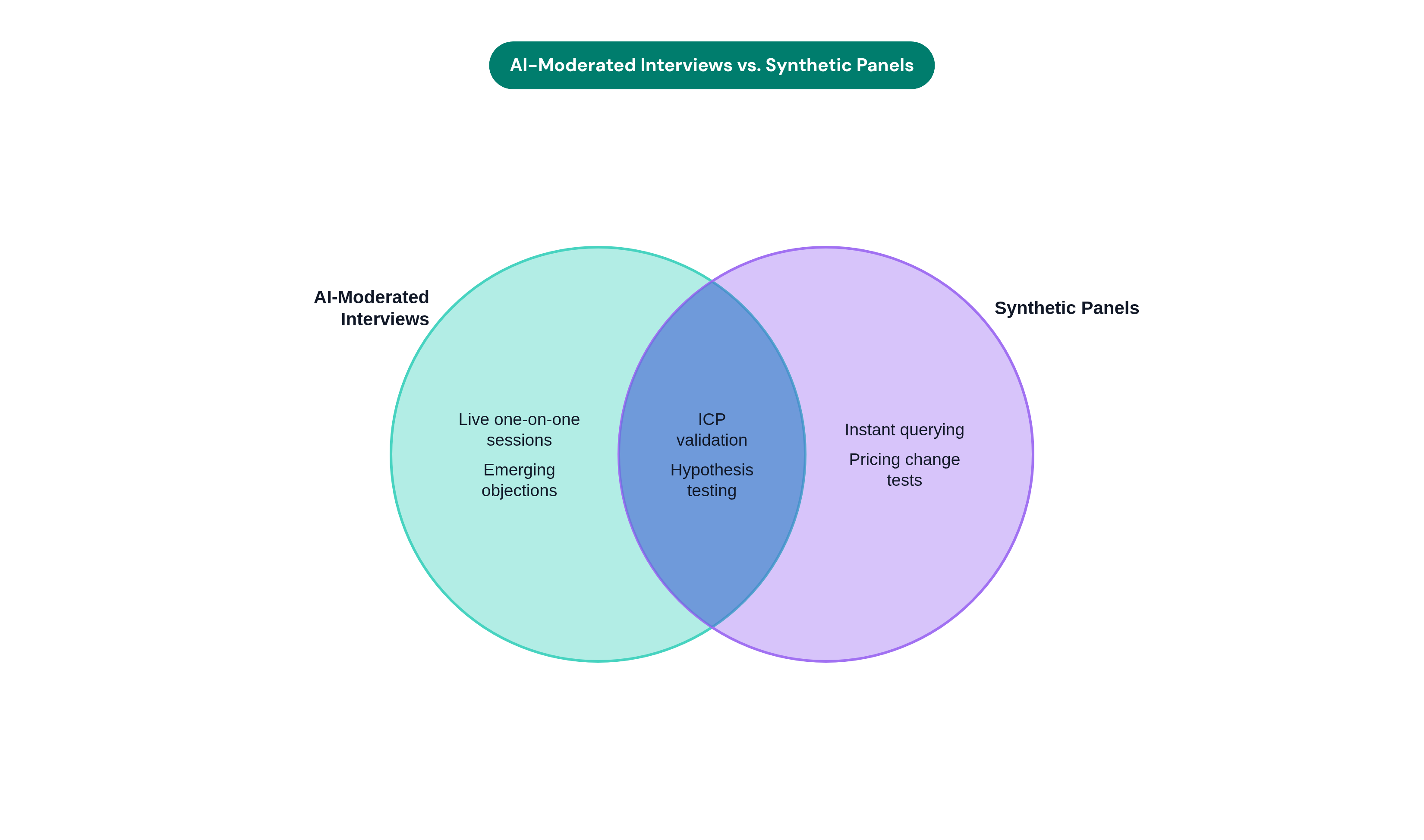
The cadence described above was genuinely impractical with traditional methods. The economics didn't support the frequency, so most teams never built the habit.
AI-moderated qualitative interviews use voice and chat agents to conduct live one-on-one interviews, ask open-ended questions, pursue contextual follow-ups, and adapt across demographic contexts. The Quirk's 2025 Researcher SaaS Report puts the all-in cost at roughly twenty-two dollars per completed conversational interview, though I'd treat that figure as directionally useful rather than precisely reliable across every context and vendor. What it points to is a real structural shift: at that cost, pulse interviews become a standing operational practice rather than a budget event. The same report found that sixty-nine percent of researchers now use AI in at least some projects, a nineteen-point year-over-year increase, with sixty-three percent reporting faster turnaround.
Synthetic consumer panels operate differently. They are AI-generated personas constructed from real-world datasets: historical survey responses, behavioral data, customer reviews, public opinion trends. Rather than recruiting new respondents for each question, a calibrated synthetic panel can be queried immediately against new hypotheses. A 2024 study co-authored by researchers at Stanford and Google DeepMind found that AI digital twins replicated human survey answers with eighty-five percent accuracy across more than a thousand participants. The calibration step is what earns that result; generic generative AI prompts without calibration perform materially worse. The same 2025 GreenBook GRIT Report found that concept-to-signal cycles shrink from four to eight weeks down to hours with calibrated synthetic audiences.
The two methods complement rather than compete. Synthetic panels handle high-frequency, directional questions: testing whether a new ICP hypothesis holds before investing in primary research. AI-moderated human interviews handle the qualitative layer, capturing language, emerging objections, and behavioral nuance that synthetic panels can only derive from historical patterns. Full human panel studies run at the periodic deep refresh, grounding the model in current primary data and retraining the synthetic layer against it.
This combination also unlocks hard-to-reach segments. Senior executives, specialists in specific verticals, respondents in markets where panel recruitment takes months: these audiences can be simulated immediately and then validated with targeted real interviews rather than waiting on recruitment timelines.
The Real Limit of Synthetic Data in ICP Work, and How to Work Within It
Synthetic data has real limits. Understanding them precisely is what separates practitioners who use it well from those who discover the constraints the hard way.
MIT Sloan researchers have noted that a language model given a demographic persona produces a response representing the weighted mean of everything the model has learned about that group. Thematically coherent, historically grounded, but not a genuine individual insight. If you're trying to discover something genuinely new rather than validate something you already suspect, that distinction matters a great deal.
The empirical boundary is particularly pronounced for novel products. A Marketing Science study found only a low correlation between synthetic and real responses for truly novel offerings, specifically non-sequels and non-extensions where there is no historical behavioral pattern for the model to learn from. BCG has articulated the use-case boundary more plainly: synthetic panels can predict the impact of pricing changes, gauge product-assortment fit, and test marketing claims with useful accuracy. They cannot reliably stand in for real consumers when the product idea is genuinely new. The synthetic model cannot reveal what it hasn't learned, and that's not a deficiency so much as a definitional constraint.
For ICP maintenance specifically, the implications are practical. Validating and stress-testing an existing ICP against incremental changes is well-suited to synthetic panels. Detecting early signals of demographic or behavioral drift within a known segment works if the model has been trained on recent real data. Discovering entirely new customer segments the ICP hasn't yet described requires real respondents.
The adoption and trust gap is also worth naming honestly. The 2025 GRIT Report found roughly forty percent of consumer insight leaders have implemented synthetic data, but reported satisfaction among brand-side practitioners is low. The gap is largely a calibration problem. Practitioners who complete calibration report satisfaction in the high eighties. The technology works when it is set up correctly, and most of the frustration in the field traces back to teams who skipped that step.
Use synthetic panels to accelerate hypothesis testing and reduce the cost of high-frequency pulses. Use human interviews to anchor the model in current reality and catch what the training data doesn't yet contain.
Building the ICP as a Reusable Behavioral Model Rather Than a Recurring Deliverable
A deliverable produces a document. A behavioral model produces infrastructure. One compounds returns; the other compounds staleness — and most teams are unknowingly running the second one.
A behavioral model contains things a document doesn't. A trained synthetic panel representing the target audience, queryable against new decisions without re-recruiting. A version history showing how the profile has changed over time and which research triggered each update, so future teams aren't left guessing whether the ICP reflects what customers said last year or three years ago. Tagged qualitative threads from ongoing interviews, specifically language shifts, new objections, and emerging motivations that inform the quantitative profile. Explicit confidence ratings by segment attribute, marking which parts of the ICP are strongly supported by recent data and which are aging and overdue for refresh.
Each research cycle in this model doesn't restart from zero. It retrains and refines an existing model, so accuracy improves over time rather than resetting with each study. BCG research found that synthetic panels can predict actual consumer choices with accuracy in the low nineties given disciplined iteration over time. That kind of accuracy doesn't come from a single well-designed study; it accumulates through consistency.
The practical output is a team that can interrogate a segment assumption before a pricing meeting, pressure-test a messaging hypothesis before a campaign brief, and examine a new-market hypothesis before a board presentation, all against the same continuously maintained audience model.
What Teams Need to Change Organizationally to Maintain the Cadence
The technology is fast enough and cheap enough. The constraint is organizational behavior, and it has been for a while.
Ownership is the first thing to solve. When no one is explicitly accountable for ICP currency, it stays current only when someone notices it's wrong, which is always too late. A named owner, a single shared artifact, a quarterly review ritual: those three things are not complicated, but they require someone with enough organizational authority to actually hold the line when a busy quarter creates pressure to defer. The quarterly review doesn't need to be a full research project. A structured thirty-minute examination of confidence ratings, flagging which attributes are aging and what trigger-based study is due, is enough to keep the system honest.
The habit shift is linguistic before it is operational, and I don't mean that as a soft observation. Moving from "we need to do an ICP study" to "we need to run the Q3 ICP pulse" signals something real about whether the cadence has taken hold. Project framing implies a beginning and an end. Maintenance framing implies a function that continues whether or not anyone calls a meeting about it. Teams that haven't made that linguistic shift usually haven't made the behavioral one either.
After twelve months of continuous maintenance, what good looks like is specific. The ICP has version history: the team can show how a specific segment's motivations shifted and name the research that surfaced it. New product and campaign decisions get tested against the behavioral model before commitment rather than after launch. The team can answer "who is our customer today" with evidence dated within the last sixty days.
The cumulative advantage isn't only better data. It's the operational confidence that comes from knowing the data is current, knowing it reflects what actual buyers told you last month, not what they said during a study that felt urgent at the time and then got filed away. That confidence is specific and earned, and it only accrues to teams that built the system deliberately rather than waiting until the revenue signals made the gap undeniable.