ICP Definition for Expansion into New Geographic Markets
Rebuild your ICP's hidden layers when entering new markets, not just the firmographics.

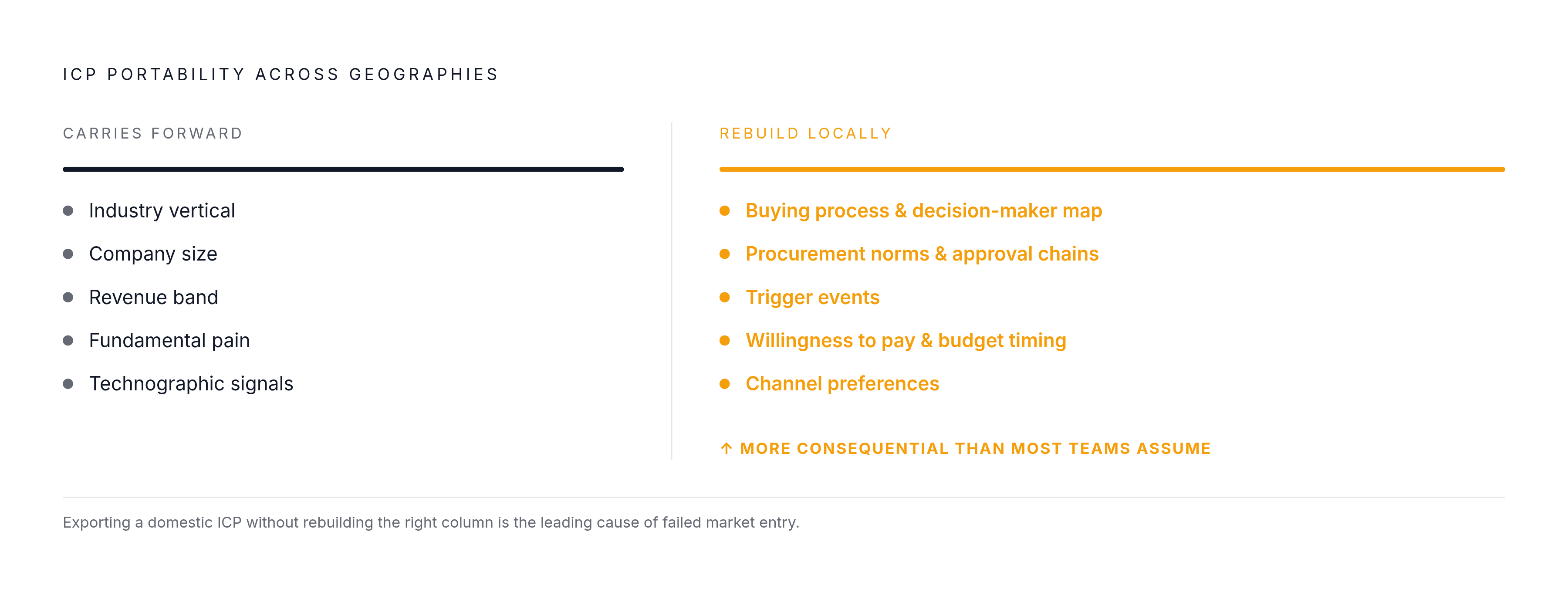
The ICP is a layered construct, not a flat profile. At the outer shell sit firmographics: industry vertical, company size, revenue band. Beneath that live the behavioral, cultural, and contextual layers that actually explain how a buyer makes a decision, what triggers the search, and what convinces them to commit. The failure mode in geographic expansion is treating the shell as the whole thing, exporting it intact, and then misreading weak conversion as a demand problem when it's really an ICP mismatch.
The shell often travels. A mid-market manufacturing software company in Germany looks firmographically similar to one in the United States. Same employee count, same vertical, comparable revenue. That similarity is real. Carry it forward. The fundamental pain the product solves is durable too, provided the structural problem actually exists in the new market at all. Technographic signals can survive the crossing as well, though dominant tech stacks and local vendor ecosystems vary by region in ways that quietly invalidate assumptions baked into a domestic profile.
What almost never carries forward without rebuilding is everything underneath the shell.
The buying process and decision-maker map are locally determined. Procurement norms, committee structures, and approval chains differ significantly across markets. The influence hierarchy in a Japanese mid-market firm operates on entirely different logic than one in Brazil or the Netherlands. Trigger events, what causes a company to begin actively searching for a solution, vary with local economic conditions, regulatory environment, and competitive pressure. Willingness to pay and budget cycle timing are shaped by fiscal year conventions and pricing expectations that have no domestic analogue. Channel preferences dictate where buyers discover, evaluate, and vet vendors, and that is profoundly market-specific.
There is also a connectivity layer that domestic ICP construction almost never surfaces. As of 2024, 5.5 billion people are online globally, but 2.6 billion remain offline, and the urban-rural internet usage gap runs from over 80% in urban centers to under 50% in rural areas. A digital-first go-to-market model embedded in a domestic ICP doesn't automatically transfer to a growth-market geography. That gap is a structural constraint, not an edge case, and treating it as one is how teams burn entry budgets without understanding why.
The practical output of this audit is a two-column map: confident carry-forward on one side, needs local evidence on the other. That map becomes the research brief for everything that follows.
How to gather the local evidence your rebuilt ICP requires
The discipline here is working from the highest signal downward. Not treating all evidence as equivalent.
Existing customers in or adjacent to the target region are your first stop. A closed-won CRM analysis filtered by geography, even from a small sample, is higher signal than any secondary research. If the company has sold into the region, even incidentally, those deals contain behavioral data that no report can replicate.
Direct local research comes next: interviews with in-market buyers and non-buyers, input from local partners or resellers, sales cycle data from any pilot activity. Qualitative interviews in a new geography need to surface questions that domestic interviews never needed to ask. Who else is involved in the buying decision and what role do they play? What vendors are buyers currently using, and why? What does a foreign vendor need to demonstrate to earn trust? How are budgets set, and when do purchasing windows actually open? That last question, asked earnestly and without leading the respondent, will surface fiscal year dynamics, approval threshold norms, and purchasing committee structures that no secondary source will hand you.
Market-level secondary intelligence comes last: industry reports, regulatory filings, job postings read as proxies for technology adoption and growth stage. This tier is accessible quickly and can sharpen the right questions for higher-signal research. It should inform your thinking, not substitute for primary evidence.
The hard-to-reach problem is real. Local C-suite contacts in niche verticals, rural segments, and emerging markets are slow and expensive to recruit through traditional channels. That constraint is not a reason to skip primary research. It is a reason to complement it.
AI-enhanced behavioral clustering offers a supplementary lens worth taking seriously. These tools can cluster localities by actual buyer behavior rather than administrative boundaries, revealing that a mid-size city with lower competitive density and unmet demand sometimes outperforms a major metro that looks more obvious on a map. One warning: AI-powered ICP tools that draw only on public data rarely capture willingness to pay, budget cycles, or procurement realities. Those dimensions require primary evidence and cannot be reliably inferred from firmographics alone.
Where synthetic consumer panels accelerate geographic ICP validation
The specific bottleneck that synthetic panels solve in geographic expansion is recruitment. Assembling a representative local sample, especially from niche segments like C-suite executives in a specific vertical or small-business owners in emerging markets, traditionally consumes a disproportionate share of a research project's total time. Teams move to market before they have the local behavioral data they need because waiting for traditional panels is incompatible with expansion timelines. That's the real problem synthetic panels address.
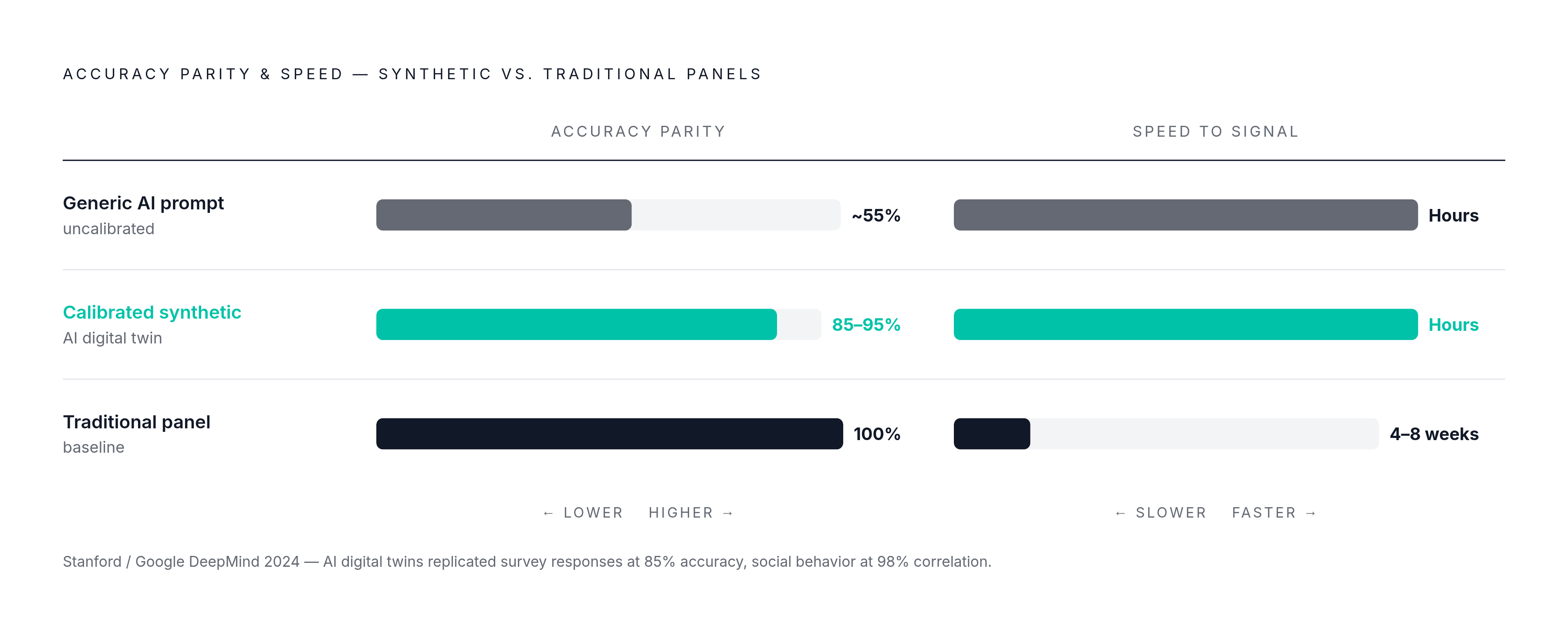
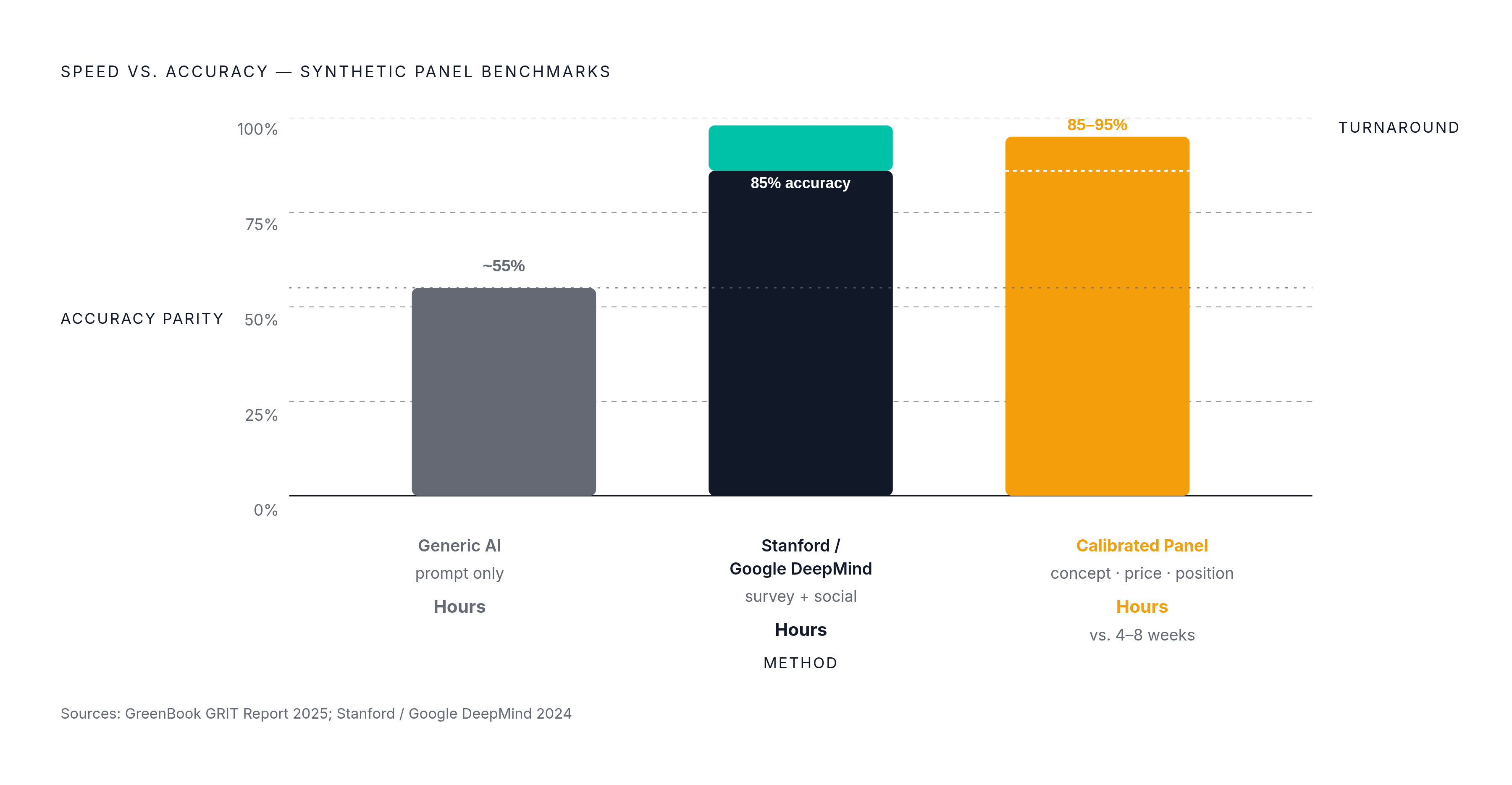
Calibrated synthetic panels are AI-generated personas constructed from real-world datasets: historical survey responses, behavioral data, customer reviews, public opinion trends. They are not random fabrications. A 2024 study conducted by researchers at Stanford and Google DeepMind, using over 1,000 participants, found that AI digital twins replicated human survey responses with 85% accuracy and social behavior with 98% correlation. Calibrated commercial panels have demonstrated 85 to 95% parity with real panels on concept, pricing, and positioning tests.
Generic generative AI prompts perform far less reliably, closer to 55% parity. And for genuinely novel products with no prior category analogues, research published in Marketing Science found only a weak correlation between synthetic and real responses. Synthetic panels work when they are grounded in real local data. Running them cold produces unreliable results.
The speed differential is the practical argument. According to the 2025 GreenBook GRIT report, concept-to-signal cycles that require four to eight weeks with traditional panels take hours with calibrated synthetic audiences. That difference is the gap between committing resources before you know and committing resources after. Anyone who has watched a market entry stall while waiting on panel recruitment understands why that matters.
For geographic ICP work specifically, synthetic panels are well-suited to several tasks: simulating how a target segment responds to a value proposition before running a pilot; testing localized pricing tiers to surface willingness-to-pay ranges; modeling cultural messaging variants to assess whether positioning that works domestically lands differently when country-of-origin framing shifts; exploring how a synthetic mid-market buyer in Southeast Asia weights vendor trust signals relative to one in Northern Europe.
Validation discipline is non-negotiable. Synthetic outputs should be benchmarked against any real human data available, even a small local interview set, and confidence intervals should be explicit. Bayesian validation techniques can surface deviations before they become expensive mistakes.
Platforms that combine a large verified human panel with a reusable synthetic layer address both requirements within a single research infrastructure. Seda, for instance, is an AI-powered customer research platform that accesses a panel of verified human respondents across 130+ countries, allowing teams to run initial local validation with real respondents and then extend that validation continuously through AI-conducted synthetic simulation. The practical benefit is avoiding the need to rebuild the research stack each time the expansion map extends to a new geography.
Building the geographic ICP as a living asset rather than a one-time document
The structural problem with treating geographic ICP work as a launch task is that consumer behavior moves faster than launch cycles. In a new market where the team has no accumulated baseline intuition, insights from even six months ago are functionally outdated by the time a sales team is operating at scale. There is no institutional memory to catch the drift.
A living geographic ICP has three components. First, a foundational behavioral model of the local target audience built from initial research. Second, a synthetic panel of that audience that can be re-queried against new product decisions, pricing changes, or messaging variants without re-recruiting. Third, a feedback loop from local sales and customer success activity back into the model. Closed-won and churned accounts in the new market update the geographic ICP the same way CRM analysis built the domestic one, except the information is richer because it carries local signal accumulated over time, not borrowed from a market you already know.
The compounding advantage here is calibration. Each research cycle adds precision. The first run of a synthetic panel in a new geography is exploratory. Subsequent runs are confirmatory, progressively more accurate as local behavioral data accumulates. That progression is where the asset actually accrues value. Teams with clearly defined and consistently maintained ICPs demonstrate meaningfully higher account win rates and stronger retention figures than those without. That finding comes from domestic research, but the underlying mechanism, precision targeting, applies with greater force in unfamiliar geography precisely because instinct cannot substitute for evidence when the market is new.
The organizational implication is ownership. Geographic ICP maintenance should reside with a team operating on a research cadence, not in a launch deck that sits unrevised after go-live. The document is not the asset. The research infrastructure behind it is.
A practical sequence for teams ready to act on a new geographic market
Start by auditing the existing ICP against the carry-forward and rebuild map. This takes a day and produces the research brief. It is not a strategic exercise; it is triage. The output is a clear list of what needs local evidence before any spend.
From there, run a rapid synthetic simulation of the target segment in the new geography. Test the domestic value proposition, pricing assumptions, and messaging against a calibrated local synthetic panel before committing real resources. The goal is surfacing the largest gaps, not achieving certainty. Certainty comes later.
Then validate and correct with local human respondents. Focus recruitment budget on the gaps the simulation flagged, not on a full re-study from scratch. Prioritize decision-maker interviews and pricing conversations; those two dimensions are most likely to determine whether the commercial model works in the new market.
Rebuild the ICP dimensions that failed the carry-forward test using the combined synthetic and human evidence. Update the decision-maker map, trigger events, channel preferences, and willingness-to-pay range. These are the dimensions that will determine whether the go-to-market motion lands.
Establish the feedback loop before launch. Instrument local sales activity so that early deal data flows back into the ICP model from day one. Define what signal would prompt a revision in the first six months, and set that threshold before anyone is in market.
What this sequence prevents is the most common and costly failure in geographic expansion: committing headcount, paid media, and localization investment to a market on the basis of a domestic ICP that has never been tested against local reality. When expansions fail, the absence of market fit is rarely evidence that the need doesn't exist. It's usually evidence that the team never confirmed who has the need, how they articulate it, and what would actually cause them to act.