Building an ICP Through Primary Consumer Research
Skip CRM data and talk to customers to build an ICP with real depth.

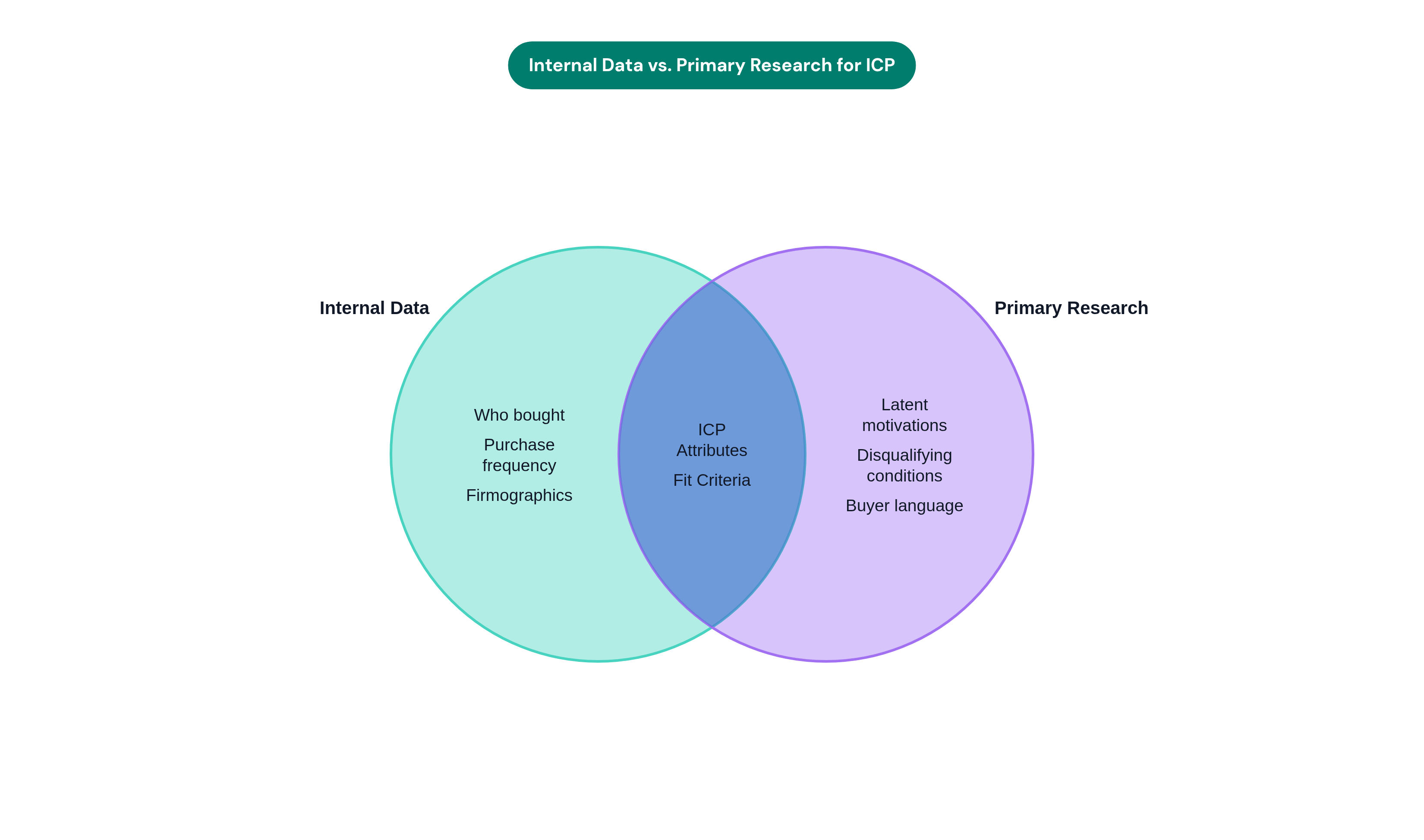
Internal data answers three questions well: who bought, how much, and how often. Everything else, the why, the almost-didn't, the job they were actually hiring you to do, lives somewhere your CRM is structurally incapable of reaching. That gap is where an ICP either gets its behavioral depth or stays a demographic sketch forever.
Here is what primary research surfaces that internal data never will. Latent motivations, meaning the chasm between what a buyer articulates on a sales call and what actually moves them to sign. Disqualifying conditions: the specific contexts where your product simply does not fit, which sharpen a profile through exclusion rather than expansion. The precise language customers use to describe their own problem, language you can lift directly into positioning without any translation. And the friction inside the buying process itself: who else shows up in the room late, what objections arrive after the demo, what competing internal priorities stall a deal right before it closes.
Primary research earns its place when it produces something uncomfortable. The respondent who describes a trigger condition nobody on the product team had ever named. The churned customer whose real reason for leaving contradicts the post-mortem narrative entirely. A single transcript can upend months of assumed positioning. It is also precisely where purely model-generated profiles hit a hard ceiling: a system trained to reproduce the most probable response will consistently suppress the outlier, which is frequently where the actionable insight lives.
The Four Research Questions an ICP Study Needs to Answer
Most ICP studies do not fail at data collection. They fail at synthesis, because the team gathered rich material across too many dimensions and cannot convert it into anything usable. The solution is to anchor the entire study to four questions before a single interview gets scheduled.
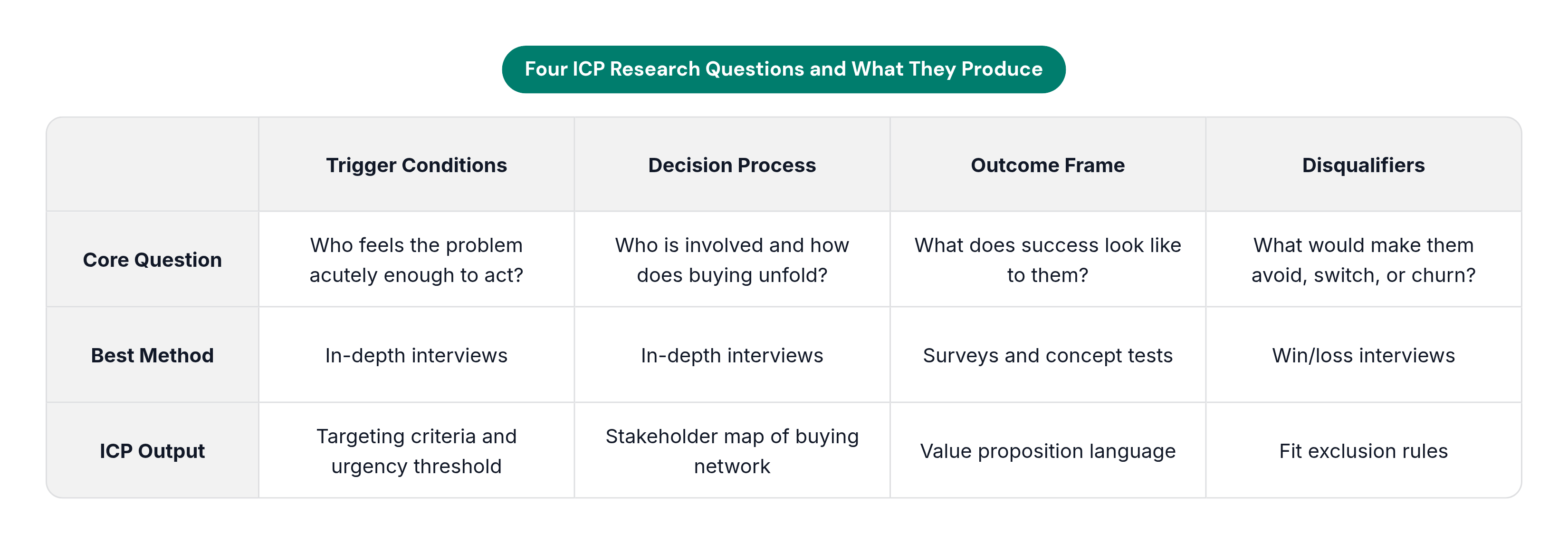
Who is experiencing the problem acutely enough to act? This defines trigger conditions and urgency threshold, the criteria separating someone genuinely in-market from someone who is casually aware of the problem and content to stay that way. What does their decision process look like, and who is actually involved? This maps the buying network, not just the end user, and is where the stakeholder complexity of modern B2B purchasing becomes visible in ways pipeline data never captures. What does a good outcome look like to them, and how do they measure it? This surfaces the value frame they will apply when evaluating your product against alternatives. And: what would make them avoid buying, switch, or churn? These disqualifiers and retention risks define the ICP's edges rather than its center.
Each question maps to something concrete on the other side of research. Trigger conditions inform targeting criteria. The decision process produces a stakeholder map. The outcome frame feeds directly into the value proposition. Disqualifiers become fit criteria and exclusion rules, the part most ICPs built from internal data are missing entirely.
There is a recruiting implication buried in the first question that teams consistently miss. Who experiences the problem acutely enough to act determines who should actually be in the study: not just current customers, but churned accounts, lost deals, and non-buyers who evaluated you and walked away.
Choosing the Right Primary Research Methods for Each ICP Question
No single method answers all four questions equally well. Forcing one method to do everything is how studies produce flat, unusable data. The choice follows what kind of data each question actually requires, and that requires some honest thinking about tradeoffs.
In-Depth Interviews
In-depth interviews, whether human-moderated or AI-moderated, are best suited to trigger conditions and decision-process mapping. These questions demand probing, follow-up, and the capacity to pursue an unexpected thread when a respondent says something that breaks the pattern. Traditional human-moderated interviews produce high depth but slow throughput, practical for five to fifteen participants. That is enough for initial pattern identification, not enough for the cross-segment confidence a full ICP study requires.
AI-moderated interviews preserve conversational depth, probe unexpected responses in real time, and generate synthesized transcripts automatically. They remove the per-researcher throughput ceiling without flattening the data. For teams covering multiple segments, geographies, or customer types simultaneously, that throughput advantage is often the difference between a study that gets done and one that stalls in scheduling.
Structured Surveys and Concept Tests
Surveys and concept tests belong to outcome priorities and disqualifying conditions. Measuring how many of your likely buyers rank a particular success metric as primary, and whether that distribution varies by company size or industry, requires quantification that interviews alone cannot provide. Surveys convert what interviews surface qualitatively into statistically defensible distributions. The two methods work in sequence, not in competition, and teams that treat them as interchangeable end up with data that is neither deep nor defensible.
Synthetic Consumer Panels
Synthetic panels are appropriate for early-stage hypothesis stress-testing: running a draft ICP against a simulated version of the target segment before committing to full recruitment. Well-calibrated panels trained on robust behavioral data can be predictive in ways that surprise people who have not used them seriously. But the accuracy figures circulating in vendor research describe best-case outcomes under optimized conditions. Independent replication is limited, and generic generative AI prompting sits well below whatever ceiling the best systems achieve. The quality of the underlying behavioral dataset matters as much as the tool itself.
The strongest use case is testing whether the ICP's assumed value frame holds across segments that are difficult or expensive to recruit at scale: hard-to-reach demographics, emerging geographies, niche verticals where a full recruitment cycle would take months. The important boundary is that synthetic panels reflect learned behavioral patterns. Novel market positions and entirely new product categories still require real-respondent validation; there is no shortcut around that.
Win/Loss Interviews
Win/loss interviews are the most underused high-signal method available. Churned accounts and lost deals reveal disqualifying conditions that current customers never surface, precisely because current customers already cleared the bar. These interviews should be a standing program, not a retrospective ritual run once a quarter when someone remembers to schedule them.
How to Recruit the Right Participants for an ICP Study
The most common failure in ICP research is not methodological. It is a recruiting problem. Teams pull from whoever is convenient, typically current happy customers and contacts already in the sales network, rather than the full population the ICP needs to describe. A profile built exclusively on current customers over-indexes on people who already converted, which means it describes who you sold to, not who you should be selling to. Those are meaningfully different populations.
A complete participant mix requires four cohorts. Current best-fit customers provide the clearest signal for what fit looks like when it is working. Churned customers reveal where the product stopped delivering on its implicit promise. Lost deals surface disqualifying conditions before they become post-sale problems. Non-buyers in the target segment test whether the pain the ICP assumes is real or something the team projected onto the market because it was convenient to believe.
Recruitment timelines for hard-to-reach segments can stretch to weeks per cohort using traditional methods, and cost per completed interview rises sharply for niche verticals, specific job functions, or international markets. Verified panels with demographic depth compress recruitment from weeks to hours for standard segments and open access to audiences that would otherwise require specialist recruiters with long lead times. That compression is worth paying attention to when a study is trying to cover four distinct cohorts simultaneously.
For early-stage ICP work, a smaller, well-recruited sample spanning all four cohorts outperforms a larger convenience sample drawn only from current customers. Representativeness matters more than headcount.
Structuring the Interview Guide to Produce ICP-Usable Data
A poorly structured interview guide produces the wrong kind of data. Participants describe feature preferences and satisfaction levels instead of the triggering context, decision dynamics, and outcome frames the ICP actually needs. The guide structure determines whether a session generates usable behavioral data or an elongated product review.
Open with the trigger, not the product. Something like: "Walk me through what was happening in your work when you first started looking for a solution to this problem." That question surfaces context, urgency, and the conditions that pushed someone into active consideration. Starting with the product gets you opinions. Starting with the trigger gets you a story, and stories are where the usable behavioral signal lives.
Map the decision process as a narrative, not a checklist. Who was involved at each stage, and what was each person's primary concern? What almost stopped the purchase? What tipped the final decision? A checklist approach here obscures the buying-network complexity that actually determines whether a deal closes. The messy, non-linear version of how decisions actually get made is more useful than any tidy framework.
Probe the outcome frame in the participant's own language. "What would success look like six months from now?" produces usable data. "What features matter to you?" produces a wishlist. Capturing verbatim language is as important as capturing the underlying logic, because those phrases go directly into positioning without requiring translation.
Close with the disqualifier probe. For churned and lost participants: "What would have had to be different for this to have worked?" For current customers: "What would cause you to stop using this?" These questions produce the exclusion criteria that most ICPs built from internal data are missing entirely, and they are almost always the most revealing part of the session.
AI-moderated interview platforms can execute this structure autonomously, probe unexpected answers in real time, and synthesize findings across dozens of sessions simultaneously. Synthetic Users is one platform built to operate within this kind of structured research framework, combining real-respondent depth with the throughput that multi-segment ICP studies require.
Synthesizing Interview and Survey Data into a Working ICP
The synthesis problem is consistent across organizations: rich qualitative material accumulates, there is no clear protocol for converting it into structured attributes, and the data sits in transcripts while the profile never gets built. Three discrete passes, each with a different objective, resolve this.
The first pass is pattern tagging. Across all transcripts and survey responses, tag recurring themes against the four ICP questions: trigger, decision process, outcome frame, disqualifiers. This pass is indexical, not interpretive. AI synthesis tools handle it efficiently across large transcript sets, auto-clustering themes and surfacing frequency counts. That frees researchers to apply judgment where it actually matters, which is not in the tagging.
The second pass is segmentation. Do the patterns cluster by company size, industry, role, or some other dimension that was not visible before the data came in? This is where the ICP either holds as a unified profile or fractures into two or three distinct segments requiring separate treatment. That decision is one of the highest-leverage judgments in the entire research program. It cannot be made by tagging alone, and it cannot be delegated to an algorithm.
The third pass is the edge-case audit. Review the anomalous responses, the participants whose answers broke the pattern, and ask honestly whether they represent a real segment being missed or noise. This is the pass most commonly abandoned under time pressure, and consistently where the most consequential findings surface. Skipping it has led organizations to spend a year building go-to-market around an assumption that one aberrant transcript would have dismantled.
The output of synthesis is not a persona document. It is a set of validated, evidence-backed ICP attributes: trigger conditions, fit criteria, exclusion criteria, and value frame. Exclusion criteria deserve particular emphasis. They are almost always absent from ICPs built without primary research, and that absence is precisely what keeps sales pursuing leads that were never going to convert.
Using Synthetic Panels to Pressure-Test the ICP Before Committing to It
A draft ICP raises an immediate practical question: does this profile hold across the full addressable market, or only among the participants who happened to be recruited? Synthetic panels offer a fast, lower-cost way to stress-test ICP assumptions before the organization commits go-to-market resources to them.
Run the draft ICP's assumed value frame against a simulated version of the target segment. Does the outcome language resonate, or does it miss for certain sub-segments in ways that were not visible in the live study? Test whether the trigger conditions generalize across verticals, geographies, or company sizes the live study could not cover at scale. Simulate how different ICP variants respond to pricing structures, product positioning, or go-to-market messaging. These are hypothesis-narrowing operations; their purpose is to reduce the cost of being wrong before that cost becomes real.
Sequencing matters. Primary research builds the ICP. Synthetic panels pressure-test its generalizability. Real-respondent follow-up validates wherever synthetic results raise a question that needs grounded confirmation. These are sequential stages of the same process, not interchangeable alternatives, and conflating them produces exactly the kind of overconfident profile that collapses on first contact with the market.
Platforms that combine a verified human panel with calibrated synthetic agents, Synthetic Users being one of them, allow teams to execute this full cycle within a single workflow, building the ICP from real interviews and stress-testing its assumptions at scale without launching a separate recruitment cycle.
Turning a One-Time ICP Study into a Continuous Research Program
The structural failure of treating ICP research as a project is predictable. The profile hardens. The market moves. The gap between the ICP and reality widens quietly until pipeline quality deteriorates, and by the time the degradation shows up in conversion data, the profile has been stale for months.
Continuous ICP research is a different operational posture toward the same methods. Standing win/loss interviews after every significant deal outcome, not a quarterly batch review when someone finds time in the calendar. Lightweight pulse surveys to detect shifts in trigger conditions or outcome priorities before they become visible in pipeline metrics. Periodic synthetic panel runs against the current ICP to catch drift early, before it metastasizes into structural misalignment between sales targeting and market reality. A defined review cadence, quarterly at minimum, at which ICP attributes are explicitly revalidated or updated against fresh primary data.
Once a team has run sufficient primary research to build a calibrated synthetic panel of their target segment, that panel becomes a reusable research asset. Future product questions, pricing decisions, messaging tests, market entry hypotheses: all of it can be run against the panel without launching a new recruitment cycle. The first study builds the model. Every subsequent study refines it. Cost per insight decreases as the model matures, which is the compounding return that makes the upfront investment worthwhile.
The ICP Attributes That Primary Research Validates, and How to Activate Them
A primary-research-backed ICP produces four categories of attributes that are directly activatable across sales, marketing, and product. The output is not a document. It is a structured set of operational inputs, and the distinction matters enormously in practice.
Trigger conditions tell sales which signals indicate a prospect is genuinely in-market, not just a demographic match. A target account that fits firmographic criteria but has not experienced the triggering conditions is a poor qualified opportunity regardless of how well it maps to the ICP on paper. Knowing the difference reduces pipeline inflation and focuses prospecting on the right moment, not just the right company.
Fit criteria give marketing the behavioral and organizational characteristics that predict successful customer outcomes. These feed into segment targeting, content strategy, and channel selection. They represent the positive case: this is what a good-fit customer looks like before the sale closes.
Exclusion criteria are the ICP's most underused activatable output. These are the disqualifying conditions, the organizational contexts, budget structures, or operational realities that make a seemingly similar prospect a poor fit regardless of firmographic alignment. Hardcoding exclusion criteria into lead scoring and pipeline qualification processes eliminates the recurring loss of selling cycles on accounts that were never going to convert.
Value frame gives every customer-facing team the language the target customer actually uses to evaluate success. This goes into messaging, sales discovery, proposal structure, and the success metrics governing the post-sale relationship. It is language captured verbatim in interviews, validated at scale through surveys, and stress-tested against synthetic panels. It is not language the team invented and hoped would land.
None of these attributes are static deliverables. They are living inputs to a research program that refines them as markets shift, buying behavior evolves, and new segments emerge. The ICP built this way does not just describe who to target. It describes why they buy, how they decide, what success means to them, and what will make them leave. That is a fundamentally different foundation for go-to-market than a CRM export and a sales team survey, and the difference compounds over time.