ICP Research for International Market Expansion
Domestic ICPs need rebuilding across four market dimensions when expanding internationally.

An ICP is not a persona. It does not describe a hypothetical buyer with a name and a stock photo. It describes the firmographic, behavioral, and contextual conditions under which a customer reliably derives value and converts. Done well, it captures jobs to be done, purchase triggers, decision-making structure, price sensitivity, preferred channels, and the competitive alternatives a buyer actually considers.
What it also captures, without knowing it, is everything structural about the market where it was built. A specific regulatory environment. A particular competitive landscape. Shared cultural assumptions about how transactions work, who initiates them, and what signals trustworthiness. Payment infrastructure norms. These things are invisible at home because they go unquestioned — they only surface when they stop being true.
IKEA's early Japan experience is the clearest illustration I know. The company read the demographic data, saw a massive consumer market, and moved. What the analysis missed wasn't a diffuse cultural sensitivity failure — it was a concrete structural variable: furniture built for European rooms doesn't fit Japanese homes. That variable never appeared on any ICP template because it never needed to. Nobody building the domestic ICP thought to ask about room dimensions. Why would they? A domestic ICP is like a map of your own backyard — precise, reliable, and useless the moment you leave the gate.
That's the trap. The domestic ICP isn't wrong. It's locally calibrated. Cross a border, and that calibration has to be rebuilt from scratch.
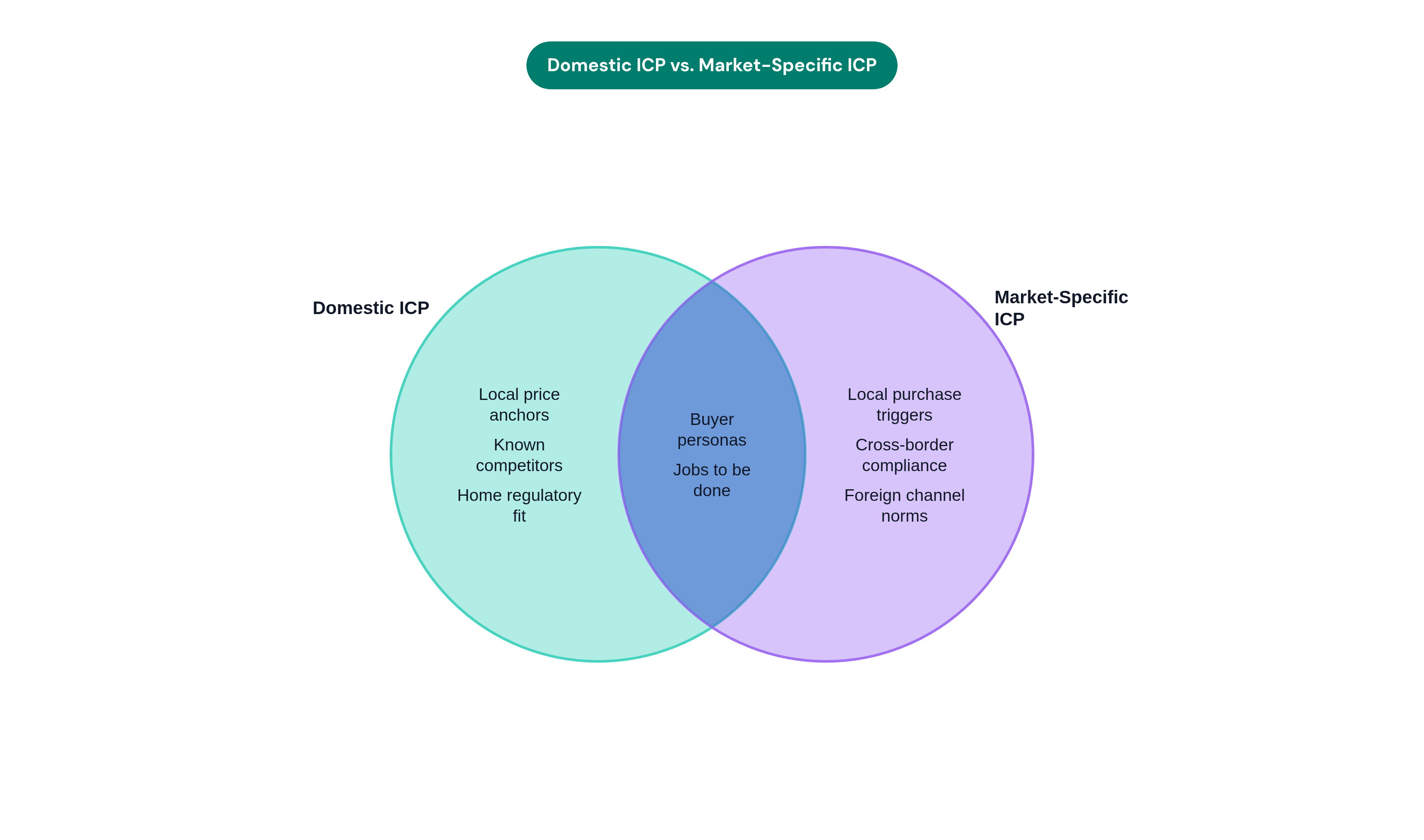
The Four Dimensions That Shift When You Cross a Border
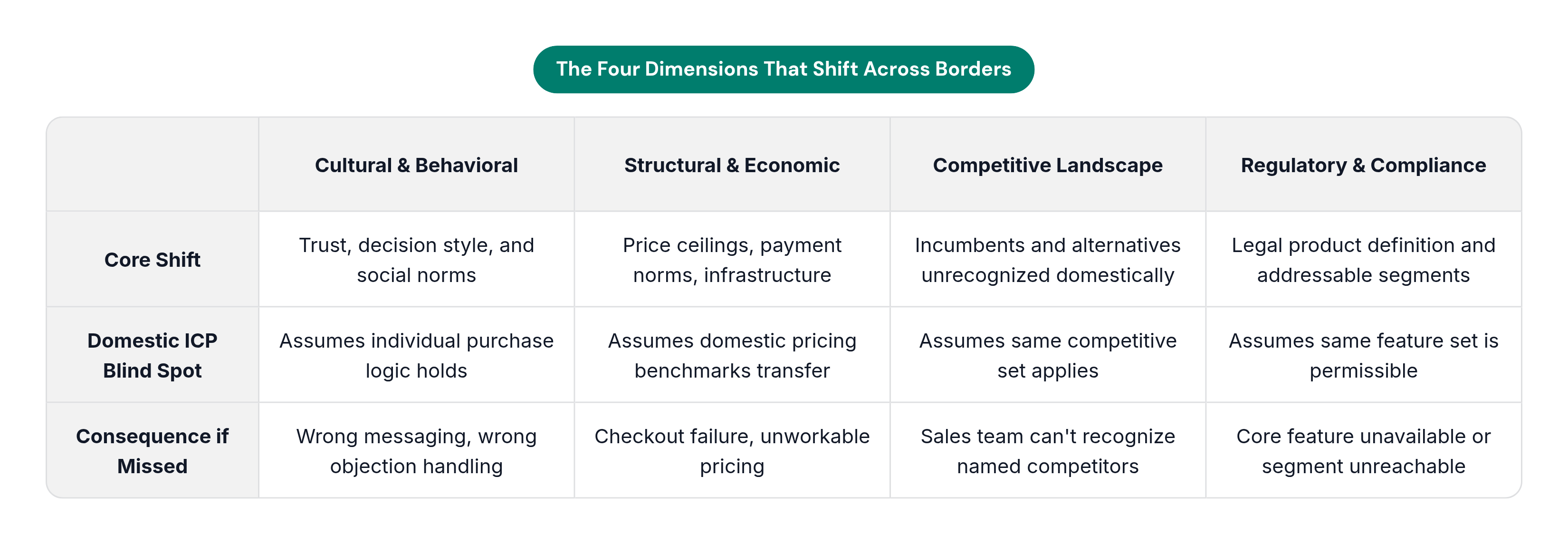
Four things change in ways that materially alter who your customer is, how they buy, and whether your product delivers value at all.
The first is cultural and behavioral. How trust accrues to a brand varies enormously across markets. In some contexts, institutional affiliation and third-party endorsement carry the most weight; in others, peer networks and community consensus govern everything. Purchase decisions that are individual in one market are collective in another. The objections that carry social weight, the pacing a buyer expects, the language that signals credibility versus arrogance — none of this is recoverable from domestic customer interviews, however many you run.
The second is structural and economic. Purchasing power parity changes the effective price ceiling in ways that feel obvious until you're actually setting pricing and realize you have no local reference point. Payment method norms determine which checkout flows actually convert. Distribution channel expectations shape where buyers look and which intermediaries hold influence. Infrastructure constraints, in logistics, connectivity, or financial inclusion, can determine whether the product is even operable for a given segment.
Third is the competitive landscape, and this is the one that catches teams most off guard. Incumbents in a new market often look nothing like the domestic competitors a team has spent years learning to displace. The alternatives a buyer spontaneously names when asked how they solve the same problem are frequently entirely different products, categories, or workarounds that the domestic team has never encountered. I've sat in research debrief sessions where the sales team simply didn't recognize half the competitive names local respondents mentioned. Domestic competitive intelligence is nearly useless here.
Fourth is regulatory and compliance. Data handling requirements, advertising restrictions, and product category rules shape what the product can legally be in a given market, which in turn shapes who the viable customer actually is. A feature that drives conversion at home is unavailable abroad. A segment that was freely addressable domestically requires a fundamentally different go-to-market structure.
Netflix and Airbnb both navigated this, imperfectly and publicly enough to be instructive. Netflix localized its content mix to match local viewing behavior rather than assuming global tastes were converging toward its domestic library. Airbnb adjusted its community messaging to account for different cultural norms around trust and hospitality rather than porting its domestic positioning wholesale. Neither company assumed its domestic ICP traveled intact.
These four dimensions are the research agenda — everything that follows is about how to work through them efficiently.
Why the Standard Research Playbook Slows Down Exactly When Speed Matters Most
Traditional international market research doesn't fail because it's unsound. It fails because its timeline is structurally misaligned with the pace at which expansion decisions actually get made.
A conventional research cycle runs roughly two weeks for survey design, two weeks for panel recruitment, two weeks for fieldwork, and two to four weeks for analysis and reporting. That's the optimistic version. Recruiting hard-to-reach populations in a new market, small-business owners in Southeast Asia, specific professional segments in the Middle East, can take months and cost thousands of dollars per respondent. By the time results arrive, the competitive window has shifted. Worse, internal momentum has usually already committed the team to a direction that research was supposed to inform.
A standard user study routinely costs $25,000 to $65,000 just to recruit participants, run sessions, and produce executive-ready insights. At that price point and that timeline, most teams face a real binary: compress research into something too shallow to be reliable, or skip the local ICP step entirely and substitute analogical reasoning. "This market looks like our domestic market five years ago." "Our European ICP probably applies here with minor adjustments." Both paths produce the same failure mode: confident entry premised on the wrong customer.
The mismatch between research timelines and decision timelines is the actual problem. Everything else is a symptom.
How Synthetic Consumer Panels Can Model a Market You Haven't Entered Yet
Synthetic panels are not fabricated data. They're constructed from real-world datasets — historical survey responses, behavioral data, customer reviews, public opinion trends — calibrated to simulate specific segments with measurable accuracy. Well-calibrated synthetic panels reach 85 to 95% parity with real panels on concept, pricing, and positioning tests. Generic generative AI prompts without calibration perform considerably worse. Calibration is what makes synthetic research credible rather than expensive guesswork — and it's the step most teams skip.
For international ICP work specifically, synthetic panels solve a structural problem. They let a team simulate consumer segments in a target market before any local recruitment infrastructure exists. Concept-to-signal cycles that take four to eight weeks with traditional panels take hours with a calibrated synthetic audience. Hard-to-reach international segments — specific professional roles, rural populations, niche demographics — are especially expensive and slow to recruit in foreign markets. Synthetic panels can model them immediately, which means the hypothesis-narrowing work that typically happens late in the research cycle can happen first.
There is a real boundary here, though, and I'd rather name it plainly than bury it. Research consistently finds that synthetic and real responses correlate poorly for genuinely novel products with no market analogues. Synthetic panels learn from existing behavioral data; when the product category is entirely new to a market and no behavioral reference points exist, predictive accuracy drops sharply. That's a scoping condition, not a disqualifying limitation. It describes a minority of international expansion scenarios. Use synthetic panels to generate hypotheses and narrow the research agenda. Don't use them to replace local validation.
What AI-Moderated Interviews Add When Entering a Market You Don't Yet Understand
Synthetic panels reveal what a segment thinks. AI-moderated interviews with real local respondents reveal the reasoning, the language, and the cultural logic behind it. Those are different things, and international ICP work requires both.
AI interview agents can pursue contextual follow-ups, adapt tone across demographics and cultures, and surface intent signals from phrasing in real time. This produces the depth of a one-on-one interview at a scale no human moderation team can replicate. Traditional qualitative discovery caps at five to eight interviews per researcher per week. AI-moderated interviewing removes that ceiling, changing the economics of qualitative work in ways the industry hasn't fully registered.
The practical application for new-market ICP work is direct: run a broad AI-moderated interview wave to surface the local language for the problem, the competitive alternatives buyers name without prompting, and the objection structures that carry real social and economic weight in that market. Then use those findings to sharpen ICP attributes before any quantitative investment is committed. Platforms supporting transcription across dozens of languages make this feasible for non-English-speaking markets without requiring bilingual research staff at each site.
This is also where the IKEA problem gets caught, incidentally. A real respondent will just tell you the sofa doesn't fit the room.
The Sequence: How to Actually Build a Market-Specific ICP from Scratch
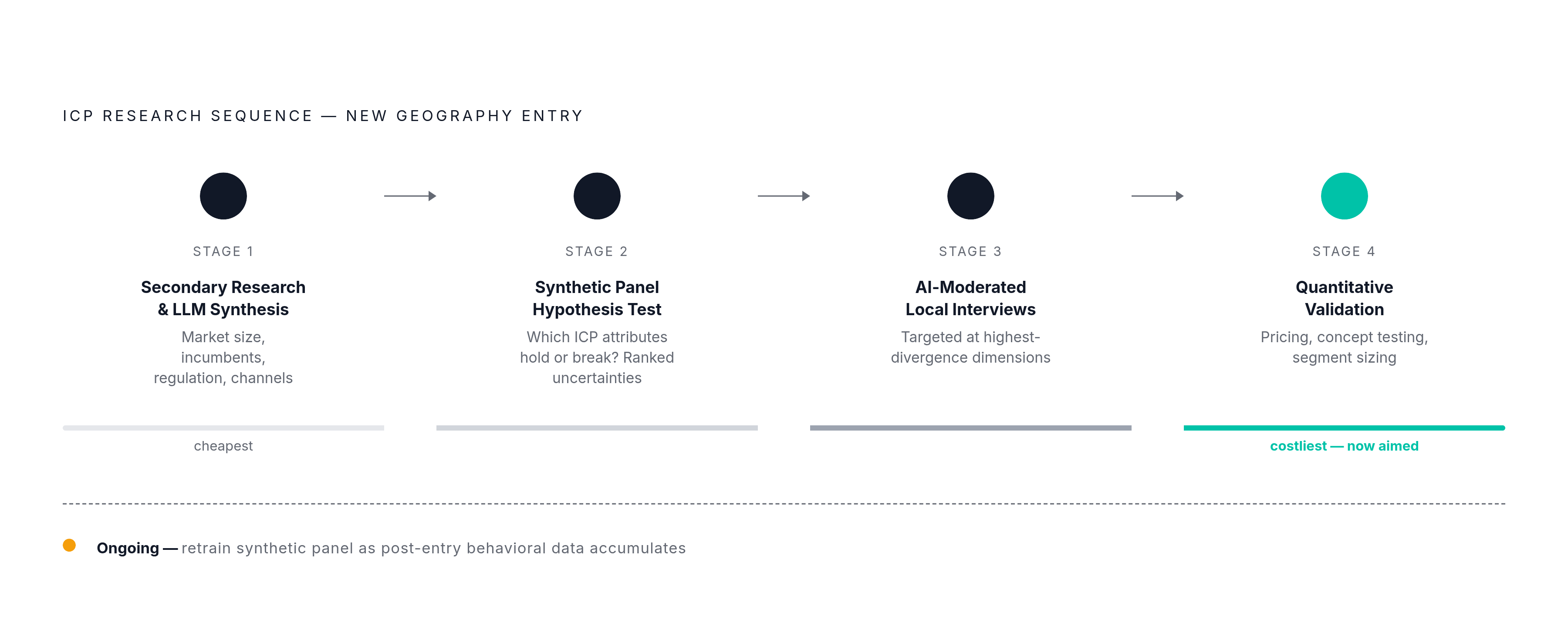
The failure pattern this sequence prevents is specific: committing to positioning, pricing, and channel strategy based on domestic ICP assumptions before any local signal has been collected. Each step is designed to make that outcome structurally harder to stumble into.
Start with secondary research and LLM-powered synthesis to map the structural landscape before spending on primary research. Market size, major incumbents, regulatory environment, dominant distribution channels. This is orientation work, not strategy work, and it's cheap. Do it first.
Then run calibrated synthetic panels against the key ICP hypotheses inherited from the domestic profile. Which attributes hold across the border? Which break? Where do the largest divergence signals appear? The goal at this stage is not conclusions. It's a prioritized list of uncertainties, which is more useful than a list of answers.
Next, AI-moderated interviews with real local respondents, targeted at the dimensions where synthetic divergence was highest. This is where the cultural logic and local language emerge. It's also slower and more expensive than the synthetic stage — which is precisely why the synthetic stage comes first. By the time you're running real interviews, you know exactly where to look.
After that, quantitative validation: pricing sensitivity, concept testing, segment sizing against the refined ICP, before any material market entry investment is committed. Because the prior stages have already narrowed what it needs to measure, this runs faster and costs less than a cold deployment would.
Finally, treat the ICP as a living model. As behavioral data accumulates post-entry, the synthetic panel can be retrained, turning the initial research investment into a continuously updated market intelligence asset rather than a deliverable that expires at launch.
The 1 to 3% of expansion investment that pre-entry research typically represents is most efficiently deployed in this order: cheap synthetic hypothesis testing first, targeted human research second, quantitative validation third. That sequencing is counterintuitive for teams trained on traditional research workflows — it reflects how information actually accumulates, not how budgets habitually flow.
Where Synthetic and Human Research Must Stay in Balance for International ICP Work
Adoption of synthetic data is real and accelerating. A meaningful share of consumer insight leaders have already implemented some form of it. But satisfaction rates with AI-powered research quality remain low, well below majority in recent industry surveys. Those two data points tell you something uncomfortable: the technology is being adopted faster than teams are learning to use it correctly.
The satisfaction gap is almost certainly attributable to uncalibrated or generic synthetic use. Teams treating raw generative AI outputs as equivalent to calibrated panel simulations produce both bad research and the low satisfaction numbers that follow. This is a workflow problem more than a technology problem.
The fix is systematic validation. Synthetic outputs should be benchmarked against real data — survey results, known market benchmarks, or experimental findings — before informing strategic decisions. For market entry into a context with little historical behavioral data, synthetic panels are weaker. Bayesian validation techniques can surface uncertainty and confidence intervals around synthetic outputs rather than presenting them as point estimates, and teams should ask vendors for these explicitly. A synthetic finding with a stated confidence range is strategically useful. A synthetic finding presented as definitive — without calibration or validation — is assumption-laundering dressed as research, and worse than no research at all because it produces confidence without warrant.
The practical rule is clean: use synthetic panels to decide where to look and what questions to ask. Use real respondents to confirm the answers that will drive material investment decisions. Speed and hypothesis generation belong to synthetic methods. Validation and cultural nuance belong to human research.
What a Finished Market-Specific ICP Enables That a Domestic One Cannot
A market-specific ICP gives the go-to-market team local pricing anchors grounded in measured sensitivity, not domestic analogies. It names the competitive alternatives that local buyers actually consider, not the ones the domestic sales team recognizes from their own territory. It captures purchase trigger language in local terms, which feeds positioning, messaging, and channel strategy with a specificity that a translated domestic template cannot provide.
Because the synthetic panel model can be retrained as new behavioral data arrives, the ICP doesn't expire at launch. It evolves with the market. The research infrastructure built to define it — the calibrated panel, the interview corpus, the validated segment model — can be applied to any future product, pricing, or positioning question in that geography without starting over. Every subsequent decision in that market draws on a foundation that improves rather than ages.
That's the structural difference between ICP research as a one-time pre-launch exercise and ICP research as ongoing market intelligence. The former gets consumed at launch and must be rebuilt for the next question. The latter keeps paying. Companies that treat the ICP as a living system learn a new market; companies that treat it as a launch deliverable simply enter one.