Scaling Usability Testing Beyond the Lab
Remote testing and AI moderators finally break the bottleneck holding research back.

Lab-based usability testing was built for a world where observing real user behavior required physical proximity. One-way mirrors, think-aloud protocols, moderated sessions. Genuinely clever solutions to a real constraint. Those solutions calcified into professional norms that treated scarcity as a feature rather than a limitation: one moderator, one participant, one hour. The discipline organized itself around that bottleneck instead of working against it.
What you end up with is a method optimized for depth at the expense of everything else. High-fidelity insight in small batches, delivered slowly. That is valuable, but it compounds into something dysfunctional as product teams try to move faster. Traditional usability testing is like a master craftsman who insists on hand-stitching every garment: the quality is real, but the wardrobe never grows.
A routine user study takes six to twelve weeks from kickoff to executive readout. Two weeks each for design, recruitment, and fieldwork; another two to four for analysis. You cannot compress that timeline without sacrificing something real. And because the per-study cost demands a formal budget line, most teams default to quarterly research cycles. Which means the vast majority of everyday product decisions happen with no research support at all.
Small bets go untested. Early-stage ideas ship or die without validation because running a study to evaluate them is economically irrational. The moderator is the irreducible constraint, and it is a structural problem rather than a staffing problem. You cannot run fifty concurrent moderated sessions the way you can send fifty simultaneous emails. That is structural.
Enterprise environments compound this further. Large UX teams often run four or more research platforms in parallel, with handoffs between platforms, agencies, and internal stakeholders at every stage. The finding that started the chain rarely matches the finding that reaches the product team. Fidelity bleeds out across every transfer.
What "Scaling" Usability Testing Actually Requires
Scaling is not running more sessions. That is the first mistake. True scaling means decoupling research volume from moderator hours, and decoupling insight cycles from quarterly planning rhythms. Those are two separate problems, and conflating them is why most scaling attempts stall.
Three things actually need to change. Volume: enough participants per study to surface segment-level differences rather than aggregate impressions that smooth over the interesting variation. Frequency: tests running continuously, so issues are caught when they emerge rather than at the next scheduled check-in. Breadth: coverage across segments, geographies, and edge cases that traditional recruitment cannot reach within a reasonable window.
Continuous testing means treating usability the way engineering teams treat uptime monitoring. You do not wait six months to find out your infrastructure is degrading. A design change that introduces friction should surface that friction in days, not quarters.
There is also a reusability problem that rarely gets named. Every time a team commissions a new study, they rebuild their audience model from scratch: recruiting, screening, scheduling. A well-constructed target audience profile should be queryable against any future design question. Research should accumulate as an organizational asset, not evaporate when each study closes.
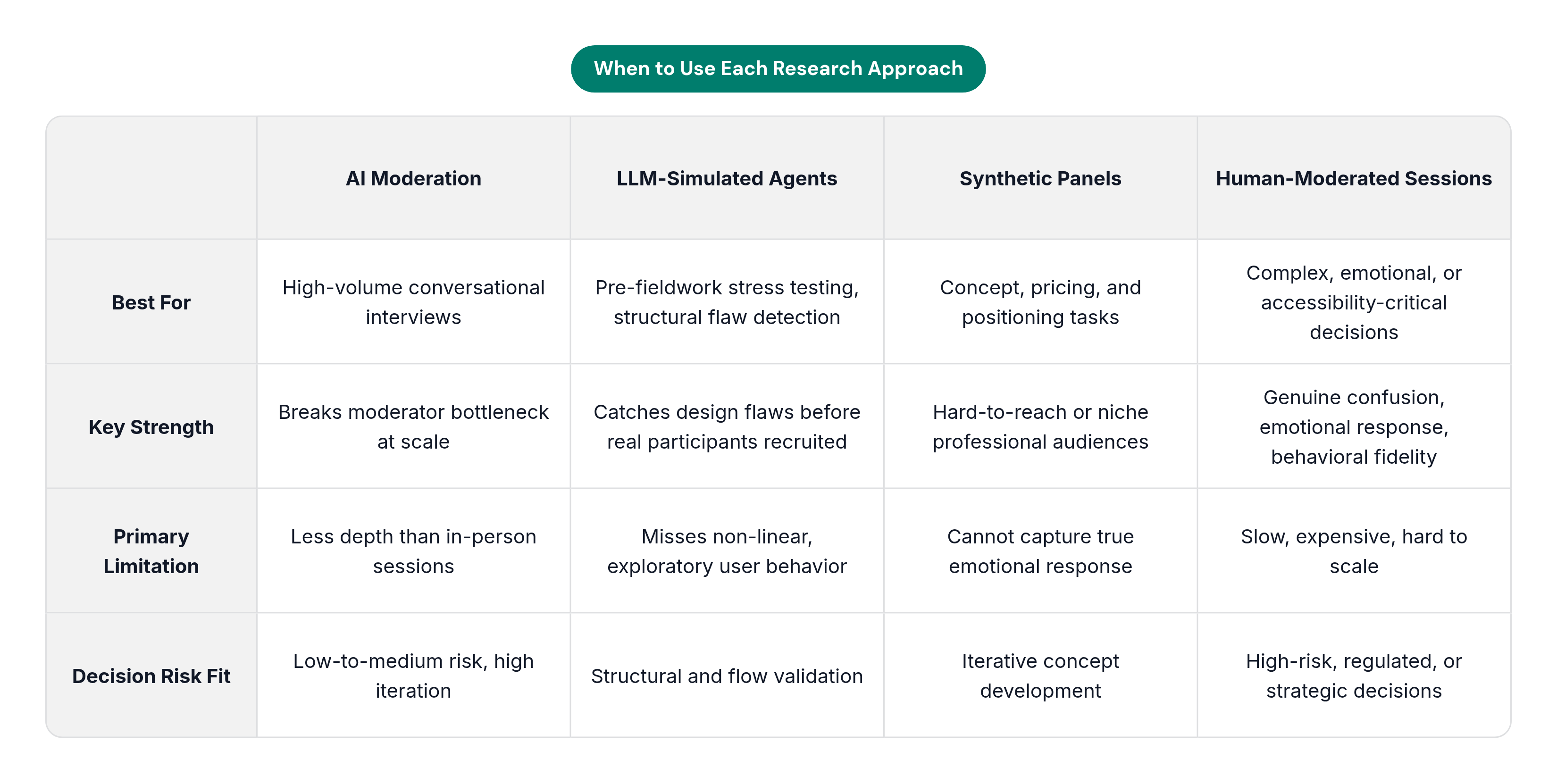
A useful way to frame the prioritization: group decisions by risk level. Low-risk, high-iteration work (naming, early ideation, feature prioritization) can move almost entirely to high-volume automated approaches. High-risk decisions (regulated claims, strategic pivots, accessibility-critical launches) still need human depth at the center. The goal is not to eliminate human judgment. It is to stop wasting it on decisions that do not require it.
How AI Moderation Breaks the Moderator Bottleneck
The moderator bottleneck is solvable now in a way it genuinely was not three years ago. Most research teams have not fully absorbed what that means in practice.
AI interview agents can run the full session loop (open-ended questions, contextual follow-ups, tone adaptation across demographics) simultaneously, at any hour, across any geography. The probe-and-follow-up dynamic that made moderated sessions valuable, the part where a skilled moderator hears something unexpected and chases it down, is now automatable at scale. That is not a minor efficiency gain. It is a structural change to what research can be.
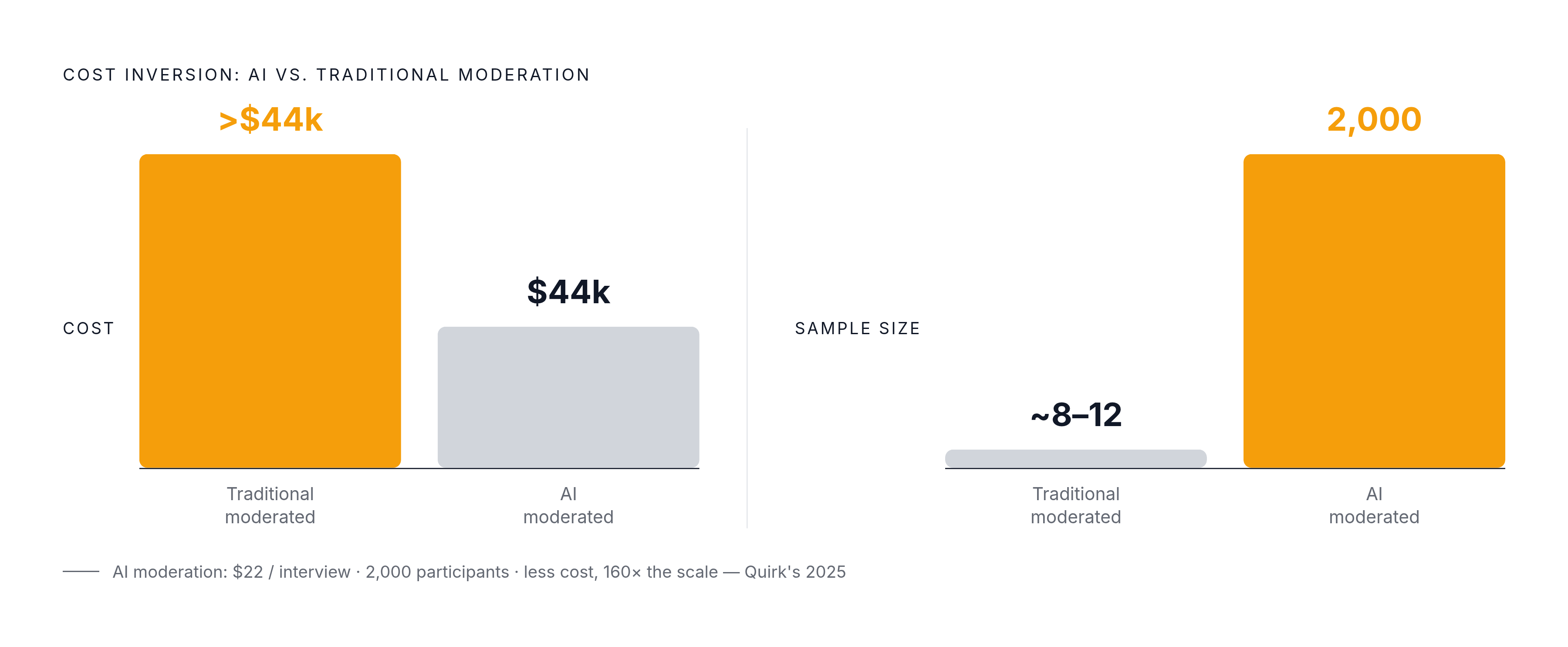
The cost shift is significant. Per Quirk's 2025 Researcher SaaS Report, AI moderation brings the all-in cost to roughly $22 per completed conversational interview. A sample of two thousand participants runs around $44,000. For context, a traditional moderated study at a fraction of that scale often costs more. That number changes the denominator of justifiable tests. Research questions that were previously irrational to pursue become obvious to answer.
The volume crossover already happened. The Insights Association reported that AI-moderated interviews exceeded human-moderated interviews by volume across member vendors as of Q4 2025, roughly two years ahead of forecast. Something more fundamental shifts here than efficiency. Qualitative research is no longer confined to the small-sample thematic saturation model. When you can hear from two thousand people instead of twelve, you stop confirming hunches and start discovering patterns you did not know to look for. The nature of what qualitative data can tell you changes. You say the field has gone from reading tea leaves to drinking from a fire hose — and finally having a cup big enough to hold it.
In video contexts, AI agents also pick up intent signals from phrasing, tone, and facial expression. The behavioral richness that once justified in-person sessions is increasingly accessible without physical co-presence.
Where LLM-Simulated Agents Fit into Usability Testing Specifically
AI interviewers ask users about their experience. LLM-simulated agents do something different: they simulate user behavior on actual interfaces — a distinction worth holding clearly.
UXAgent, published at CHI EA 2025, is the clearest documented example. The system includes a Persona Generator, an LLM Agent module, and a Universal Browser Connector. It generates thousands of simulated users who interact with a live website, producing qualitative data through post-study surveys and quantitative data through interaction logs. Structural issues can surface across thousands of simulated sessions before a single real participant is recruited.
The most immediately practical use case is pre-fieldwork stress testing. Structural flaws in task wording, flow, or scope are expensive to discover mid-study. Running a simulation first catches those problems while they are still cheap to fix. That benefit is underappreciated because it is invisible when it works: you never see the fieldwork disaster that did not happen.
The honest limitation: current LLM web agents follow optimized, efficient paths through interfaces. They do not naturally replicate the exploratory, non-linear behavior of real users who get lost, backtrack, or miss affordances because of subtle visual hierarchy problems. A simulated agent will not experience the confusion that comes from overlooking a button a real person's eye would slide right past. Simulated agents are skilled at finding the shortest path. They are poor at getting lost.
That limitation defines where simulation is most useful today: design validation, structural issue detection, pre-study preparation, post-launch monitoring. It also defines where human sessions remain irreplaceable: genuine confusion, emotional response, accessibility edge cases where behavioral fidelity is non-negotiable. LLM agents compress preparation time and expand monitoring capacity. They do not replicate the experience of watching a real person encounter something they have never seen before.
Synthetic Panels as a Parallel Track for Concept and Experience Testing
Synthetic consumer panels are not fabricated audiences. They are AI-generated groups of virtual respondents built from real-world data: historical survey responses, behavioral patterns, customer reviews, public opinion trends. The accuracy depends entirely on the quality and calibration of the underlying data, and the gap between calibrated and uncalibrated synthetic panels is not marginal.
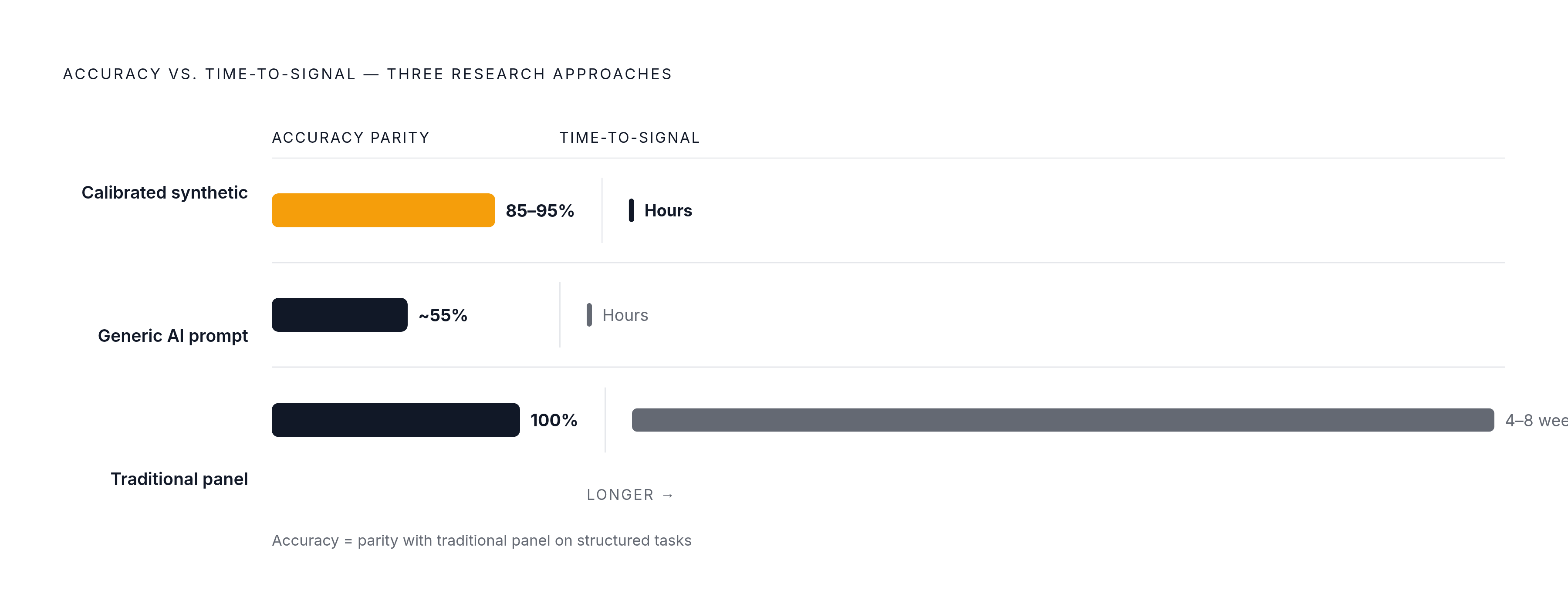
A 2024 study from Stanford and Google DeepMind found 85% accuracy on survey replication and 98% correlation on behavioral tasks across 1,052 participants. Calibrated synthetic panels, trained on real human data rather than generic LLM outputs, reach 85 to 95% parity with traditional panels on structured concept, pricing, and positioning tasks. Generic generative AI prompts sit closer to 55%. The difference between those two numbers is the difference between a useful signal and a confident mistake.
The speed differential is where the practical argument lives. Concept-to-signal cycles that take four to eight weeks with traditional panels take hours with calibrated synthetic audiences. For iterative concept development, that compression changes how many ideas a team can evaluate before committing resources. You are not just doing the same thing faster — you are doing a different kind of thing: running ten iterations where you used to run two.
Hard-to-reach segments are a particular strength. Modeling the perspective of a CISO evaluating enterprise security software, without the logistical difficulty of recruiting and scheduling that person, is a genuine capability expansion. Niche professional audiences that would take weeks to assemble can be queried in an afternoon.
The limitations deserve plain statement. Synthetic panels do not capture true emotional response. They can inherit biases from their training data. They struggle with culturally sensitive topics or markets where training data is thin or unrepresentative. These are not edge cases — they are precisely where synthetic panels should not be the primary source of confidence. For those decisions, human depth still earns its cost. Roughly 69% of market researchers have incorporated synthetic data into their research efforts, per Qualtrics data cited in Backlinko's 2026 research compilation. Teams that have not yet engaged with it are operating at a throughput disadvantage, not waiting for the technology to mature.
Building a Continuous Usability Research System Instead of Running Periodic Studies
The episodic model — design, recruit, field, analyze, report, repeat — persists not because it is optimal but because it is baked into how research is budgeted, staffed, and delivered. The constraints that made that rhythm necessary have loosened considerably; the rhythm itself has not. Changing it requires treating research infrastructure as a product problem rather than a project problem.
Continuous usability practice has three components: always-on monitoring of live products, rapid testing of design changes before full deployment, and a standing audience model that teams can query as decisions arise. That third piece is the foundation. If you rebuild your audience model for every research question, you are always starting from zero. If the model exists as a persistent, queryable asset, research becomes something you run rather than something you commission.
Most routine research — concept testing, message validation, feature prioritization — is well-suited to continuous automated approaches. The remainder, the strategic planning work, complex purchase decision research, emotional insight work, warrants human depth. That work is now more accessible, because the high-volume routine work has moved to faster channels and is no longer consuming the time of the people who should be doing the harder stuff.
Companies that have made this structural shift report compressing research timelines by up to 80% while reducing costs by 60 to 70%. Those figures matter not primarily as efficiency metrics but as signals of a behavioral change: when testing a small bet costs an afternoon and a few hundred dollars instead of six weeks and $40,000, teams test by default rather than by exception. Platforms like Seda, an AI-powered market research tool that runs interviews and UX tests against a panel of verified human respondents across 130+ countries and auto-synthesizes findings into structured reports within hours, are the kind of infrastructure that makes that default possible. That shift is harder to engineer than any tool selection. It is also where the real competitive separation accumulates, quietly, over time.
What Faster, Higher-Volume Usability Research Changes About Product Decision-Making
When testing is cheap and fast, the calculus inverts. Teams validate assumptions before committing resources rather than after, because the cost of validating is now lower than the cost of being wrong.
A significant share of product failures, across startups and enterprise launches alike, trace back to decisions made before the evidence was in. Not because the teams involved were reckless. Because gathering the evidence took too long and cost too much. Faster research cycles do not guarantee better outcomes — they remove the structural excuse for skipping validation. That is a quieter kind of value than breakthrough insight, and more consequential across an organization over time.
The competitive implication is about velocity. Companies that gather insights faster can adjust strategy while competitors are still designing their study. MIT Sloan Management Review noted in April 2026 that generative AI is shortening exploration-to-insight timelines in ways analogous to how AI-driven drug discovery shortened the path from candidate screening to clinical-trial readiness. More candidates tested faster means better options available at decision time.
For UX researchers, the organizational implication is a reallocation of where expertise actually gets applied. Less time on logistics, moderation, and recruitment coordination. More time on interpretation, judgment calls, and the complex studies that genuinely require human depth. High-volume qualitative data also changes which questions are askable at all. Segment-level behavioral differences that a twelve-person study cannot detect become visible at scale. Research shifts from confirming what the team already suspects to surfacing what they did not know to ask about.
The lab is not gone. High-stakes, emotionally complex, or accessibility-critical testing still benefits from in-person or closely moderated sessions, and will for the foreseeable future. The argument is not against the lab. It is for building the infrastructure that surrounds and extends it, so that skilled researchers and moderated sessions are reserved for the decisions that actually need them, rather than used as the default vehicle for questions that can be answered faster and cheaper somewhere else.