User Interview Recruitment and Screening at Scale
How to redesign recruitment workflows to eliminate delays and catch bad-faith participants.

The standard agency-mediated recruitment workflow is a chain of handoffs: brief, panel pull, screener, QA, scheduling, confirmation, reminder. Each handoff is a place where time drains and accountability diffuses. From study brief to completed interviews, the elapsed time consumes weeks, sometimes stretching past a month, even for straightforward consumer audiences.
The costs arrive before you learn anything. A significant share of the total research budget, according to State of User Research data, goes to recruitment before a single interview is conducted. That front-loading leaves compressed runway for analysis, the work that actually produces decisions.
The bottleneck compounds nonlinearly under pressure. Niche B2B audiences, low-incidence conditions, multi-country studies: each constraint multiplies the timeline rather than adding to it. Enterprise research teams often make this worse by managing a sprawling vendor stack where panel providers, scheduling tools, and interview platforms exist as separate systems that don't talk to each other cleanly. Every integration is a failure point. Every failure point is a delay.
Here is the thing that took me a while to name clearly: traditional recruitment is not broken so much as it was never designed for what teams are asking of it now. It was built for episodic, agency-mediated research. Running it continuously, at team speed, produces friction by design. The workflow is not malfunctioning. It is doing exactly what it was built to do, in conditions it was never built for. That distinction matters because teams keep trying to fix the wrong problem.
The panel quality problem that volume alone cannot solve
Large commercial panels optimize for coverage and fill rate. Verification is light. What you end up with skews toward experienced survey-takers, people who have become fluent in the conventions of screeners and have learned, consciously or not, which answers get them through the door.
Panel fraud in unmanaged commercial sources is a documented and growing problem. Independent QA audits have found fraud rates reaching into the double digits. AI-generated respondents have compounded this: language models can now produce coherent, paragraph-length open-text answers at negligible cost, giving bad actors a mechanism for spinning up synthetic identities that pass basic qualification checks. Panels with high incentives, particularly in B2B, healthcare, and financial services, are most exposed because the reward for qualifying is highest.
Underneath the fraud problem sits something subtler and, honestly, more corrosive. The most-surveyed people are the ones most likely to show up. Survey fatigue has suppressed response rates for cold outreach to near-negligible levels across most audience categories. The people who still respond reliably are those who respond to everything. That is not the same as a representative sample of any real user population. You are hearing from your panel's most enthusiastic participants, not your users.
Adding more of those participants does not get you closer to the truth. Scale, without verification, just means more confident errors.
Screener design as the first line of quality control
A well-designed screener does not confirm that a participant qualifies. It creates conditions under which unqualified respondents self-select out quickly, and in which bad-faith participants cannot easily perform qualification. That is a genuinely different design objective, and most screeners I have encountered are built for the wrong one.
Lead with behavioral and situational questions, not demographics. The first questions should disqualify fast. If someone has not used a product category in the past ninety days, that should surface in question two, not question twelve. Every question they answer before you catch them is a question working against your data.
Keep screeners short. Beyond a small number of questions, completion rates fall and attentiveness degrades. Obscure the qualifying answer. If daily use of a specific software tool is the criterion, present several plausible alternatives as distractors. The correct answer should not be legible from the framing of the question.
Include at least one mandatory open-text question asking a participant to describe a specific recent experience in their own words. Genuine users give idiosyncratic detail: they remember the particular frustration, the specific workaround, the version they were running. Professional respondents and AI-generated submissions produce generic text that reads coherently but lacks that texture. That gap is detectable and, in my experience, it is reliable enough to catch the large majority of bad-faith submissions before they ever reach your study.
Attention checks and consistency traps, where the same underlying question appears in two different forms across the screener, catch satisficers without alienating good-faith participants. Screener design is where methodology and operations converge, and it is probably the highest-leverage place most teams are currently under-investing.
What automation can accelerate in the recruitment workflow
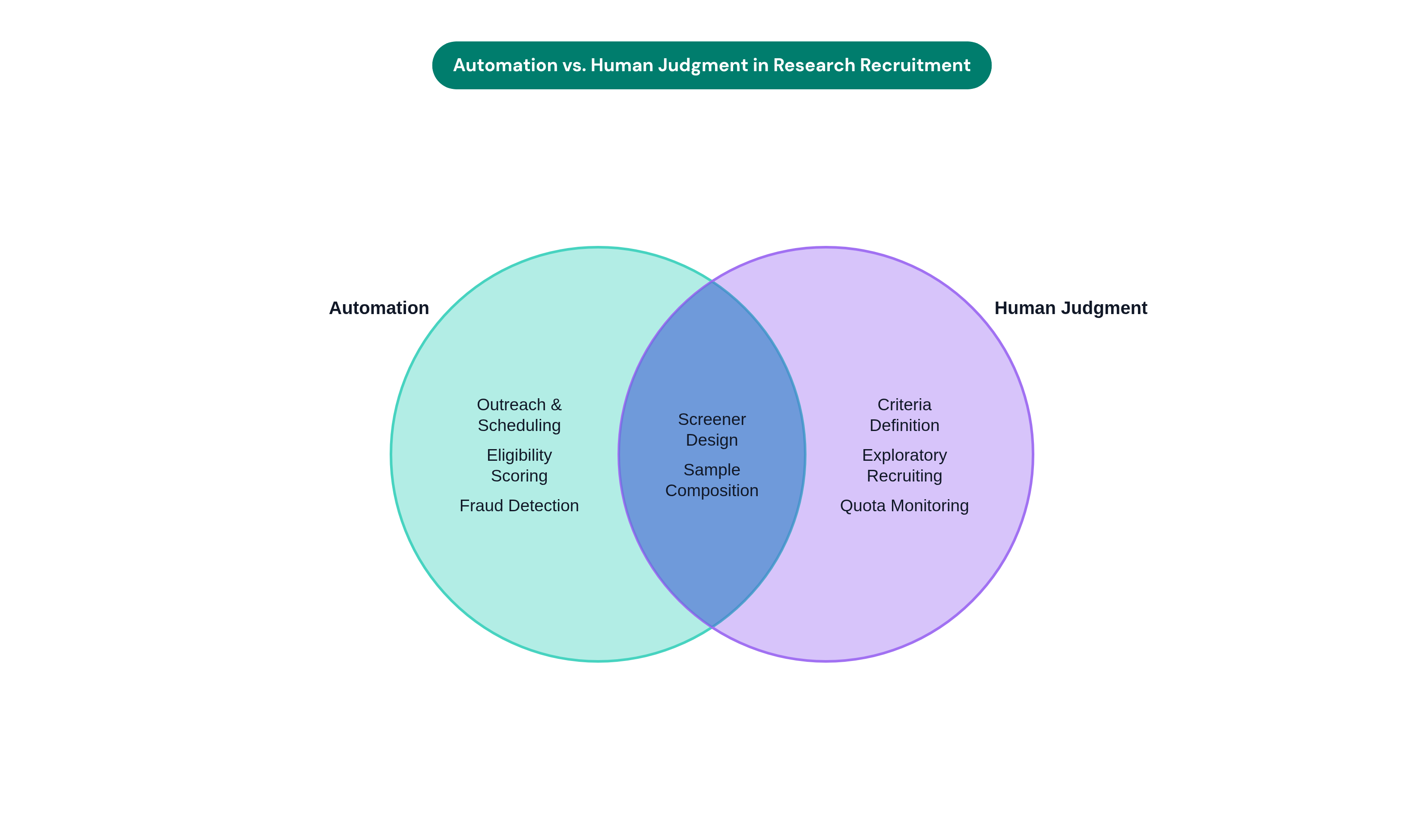
The stages of recruitment that benefit most from automation are the ones that are rule-bound and high-volume: initial outreach, screener delivery, response collection, eligibility scoring, scheduling, confirmation. These are not judgment calls. They are logistics, and logistics should not require a human in the loop for every step.
Machine-learning-based participant matching, where algorithms score panel members against study criteria, meaningfully compresses the time from recruitment brief to qualified shortlist. Automated scheduling and confirmation flows eliminate the coordination overhead that typically delays fieldwork by days. For broad consumer audiences on end-to-end platforms, the gap between study setup and completed sessions can collapse to a single day. I've watched that happen. It still surprises people who have spent years inside slower systems.
Niche B2B audiences take longer regardless of automation. The constraint there shifts from workflow speed to panel depth, and automation cannot source participants who do not exist in the panel. But it stops wasting time on everything surrounding the sourcing, which is its own meaningful gain.
AI-powered fraud detection that operates continuously across the participant lifecycle, analyzing behavioral signals throughout onboarding, screening, and session completion rather than only at screener entry, functions as an ongoing quality control mechanism rather than a single gate. That distinction matters more than it sounds: a gate can be gamed once you know where it sits.
Reducing handoffs is the structural lever. Platforms that consolidate panel sourcing, screening, scheduling, and interview execution into a single workflow eliminate those seams. Automation belongs in the high-volume, low-judgment portions of the workflow. It executes the decisions that have already been made. It does not make them.
Where human judgment remains load-bearing in the screening process
Criteria definition is a human decision. What counts as "qualified" depends entirely on the research question, and that cannot be automated without first being specified with precision. Ambiguous cases, a participant who almost qualifies, or who qualifies on paper but whose open-text response signals low engagement or implausible experience, require a researcher's call. No scoring algorithm resolves that without judgment underneath it.
Quota management across demographic or behavioral cells requires active monitoring. Automated fill processes over-represent compliant subgroups if no one is watching the composition in real time. The algorithm fills to quota. It does not notice when the resulting sample is structurally skewed. That gap is not a bug; it is just a boundary condition that teams often discover only after the data looks strange.
Recruiting for exploratory research, where the precise audience is still being defined, is genuinely different from recruiting for evaluative research, where criteria are fixed and verification is the task. Exploratory recruitment requires researcher involvement in shaping who gets through, not just confirming eligibility. That nuance gets lost when teams try to automate too early in the process. I have seen this go wrong enough times that I would call it a predictable failure mode, not an edge case.
Participant communication at the margins also benefits from human discretion: handling edge cases, managing no-shows, deciding whether to reschedule or replace, determining when a replacement would compromise the study's composition.
The practitioners getting the most from automation are those who are precise about which decisions they are delegating and which they are not. The judgment work remains, and it compounds in importance as the automation absorbs the volume work around it.
How AI-moderated interviews change what's possible at the interview stage
Once participants are recruited and screened, the interview has traditionally been the hardest part of the workflow to scale. Human moderators can only run so many sessions. Skilled moderation is time-intensive and cannot be parallelized beyond a point. That ceiling has real consequences for how often teams can do qualitative research at all, and most teams have just accepted it as a constraint of the medium.
AI interview agents now handle the full session loop: asking open-ended questions, pursuing contextual follow-ups based on participant responses, adapting tone. They can run concurrently across hundreds of sessions simultaneously, which no human moderation team can match. The cost difference between AI-moderated and human-moderated qualitative interviews is substantial, and platforms with per-completed-interview pricing make that comparison concrete quickly.
The Insights Association has reported that AI-moderated interviews have crossed over to exceed human-moderated interviews by volume among member vendors, and that this occurred earlier than industry forecasters had predicted. The adoption curve accelerated faster than the discourse around it. That gap between what is happening in practice and what is being debated in conference panels is a recurring feature of this industry, and it is worth sitting with rather than explaining away.
This is not a replacement argument. AI moderation is best suited for structured-but-conversational interviews where the guide is well-defined and the follow-up logic is predictable. Complex relational topics, sensitive clinical or personal subject matter, and research that depends on reading nonverbal cues still benefit from human moderators. The question is not which is superior; it is which is appropriate for the study design.
The pairing that produces the most meaningful compression is fast recruitment combined with AI-moderated sessions and automated synthesis. What was a multi-week workflow becomes a matter of days. Seda's AI interviewer model fits directly into this configuration, combining a large verified human panel with AI-driven interview execution and synthesis, built for teams that need volume and follow-up quality that static surveys cannot provide.
Synthetic panels as a complement to recruited participants, not a workaround
Synthetic panels, AI-generated personas built from real-world behavioral data, historical survey responses, and market data, can respond to research questions without any recruitment timeline. Their strongest use cases cluster at the early stages of a project: concept screening, directional pricing tests, messaging evaluation, market sizing. Anywhere you need a signal quickly before committing to a full recruited study.
A study conducted by researchers from Stanford and Google DeepMind, using more than a thousand participants, found that well-calibrated AI digital twins can replicate human survey responses with meaningful accuracy. Calibration is doing a lot of work in that sentence. Generic prompting without calibration produces far weaker results, and the gap between a calibrated synthetic panel and an uncalibrated generative AI prompt is large enough that teams conflating the two are comparing very different things.
Real limits exist and are worth naming plainly. Synthetic panels perform poorly on genuinely novel products with no behavioral precedent, where the correlation between synthetic and real responses drops sharply because there is no historical pattern to learn from. Regulatory contexts, anything patient-facing in pharmaceutical research, anything requiring clinical evidence, are inappropriate for synthetic panels regardless of calibration quality. That is not a nuance; it is a hard boundary. Teams that treat it as a nuance tend to find out the hard way.
Synthetic populations accelerate exploration and reduce the cost of early-stage validation. Real recruited participants confirm and deepen findings before consequential decisions are made. These are sequential, complementary roles, not competing ones.
Adoption among insights leaders is growing, but satisfaction data suggests the gap between implementation and confident use remains real. Teams that invest in calibration and validation close that gap. Teams that skip calibration are essentially running a different, weaker methodology and should not expect the same results.
Building a recruitment and screening system that holds up at scale
The design question for a scaled recruitment system is not which tools to use. It is which decisions should be made once versus what needs to happen dynamically for each study. Criteria specification, screener architecture, and platform selection are infrastructure decisions, not per-project vendor negotiations. Make them carefully, document them, revisit them periodically.
Treating recruitment as a permanent infrastructure problem rather than a per-project engagement changes both the economics and the timeline in ways that are hard to fully appreciate until you have experienced the alternative. The upfront investment pays dividends across every study that runs through the system, and those dividends compound.
Platform choice determines the ceiling. End-to-end platforms with integrated panels, AI moderation, and automated analysis eliminate the handoffs that fragment vendor stacks. Fewer handoffs means faster fieldwork, fewer failure points, and cleaner data provenance. Screener design, criteria specification, and quota monitoring remain human responsibilities regardless of how much automation surrounds them. Automation does not inherit those responsibilities. It amplifies whoever is holding them, which means weak judgment at the center of a highly automated system scales faster and costs more than weak judgment in a slower one.
Synthetic panels belong earlier in the workflow than most teams currently place them. At the hypothesis-formation and concept-screening stage, before a full recruited study is warranted, they reduce cost and compress time. By the time a recruited study runs, the research question should already be sharper for it.
The teams getting the most out of scaled research are not the ones with the biggest panels. They are the ones with the clearest criteria, the tightest screeners, and the fewest handoffs between a research question and a completed answer. Continuous research, running studies regularly against a maintained panel or synthetic model rather than commissioning episodic engagements, is what makes the system design investment compound over time. Every study that runs through a well-built infrastructure is faster and cheaper than the one before it.