Continuous UX Research Between Product Releases
Listening to users between releases prevents decisions made on intuition instead of evidence.

The first failure mode is treating research as a phase rather than a function. Teams invest heavily at the bookends of a release cycle, then let months pass with no structured listening. Decisions made in those dead zones don't wait for evidence; they default to stakeholder intuition, inherited assumptions, or the opinion of whoever's most confident in the room. By the time research resumes, the team is validating choices already made, not informing ones still in flux. I've watched this happen on teams that genuinely cared about users. The calendar just fills up, the next sprint starts, and somehow the listening never gets scheduled.
The second failure mode is subtler and considerably more insidious: mistaking analytics for understanding. Dashboards are genuinely useful, and teams that ignore them are flying blind in a different way. But dashboards show what users do; they reveal almost nothing about why. A team can watch a metric improve while the underlying problem worsens. Optimizing click-through on a confused flow doesn't fix the confusion; it relocates the abandonment. The number improves. The user experience doesn't. And at the next planning cycle, someone will cite the number as evidence that things are fine.
Both failures share a root cause. Research gets treated as a resource consumed on demand, a budget line activated when a decision is imminent and paused when it isn't. The corrective isn't a larger research budget. It's a different operating rhythm, and the methods available now make that rhythm genuinely achievable without scaling headcount.
What a continuous research cadence actually looks like across the inter-release window
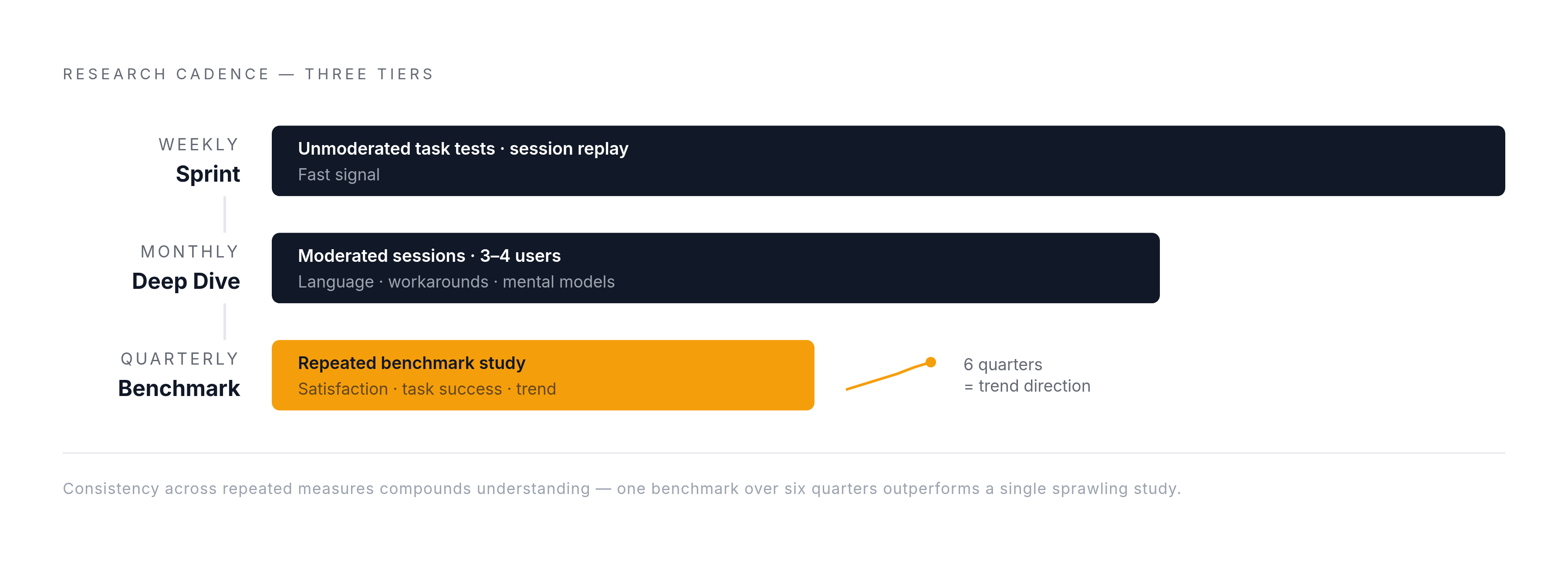
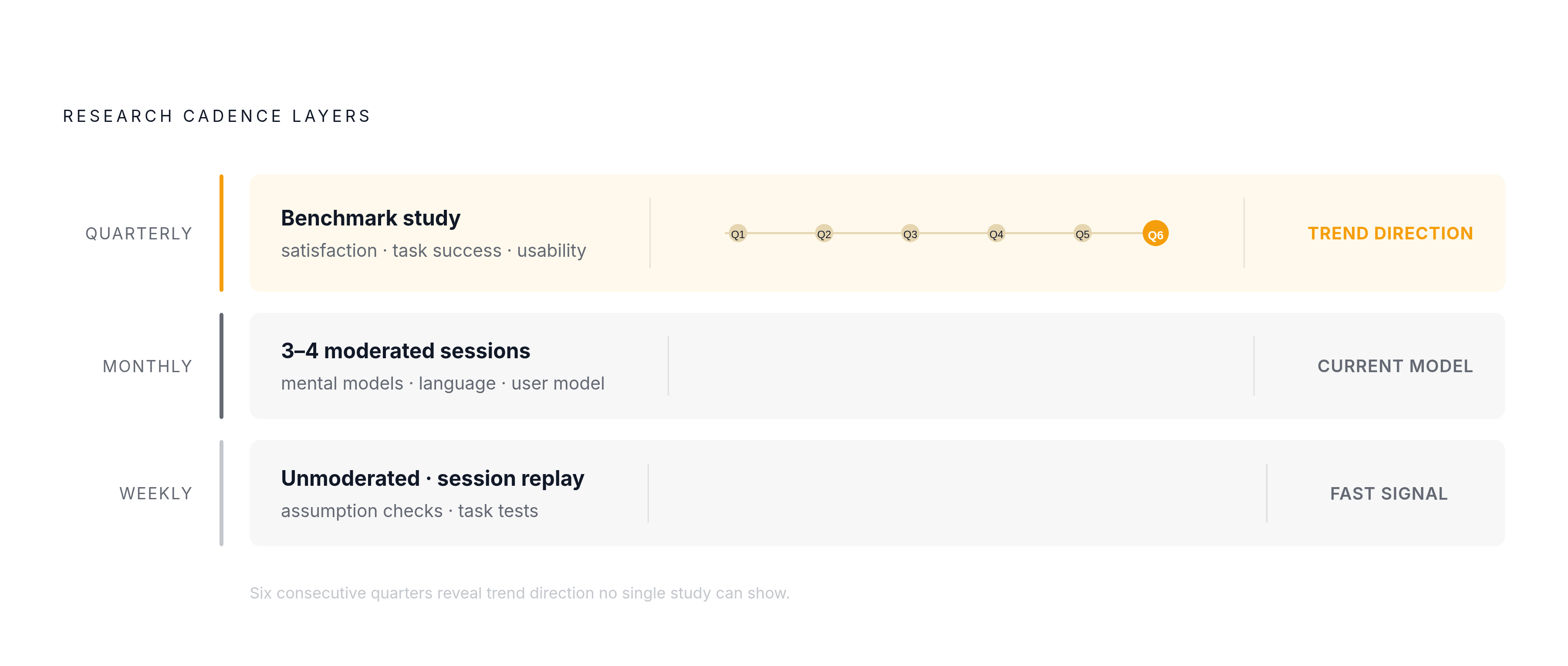
The practical structure involves work running at three different frequencies, each feeding into the next. Not a framework so much as a recognition that different questions have different time horizons, and the work needs to match.
At the sprint level, weekly or biweekly, the work is deliberately lightweight: quick unmoderated task tests on current designs or prototypes, session-replay review to flag emerging friction, fast assumption checks before a direction goes further. The goal at this layer isn't rigor. It's signal, fast enough to affect work still in motion.
At the monthly layer, a small but consistent moderated session cadence keeps the team's user model current. This doesn't mean recruiting twenty participants for a comprehensive study. It means sitting with three or four users regularly enough to hear new language, catch new workarounds, and notice when the mental model you built six weeks ago no longer fits the behavior you're now seeing. Those sessions are often where the real surprises live. A user will describe your product using a metaphor you never considered, and suddenly three design decisions from the last quarter look questionable.
At the quarterly layer, benchmark studies track satisfaction, task success, and key usability metrics over time. A single benchmark is a snapshot. Four of them, collected consistently, show trend direction, and trend direction is what tells you whether the choices you've been making are actually working.
The rhythm matters more than the scale of any individual study. One thoughtfully designed benchmark repeated across six quarters tells you more than a sprawling one-time study ever could, because you can see movement. Consistency is the mechanism that produces compounding understanding, and that's not a platitude; it's the structural reason most one-time research investments fail to generate lasting value.
One practical prerequisite that doesn't get discussed enough: someone has to own the cadence. Without a named owner, whether that's a researcher, a PM, or a structured rotation, the rhythm collapses under sprint pressure. Every team has good intentions about continuous research. The ones that actually sustain it have someone whose explicit job it is to make sure the next study gets run.
Where unmoderated remote testing fits in a continuous cadence — and where it doesn't
Unmoderated remote testing has moved from cost-saving compromise to default method for high-frequency research, and the reason is simple time economics. A moderated remote session yields richer qualitative insight, often substantially so, but a study that takes two weeks to recruit, schedule, conduct, and analyze in moderated form can be completed and in review within 48 hours unmoderated. For inter-release cadence work at the sprint layer, that ratio usually tips toward unmoderated. The goal is signal over time, not depth at a single point.
Unmoderated testing has real limits, though, and ignoring them is how teams end up with misleading confidence. It can tell you that users struggled with a particular step. It cannot reliably tell you why they struggled, what they were expecting, or what prior experience shaped that expectation. Those are moderated-session questions. Which is precisely why the monthly layer of a well-structured cadence should reserve moderated work for moments when you need to hear new language or probe a finding that unmoderated data surfaced but couldn't explain.
Several platforms serve the sprint-aligned layer well, and they differ in ways that matter depending on your user base. UserTesting operates one of the largest pre-recruited contributor networks available, which makes it strong for rapid participant recruitment when you need a specific profile fast. UXtweak brings a large built-in global panel useful for teams that need narrow demographic or international cuts without building a separate recruitment operation. Loop11 supports competitive benchmarking, prototype testing, and A/B testing with fast turnaround, making it a natural fit for the quarterly benchmark layer as well as sprint work. Userlytics has built particular strength in international and non-English-speaking participant pools, which matters considerably for teams whose user base doesn't map neatly to English-language platforms.
The real risk at high frequency isn't running too many studies. It's running studies without the synthesis capacity to process them. Volume without analysis produces data debt, not insight. That's the problem the next section addresses.
How AI tools are changing the cost of keeping up with continuous data
The real constraint on continuous research has never been running studies. It's staying ahead of the analysis. A team running weekly unmoderated tests and monthly moderated sessions generates substantial data, and without synthesis infrastructure, that cadence produces a growing backlog of unread transcripts and untagged sessions. Which is, honestly, worse than no research at all. It creates the illusion of rigor without the substance, and stakeholders start citing "the research" without anyone having actually synthesized it.
AI tools have changed this calculus in concrete, practical ways. Transcription and first-pass thematic coding, tasks that previously consumed hours of researcher time per session, now happen in minutes. Looppanel produces transcripts with high accuracy almost immediately after a session ends, auto-tags content against emerging themes, and makes the full corpus of accumulated findings searchable. Dovetail has added AI-assisted tagging and summarization that speeds signal extraction across large qualitative datasets. Session-replay platforms now use machine learning to surface dead clicks and rage-click clusters automatically, so teams can zero in on friction without watching every recording.
The aggregate effect is that analysis load, historically the thing that broke continuous cadences, no longer scales linearly with study volume. A researcher who previously could meaningfully synthesize six sessions a month can now process three or four times that volume. That's not a marginal improvement. It's the operational shift that makes a true continuous cadence feasible for teams without dedicated research departments.
One thing worth naming directly: AI coding decisions are not neutral. Over-aggressive summarization strips the contextual texture that makes qualitative data valuable in the first place. AI-suggested themes need researcher review before they drive decisions. The tools handle volume; the researcher's judgment remains the load-bearing element. What AI cannot do is set research goals, decide which findings matter, or reliably interpret the emotional register of a user who hesitates before answering. Those remain human responsibilities.
Where synthetic consumer panels fit in a continuous research practice
Synthetic panels are AI-generated personas that simulate real consumer behavior and respond to research stimuli based on patterns learned from historical survey data, behavioral data, product reviews, and public opinion trends. They don't fabricate responses from nothing. They model responses from an underlying data foundation, and the reliability of the output depends entirely on the quality and relevance of what they were trained on. That distinction matters more than most teams initially appreciate.
The speed case is genuine. Concept-to-signal cycles that take weeks with traditional panel recruitment take hours with calibrated synthetic audiences. For inter-release research specifically, this means a team can pressure-test a design direction, a copy variant, or a feature framing against a synthetic audience before a human study is even recruited, before a single calendar invite goes out.
When used correctly, calibrated synthetic panels reach accuracy parity with real panels in the high-80s to mid-90s range on concept, pricing, and positioning tests, according to findings from the 2025 GreenBook GRIT report. The qualifier "calibrated" is doing real work in that sentence. Generic generative AI prompts without calibration sit far lower, close enough to noise to be genuinely misleading. A 2024 study involving over a thousand participants from Stanford and Google DeepMind found that AI digital twins replicated human survey answers with around 85% accuracy and social behavior with correlation in the high 90s. These are not marginal results, and they've shifted how serious research practitioners think about where synthetic fits.
But the limits matter, especially for UX work. For truly novel products with no historical analog, models have no learned pattern to draw on, and accuracy falls substantially. Synthetic panels can replicate preference patterns and behavioral tendencies; they cannot replicate the moment a user pauses mid-task, sighs, and says "I just don't trust this." The 2025 GRIT Report also found that brand-side satisfaction with AI-powered research quality remains relatively low, reflecting a genuine confidence gap between adoption and trust. Teams should size their reliance on synthetic panels accordingly.
The structural advantage in a continuous cadence is reusability. A persona calibrated once against a target segment can be rerun against future research questions without re-recruitment. A one-time calibration investment becomes a standing research asset.
How to combine synthetic and human research across the inter-release cadence
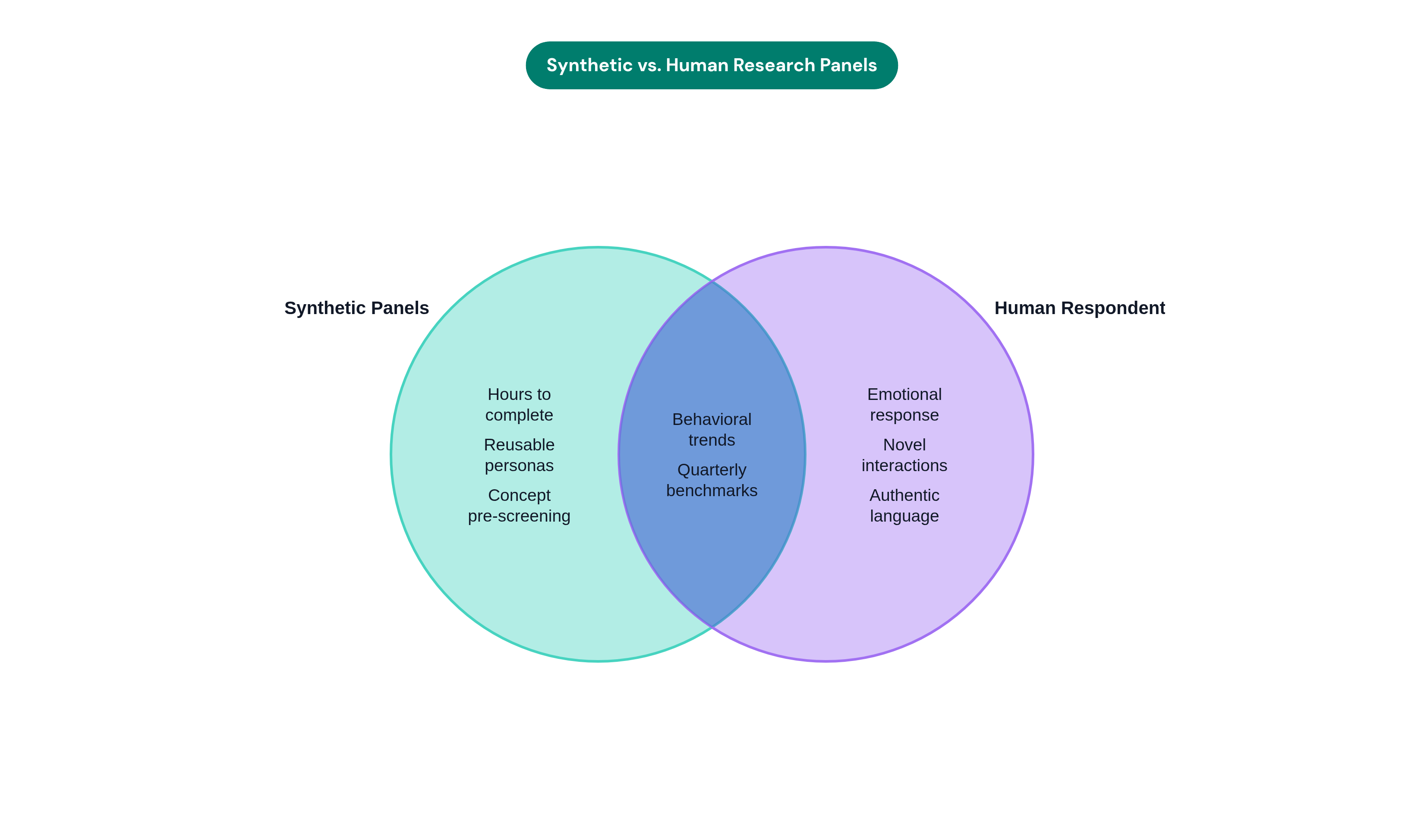
The core principle: synthetic panels accelerate; human respondents validate and deepen. Neither replaces the other, and the cadence is stronger when each occupies its appropriate slot.
At the sprint level, synthetic panels earn their keep. Before a navigation model goes to design review, before copy variants are handed to a developer, a calibrated synthetic audience can apply directional pressure in hours. The stakes at this layer are appropriate for the method: low-cost, fast-turnaround, pre-screening for ideas that warrant further investment. Questions synthetic panels answer reliably, "does this framing resonate with our target segment?" and "which of these two mental models fits better?", get answered fast enough to influence work still in progress.
At the monthly moderated layer, human respondents take over for the questions synthetic panels can't touch. Emotional response to a novel interaction. The "why" behind a behavioral pattern that unmoderated data surfaced but couldn't explain. The language users actually reach for when they're frustrated with a flow, language that belongs in the team's shared vocabulary and informs how they write error states, tooltips, and onboarding copy. There's no substitute for that. I've sat in sessions where a user's phrasing completely reframed how the team understood their own product, and no synthetic model would have generated that moment.
At the quarterly benchmark layer, real panel data serves a dual purpose. It tracks whether trend direction matches what the synthetic layer has been suggesting, and it recalibrates the synthetic model against current human behavior. This is the feedback loop that keeps synthetic accuracy in the reliable range rather than allowing it to drift as user behavior evolves.
Platforms that integrate both layers reduce operational friction significantly. For teams managing a continuous cadence, that integration matters. Switching costs between tools are a friction source that erodes cadence consistency over time, and cadence consistency is the whole point.
Building a research repository that makes inter-release findings reusable
The failure pattern is familiar to anyone who has run research inside a product organization. The study is good. The synthesis is solid. The findings get shared in a readout, saved to a folder, and effectively disappear. Six months later, a new PM joins the team and makes a decision based on an assumption the research already answered. You pay the cost of the original study twice: once to produce the finding, once to learn it again.
A continuous cadence only compounds if findings are retrievable. The repository is the infrastructure that converts recurring studies into a growing organizational asset rather than a series of disconnected deliverables.
A working repository tags findings by feature area, user segment, and research question. It links findings to the decisions they informed, so a team can trace why a design choice was made and what evidence it rested on. Critically, it surfaces contradictions: when a new finding conflicts with an older one, the system makes that visible rather than letting stale assumptions persist quietly beneath current decisions. That last function is underrated. Assumptions don't announce when they've expired.
AI-assisted organization through tools like Dovetail and Looppanel now handles much of the tagging and retrieval load. The repository becomes searchable without requiring a researcher to manually curate every entry. That's the operational shift that makes a repository sustainable across a continuous cadence rather than becoming a maintenance burden that gets quietly abandoned by month four.
Synthetic panel personas, once calibrated, belong in the repository too. A behavioral model built for one research cycle doesn't expire at the end of that cycle. It can be rerun against future hypotheses, turning a one-time calibration cost into a permanent instrument.
The practical test of a good repository is simple: a PM joining the team mid-cycle should be able to answer "what do we know about how users navigate the checkout flow?" in under ten minutes without asking a researcher. If that's possible, the repository is working.
What changes when inter-release research becomes a standing practice
The shift isn't just operational. It changes the quality of decisions made under time pressure, which describes most decisions in most product organizations.
Teams with an established continuous cadence arrive at planning cycles carrying current user evidence rather than stale assumptions. The research question in those meetings shifts from "what do we think users want?" to "what does this new data change about what we were already planning?" That's a fundamentally different conversation, and it produces different outcomes. Debates that used to last two hours get resolved in twenty minutes, because someone can pull a finding rather than restating an opinion.
The compounding effect becomes visible over time in ways that are hard to communicate until you've seen it. Benchmark data from six consecutive quarters reveals trend direction, not just a point-in-time state. A synthetic panel refined against real data multiple times becomes a reliable pre-screening instrument for nearly any product hypothesis the team generates. A searchable repository of tagged findings from two years of inter-release studies is a competitive asset that no outside agency engagement, no matter how well resourced, can replicate quickly. The institutional knowledge is already built in.
Sustaining a continuous cadence doesn't require a large research team. It requires a clear cadence structure, AI-assisted synthesis to manage the analysis load that continuous data generates, and at least one person whose explicit responsibility is to maintain the rhythm. Those are achievable conditions for most product teams, and the operational barrier is lower now than it has ever been.
The teams that don't build this practice spend each release cycle re-learning things they've already learned. They pay the cost of research repeatedly without banking its returns. The compounding advantage accrues to the teams that treat the inter-release window not as downtime, but as the primary window for building durable user understanding.