UX Research Methodology Selection for Large-Scale Studies
Match your research question, sample size, speed, and budget before selecting a method.

Picking a UX research method for a large-scale study is a matching problem. You're lining up the business question, the sample size it actually needs, and your speed and budget against what each method can realistically deliver. Most of the expensive mistakes I've watched teams make come from skipping that match entirely and just running whatever method worked on the last project. A method that hums along fine at small scale often breaks once the study gets bigger, and nine times out of ten, nobody checked whether it was built for the question in the first place.
"Large-scale" gets thrown around loosely, so let me pin it down. It's the combination of audience breadth, decision speed, and the sheer volume of raw data that has to get turned into something a team can act on. Miss the match on any one of those and you get a specific, predictable failure: a method too slow for the release calendar, a method too soft to support a statistical claim, or a method too shallow to catch the nuance that was the whole point of asking.
Market research is roughly a $150 billion industry right now, and turnaround in a lot of shops has gone from months down to days. That means the bar for "good enough methodology" keeps climbing. What passed for rigorous two years ago reads as slow today. I'm not going to walk through every method with a pros-and-cons list underneath; the goal here is a way to look at a research question and know, before you spend a dollar on recruitment, which method can actually hold up at the scale you need.
The four variables that determine which method can survive at scale
Four things decide whether a method survives contact with a real, large-scale study.
Business question type comes first. Is it generative (what do people want, what haven't we thought of), evaluative (does this thing work), or comparative (which of these two performs better)? Each type points toward a different family of methods, and mixing them up is where a lot of research plans go sideways before anyone's run a single session.
Required confidence level is next. Do you need a directional signal that lets you move, or a statistically defensible finding you can put in front of a board? That distinction alone decides whether you're talking about a sample of 50 or a sample of 5,000. I've seen research teams treat those as interchangeable, and it's one of the more expensive habits in the field.
Then there's the speed constraint. How long can the decision actually wait? A sprint-cycle question and an annual strategy question aren't the same animal, and no method is fast enough for one and rigorous enough for the other by default.
Last is the resource envelope: analyst hours, recruitment budget, panel access, synthesis tooling. Something cheap on paper can turn brutally expensive once you count the hours a researcher spends making sense of what comes back.
These four don't sit in isolation. Tighten the speed constraint and shrink the budget at the same time, and you've knocked out most traditional methods no matter how sound they look on paper. That's scale pressure: the rate at which a method's quality degrades as any of these four get squeezed. Some methods bend. Others just break.
There's a fifth input that's crept in whether teams planned for it or not. AI adoption among researchers is now close to universal, and it changes the math on what's even possible at a given speed and budget.
How quantitative methods hold up when sample size and speed are the primary constraints
Surveys and large-panel studies are the reflexive answer whenever someone says "we need scale." Often that's the right call, but only when the question underneath is structured enough to survive being turned into a fixed instrument.
Quantitative methods earn their keep in specific spots: measuring prevalence, benchmarking against last quarter, segmenting people by attributes they declared or attributes their behavior gave away, running significance tests between two variants. Clean, closed-form jobs. A well-built survey nails them.
Trouble starts when a team forces an open-ended, exploratory question into a closed-form instrument. The data comes back clean, with a big n attached, and it answers a question nobody was actually asking. No sample size rescues an instrument that was never built to catch the answer.
Speed is the quieter problem. Traditional panel recruitment still runs on multi-week lag between the question going out and the insight coming back. Teams working in two-week sprints often get their results after the product decision already got made on a hunch, and that's the default outcome for anyone without fast panel infrastructure already built.
Data quality is the issue nobody talks about enough. A meaningful chunk of research records, somewhere around 40% by some estimates, carry a quality problem, and a smaller slice of that is outright fraud. At scale, that error rate doesn't average itself out. It compounds. A thousand bad responses buried in a sample of ten thousand behave very differently than ten bad ones in a sample of a hundred.
Where a fix exists, it's AI-assisted survey design paired with automated quality screening and real-time panel access, which together can compress turnaround dramatically. That only works if the infrastructure's already built and the team knows how to run it. Bolting AI onto a broken process just gets you bad answers faster. Quantitative methods work best when the question is confirmatory and you already know your sample frame cold. They lose their footing the moment the real goal is figuring out what question you should've asked.
What happens to qualitative methods when the study demands breadth
Moderated interviews, contextual inquiry, think-aloud sessions produce the richest insight in UX research, full stop. They get at the why behind behavior in a way a survey structurally can't.
The catch is the human moderator running them. There's a hard ceiling on how many sessions one person can do in a day, and open coding even a moderate set of transcripts eats weeks. A single day of traffic on a busy website generates more raw user interaction than a researcher could work through in months, so unassisted qualitative research was never sampling everything. It was always sampling a slice and hoping the slice generalized.
AI has moved that ceiling, though it hasn't erased it. Real-time transcription and theme extraction turn weeks of synthesis into hours: scanning a large body of sessions, proposing initial codes, clustering similar responses, mapping evidence back to themes as they emerge. That means a team can work through the full corpus instead of a hand-picked slice. AI moderators go further, probing and following up and adapting mid-conversation at a volume no human team could match.
That capability needs oversight, though. Run an AI moderator without deliberate design and you'll flatten exactly the nuance that made qualitative research worth doing in the first place. The ceiling moved up, but it didn't disappear, and what comes out still depends on how well the study was designed and how much judgment a person applies to whatever codes the AI hands back.
AI cleaning decisions aren't neutral, either. Over-aggressive sanitization strips context nobody meant to lose, and AI won't reliably tell a sensitive detail worth keeping apart from irrelevant noise unless a researcher hands it explicit rules up front. For large studies built around a "why" question, AI-assisted qualitative research is now a real path forward, with the AI working as a synthesis partner under your direction rather than an analyst holding the keys.
Where behavioral and observational data scale without the recruitment bottleneck
Clickstream data, session recordings, heatmaps, A/B tests run at the scale of your actual user base. No recruiting, no scheduling, no waiting on synthesis. The data piles up continuously, at close to zero marginal cost per observation.
These methods answer behavioral questions with real fidelity: what people did, where they stalled, which path they took through a flow. What they can't do, ever, is tell you why. A drop-off at a checkout step could mean confusion, a trust problem, a competing task pulling someone away, or a feature they simply couldn't find. The data shows you the cliff. It never tells you why someone walked off it.
A/B testing is the strongest comparative method available at scale, but it comes with real preconditions: enough traffic to hit significance, a user population that's reasonably stable, a question you can operationalize as a measurable behavioral outcome. Plenty of important UX questions don't fit that mold no matter how you squint at them.
The real move is using behavioral data to trigger qualitative follow-up instead of treating it as a standalone answer. Spot the anomaly at scale, then go understand it with depth. Teams that run these as separate silos, one group watching dashboards while another runs interviews on an unrelated schedule, leave most of the value on the table.
Teams running continuous discovery, small frequent research sessions woven into the product cycle instead of batched into occasional big studies, tend to ship faster and see meaningfully higher feature adoption. Behavioral signals are what trigger those research moments in the first place. They work best as the detection layer of a large-scale program, with the explanation work handed off to qualitative or survey methods planned before the anomaly even shows up.
What synthetic consumer panels can and cannot replace at scale
Synthetic panels are AI-built personas trained on real-world data, historical surveys, behavioral logs, customer reviews, public opinion trends, set up to respond to research instruments instantly with no recruitment step at all.
The speed argument holds up. Concept-to-signal cycles that take weeks with a traditional panel can take hours with a properly calibrated synthetic audience. That's a different category of speed, not a marginal improvement on the old one.
Accuracy is where you slow down and read the fine print. Research pairing AI digital twins against real human respondents has found matches in the high 80s percentage-wise on survey answers, with social behavior correlations running even higher. Calibrated synthetic panels generally land somewhere in the 85 to 95% parity range with real panels on concept testing, pricing, and positioning work. Generic AI personas, the kind you get out of an uncalibrated, off-the-shelf prompt, sit way lower, closer to a coin flip than a match. That gap between calibrated and uncalibrated is the whole argument for doing the calibration work properly instead of treating synthetic panels as a shortcut around it.
There's a hard boundary here too. When the product being tested is genuinely novel, meaning there's no clear sequel or extension sitting in the training data for the model to lean on, synthetic and real responses barely correlate at all. Synthetic panels are a weak tool for testing an idea with zero precedent anywhere in the data the model learned from.
Satisfaction numbers tell a split story. Research teams actively using synthetic data day to day report high satisfaction with it. Brand-side stakeholders judging AI-powered research quality from the outside report far less. That gap traces almost entirely back to whether calibration got done right. Teams that skip it get burned.
So where do synthetic panels actually belong? Early concept screening before you commit budget to full recruitment, pricing sensitivity work on categories that already exist, hard-to-reach populations that would otherwise take months and a steep per-respondent cost, fast iteration on messaging where speed matters more than nailing the exact final number, and directional checks before a bigger study locks in its design. As for where they don't belong: novel product categories with zero behavioral precedent, patient-facing research inside regulated clinical settings, and any study where the result becomes the sole basis for a high-stakes call with no real-panel check on it.
The field has actually landed on pairing verified panels of human respondents with synthetic AI agents. Synthetic panels earn trust when they're calibrated against real human data and triangulated with it, rather than run alone as a stand-in for the real thing. Good validation practice benchmarks synthetic output against real responses with a transparent confidence interval attached, a level of rigor a lot of traditional survey work never bothers with either.
How to combine methods into a research architecture that holds at scale
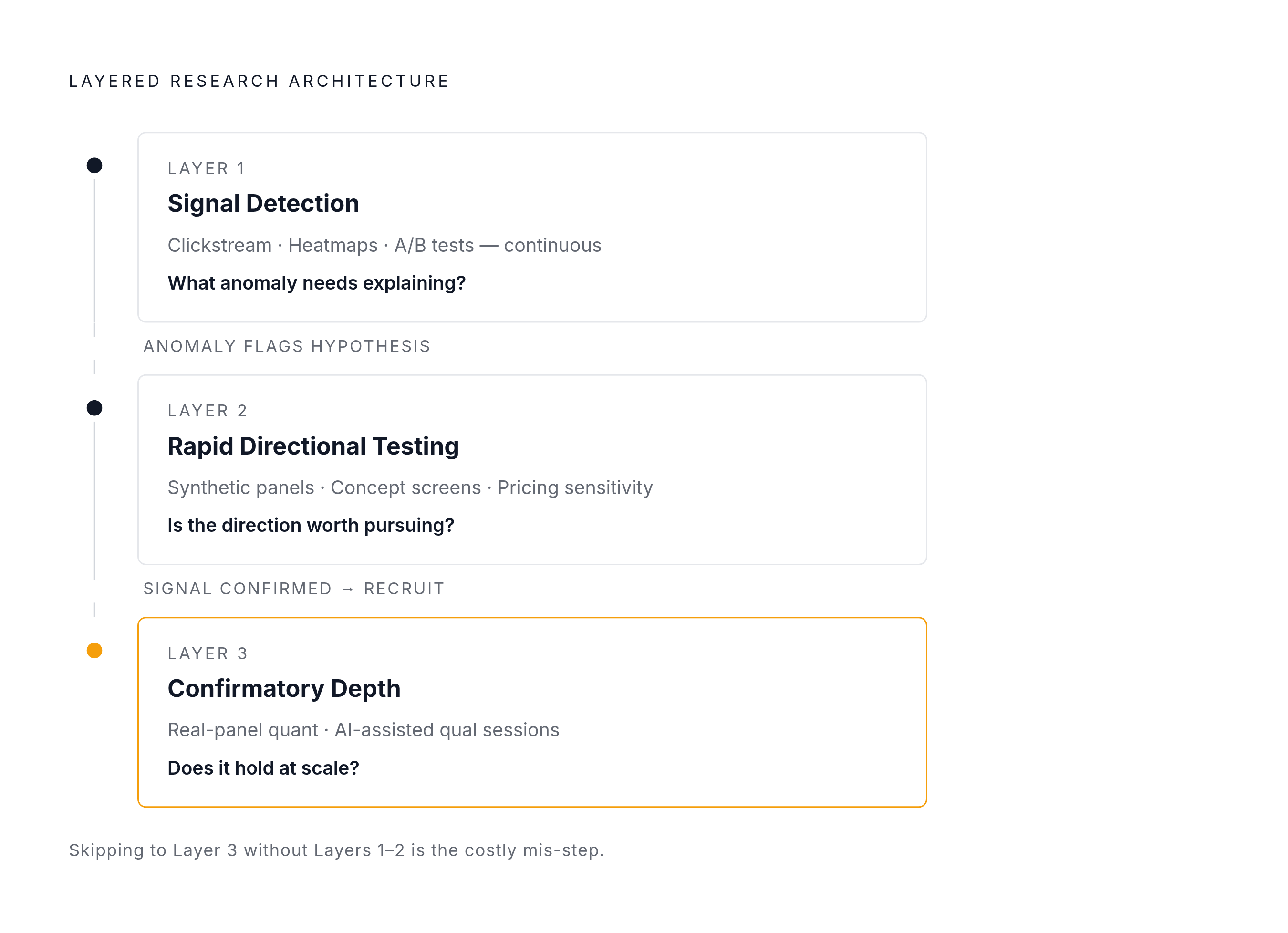
No single method covers all four variables once a study gets big. The real question is which sequence of methods, layered together, actually gets you there.
Signal detection comes first: behavioral and observational data running continuously in the background, flagging anomalies and surfacing the questions worth chasing down.
Rapid directional testing comes next, synthetic panels or fast-turnaround surveys used to pressure-test a hypothesis before you commit real recruitment budget. Concept screening, messaging tests, and pricing sensitivity work all belong here.
Confirmatory depth is the last layer: a real-panel quantitative study or AI-assisted qualitative sessions, brought in when the stakes justify the investment and you need to validate what the earlier layers pointed toward.
Continuous discovery is what actually makes this run. Small, frequent research moments built into the sprint cycle, with the three layers feeding each other instead of running as separate phases that only talk in a quarterly readout.
Most organizations already lean on research to inform major decisions, but the share treating research as essential at every level of business strategy, rather than a nice-to-have, has been climbing fast. The organizations making that jump are running research as a continuous system, not a one-off deliverable tied to a project milestone.
I've watched this failure mode sink good teams more than once: heavy research investment at project kickoff, heavy investment again right before launch, pure assumption in the stretch between. Two checkpoints with a blind spot in the middle isn't rigor, and it's exactly where a team that thinks it's doing careful research gets caught flat.
For planning purposes, sketch it as a matrix: business question type on one axis, speed constraint on the other, each cell pointing to the layer combination that fits. Rough as that sounds, it's concrete enough to bring into a planning meeting.
The organizational conditions that determine whether a methodology choice actually works
Picking the right method matters, but it's not sufficient on its own. Three organizational conditions decide whether that choice pays off once the study is underway.
Infrastructure is the first. AI-assisted synthesis, real panel access, automated quality screening are prerequisites now for large-scale research at sprint speed, not nice extras. Teams without them stay permanently a cycle behind the teams that have them, and the cost gap between AI-assisted workflows and manual ones has gotten wide enough to show up directly in project timelines, sometimes cutting them close to in half.
Research ownership is the second. The shift toward democratized discovery, where PMs, designers, and founders run research themselves alongside dedicated researchers, needs real guardrails on method selection to actually work. Democratization without a framework produces fast research matched to the wrong question, which is worse than slow research, because it looks legitimate on the surface.
Activation discipline is the third. The metric that matters at the end of a large study is the activation rate, the share of key insights that turn into an actual decision or a shipped change, more than how polished the insight deck looks. Research that doesn't move a decision functions mainly as documentation, and documentation needs a filing system more than a methodology framework.
Regulatory requirements rolling out around AI use in research add a compliance layer for teams using AI anywhere in the process. That's a reason to write down why you picked the method you picked, and how AI factored into it, before someone asks you to explain it after the fact.
The teams that get this right at scale aren't the ones with the biggest research budgets. They're the ones who treat method selection as a design problem in its own right, who match each layer of the architecture to the question it can actually answer. Platforms that pair real-panel depth with synthetic simulation and AI-moderated interviewing exist to make that three-layer architecture something a team without a large in-house research group can run, rather than something they read about once and admire from a distance.