UX Research for Global Product Launches
AI-moderated research reveals market-specific breaks before global launch.

Most global launches fail the same way: the product works fine at home, then hits three foreign markets and quietly breaks. The code usually holds up fine; the assumptions underneath it are what give way. This piece is about how UX research, done with the right methods, can surface those breaks before a single feature ships, and why the methods that used to make this kind of research impossible on a launch timeline aren't the constraint anymore.
What UX research for a global launch actually has to answer
A launch team needs answers in four places, and most teams only check one.
Cultural and linguistic fit is the obvious one. Does the copy, the tone, the framing land the way you meant it, or does it carry a connotation you didn't intend? That's the layer everyone checks, usually through a translation review.
Behavioral fit gets skipped more often. I've watched teams assume users in Jakarta and users in Denver move through an interface the same way, then get confused when the funnel data says otherwise. They follow different paths, they prioritize different features, and they drop off at different points. If your onboarding flow assumes a certain order of operations, that assumption might just not hold somewhere else.
Then there's trust. What makes a product feel legitimate varies by audience: some markets want institutional backing and certifications, others want peer reviews and visible community activity, and almost everyone wants to see a payment method they actually recognize. Skip this layer and you'll misread a trust problem as a conversion problem.
And pricing sensitivity, independent of whatever the currency converter tells you. A price that reads as fair in one market reads as either insulting or suspicious in another, and that has nothing to do with exchange rates.
Here's the distinction that trips teams up: localization and adaptation are different jobs. Translating your copy is table stakes, the bare minimum. Testing whether that translated, adapted version actually works for the market it's headed into requires separate research entirely.
The research also has to produce something you can act on. Cultural awareness is nice at a dinner party; it doesn't move a roadmap. A good study should end with a specific decision changed: a feature reprioritized, a message rewritten, a price point adjusted. If the study just confirms "yep, markets are different," it wasn't worth running.
One more wrinkle, and it's one I keep running into: certain professional segments and demographic niches in non-English-speaking markets are genuinely hard to reach. Recruiting enough senior IT buyers in Vietnam, or working parents in a mid-size German city, through a traditional panel can eat months before you get a single interview scheduled. That constraint shapes everything about how this research has to be run.
Why traditional international research workflows break under launch timelines
Traditional qualitative research was built for one market at a time. You recruit, you schedule, you moderate, you synthesize, and then you move to the next market and start over. For two or three markets, that sequence alone can consume your entire pre-launch window, and that's before anyone's looked at the findings.
Recruiting is the first wall you hit. Reaching a specific professional or demographic profile in a non-English-speaking market through a standard panel can take weeks just to fill your session calendar, and that's assuming the panel has enough of the right people to draw from in the first place.
Cost is the second wall. Run moderated sessions across a handful of markets simultaneously, with human moderators, local recruiters, and translation support layered on top, and the bill lands somewhere most product teams can't get approved on short notice. So teams cut the number of markets instead, which defeats the point of a global study.
Outsourcing moves the bottleneck rather than removing it. Hand the research to an agency and you're back into weeks of briefing, weeks of fieldwork, weeks of reporting; and at the end you get a document, not a tool you can go back and query when a new question comes up mid-sprint.
Panel quality is its own problem, separate from cost and speed. Unmanaged commercial panels have real fraud issues and real fatigue issues; the average internet user gets hit with a steady stream of survey invitations every month, and response quality degrades accordingly. Bad data dressed up as a finished report is worse than no data, because it looks authoritative.
The real cost, though, isn't the delay. It's what the delay causes. When research takes longer than the sprint it's supposed to inform, the team doesn't wait, they decide anyway. So the actual opportunity cost of slow research isn't a late finding; it's a decision made with no research behind it at all.
How AI-moderated interviews and synthetic panels change what's researchable before launch
Two methods have changed what's actually possible here, and they work differently enough that it's worth separating them.
AI-moderated interviews run conversational sessions, in text or voice, that probe past a vague first answer the way a good human moderator would, then synthesize patterns across however many completed conversations you've collected. Cost per completed interview is a fraction of what a human-moderated session runs, which is the detail that actually matters: it means you can run five markets at once instead of one market five times. A team can pull qualitative signal out of hundreds of conversations, across multiple markets, in roughly the time a single traditional focus group used to take. They're well suited to usability walkthroughs, first-impression checks, and messaging tests where you need someone to talk through their reasoning, not just click a button.
Synthetic panels are a different animal, and it took me a while to trust the distinction. These are AI-generated personas built off real behavioral data: past survey responses, review text, documented behavioral patterns grounded in evidence rather than invented from an ungrounded prompt. That calibration step is the whole game. Panels built on real data show strong parity with human panels on concept tests, pricing tests, and positioning tests; generic, uncalibrated AI personas don't come close. A 2024 study from Stanford and Google DeepMind found that AI digital twins replicated human survey responses and social behavior at high accuracy, which matters because it means the evidence for this isn't just coming from vendors selling the tool.
Synthetic panels are the right call for early concept screening, pricing sensitivity work, message testing, and sorting through market entry hypotheses before you commit budget to fieldwork. They have a real limit, though: for a product with no real precedent, something genuinely new, accuracy drops off fast. The model has learned what people have done. It hasn't learned what they'll do with something they've never seen, because nobody has.
Used together, the two methods split the labor sensibly. Synthetic panels do the first pass, generating hypotheses and flagging where markets diverge. AI-moderated interviews with real people then go validate, deepen, or kill the findings that matter most. And the whole thing runs as a loop, not a single event before launch; what you learn in round one reconfigures what you test in round two.
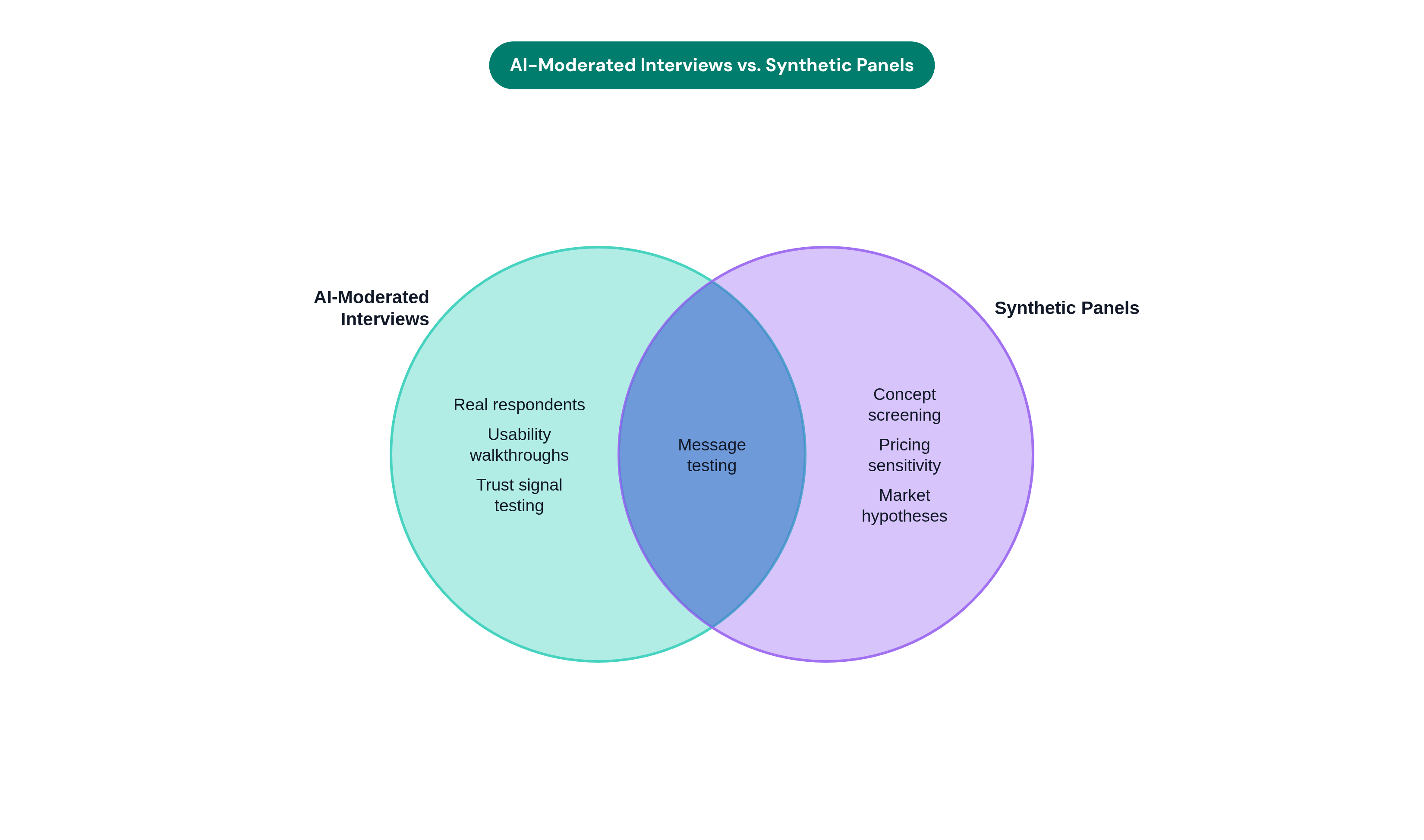
Running a multi-market UX study before launch: the method layer by layer
Stage one is the synthetic market scan. Run the same concept, value proposition, and pricing scenarios through calibrated synthetic panels across every target market at once. Look for where the responses split: which features land differently, which price points create resistance, which piece of messaging confuses people in one market and clarifies things in another. The output is a shortlist rather than a final answer. It tells you which markets and which hypotheses actually need real people to weigh in.
Stage two brings in real respondents, AI-moderated. Deploy interviews and task-based usability sessions across the markets stage one flagged, running them simultaneously rather than one after another. This is where you chase the questions synthetic panels can't answer with confidence: unfamiliar interaction patterns, trust signals tied to local context, emotional reactions to specific brand language. Access to verified panels spanning tens of millions of respondents across dozens of countries is what removes the old recruiting bottleneck; you're not waiting weeks to fill a session calendar in one market before moving to the next.
Stage three is synthesis and routing findings back to decisions. AI synthesis tools pull themes and contradictions out of hundreds of sessions, cutting down the analyst hours that used to be required to make sense of it all. Every insight should map to something concrete: a design question it closes, or one it reopens. Contradictions between markets deserve as much attention as agreement does, since that's exactly where you learn whether localization investment is warranted or whether one design travels fine everywhere.
This process has limits, and they're worth naming plainly. It doesn't replace in-person research where physical context is the product, retail environments, hardware, health settings. It doesn't replace accessibility testing with real users with disabilities. And it doesn't help with behavior the model has never seen data on. Adoption of AI across researcher workflows has roughly doubled in the space of a year, and teams that have folded these stages into their process report going from study configuration to synthesized findings in days, not the weeks it used to take.
Where cultural differences show up in UX — and how to design research that catches them
Navigation is the first place things diverge, and it's subtle enough that teams often miss it entirely. Menu depth that feels natural in one market feels cluttered or sparse in another; the balance between search and browse shifts; how much information people expect on one screen varies more than most product teams assume going in.
Trust signals aren't universal, and this is worth sitting with. Some markets respond to certifications and regulatory badges. Others care more about peer reviews and visible community activity than any institutional stamp. And payment trust deserves its own callout: a checkout that doesn't show a locally familiar payment provider, not just a card type but a specific, recognized brand, generates drop-off that can look like a design flaw when the underlying cause is really a trust flaw.
Language runs deeper than translation. Idioms, formality level, whether a culture prefers direct or indirect phrasing, all of this shapes how an error message or a call to action actually lands, and none of it gets caught by a standard translation pass. You need someone reacting to the live copy, not proofing it.
Visual conventions matter too: color meaning, how icons get read, how much density on a screen feels normal versus overwhelming. These are all directly testable with localized prototypes, so there's no excuse for guessing.
The sharpest version of this, the one that took me longest to internalize: don't just test whether someone can finish a task. Test what they assumed the product was for before they even started, and whether the interface confirms that assumption or fights it. Task completion rates will lie to you here. A user can complete a flow while completely misunderstanding what they just did. Catching that requires culturally specific scenario framing, first-click tests on localized wireframes, and open-ended first-impression questions, not just a stopwatch and a completion rate.
Using research to make pricing and market entry decisions before committing resources
Pricing carries as much design weight as it does financial weight. How a number gets presented, anchored against a higher tier, bundled, broken into a payment plan, changes what it feels worth, and that effect isn't constant across markets. It has to get tested directly, not assumed from a spreadsheet.
This is where synthetic panels earn their keep. You can run multiple pricing models at once, penetration pricing, skimming, value-based tiers, a freemium entry point, across every target market simultaneously, and see where willingness-to-pay actually breaks down before you've committed to a number anywhere. You can also learn which features people expect for free and which ones they'll actually pay extra for, which reshapes the whole pricing structure, not just the sticker price. And because the testing runs at this speed, real A/B concept comparisons across markets become something you can fit inside a pre-launch window instead of something you wave off as a nice-to-have.
Market entry sequencing benefits the same way. Research can rank target markets by more than population size: which ones show the strongest intent alignment, the least onboarding friction, the best fit between your value proposition and what people there actually want.
Context matters going into 2026 specifically. A large share of consumers globally report feeling worse off financially, with cost-of-living pressure named as the driver, so products entering price-sensitive markets now are facing a more cautious buyer than the one earlier research cycles were built around. Pricing work needs to reflect that, not the assumptions baked into a study run two years ago.
It's worth being honest about where synthetic panels are strongest and where they're not: pricing and concept testing, in established categories with known consumer segments and structured scenarios, is close to the ideal use case. That's exactly where calibration shows its value and where a generic, uncalibrated AI prompt falls apart. And the payoff isn't abstract. Firms with strong consumer insight capabilities are, per Forrester's research, substantially more likely to report strong revenue growth than firms without that capability. The return here comes from better sequencing and better pricing decisions, not just a cleaner interface.
Building a reusable global research foundation rather than a one-time pre-launch study
Here's the shift that actually changes the economics, and it's the one I had to sit with before it clicked: build a behavioral model of your audience in a given market once, then query that model against every future decision, a feature change, a pricing adjustment, a new market entry, without re-recruiting from scratch each time.
Teams running continuous research this way ship faster and see stronger feature adoption than teams that treat research as a series of isolated, one-off studies. The gap compounds. Retention gains from ongoing UX research don't plateau the way a single pre-launch study's value does; they keep growing the longer research stays embedded in the product cycle rather than bolted on before a launch date. And research's actual influence on product decisions has climbed sharply among teams that track it, more organizations now judge research by the decisions it changed, not the number of reports it produced.
A calibrated synthetic panel, once built, becomes infrastructure rather than a deliverable. You can query it against a messaging change next quarter, a new feature next year, a competitor's move next month, without paying the cost or eating the time of a fresh recruitment cycle every time a question comes up.
That requires a different posture inside the org: research as a standing capability the team runs itself, not a vendor engagement that starts and stops with each launch. It also changes the math on every launch after the first one. Your second market entry gets faster and cheaper, not because the market is easier, but because the foundational model of that market already exists. Each launch adds to the asset instead of spending it down.
This architecture pairs a verified global panel with synthetic AI agents that can simulate a target market on demand. It turns what used to be a single pre-launch study into a research layer that sticks around, informing every product and market decision that comes after the launch, not just the one before it.