UX Research ROI for Product Leadership
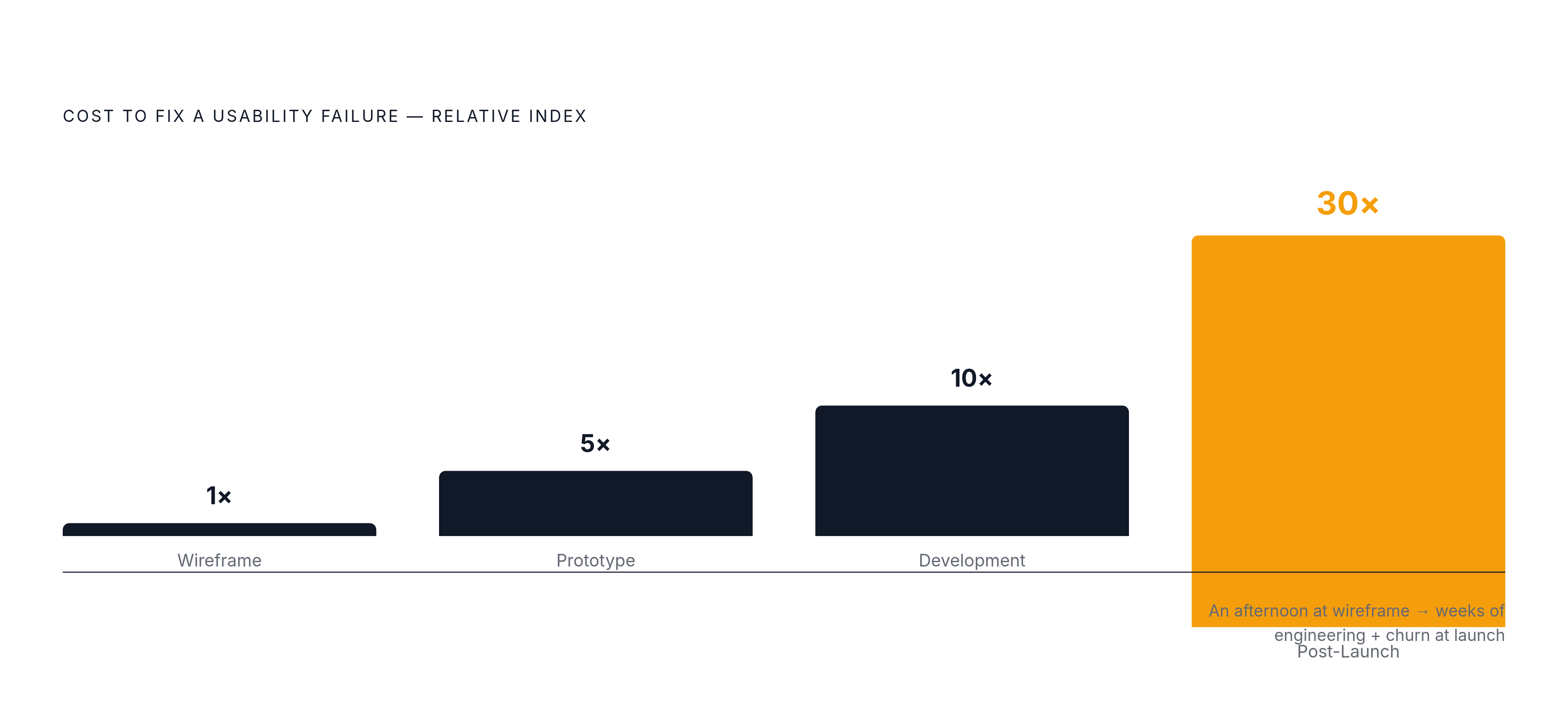
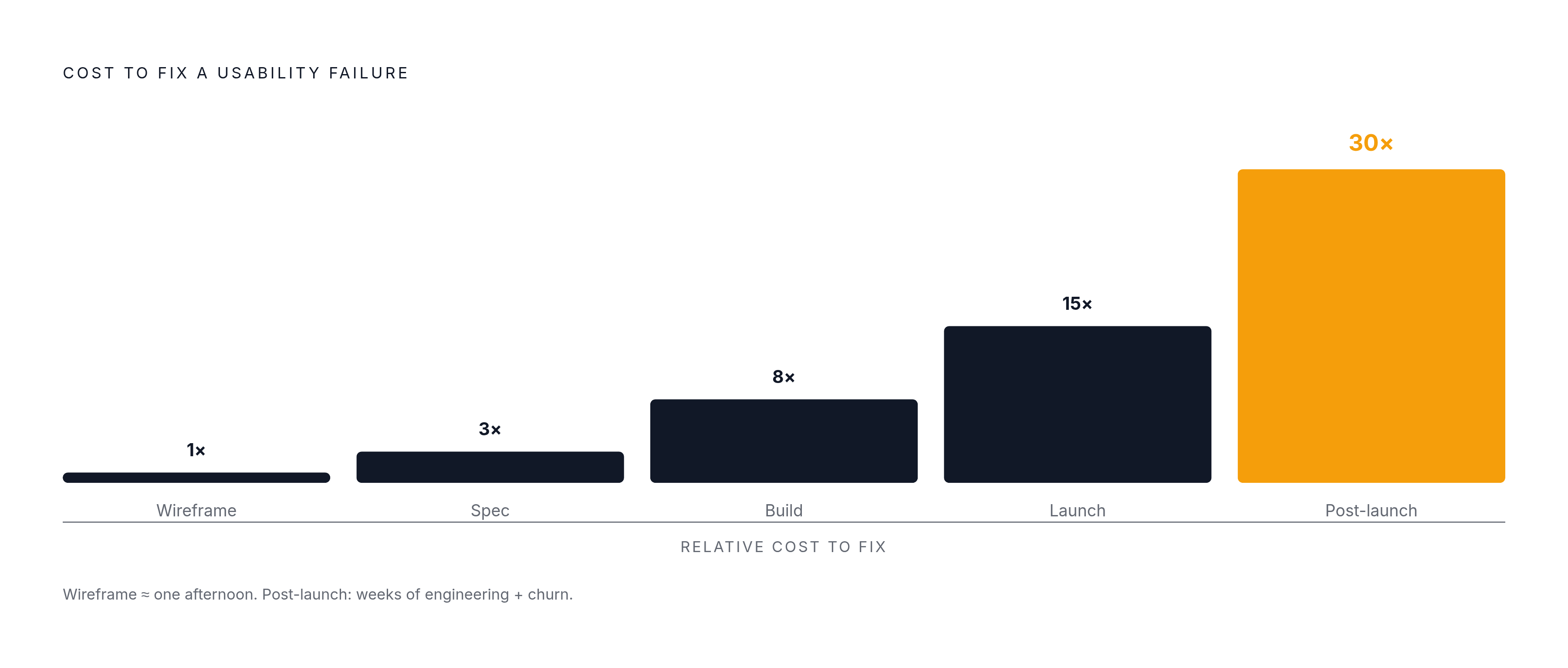
Catching UX problems early costs 30 times less than fixing them after launch.

The real cost of a UX problem is how late you catch it. A usability failure spotted in a wireframe costs a designer an afternoon; the same failure caught after launch costs weeks of engineering time, an inbox full of angry tickets, and a churn number that shows up in next quarter's board deck. Product leaders already think this way about backlogs and cost of delay. Almost nobody runs the same math on research, and that gap is the subject of this piece.
What the financial evidence actually shows about UX research returns
I went looking for hard numbers because "research is valuable" isn't something anyone can act on. Most product orgs still treat UX research as a nice-to-have, first thing cut when budgets tighten and hardest thing to tie back to revenue. The numbers say otherwise, and they've said so for years now.
McKinsey tracked 300 public companies over five years and found top design performers grew revenue 32% faster than their industry peers, with 56% higher total returns to shareholders. That's a capital allocation signal, the kind that shows up in how the market actually prices a stock, not a slide in a design team's deck.
Zoom out further and the pattern holds. The Design Management Institute found design-centered companies outperformed the S&P 500 by 228% over ten years. Forrester's 2025 Total Economic Impact study on the UserTesting platform found 415% ROI and $9.4 million in benefits over three years for orgs running research through it, including $2.5 million in developer rework avoided. That's avoided cost — money that never left the building because someone caught the problem in week two instead of month six.
You don't even need much testing to get most of the way there. Nielsen Norman Group's research shows testing with just 5 users uncovers 85% of a product's usability problems. Five people and an afternoon gets you most of what a hundred participants and a six-week fielding window would.
So why doesn't everyone do this? Econsultancy found 45% of companies run no UX testing at all. The ROI numbers above are airtight at companies that already believe in research; they say nothing about why the other 45% never got there. That's the harder question, and it's the one this piece is actually chasing.
How research gets delayed in most product organizations — and why it keeps happening
Walk through the standard workflow slowly, because the failure never shows up at any single step. Someone commissions a study. An agency or a centralized team picks it up. Everyone waits. Recruitment eats two weeks, fieldwork eats another one or two, synthesis eats a third. By the time findings land, the roadmap has already moved on without them.
That's the model working as designed, not bad luck. Three failures do the damage.
Research usually gets requested after the decision is half-made. Someone wants validation, not direction, so even a clean study can only confirm or complicate a call that's already locked in. Long cycles also train teams to skip the step entirely rather than blow a sprint waiting on results, and "we'll validate post-launch" becomes the default. That just defers the cost of failure to a point where it's roughly 30 times more expensive to fix. Agency dependency turns research bandwidth into a negotiation instead of something you reach for on instinct; nobody runs a quick usability check when running one means a vendor call and a statement of work.
The org chart tells the same story, honestly. ZDNET found only 13% of companies have a UX leader at the C-suite level. Research sits as a service function, something teams request rather than something baked into how decisions get made, and that positioning is the actual root of the delay. It's more than laziness, and more than budget.
What you get out of this is research debt: teams ship on assumption, stack up unvalidated decisions, and pay for all of it at once when churn spikes or the support queue floods. Analytics doesn't bail you out here, either. Your dashboard tells you what users did; it almost never tells you why, and a team optimizing purely on behavioral metrics without qualitative context just gets faster at improving the wrong thing.
This isn't a researcher problem, and it isn't really a budget problem, even though it gets blamed on both. It's a process design problem, which puts it squarely inside a product leader's authority to fix.
What continuous discovery looks like in practice and what it costs to switch
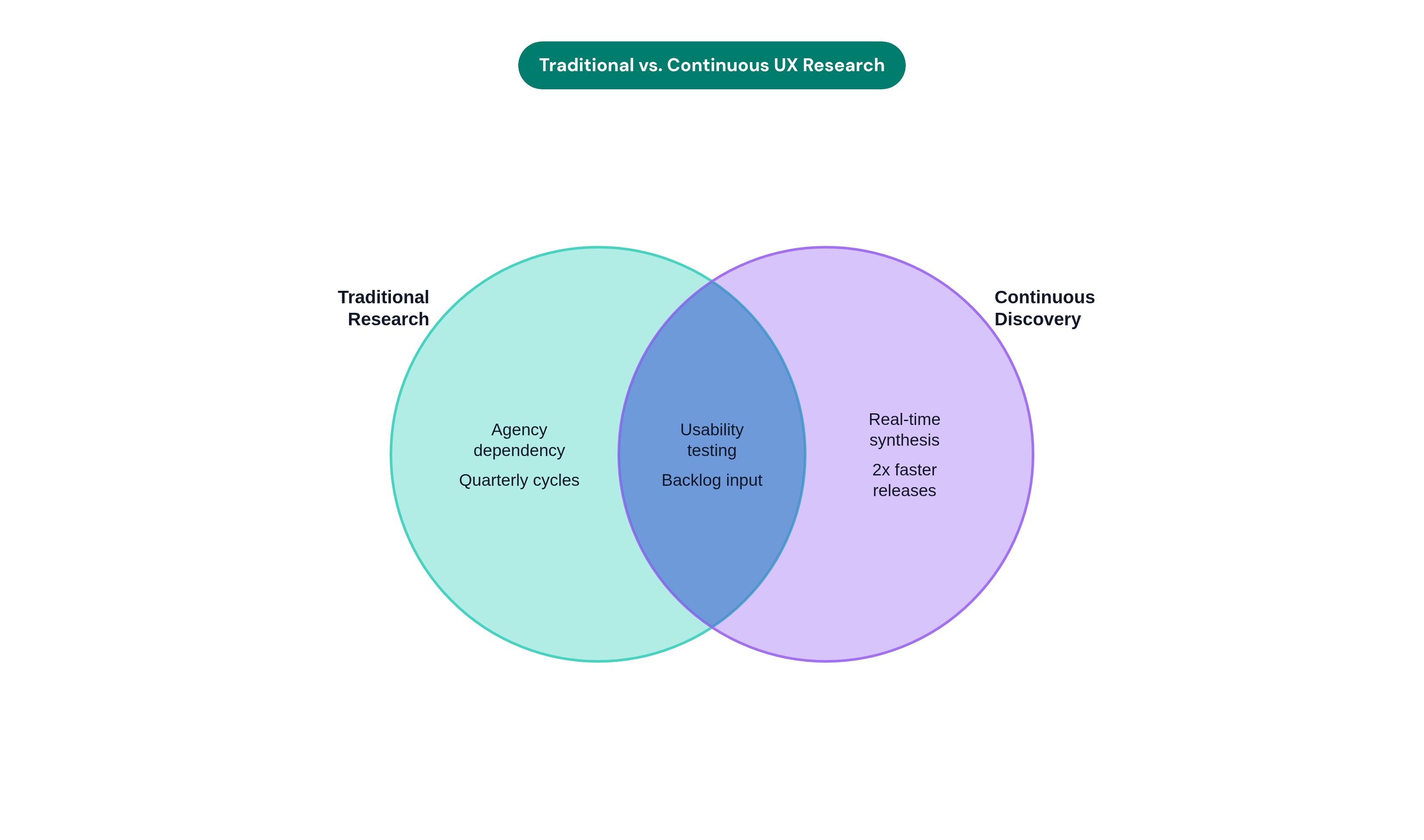
Continuous discovery flips the model. Research gets embedded into the sprint itself, running as an always-on signal rather than sitting on its own calendar as a quarterly checkpoint nobody quite plans around.
A few things change when a team makes the switch. Questions get scoped tightly to whatever decision is in front of the team that sprint, not to open-ended exploration. Synthesis happens close to real time instead of landing in a report two weeks after anyone still cares. Findings feed straight into backlog prioritization, skipping the design review that used to sit between the two.
The performance data backs it up. The 2024 ProductBoard Product Excellence Report found teams running continuous discovery report release cycles twice as fast, with 30% higher feature adoption. A velocity number and a quality number moving together. That doesn't happen often enough to ignore.
The switch costs something real, though. It means renegotiating how research bandwidth gets allocated, from project requests routed through a queue to standing capacity a team owns outright. That's an operating model change, not a tooling purchase, and a lot of teams try to buy their way into it instead of restructuring for it. It doesn't work.
The payoff shows up fast once it's in place, though. A product manager can run a lightweight usability check on a prototype the same week they write the spec. Decision and evidence travel together instead of arriving three weeks apart.
What continuous discovery doesn't fix on its own is speed of insight generation. You've decentralized the request, sure, but you're still bound by how fast you can recruit participants and make sense of what they tell you. That's the next wall.
How AI-powered research methods compress the timeline between question and answer
AI-moderated interviews run adaptive one-on-one conversations with a large number of participants at once, probing follow-ups dynamically instead of reading down a fixed script. That collapses the part of research that used to eat the most time: fieldwork.
Put it in cost-of-delay terms. A cycle that used to take weeks can return usable signal in hours, which moves the discovery timestamp earlier in the product timeline by default. That's the whole argument for why this matters to a product leader, not just to a research team stuck in the weeds.
Synthesis gets the same treatment. LLM-driven analysis of open-ended survey responses, support transcripts, and review data surfaces themes in hours that would take a human researcher days of sorting and re-sorting quotes by hand. This is useful for a formal study, and even more useful for post-launch monitoring, where you're keeping a constant ear on what people say about the thing you shipped rather than running one discrete study and moving on.
The industry's already moving this way at scale. The 2024 GRIT report found 83% of researchers plan to invest in AI for research in 2025, and 61% of insights professionals already use AI or predictive analytics in their work. This is close to table stakes at this point.
One benchmark from practice: a food brand concept test that used to take three weeks with traditional methods came back in roughly 72 hours using AI-powered feedback analysis. Real workflow, not a lab condition.
Speed creates its own failure mode. Lean too hard on automated output with no methodological check, or run your study on a commodity panel with fraud risk baked in, and you get fast answers that are also wrong ones. The quality of your participant pool matters as much as the speed of your synthesis layer, and neither substitutes for the other. Treating speed as the only variable that counts is how teams end up shipping confidently on garbage data.
AI-moderated interviews with real respondents solve the speed problem. Reach and cost at scale are a separate constraint, one they don't solve on their own, which is where synthetic panels come in.
Where synthetic consumer panels fit into a product team's research stack
Get the distinction straight first: synthetic panels are AI-generated proxies simulating consumer responses, not real people. This is a different use case entirely from AI-moderated interviews with actual humans, and confusing the two is exactly where teams get burned.
Calibrated synthetic panels earn their place in a few specific situations: early-stage concept testing and pricing exploration before you've committed budget to a full study, hard-to-reach populations like C-suite executives or niche professional segments where traditional recruitment drags on for months, and privacy-first contexts where exposing real consumer data creates compliance exposure nobody wants to deal with.
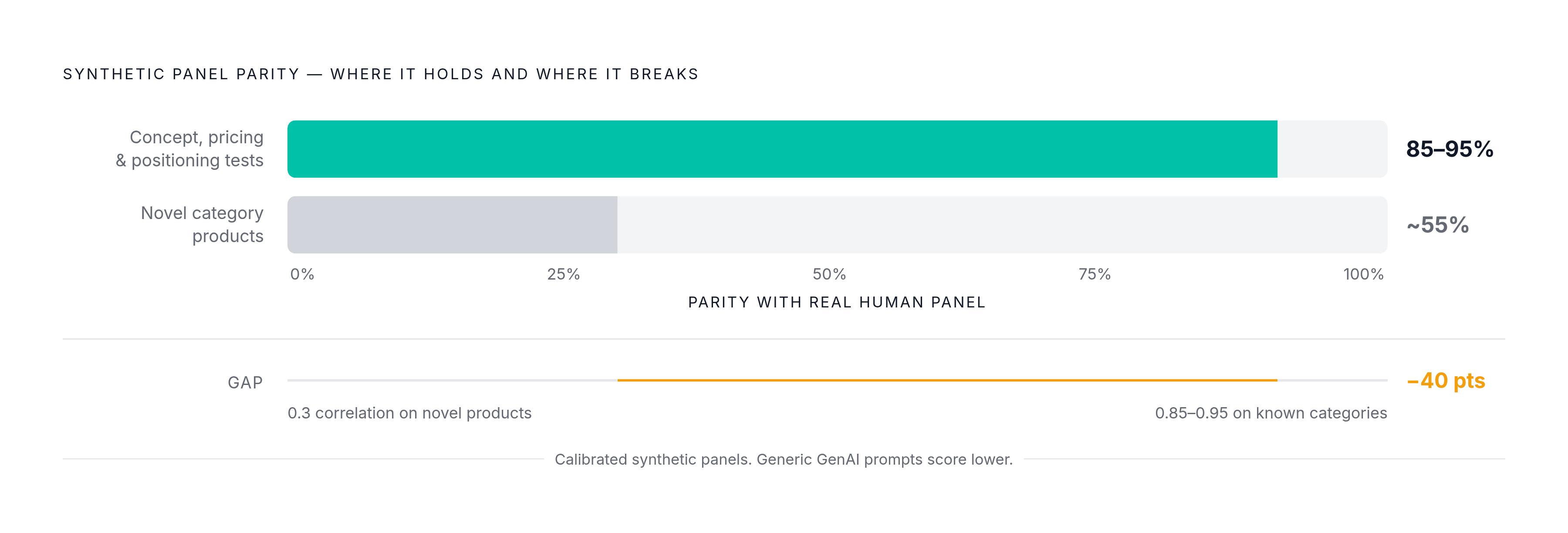
The accuracy numbers hold up better than most people assume, as long as the panel's actually calibrated. A 2024 Stanford and Google DeepMind study with 1,052 participants found AI digital twins replicated human survey answers with 85% accuracy and social behavior with 98% correlation. Calibrated synthetic panels more broadly land at 85 to 95% parity with real panels on concept, pricing, and positioning tests. Speed is the other half of the pitch: the 2025 GreenBook GRIT report found concept-to-signal cycles that take four to eight weeks with traditional panels come back in hours with calibrated synthetic audiences.
Now the limits, because adoption is running well ahead of judgment here. A Marketing Science study found only a 0.3 correlation between synthetic and real responses on genuinely novel products. Synthetic panels do fine on iterations and line extensions; they fall apart on anything that creates a new category. Forrester found 42% of consumer insight leaders have implemented some form of synthetic data, yet the 2025 GRIT Report found only 13% of brand-side teams report satisfaction with AI-powered research quality. That gap, between what people adopted and what they actually trust, tells you something about how messy this rollout has been. Generic GenAI prompts run without calibration land closer to 55% parity with real panels, a shortfall invisible to teams who assume all synthetic research performs the same and skip the calibration step.
The practical model treats the synthetic panel as a filter that precedes a full study, not a replacement for one. Run it first to pressure-test a hypothesis cheaply, then commit to a full human-respondent study once the hypothesis survives that pass. Some platforms give product teams both sides of this: verified human panels for studies that need real people, and calibrated synthetic audiences for the early filtering pass. The choice between the two stops being a procurement decision every single time.
And here's what turns this from a one-off tactic into infrastructure. A calibrated behavioral model of your target audience, once built, runs against every future product decision after that. You're building an asset that compounds, not buying a single study.
How to build the internal business case when research budgets are under scrutiny
Finance responds to avoided cost far more reliably than to claims that research "creates value." The $2.5 million in developer rework avoided from Forrester's TEI study lands harder in a budget meeting than a revenue growth correlation, because it maps onto a line item someone in the room already owns.
Here's how to build that case for your own org. Take a recent feature that needed real post-launch rework and put an actual number on the engineering hours and opportunity cost it burned. Then ask where in the cycle a usability test would have caught it, and what that test would have cost. The gap between those two numbers is your argument, grounded in your own shipping history instead of theory.
There's a second argument for product leadership specifically, running alongside the cost one rather than replacing it. Continuous research cuts the number of decisions made on pure assumption, which cuts how often you get forced into an expensive pivot mid-cycle. That's a release cycle argument, not a design quality argument, and it lands better with people who think in sprints and roadmaps than with anyone quoting usability heuristics.
Resist leading with the portfolio-level numbers, tempting as they are. The 228% S&P outperformance and the 32% revenue growth figure make good context, but they're too far removed from any single budget line to win the ask on their own; they make the strategic case, and the operational case needs its own footing. Mixing the two together is how a pitch gets dismissed as aspirational.
What follows is an organizational ask: research capacity needs to get funded as infrastructure, not as a project cost. An agency engagement and standing, embedded research capacity run on entirely different budget logic, and trying to fund the second one like the first is where most of these pitches stall out. On-demand access, to a verified human panel and to calibrated synthetic audiences, is what actually changes the math. It lets a team run a study at the moment of decision without a procurement cycle sitting in the way. That's the move that turns research from a capital expense into an operational one, with a cost per study you can actually predict.
What the research infrastructure of a fast-moving product org actually looks like
The end state: research capacity that's on-demand, lives at the team level, and runs on the sprint's own rhythm, rather than a separate function teams have to petition every time they need an answer.
A few pieces make that real. An always-available respondent pool kills recruitment as a bottleneck, giving teams real human participants across geographies and demographics with no negotiation timeline attached. AI-moderated interviews let a team field a hundred conversations in the time it used to take to schedule ten, with no researcher moderating each one by hand. Calibrated synthetic audiences give early-stage pressure testing a directional signal, so nothing goes into engineering on pure guesswork. Synthesis tooling delivers findings in hours instead of a slide deck that surfaces two sprints too late to matter.
There's a timing pressure worth naming here. Gartner predicts a large share of enterprise applications will include task-specific AI agents by the end of 2026, up from a small fraction in 2025. Every one of those deployments is a new onboarding moment, a fresh trust-formation moment with users who've never dealt with an agent inside that product before. Teams without fast UX research capacity are going to miss those moments, and it won't be because they didn't care — their research cycle simply couldn't keep pace with their release cycle.
A continuously updated behavioral model of your audience isn't a deliverable you file away when the project wraps. It's a capability that compounds, one that gets sharper every time a new decision runs against the same foundation instead of starting over from zero.
The companies McKinsey, BCG, and DMI keep flagging as revenue and shareholder return leaders are the ones treating research as infrastructure instead of overhead. The distance between those companies and the 45% doing no UX testing at all reflects a decision-making gap more than a design gap. Closing it sits well within a product leader's power, starting with the next budget cycle.