Automated Research Synthesis Techniques
AI transforms raw research data into actionable patterns at scale.

Synthesis is the movement from raw observation to pattern, and then from pattern to something a team can actually act on. A quote is not a finding. A rating is not a finding. A behavioral trace from a usability session is not a finding. What converts those materials into something usable is the synthesis step, and that step has historically required a human being sitting with the data, reading, grouping, interpreting, writing, and then starting over when a stakeholder asks a follow-up.
Automated synthesis means AI is performing some or all of that movement instead.
What it is not: transcription, data collection, or dashboarding. Converting audio to text is transcription. Running a survey is data collection. Displaying numbers in a chart is dashboarding. All three are useful. None of them is synthesis. The confusion matters because teams sometimes adopt a transcription tool, find that their synthesis problem persists, and conclude that AI was oversold. It was not oversold. It was pointed at the wrong problem — like buying a map when what you needed was a compass.
The four techniques covered here, thematic clustering, sentiment extraction, cross-study pattern recognition, and AI-moderated interview analysis, all sit between raw data and the insight brief. Each handles a different type of input and a different failure mode. The question is no longer whether to use AI in synthesis. It is which approach fits which task.
How thematic clustering turns thousands of open-ended responses into a structured finding
The problem thematic clustering solves is volume. A skilled human coder can work through a few hundred open-ended responses with real reliability. A few thousand is a categorically different problem: one that either takes weeks or gets abbreviated in ways that quietly compromise the finding.
Thematic clustering works by embedding responses as vectors in semantic space, grouping them by meaning proximity, and labeling each cluster with a representative theme. The result surfaces structure that the human eye would miss at volume. Not because a skilled researcher cannot perceive patterns, but because no single person can hold thousands of responses in working memory simultaneously and determine which ones belong together. That cognitive ceiling is real, and it is not a function of effort.
The distinction that actually changes the output is semantic clustering versus keyword matching. Keyword matching groups responses that share the same word. Semantic clustering groups responses that convey the same meaning, even when expressed in entirely different language. A respondent who writes "I can never find my past orders" and one who writes "the account history is buried and useless" belong in the same cluster. Keyword matching separates them. Semantic clustering does not. Replicate that gap across thousands of responses and findings start to diverge in ways that matter.
Where this technique belongs: product feedback at scale, open-ended NPS follow-ups, any study where the researcher wrote "tell us more" and received two thousand answers. If that describes half the studies your organization runs, this technique is relevant to half your work.
One caution before moving on. Cluster labels are AI-generated summaries and can flatten nuance. A researcher reviewing representative quotes within each cluster before declaring a finding is still necessary. The AI identifies the structure. A human verifies that the label actually reflects what the responses say. Skip that step and you are trusting a summary of a summary, and the compounding distortion may not reveal itself until someone asks a question the brief cannot answer.
How sentiment extraction adds emotional weight and direction to thematic findings
A theme without sentiment direction is usually not actionable. "Pricing" as a theme can represent satisfaction, frustration, or confusion, and knowing that pricing was mentioned frequently tells a team almost nothing useful about what to do next. Knowing that pricing surfaces with frustration, predominantly among a specific segment, at a higher rate than any other theme: now you have something to work with.
Sentiment extraction classifies the emotional valence of each response or passage, typically positive, negative, mixed, or neutral. More capable implementations do this at the entity level, meaning "pricing" and "customer service" within the same response receive separate sentiment scores rather than a single composite. That granularity matters because real consumer responses are rarely tidy.
Better models also detect emotional register beyond the binary: urgency, confusion, delight, skepticism. When the research question concerns friction or motivation rather than overall satisfaction, that granularity is often the entire point. A response that reads as mildly negative on a simple valence scale might read as deeply confused on a more nuanced model. Those are different findings. They imply different interventions.
Where sentiment extraction belongs: voice-of-customer programs drawing from reviews, support tickets, and social listening; post-launch feedback monitoring; continuous brand tracking. The speed advantage in those contexts depends on sentiment extraction running continuously on incoming data, not being batch-processed at the end of a quarter.
One limitation worth naming directly. Sentiment models trained on general corpora can misread domain-specific language. "Sick" meaning excellent in youth consumer research will be classified as negative by a model that learned sentiment from general text — you could say the model just doesn't get the vibe. Clinical understatement in healthcare responses presents the same problem in a higher-stakes context. Domain calibration, fine-tuning the model on language patterns from the relevant category, is not optional when misclassification has real downstream consequences. It is the kind of step that gets skipped when teams are moving fast, and then quietly blamed for something else later.
How cross-study pattern recognition finds signals that no single study could surface
Most organizations run studies in isolation. A concept test from six months ago and a segmentation study from last quarter may share a directly relevant overlap, but if no one has compared them, the overlap stays invisible. The knowledge exists somewhere in the archive. Nobody has the bandwidth to surface it.
Cross-study pattern recognition works by indexing findings, themes, and sentiment scores across a library of completed studies, then surfacing recurring patterns, contradictions, and emerging signals that span projects. Think of it as a researcher who has read everything the organization has ever fielded and can answer, in plain language, what the archive already implies about a new decision. That is a genuinely useful capability. Most organizations are sitting on years of data that could inform current decisions and are not accessing it because the access problem was never solved.
The system improves with use. The more studies are indexed and consistently tagged, the more precisely it can identify patterns and extrapolate early signals. Each study adds to what all future studies can draw on. The archive becomes more valuable the more it grows, which is not how most research archives currently work.
Where this technique belongs: organizations that have fielded multiple studies over time and need to brief a new product decision without starting from scratch; teams entering adjacent markets who want to know what existing data already implies before commissioning new fieldwork. The ability to ask "what do we already know about this?" before spending budget on new research is one of the most underused capabilities in research operations.
What it requires is also real. Studies must be stored in a structured, searchable format with consistent tagging. Organizations with siloed or inconsistently archived research will get limited benefit until the archive is in order. If the organizational memory lives on a shared drive full of PDFs named something like "Finalv3REVISED," the pattern recognition system has nothing coherent to index. Getting the archive into shape is unglamorous work. It is also a prerequisite, and deferring it does not make it smaller.
How AI-moderated interview analysis extracts structured insight from conversational depth
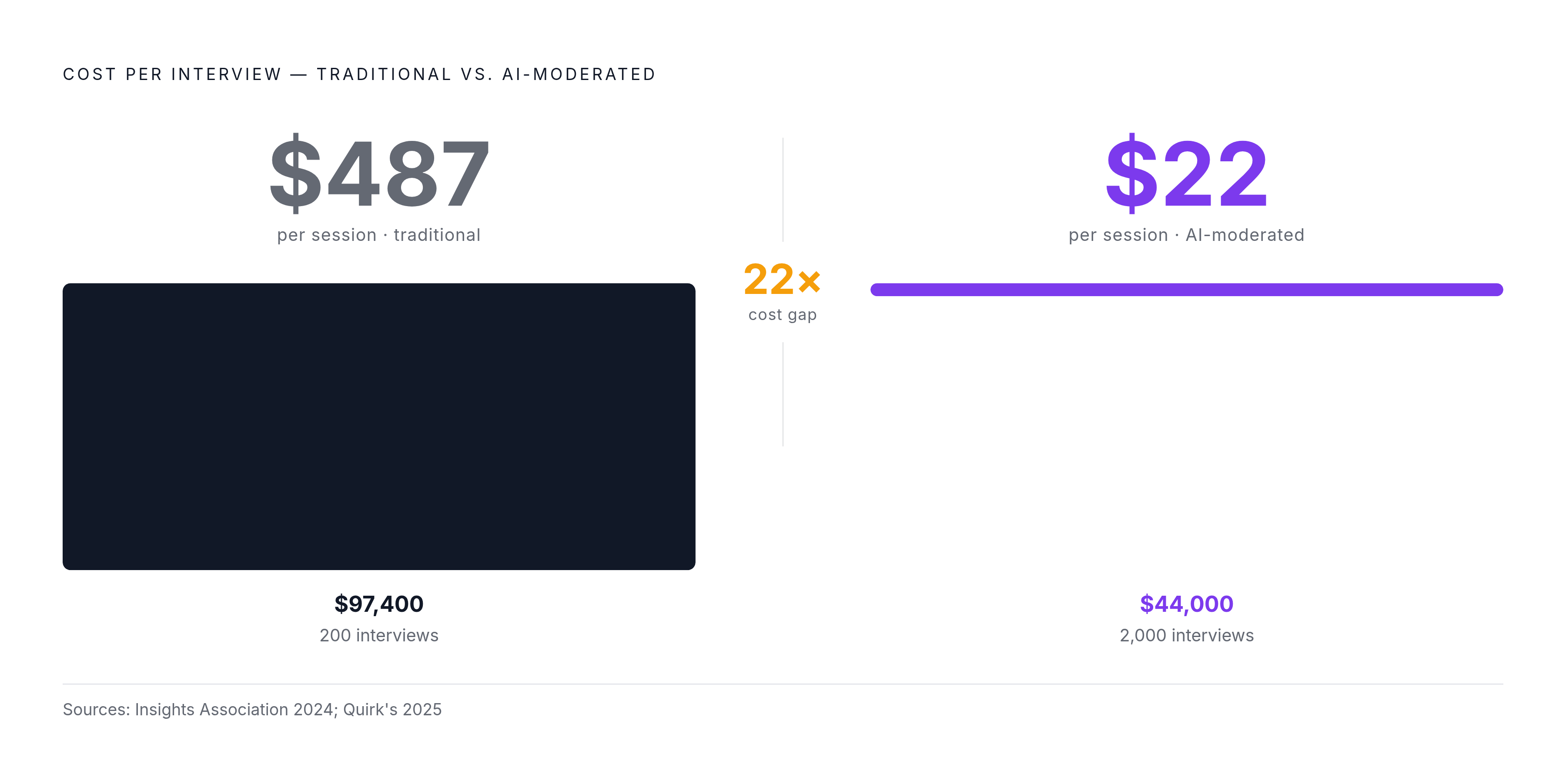
Traditional qualitative interviews produce rich data and are expensive to run at scale. A 60-minute moderated interview costs roughly $487 all-in, per the Insights Association's 2024 Industry Pricing Study. At that rate, a sample of 200 conversations costs nearly $97,400 in fieldwork alone, before a single minute of analysis begins. The consequence is predictable: qualitative depth gets reserved for high-stakes decisions, and most research questions receive either no qualitative input or a sample too small to generalize from with any confidence.
AI moderation drops the all-in cost to roughly $22 per completed conversational interview, per Quirk's 2025 Researcher SaaS Report. A sample of 2,000 AI-moderated interviews becomes less expensive than a traditional sample of 200. That is not a marginal cost improvement. It changes what is economically feasible. Research questions that never justified a budget line can now be answered.
The synthesis advantage goes beyond the cost reduction. The system does not simply capture text. It simultaneously tags themes, tracks sentiment, flags moments of hesitation or contradiction, and generates a structured summary, which means synthesis begins during fieldwork rather than after it. By the time the last interview concludes, a first-pass analysis is already in draft.
Better implementations separate function deliberately. A guider agent tracks topical coverage and decides when to probe. A communicator agent handles phrasing and conversational naturalness. Per MIT Sloan Management Review's 2026 reporting on multi-agent interview systems, this separation produces interviews that are both methodologically disciplined and conversationally coherent, two qualities that are genuinely difficult to achieve simultaneously. In traditional moderation, getting one usually costs the other.
The output is not a raw transcript. It is a pre-structured document: themes ranked by frequency and sentiment, representative quotes surfaced per theme, contradictions flagged for human review. Synthesis arrives as a byproduct of the interview itself.
The risk worth flagging is specific. AI interviewers can generate summaries that sound authoritative and misrepresent edge-case responses. The system produces confident-sounding language by design, and that same quality makes it possible to miss a genuinely idiosyncratic response that a skilled human moderator would have recognized as significant. Human review of flagged contradictions is the quality gate that keeps the system honest. It is not optional; it is the part of the workflow that makes the rest of it trustworthy.
Matching the right technique to the right research problem
The four techniques are not a hierarchy. They address different inputs and different bottlenecks. Mismatching technique to problem produces worse results than no automation at all.
Thematic clustering belongs when the input is large-volume unstructured text and the question is "what are people talking about?" Sentiment extraction belongs when themes are already known and the question is "how do people feel about each one, and does that differ by segment?" Cross-study pattern recognition belongs when an existing research archive exists and the question is "what do we already know that bears on this decision?" AI-moderated interview analysis belongs when the question requires conversational depth and the team needs synthesis at a scale that manual moderation cannot reach.
Many real research challenges require more than one technique in sequence. A concept test might begin with AI-moderated interviews for depth, apply thematic clustering to the resulting transcripts for structure, then run sentiment extraction on the themes for direction. Each technique hands its output to the next. The synthesis gets richer at each stage without proportionally increasing the time required.
The practical choice also depends on what the team already has. Existing data, from surveys, support logs, or archived transcripts, favors clustering, sentiment extraction, or cross-study methods. A new research question with no relevant archive favors AI-moderated interviews from the start, because the raw material has to be generated before it can be synthesized. Starting with pattern recognition when there are no patterns indexed yet is just spinning up infrastructure and waiting.
Where human judgment stays in the loop across all four techniques
The risk in automated synthesis is not that the system fails visibly. It is that it produces an output that reads like a finding, gets treated as one, and influences a decision that the underlying data did not actually support. Only 27% of organizations using AI say they actively work to reduce bias in their AI outputs, per 2025 data. The majority are not treating bias mitigation as a systematic step. That will eventually be visible in the decisions those organizations make, and the connection will be difficult to trace.
Hallucination risk is real and asymmetric. A fabricated correlation or an invented theme does not announce itself as fabricated. It arrives formatted like an insight, cited with the apparent confidence of a well-run analysis, and gets embedded in a brief that stakeholders read and act on. The source data never supported it. Nobody reading the brief knows that.
Cross-study pattern recognition carries its own specific failure mode. AI may surface a pattern across studies that reflects a shared methodological artifact rather than a real consumer behavior. If two studies used identical question wording that introduced a leading framing, the system will find the consistent pattern in the responses without any awareness that the pattern was produced by the question, not the consumer. Human familiarity with the original studies is the check that catches this. The AI does not know what it does not know about how the data was collected.
Speed can also mask missing context. A global consumer brand in 2025 launched a campaign across 22 markets and watched performance collapse in one region almost immediately. The post-mortem revealed that AI-driven scheduling had placed the campaign during a national day of mourning, a detail absent from the behavioral data the system had access to. The system had done exactly what it was designed to do. Pattern recognition operates within its training data; it cannot reason about external context that was never ingested. That particular failure was expensive, and it is a category of failure that automation will not eliminate.
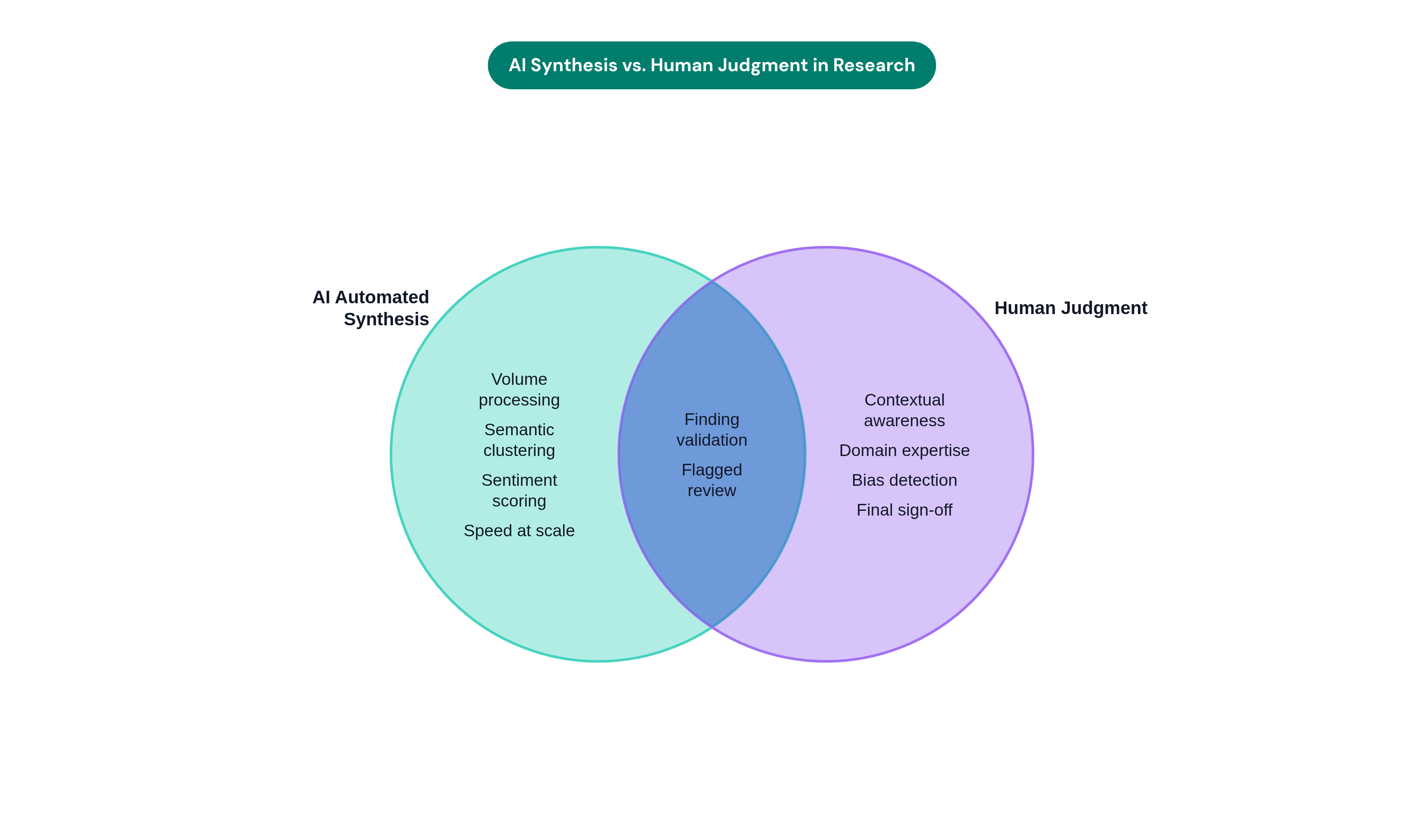
The practical standard across all four techniques is consistent: AI handles volume processing and first-pass structuring; a researcher reviews flagged contradictions, checks representative quotes within clusters, and takes responsibility for the final finding before it reaches a stakeholder. Triangulation with CRM trends, sales data, or traditional survey results before committing to high-stakes decisions remains sound practice. Automated synthesis is a very fast first draft. A human still has to sign the finished argument.
What teams can realistically expect when they add automated synthesis to an existing workflow
The measurable shift is time. Analysis that previously took weeks happens in hours. Usability studies that previously required a two-week analysis cycle are completing in 48 hours, per Perspective AI's 2026 research. That compression changes what a team can promise a stakeholder, and it changes what the stakeholder expects in return. Both of those changes have organizational consequences that are worth planning for before they arrive.
The less obvious shift is the expansion of the decision set that research can actually inform. When synthesis takes weeks, only the highest-stakes annual priorities justify waiting for it. When synthesis takes hours, questions that were previously too slow or too expensive to investigate become answerable, not because the organization suddenly has more researchers, but because each researcher can cover more ground in the same period. Research becomes relevant to a wider range of decisions across the product cycle. That is a different relationship between research and strategy than most organizations currently have, and it does not arrive automatically; it requires stakeholders to start asking different questions.
Ninety percent of UX professionals now use AI during the analysis and synthesis stages of research, primarily to summarize transcripts and identify themes, per User Interviews' 2024 AI in UX Research Report. Adoption at this stage is mainstream. Organizations treating it as experimental are not preserving rigor. They are falling behind a standard that most of their peers have already met.
What does not change is equally important. The quality of any synthesis output is bounded by the quality of the research design that produced the raw data. Automated synthesis cannot rescue a poorly scoped study, a leading survey instrument, or a sample that was not representative of the population the organization needed to understand. The technology processes what it is given. Structured findings from compromised inputs still look convincing. That is exactly what makes them dangerous.
The organizational shift worth planning for: as synthesis becomes faster and cheaper, research volume tends to increase. Teams that do not build a system for managing and cross-indexing findings will find that the archive problem compounds faster than any pattern recognition technique can address. The infrastructure question is unglamorous, but it is the difference between a knowledge base that grows more useful with every study and a pile of outputs that no one can search or connect to anything else. That is not a technology problem. It is a habits-and-governance problem, and automation will not solve it on your behalf.