Unmoderated vs Moderated UX Testing Tradeoffs
Moderated uncovers why users hesitate; unmoderated reveals how many do.

Moderated testing puts a live researcher, human or AI, in the room while someone works through a task. That researcher notices the hesitation, redirects a session that's drifting, chases a thread nobody planned for. You walk away with the reasoning behind the behavior.
Unmoderated testing cuts the researcher out. People do the task alone, on their own schedule, and the platform logs what happened: clicks, completion rates, time on task, where they quit. That's real data, but it stays flat. Someone sits on a pricing page for twelve seconds, and the recording tells you the pause happened, though it won't tell you if that's sticker shock, comparison shopping, or a dog barking in the next room. Tone, hesitation, the small stuff that often says more than the click itself, tends not to show up in a session log.
Here's what people skip over, though. Unmoderated testing kills the moderator effect, since nobody's watching, so people stop performing for an audience and stop reaching for the answer they think you want to hear. When you need behavior in its raw state instead of a polite explanation of it, an empty room is doing you a favor.
Moderated gets you the "why." Unmoderated gets you the count. I've said some version of that sentence in more product meetings than I can count at this point, and it still holds. Neither wins by default; the question you're asking picks the method, and the method picks the tradeoffs you're stuck living with after.
The tradeoffs that actually determine which method fits
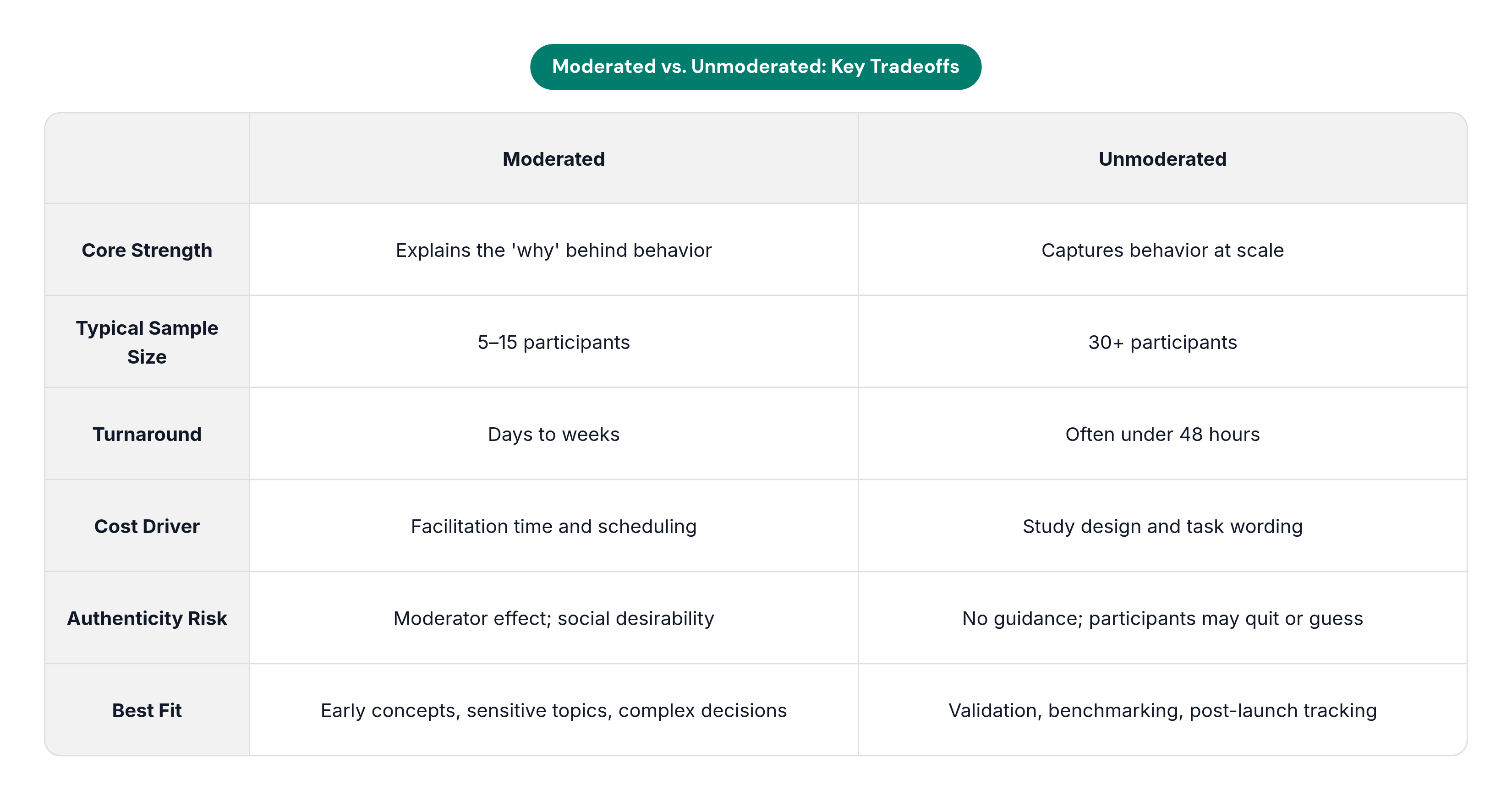
Depth against scale, first. Moderated rounds used to top out around 5 to 8 participants, because a researcher's calendar only stretches so far in a week, and what you get back is dense and specific to each person. Unmoderated flips that: thinner per person, but you can run it against dozens or hundreds at once. The real question isn't which sample size looks more rigorous on a slide. It's whether you're trying to explain something or confirm a hunch you already have.
Speed against nuance comes next. A study that eats two weeks as a moderated project can go out and come back inside 48 hours unmoderated. When a launch date is bearing down on you, that speed matters a lot, except you're often buying an answer that needs a follow-up moderated session just to figure out what it actually means.
Then there's cost against coverage. Moderated work carries facilitation time and scheduling friction that doesn't shrink no matter how tight your process gets. Unmoderated scales cheap once the study's built, and there's a trap hiding right inside that cheapness: sloppy task wording gives you sloppy data, and now your team's arguing about what the numbers mean instead of running the next study.
And authenticity against guidance. Unmoderated behavior reads more natural, since nobody's shaping it as it happens. But hand someone a rough prototype with nobody there to answer "wait, what am I even supposed to do here," and you'll watch them quit or guess wrong. Guidance costs you something, and leaving it out costs you something too, just a different bill.
People like to toss around a number, something like unmoderated catching 80% of core usability insight for a fraction of the effort. I wouldn't build a slide around that stat. It only holds when the question in front of you is one that behavior alone can settle, and a lot of the questions that actually matter aren't that simple.
Which research questions belong to which method
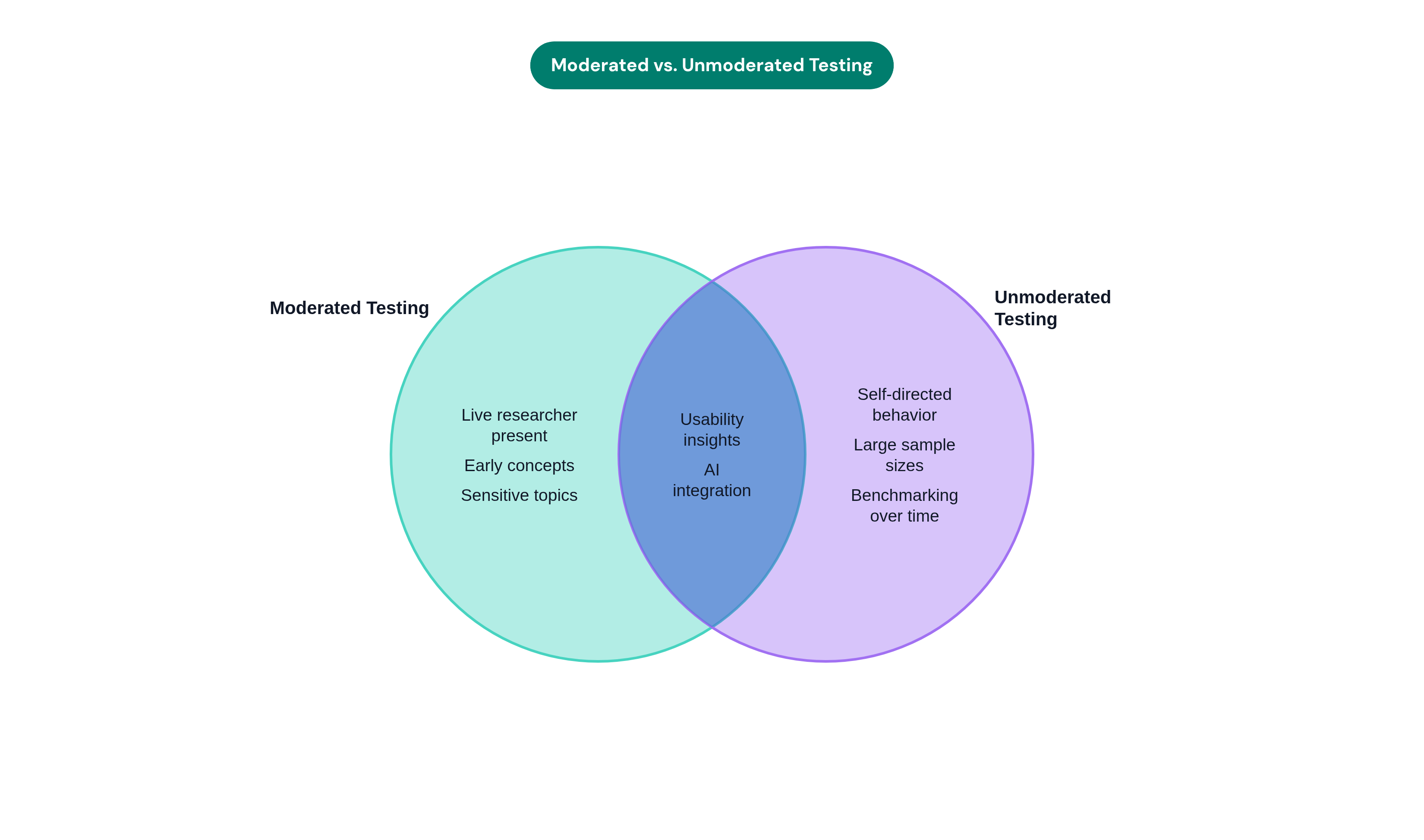
The filter I keep coming back to: does the question have a "why" hiding inside it?
Need to know where people clicked? Unmoderated answers that fine. Need to know why they clicked there, what they expected next, what they did the second that expectation broke? You need a person in the loop, live, and there's no shortcut around that one, AI moderator or not.
Moderated earns its keep on early concepts and half-working prototypes, where someone needs a guide just to engage with the thing at all. Same goes for anything carrying real decision weight: configuring enterprise software, picking a financial product, weighing a treatment option. Anywhere the reasoning matters as much as the click, and anywhere the topic's sensitive enough that tone tells you something the click stream never will.
Unmoderated takes over once you're validating a fix moderated work already pointed you toward. It's your benchmarking tool: completion rate, time on task, tracked release over release. It's also the right call for information architecture, where you generally want 30-plus people before a pattern means anything. And it fits naturally post-launch, when unobserved, self-directed behavior is the whole point of watching.
Product stage adds another layer. Early discovery leans moderated: interviews, contextual inquiry. Pre-launch leans moderated prototype testing. Post-launch tilts unmoderated: surveys, benchmarks, tracking studies over time. Sample size should track the goal, not some round number everyone quotes without checking it. Task-based usability tends to surface its big issues around 8 to 15 people, while IA work wants 30-plus. Anything chasing statistical confidence needs a sample sized to the confidence level you actually need, not whatever number feels safe in the room.
How teams actually combine the two methods in practice
Moderated to explore, unmoderated to validate. That's the pattern, and it holds up in nearly every team I've watched run it.
Run moderated sessions on a new idea or a pain point nobody's pinned down yet, then pull hypotheses out of that. Next, run unmoderated across a wider, messier sample to see if the fix actually sticks. Unmoderated flags the symptom, moderated names the cause. They work the same problem from opposite ends.
I've watched teams at bigger companies fold unmoderated testing into weekly sprints, using it as ongoing, low-friction measurement, and saving moderated sessions for the formative questions that genuinely need a human reading the room. Cadence ends up mattering almost as much as method choice. A bi-weekly moderated session, a monthly survey, a quarterly benchmark, kept up without fail, will beat one big annual study almost every time I've seen the comparison made honestly. A one-off project teaches you what it teaches you, then it's done.
There's research tying continuous programs to stronger product outcomes than sporadic ones, and directionally it matches what I've seen firsthand: rhythm beats raw volume. Teams that treat research like a habit catch problems earlier and cheaper than teams that treat it like an event they schedule once a year and hope covers everything.
How AI is changing the constraints that made this tradeoff feel fixed
That 5-to-8-session ceiling on moderated testing was mostly scheduling, facilitation cost, and one analyst's limited hours in a week, dressed up as a principle. AI moderation is tearing through that ceiling now. Teams run well over a hundred moderated sessions in a day and still get adaptive follow-ups: an AI interviewer probing in context, adjusting tone across different groups. The bottleneck that used to define the whole tradeoff is mostly gone, and funny thing is, the depth that bottleneck used to cost you stuck around anyway.
Cost tells the same story from a different angle. AI-moderated interviews now run somewhere in the low tens of dollars per completed interview, against a few hundred for the human-run equivalent. Moderated-grade depth at unmoderated-grade cost wasn't really available five years ago. Now it is, more or less.
The underlying logic holds anyway, and this is the part worth sitting with. AI makes depth cheaper to reach, but unmoderated stays the right call whenever what you actually need is naturalistic, self-directed behavior, no matter how cheap moderated gets. The real question shifts from can we afford this toward do we even need it. That's a sharper question than most teams are used to asking, and it's worth pausing on before you default to whatever method ran last quarter.
The researcher's job carries forward through all of this too. AI shows up inside both moderated and unmoderated work now, mostly on analysis and transcription from what I've seen, but it's still working under someone who decides what's worth asking in the first place. If anything, the specialist's role narrows toward exactly the sessions where judgment can't be automated out.
What this means for teams deciding how to build their research practice
The teams getting the most out of research have made it a habit built into the product cycle, matching method to question instead of defaulting to whatever ran last time.
Research has also stopped being one team's job, for better and worse. Designers run their own studies now, and so do product managers, engineers, sometimes marketers. That's mostly good: faster feedback, more decisions grounded in something other than a strong opinion in a meeting. But there's a real cost sitting right next to that benefit. Bad study design, sloppy recruiting, findings misread by someone without research training: all of that shows up more often once anyone can spin up a study without a researcher checking the guardrails.
Method choice matters less than people assume if the infrastructure underneath both methods is thin. Teams need fast access to the right participants across geography, segment, and device type, without a recruitment timeline so long it ends up picking the method for them by default. And they need synthesis that tells them what was found clearly, sparing someone a transcript dump to comb through at 11pm before a Monday readout.
I've watched companies cut recruitment timelines from months down to days just by fixing the tooling underneath, and once that logistical wall comes down, teams stop letting scheduling make the method decision for them.
The real shift happening right now is the removal of the excuse. Cost and scheduling used to be legitimate reasons to skip moderated depth or settle for a thin unmoderated read, but those reasons get weaker by the month. Write down the research questions your team keeps asking over and over. Build a rhythm around them; the framework only works once you stop letting logistics choose for you, and for the first time in a while, you mostly don't have to.