AI Moderation in Usability Studies
AI moderators excel at consistency and scale, but human judgment still catches what algorithms miss.
The mechanic is simpler than people assume. An agent parses what a participant says in real time, catches hesitation or contradiction or a half-finished thought, and fires off a follow-up based on it. Sometimes that follow-up comes from a decision tree, and sometimes an LLM generates it fresh, reading the moment as it unfolds. Either way, the probe reacts to the actual words the participant used, not a canned "can you tell me more about that."
Conveo, Outset, and ListenLabs have all built contextual follow-ups that shift depending on who's talking and how. The signals worth watching for are specific: phrasing that hints at confusion ("I guess," "I think you want me to click here"), a sentiment shift mid-answer, a pause long enough that you can tell someone got stuck.
What this replicates is the "why did you do that" instinct, the thing that turns a behavioral observation into an actual insight. Judgment is a different animal. A good researcher knows when not to probe, because pushing too hard sends someone down a path they wouldn't have taken on their own, and that same researcher throws out the script entirely when a session goes somewhere nobody planned for. AI works inside its parameters and doesn't know when to stop.
So the discussion guide carries more weight here, not less. A sharp guide gets amplified into sharp probing, session after session, while a sloppy one gets amplified too, just pointed the wrong way, consistently, every time. I ran a pilot last year for a fintech client with no in-house researcher, and the AI moderator got steadier probing out of that guide than a well-meaning PM would have gotten running the sessions cold. Consistency beats improvisation, at least when the improvisation wasn't any good to start with.
Real-time synthesis: how findings accumulate during a study rather than after it
The old workflow bakes in dead time. Fieldwork eats maybe a third of the calendar; the rest goes to transcription, coding, synthesis, and report writing, stacked one after another like a relay where every runner stands around waiting for the baton.
AI moderation collapses that relay. Transcription happens instantly, thematic coding runs the moment each session closes, and the synthesis view updates while participants are still finishing the study, not after the last one hangs up.
Themes strengthen or fall apart as the sample grows, live, and sentiment trends show up well before fieldwork ends. Outliers get flagged automatically instead of sitting buried in a spreadsheet nobody reopens. Some platforms turn hours of session footage into structured findings with transcription running across dozens of languages at once, and that alone tells you how wide the speed gap has gotten against manual processing.
The researcher's job shifts accordingly: less time reducing data, more time interrogating it while it's still forming. Sometimes that means adjusting the guide mid-study once a pattern demands it, and sometimes it means getting early signal in front of stakeholders before the study has even closed.
Here's the part that still breaks, though. Automated coding groups by surface language, which flattens nuance in the process, and it catches what people said fast, but not always irony, contradiction, or the kind of meaning that only clicks once you know the backstory. I've seen a coding pass tag three separate frustration comments as "neutral" because the participant said them in a flat, polite tone. Somebody still has to sit with the raw transcripts, not just the theme summary handed to them.
Scale: what changes when session count is no longer a constraint
A single moderator running human sessions manages four or five a day, six on a good one. A 20-person study, at that pace, eats a week of fieldwork minimum, more once no-shows and rescheduling get factored in.
AI moderation doesn't hit that ceiling. Sessions run concurrently, hundreds or thousands at once, and that's a structural change in what a usability study can even look like. Median sample sizes for this kind of research have climbed hard over the past few years, and the reason isn't complicated: nothing's waiting on a moderator's calendar anymore.
So what does a bigger n actually buy you? Edge-case behavior invisible at 12 participants becomes an identifiable pattern at 500. Segment cuts, by device, by experience level, by region, turn into something statistically meaningful instead of an anecdote flagged with a caveat. You can test multiple task flows or prototype variants in the same study without slicing an already-thin sample into pieces too small to trust.
The economics back it up too. AI-moderated interviews run a fraction of the per-session cost of human-moderated ones, and that's a different cost curve entirely, one where the ceiling used to be a moderator's calendar and now sits much closer to flat.
That's part of why always-on research suddenly makes sense. Teams run continuous studies against a rolling sample instead of the old one-and-done project cycle, and that shift happened fast once cost per session stopped being the bottleneck holding it back.
None of that fixes a bad panel, though. A thousand responses pulled from a biased recruitment source is still a biased study; it just looks more convincing on the slide.
Where the speed gains actually come from, and where they stop
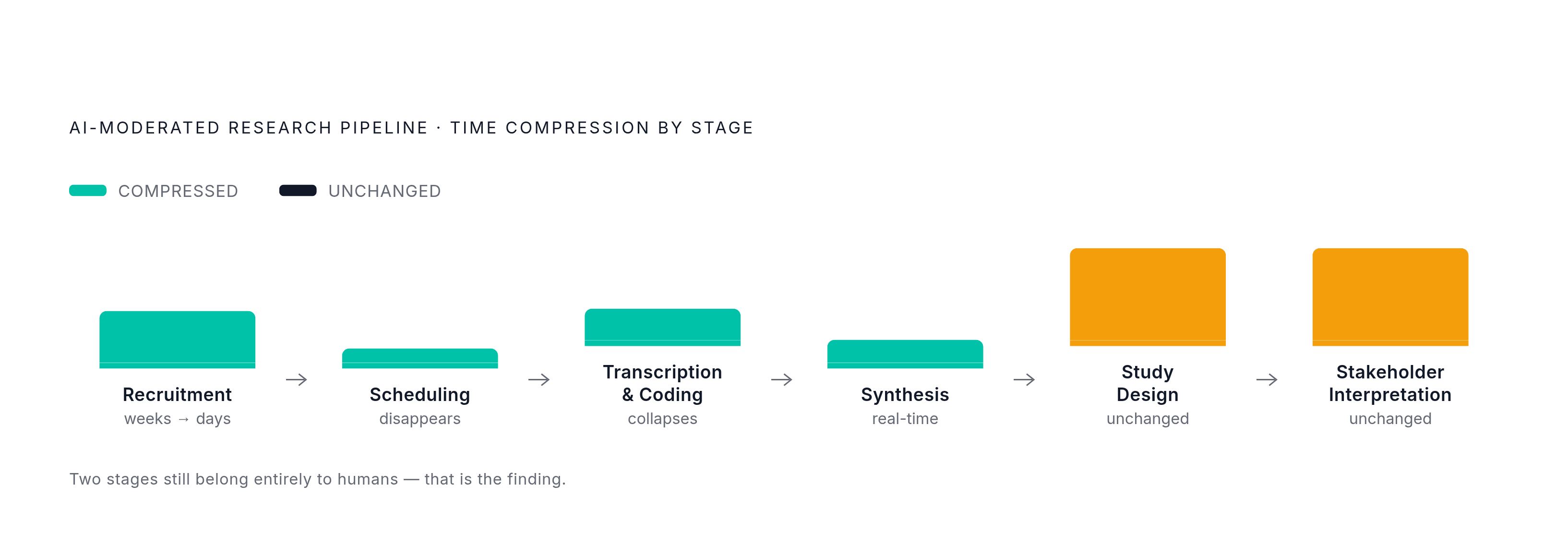
The number people throw around is weeks to days, research question to decision. It's real, and it's not a minor improvement on the old pace. It's a different category of speed.
The compression happens in specific places. Recruitment shrinks because platforms with built-in panel access skip weeks of vendor back-and-forth over screeners. Scheduling disappears almost entirely once sessions run asynchronously, since there's no calendar left to coordinate. Transcription and coding happen during the session instead of two days after it, and synthesis sits ready before the last participant logs off.
Study design doesn't move at all, though. A poorly built discussion guide or task scenario doesn't get fixed by running it faster; it just produces bad findings faster. Stakeholder interpretation still takes however long it takes, because you can't compress the time someone needs to sit with a finding and decide what to do about it. And the review step, catching whatever the automated synthesis missed, isn't a place to cut corners just because the rest of the pipeline moved faster.
Why does any of this matter past the research team? Consumer habits shift fast enough now that a usability finding taking six months to produce is stale before it ever reaches a roadmap. A traditional study running tens of thousands of dollars and six to twelve weeks, just to recruit, run, and package into something executive-ready, was never built for that pace. AI moderation cuts the cost, sure, but it also makes research fast enough to live inside a sprint cycle instead of hovering outside one, waiting its turn.
What AI moderation handles well and where human moderators remain necessary
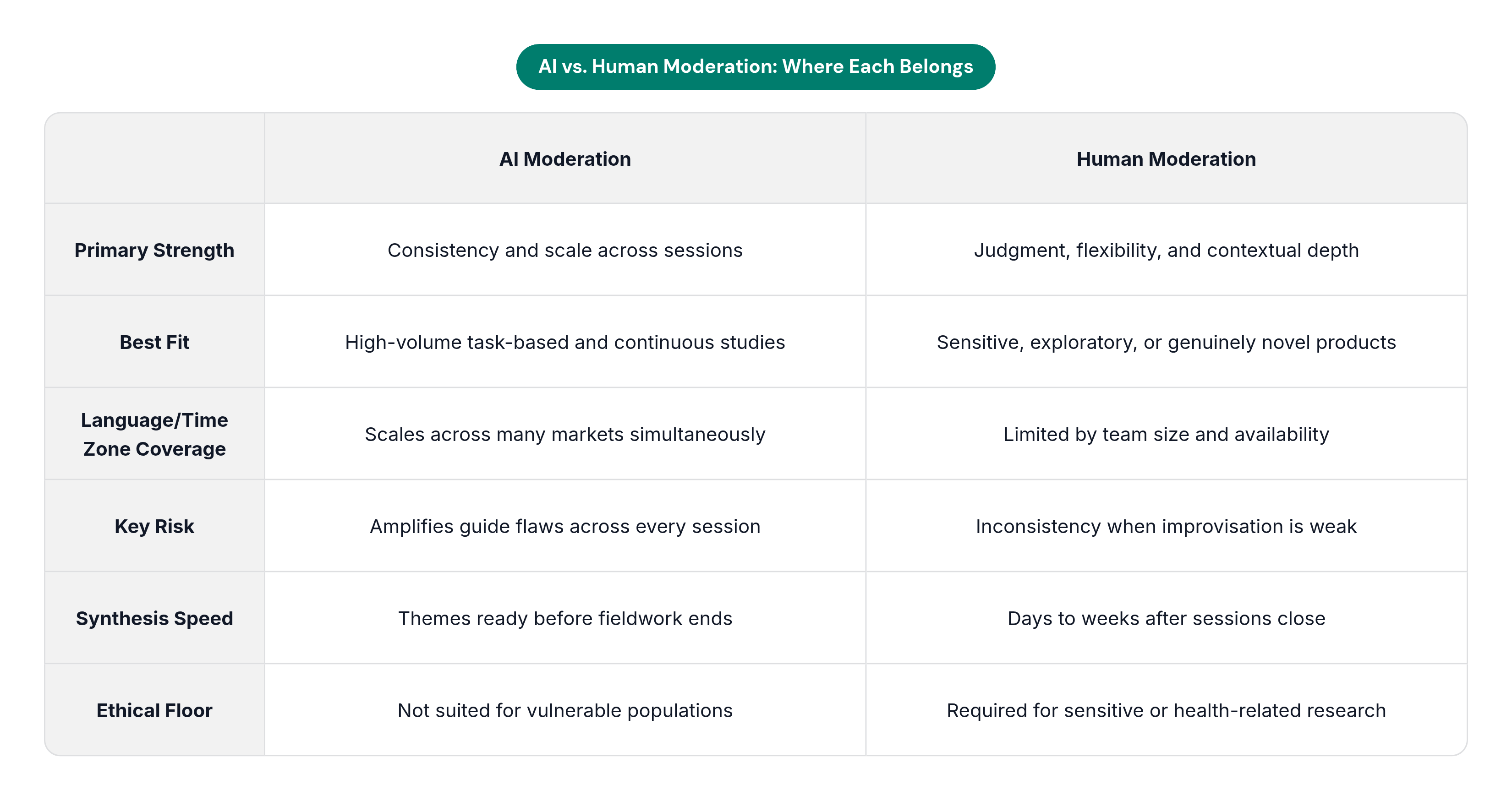
AI moderation earns its place in a few specific spots: high-volume task-based studies where consistency across sessions matters more than any one moderator's improvisation, studies spanning multiple languages or time zones where a human team physically can't scale to match, teams without a dedicated researcher, where the real alternative is an untrained colleague winging it, and continuous studies, post-launch checks, and A/B variant testing, where the question repeats and stability matters more than novelty.
Human moderation holds ground where the stakes or the ambiguity climb higher. Sensitive contexts, accessibility research, health-related products, vulnerable populations: a human presence is an ethical floor in those cases, full stop.
Genuinely novel products with no category precedent need a human touch too, since synthetic respondents correlate weakly with real human answers on anything truly new. Even AI-moderated sessions with actual participants need an expert steering the probes when the territory is unfamiliar, and open-ended, exploratory questions, where a skilled moderator builds a new line of questioning on the spot that no script anticipated, still call for a person in the room. There's also a seeing-is-believing effect when stakeholders watch a real session happen live; a recording or an AI summary doesn't fully replace that.
I'd frame it this way: AI expands the total volume of research that gets done rather than competing with human moderators for the same sessions. It picks up the studies that used to go unrun because they cost too much or moved too slowly. AI-generated usability insights still need a researcher's review, since automated analysis misses context, contradiction, and subtler behavioral cues on a fairly regular basis. That review step is the job. It doesn't get cut.
How to set up an AI-moderated usability study that produces defensible findings
Discussion guide design carries more weight here, not less. The agent can't improvise its way out of an ambiguous task or a leading question, and whatever flaw sits in the guide gets copied across every session, unnoticed. That's worse than one human moderator just having an off day.
A few things matter specifically for task design. Tasks need to be bounded enough that the agent recognizes when they're done, but open enough that real behavioral variation still shows up. Follow-up triggers should be spelled out in advance, which phrasing or hesitation counts as a signal, and what the probe actually says when it fires. Branching logic shouldn't get more complicated than what the platform can reliably track, since overbuilt decision trees break in ways that are hard to catch after the fact.
Recruitment quality matters just as much as sample size, maybe more. Unmanaged commercial panels carry real fraud rates, and a big n pulled from a weak panel just produces confident-looking noise. Check how a platform vets its panel before you scale a study against it, and don't take that part on faith.
Pilot it first. Run a small cohort, watch how the AI probes and what the synthesis produces, and fix the guide before opening the floodgates. Then put someone on the hook to actually read a sample of transcripts, not just skim the synthesized themes, since automated coding surfaces the most common response well enough, but catching the most important one takes closer attention than that.
Treat the AI's themes as a first draft. The researcher's job shifts from pulling data out to pushing back on what's already been pulled. And document which findings came from AI-moderated sessions, at what sample size, so anyone downstream making a high-stakes call knows whether it's worth running a human follow-up first.
Where this approach fits into an AI-moderated usability workflow
Everything above points to one condition: AI moderation pays off most when it runs continuously against a panel you actually trust, at a scale that makes the volume worth having. A one-off study at low volume doesn't unlock much of what I've described here; it just swaps one moderator for another and calls it progress.
Some platforms are built around that gap specifically, combining a verified panel of human respondents across more than 130 countries with synthetic AI agents modeled on target markets, so a team can run AI-moderated sessions with real participants and then extend the findings against a synthetic population for broader signal, without waiting on another round of recruitment. The AI interviewers that probe, follow up, and synthesize as sessions run aren't bolted on after the fact; they're built into how the platform works from the ground up.
There's a compounding advantage once a team builds a foundational audience model this way. That same synthetic panel runs again against pricing questions, market entry decisions, the next round of usability testing down the line. A single study stops being a one-time expense and starts looking more like a reusable asset, one you keep drawing on instead of rebuilding from scratch each quarter.
Different teams get different things out of it. Resource-constrained product teams get AI moderation without hiring a dedicated researcher just to run sessions. UX research teams get session volume high enough that segment-level findings mean something, instead of gesturing vaguely at a trend. Organizations testing across multiple markets get panel access across 130-plus countries instead of a recruitment timeline measured in weeks.
If you're new to this, start small. Pick one bounded usability question, a single flow, one prototype variant, and use it to set a behavioral baseline you can actually trust. Confidence in the output tends to build fast from there, and that's usually the point where teams start shifting toward continuous, always-on research instead of running one study at a time and hoping the next one gets funded.