Research Panel Quality in the AI Era
AI-generated respondents pass quality checks while corrupting research datasets.

Panel quality in 2026 doesn't mean what it meant two years ago. Hitting demographic quotas, keeping response rates up, meeting incidence targets, none of that catches the two things most likely to wreck a dataset right now. One is AI-generated respondents pretending to be people. The other is AI tools on the research side reshaping how data gets collected from the outset. Adoption has more than doubled in two years by some counts, and teams still running an outdated quality checklist are moving fast toward conclusions built on data nobody actually checked.
The fraud and contamination problem that predates AI but is now accelerating
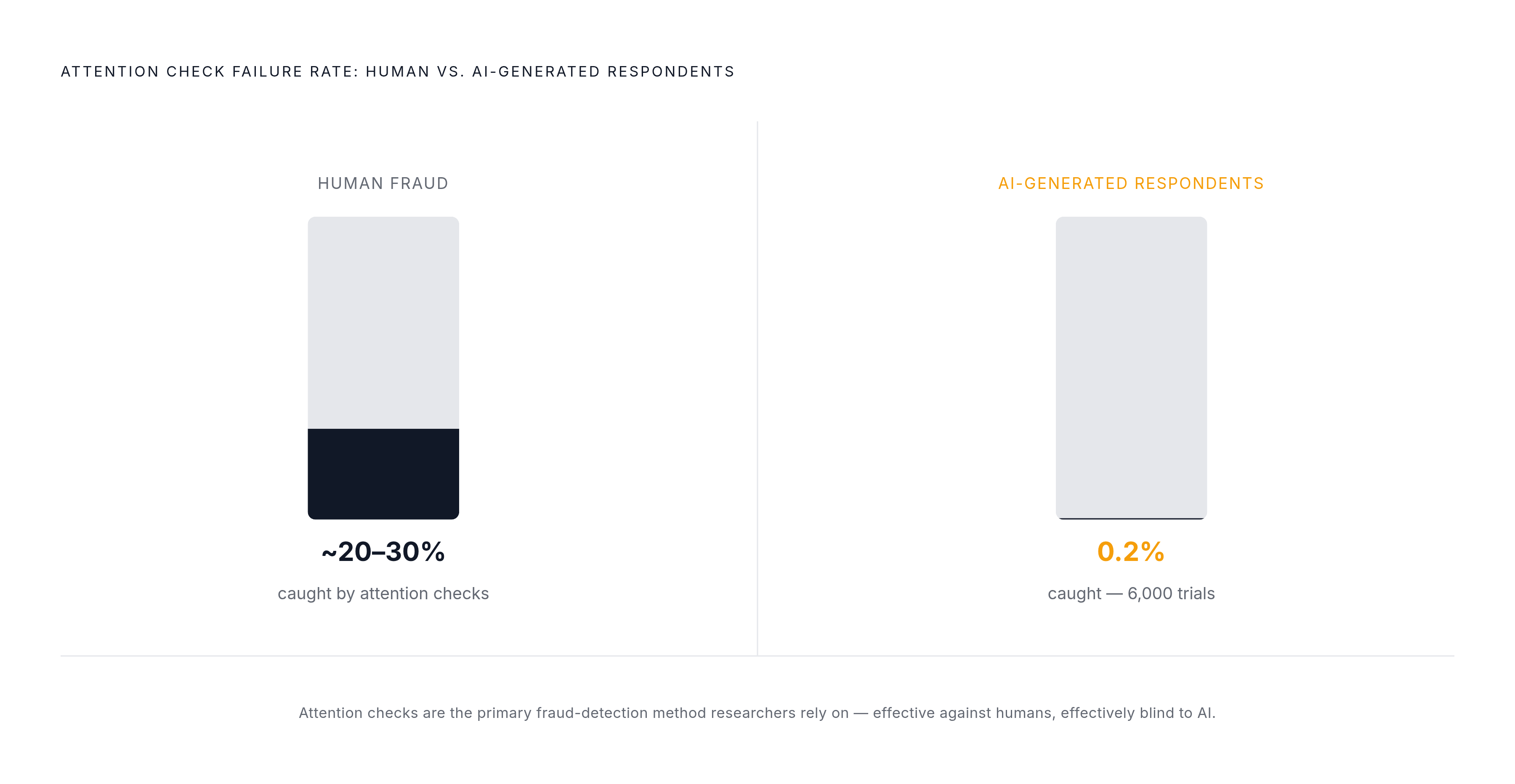
Professional survey-takers, people grinding through study after study for the incentive payout rather than answering honestly, were dragging down panel quality long before synthetic respondents appeared. Independent panel QA audits put fraud rates at 15% to 30% in unmanaged commercial panels. On major panel providers, only about 22% of respondents pass basic attention checks. Fewer than one in four people on a supposedly clean panel are even paying attention to the questions in front of them.
Survey fatigue piles on top of that. The average internet-connected consumer in 2026 gets hit with 15 or more survey invitations a month across email, SMS, app prompts, post-purchase flows, NPS triggers, and intercepts. Tired people click through without reading. That isn't fraud, exactly, but it produces the same garbage output.
Pew Research Center found that widely used online opt-in sources run about 4% to 7% bogus respondents. Small number, big consequence: these respondents don't add random noise, they add systematic bias, skewing toward positive answers across the board. The dataset still looks internally consistent and the numbers still hang together. As a result, purchase intent, brand advocacy, and willingness to pay end up quietly inflated without anyone catching it.
A high-profile DOJ indictment of a panel provider for fabricating research results made headlines, but structural panel quality problems persisted. One prosecution doesn't fix a structural problem. AI arrived into a fraud landscape that had already gone unsolved for years.
Why AI-generated respondents are a categorically different threat than traditional fraud
Traditional fraud is still a person: gaming incentives, rushing through questions, lying about who they are. AI-generated respondents involve no person at all, and that flips what detection must catch on its head.
In controlled trials across 6,000 cases, AI-generated responses passed attention checks 99.8% of the time. The main tool researchers rely on to catch bad-faith respondents is blind to the biggest threat facing the field, and that gap is not small. It's the primary defense failing silently, with nobody noticing until the data has already shaped a decision.
The scale consequences are measurable, and frankly alarming. CampaignNow found that just 10 to 52 fake responses could have flipped the predicted winner in 7 close national polls. Contamination can change an outcome without needing volume. It just needs to land in the right spot.
No single detection method covers this on its own. Digital fingerprinting catches one kind of anomaly, automated screening catches another, reverse image search catches a third, and Accelerant Research's ARVIC report is blunt that none of them works alone. Layered, multi-method defense is the only setup that holds up under real fraud attempts. Making things harder, AI-generated answers often read as more internally consistent than genuine human ones, since they skip the small contradictions and hesitations real people naturally produce. Standard markers of response quality offer little protection when the threat is synthetic rather than human.
The industry has noticed at the institutional level too. In 2026, the American Association for Public Opinion Research released a Task Force report on Responsible AI Integration in Survey Research, co-chaired by David Rothschild of Microsoft Research and Jenny Marlar of Gallup. Two names carrying that kind of weight co-chairing a task force on this exact problem is a signal the issue runs across the whole field, not just one sloppy vendor.
For product and UX teams, the risk is blunt: AI-contaminated data doesn't look wrong. It looks clean, complete, statistically plausible, right up until it quietly distorts willingness to pay, purchase intent, brand perception, and segment sizing.
What a genuinely upgraded quality framework looks like in practice
Quality can't get checked once at recruitment and then filed away. It has to get evaluated at every stage of a study, and most teams still treat it as a one-time gate they clear and move past.
Start with source-layer controls: which panel networks does a platform actually pull from, and does it steer clear of commodity panels known for professional survey-takers and synthetic contamination? From there, real-time behavioral monitoring during the interview itself, reading video, voice, content, and device signals as the conversation unfolds, catches things a post-hoc review simply can't. Structural limits help too. A hard cap on how often any one participant can take part cuts down on professional survey-taker behavior even inside otherwise well-run panels. For hard-to-reach segments, enterprise decision-makers, healthcare workers, audiences under a 1% incidence rate, a human review layer earns its keep, because these are exactly the populations fraud goes after hardest.
Matching respondents on behavioral and intent data, rather than trusting self-reported demographics alone, cuts down on misclassification. A demographic quota tells you someone claims to be a 35-year-old marketing director. It tells you nothing about whether that person actually behaves like one, buys like one, or has the authority the study assumes they have.
No single control does the whole job. Each layer needs to catch what the one before it missed, and quality transparency should extend to inclusion criteria as much as to findings. A platform ought to show why a respondent got included or excluded.
This matters more given where the industry is headed. According to the AI-Powered User Research Tools: The 2026 Buyer's Guide, 62% of B2B SaaS product teams plan to consolidate their research tooling in 2026. Consolidation is efficient, sure, but if that one surviving platform's quality controls are weak at even a single layer, the weakness compounds across every study run through it from that point on.
How AI-moderated interviews change the quality calculus for qualitative research
Qualitative research has had a speed problem for a long time. Human-moderated interviews run one after another, and a study can easily take 4 to 6 weeks from design to final report. By the time the insights land, the decision they were meant to inform has often already been made without them.
AI-moderated platforms run interviews in parallel instead of one at a time, compressing the full cycle down to under 24 hours in some cases, a structural shift rather than a minor speed bump. That's a structural shift, not a minor speed bump.
The obvious worry is depth. Does moving fast mean losing the texture that makes qualitative work worth doing? A controlled study run by Verasight with Outset gives some of the clearest evidence available. Researchers started 3,160 panelists on a standard survey, then randomized them into either written open-ended questions or an AI-moderated video interview, both covering the same four topics. The AI condition produced 4.8 times as many words per assigned respondent (128 versus 27), and that gap held even when every dropout got counted as a zero. That's a real answer to the depth-versus-scale tradeoff, at least in this case.
Nielsen Norman Group's guidance on qualitative interviewing warns against leaning on closed questions, since they cap what you can learn and make a conversation feel stiff. AI moderation that stays open-ended and adaptive, instead of defaulting to a fixed script, sidesteps that trap. 2026 benchmarks show modern citation-backed AI platforms hitting 90% to 95% accuracy on theme extraction and quote attribution, though they're still weaker on nuanced behavioral interpretation and on catching what a respondent chose not to say. That's a real limit, and it's exactly where human judgment still earns its place in the loop.
Some of the scale numbers out of real deployments are striking. Anthropic ran more than 300 user interviews in 48 hours, surfacing churn drivers five times faster than its previous methods. P&G validated product claims with more than 250 male consumers in a matter of hours. Microsoft gathered customer stories from around the world for its 50th anniversary in a single day. None of that speed matters if the respondent pool is contaminated with fraudulent or low-quality participants. Faster only helps when fraud controls sit inside the pipeline from the start. Otherwise it's just a quicker way to manufacture bad data.
What synthetic panels are and are not
The word "synthetic" gets thrown around loosely, and that looseness does real damage to quality judgments. The term synthetic gets applied to at least several distinct things: synthetic personas, synthetically-derived insights, simulated individual-level data, digital twins of specific known individuals, and simulated conversations with AI participants. Treating all five as one category means applying the wrong quality bar to the wrong kind of output, and that's how bad calls get made.
Synthetic consumers earn their keep in early ideation, directional sizing, and scenario testing. Nowhere else, and teams that stretch them further are asking for trouble. They're available around the clock, can get built to represent almost any demographic or psychographic profile, and produce consistent output in minutes. They're genuinely useful for segments that are close to impossible to recruit at volume: senior executives at named companies, mid-tier B2B buyers in a narrow vertical, edge-case personas nobody has a panel for. A researcher can run hundreds of questions past a synthetic panel in an afternoon, something no human panel supports at that pace or that price.
But the limits are hard, and ignoring them is where teams get burned. Synthetic outputs are directional by nature. They don't establish statistical representativeness, they don't prove causation, and they don't forecast actual market demand. A study published in Marketing Science found only a 0.3 correlation between synthetic and real human responses when testing genuinely novel products, ones that aren't a sequel or line extension of something already on shelves. That's a weak correlation, and it means skipping calibration against real market data isn't an option if the output is going to steer an actual decision. Synthetic research also still struggles with emotionally charged behavior, deep cultural nuance, genuinely novel markets with no calibration history, irrational purchasing decisions, and social contagion effects.
Validation is the actual quality mechanism here, not a nice-to-have. Synthetic outputs need benchmarking against real human data, survey results, experimental findings, known market benchmarks, ideally using Bayesian validation techniques that produce honest confidence intervals instead of one clean-looking number. A point estimate with no error bars is a red flag, full stop.
Treat synthetic panels as a complement to human respondent research for early ideation, directional sizing, and scenario testing. They are not a substitute for recruited human participants once a decision hits the validation stage and real money is riding on the answer. Pricing is dropping fast too, moving from enterprise-only territory toward self-serve tools anyone can buy. More teams are going to bump into synthetic panel options without understanding where those tools actually sit in the quality hierarchy, and that gap is where the bad decisions come from.
Applying the updated quality standard when choosing and running research in 2026
The central question has changed. It used to be whether a study hit its sample size and demographic quotas. Now it comes down to whether every respondent, and every insight drawn from them, can get traced back to its source.
Most RFPs still skip the questions that actually matter. A platform evaluation in 2026 needs to push on specifics: what panel sources feed the tool, and are commodity panels explicitly excluded? What real-time behavioral monitoring runs during the interview itself, not just during initial recruitment? Are there structural limits on how often one participant can take part? Does detection of automated respondents use multiple methods, or is it leaning on one signal that a smart enough model can learn to fake? For anything synthetic, what calibration data trained the model, and what validation ran against real human responses?
Most rigorous teams are converging on a hybrid setup: AI-moderated interviews at scale for speed and depth, backed by layered fraud controls on the human side, with synthetic panels kept to early directional work rather than final validation. Traditional, fully human-moderated methods still hold a clear place, particularly for exploratory research needing a novel methodology, complex B2B investigations where an interviewer's domain expertise actually shapes the conversation, and emotionally sensitive topics where human rapport does work no AI moderator replicates yet. None of this replaces human judgment with AI. It just demands a far more explicit quality framework than most teams currently run.
Some product organizations are already building this accountability into process rather than just buying tooling and hoping it works out. Requiring every PRD to include a customer evidence section, with quotes cited from real conversations, forces quality scrutiny right at the point a decision gets made, instead of after the fact when it's too late to matter.
The research stack that wins in 2026 pairs AI's speed with quality controls that compound at every layer. Confident conclusions built on compromised data don't get anyone anywhere. They just get you to the wrong decision faster.
Sources
- AI-Powered User Research Tools: The 2026 Buyer's Guide
- AI vs Traditional Customer Research: Complete Guide 2026
- The New Research Quality Crisis: Why Traditional Fraud Detection Is No Longer Enough in the AI Era
- AI and the Future of Research Panel Quality
- Maintaining Participant Quality in the Age of AI | Accelerant Research
- orr-consulting.com
- userintuition.ai