Ethics of Synthetic Consumer Representation
Synthetic panels excel at structured tasks but fail on truly novel products and emotional nuance.

Synthetic consumers, the AI personas built to stand in for human research panels, are already mainstream: Forrester found that 42% of consumer insight leaders had implemented some form of synthetic data as of their most recent survey. The public debate about them keeps circling one question: are these AI respondents "good enough" to replace people? That question misses where the actual risk sits. The risk isn't a low accuracy score averaged across a thousand runs. It's a synthetic panel returning a confident, wrong answer on the one question that mattered, with nobody catching it before a launch decision got made.
Qualtrics' 2026 Market Research Trends report makes a smaller but related point: practitioners use the word "synthetic" to mean at least five different things, from simple personas to full digital twins. That's not a semantic quibble. A stakeholder can't judge the risk of something nobody has bothered to define precisely. So before getting into where synthetic panels earn trust and where they quietly fail, the term's coverage and limits need to be stated exactly.
Three obligations run through everything that follows: say plainly what a synthetic respondent can and can't model, check synthetic output against real human data before any decision that actually matters rides on it, and never let a synthetic panel stand in for a population whose lived experience the training data never captured. That's the spine of this piece.
What synthetic consumers are and are not
A synthetic consumer is an AI persona trained on real behavioral and demographic data, built to reason the way a person might reason about a purchase, a price, or a piece of creative. It answers survey questions. It reacts to concepts. It behaves, in a research setting, like a participant, minus the participant.
Synthetic audiences represent segments, not people. "Urban Gen Z tech enthusiast" is a pattern pulled from data, not a stand-in for any single identifiable human. That distinction matters both for privacy and for accuracy: it's a statistical composite, and composites smooth over exactly the variation that makes a real population interesting.
Not all synthetic output carries the same risk, though, and this is where Qualtrics' five-way taxonomy earns its keep:
Synthetic personas. Directional sketches. Low stakes if labeled clearly as directional. Synthetically-derived insights. Aggregated findings with no individual-level data behind them, and correspondingly lower exposure. Simulated individual-level data. Structured to look exactly like a real panel dataset, row by row. This is the highest-stakes category, because it's the easiest to mistake for something it isn't. Digital twins. Built to mirror one specific, known person's behavior. This is where consent and re-identification questions get sharp fast. Simulated conversations. AI-moderated interviews with synthetic participants, stacking generation risk on top of interpretation risk.
Behind all five sits the same basic engineering: real survey responses, purchase histories, CRM records, and public datasets feed into an LLM or a probabilistic model, which then generates persona behavior. What separates something credible from a slick demo is calibration: the output gets checked against human data the model never saw during training.
PyMC Labs' practical guide distinguishes build approaches by the rigor behind them, ranging from fast, generic implementations at the low end to purpose-built models trained on proprietary research data at the high end, and only the latter carries a defensible methodology for decisions that actually carry weight.
What synthetic consumers are not: a replacement for human respondents, a source of ground truth on anything genuinely new or emotionally loaded, or a workaround for reaching populations the training data barely touched.
Where synthetic consumers perform well versus where the accuracy floor drops away
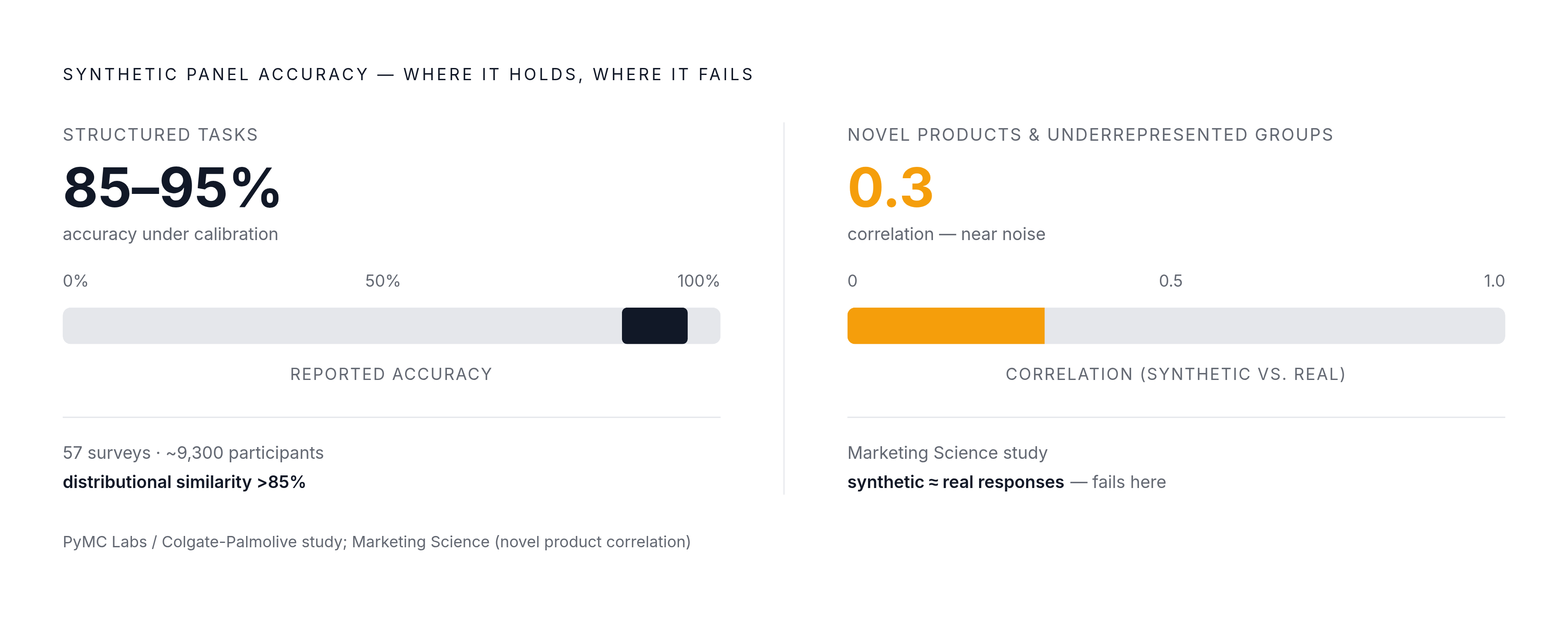
The aggregate numbers are genuinely decent. A PyMC Labs study conducted with Colgate-Palmolive, running across 57 real consumer surveys and roughly 9,300 participants, found synthetic respondents hit about 90% of human test-retest reliability, with distributional similarity above 85%. A separate digital twin experiment matched real survey results with up to 94% accuracy on stated-preference questions. A review of 14 studies published between late 2023 and early 2025 found half concluded strong similarity between AI and human answers, with only 14% finding minimal or no similarity at all, putting roughly 86% of recent research on the side of at least partial success.
Structured tasks are where it holds: ranking a set of options, testing price sensitivity, scoring sentiment, screening concepts, checking which message lands hardest. Structured tasks are where it holds: ranking a set of options, testing price sensitivity, scoring sentiment, screening concepts, checking which message lands hardest. These are all questions with a bounded answer space. The model isn't inventing an opinion from nothing, it's reasoning within known constraints.
The floor drops away the moment the question stops being structured. A Marketing Science study found only a 0.3 correlation between synthetic and real responses on truly novel products, meaning products that weren't sequels or line extensions of something already in the market. A 0.3 correlation is close to noise. Running synthetic-only concept testing on a genuinely new product category, without a human check, isn't a shortcut. It's a decision made on a coin flip dressed up as data.
Emotional nuance and cultural context fail for a related reason: the model can only reason from what's in the data, and lived experience, group dynamics, and community-specific meaning rarely appear cleanly in a training set. There's also a slower failure mode: training-data drift. A panel calibrated last year on last year's market will keep answering confidently about a market that has since moved. Nothing in the dashboard tells the analyst that the ground shifted underneath the model.
Practitioners appear to sense this, even where the public conversation hasn't caught up. One 2026 survey found 97% of researchers already use AI somewhere in their workflow, yet only 8% trust AI-generated respondents for a decision-grade call. The 2025 GRIT Report found brand-side satisfaction with AI-powered research quality is just 13%. Vendors willing to publish honest numbers tend to run in the 85% to 95% accuracy range on structured tasks, contingent on calibration and validation actually holding up. A vendor who won't publish that range isn't offering a methodology. They're offering a demo.
The three ways synthetic panels silently fail the people they claim to represent
Three failure patterns occur again and again, and none of them are visible on the dashboard.
Demographic skew, baked in at the source. Generative models trained on internet-scale data reflect the populations that dominate that data, leaving some communities underrepresented from the start. Minority communities and local cultural context fare the same way whenever those voices were thin in the original training mix. The practical consequence: a synthetic panel can hand back a confident, wrong answer for exactly the segment that most needed to be heard, and nothing in the output flags the gap. A 2026 review of synthetic-user experiments, alongside a Stanford HAI persona study, both document sycophancy and convergence toward majority opinion as structural outputs of current systems, not occasional glitches.
Sample-size theatre. A platform can generate ten thousand synthetic respondents from a small calibration set of real profiles, and the output will look like a large sample. It isn't. It's a small sample copied ten thousand times, wearing a large sample's clothing. Per neuroflash's 2026 methodology guide, the variable that actually matters is the underlying calibration data, meaning its size, how recent it is, and how representative it is, not the number displayed on the results screen. Organizations without solid internal data to calibrate against face a compounding version of this problem: they calibrate on thin, unrepresentative inputs, then scale that error across thousands of synthetic responses that all inherit the same blind spot. A credible platform anchors each synthetic respondent on somewhere between 68 and 255 real data points, drawn from a pool of over one million real profiles. A credible platform anchors each synthetic respondent on somewhere between 68 and 255 real data points, drawn from a pool of over one million real profiles, and that's the standard to demand. The respondent count on the dashboard is not.
Consent, and the training-data problem that produces it. Informed consent is hard to apply cleanly when a model trains on data scraped from the public internet at scale. The people whose real behavior shaped a given synthetic persona never agreed to play that role. A 2026 structured review covering 91 studies published between January 2023 and September 2025 identifies ethical themes running through AI-driven consumer data research as the dominant concerns across that body of work. Digital twins sharpen this problem further, since they're built to mirror one specific, identifiable person, and the gap between "modeled after" and "identified as" gets thinner with every added data point. None of this is speculative. As AI gets more embedded in how companies collect data, personalize content, and shape persuasion, the question of where the underlying data came from becomes structural to the whole enterprise rather than a footnote.
The inverted problem: AI respondents contaminating real panels
Flip the usual framing around. Most of the ethical conversation treats synthetic data as "AI instead of humans." A parallel problem runs the other direction: AI respondents showing up inside panels labeled as human.
Commercial panels have always carried some share of respondents optimizing for the incentive rather than answering honestly. AI-generated respondents capable of passing basic attention checks have become a growing source of that contamination. Independent panel QA audits have flagged fraud rates between 15% and 30% in unmanaged commercial panels, a range that should make anyone pause before treating a "human" dataset as an automatic gold standard.
This creates a genuine circularity problem. If the human benchmark used to validate a synthetic panel is itself partly synthetic, the validation chain doesn't just weaken, it breaks at the foundation. "Human panel" stopped being a safe label the moment AI respondents got good at blending in. Provenance and quality control now matter as much for the real panel as for the synthetic one. That has a direct bearing on transparency obligations too: a researcher who validates synthetic output against a low-quality, uncontrolled human panel hasn't actually met the standard the methodology requires. They've just moved the uncertainty one step upstream.
The updated ICC/ESOMAR code's requirements and open questions for practitioners
The ICC/ESOMAR International Code got its fifth-edition update in 2025, built specifically to catch up with a fast-moving digital research environment. The revision centers on strengthening ethics, accountability, transparency, and human oversight across digital research.
Two provisions bear directly on synthetic consumer research. Article 9, covering publication in the age of AI, makes disclosure mandatory: if a study used synthetic data or AI-generated respondents anywhere in the process, the public has to be told. That's no longer a courtesy. Article 6, on privacy and protection, tightens safeguards against AI-driven re-identification, cyberattacks, and data breaches, language that lands squarely on digital twin methodologies.
The code also introduces a shared responsibility principle. Ethical accountability can no longer be outsourced to whichever party happens to hold it last. Each party involved in a project is responsible for upholding the code to the extent of their own role in it. That's a real structural shift from earlier models of research accountability.
The update's direction suggests sector-specific rules will keep tightening rather than loosening, particularly where AI research methods intersect with sensitive domains. The Market Research Society of India has already adopted the 2025 code, a sign that these concerns are becoming global rather than staying tied to any one jurisdiction.
What the code doesn't do is spell out validation standards, minimum calibration data requirements, or acceptable accuracy thresholds. It sets a disclosure floor and a responsibility structure. Everything past that is left to practitioner judgment, which is exactly the gap the next section is meant to close.
The three obligations that make synthetic consumer research ethically defensible
Transparency about capability and limits. Stating that a study used synthetic data isn't the ceiling, it's the floor the code already requires. Real transparency means naming the exact type used (persona, simulated individual-level data, digital twin, whatever applies), and stating the accuracy envelope honestly: structured tasks like ranking or pricing are in the 85% to 95% range under proper calibration, while novel products, emotionally loaded questions, and underrepresented communities are well below that. It also means naming the calibration source directly: what real data trained it, how recent that data is, and which populations it actually covers. A vendor who won't say should be treated as a red flag, not as protecting a trade secret. An accuracy claim without a published validation chain, checked against held-out real data, is a marketing line, not a methodology.
Validation against real human data before anything consequential happens. The two-phase approach earns its place here as both a workflow and a standard. Phase one uses synthetic panels to screen a wide field of options fast. Phase two brings in AI-moderated conversations with actual human respondents to validate whatever survived the first cut. Per neuroflash's 2026 methodology guide, a workable split runs synthetic for roughly the first 80% of variants and segments, with human validation reserved for the final 20%, focused on the two or three leading candidates. Skipping phase two to save budget on a high-stakes call isn't a shortcut. It's a due-diligence failure with a spreadsheet attached. Validation cuts both directions too: given fraud rates of 15% to 30% in unmanaged panels, the human benchmark itself needs checking before it gets used to validate anything synthetic. Pricing and market-entry decisions carry an extra burden on top of all this, since algorithmic bias in synthetic data can produce pricing disparities that quietly widen existing inequality. Those use cases need explicit bias audits, not just an aggregate accuracy number that looks fine on average.
Protecting direct access to populations the training data missed. Synthetic panels cannot substitute for real research with groups that are structurally thin in training data: older consumers, lower-income households, minority communities, non-English-speaking markets, and any population defined by an embodied experience the model has never encountered. The 0.3 correlation on novel products is the quantitative version of this warning. The qualitative version is simpler: if a segment's answer would genuinely surprise a researcher, a synthetic panel isn't built to surface that surprise. Hard-to-reach groups, C-suite executives, rural professionals, niche occupational categories, get cited often as the natural use case for synthetic research, but that conflates two separate things: how hard a group is to recruit, and how well a model actually represents them. Those are not the same property. This obligation is institutional at heart. Organizations need to keep budget and capacity set aside for direct human research with these groups, rather than treating synthetic coverage as close enough. That's where "complement, not replacement" becomes an actual ethical requirement rather than a nice sentiment.
Building a research practice that operationalizes these obligations
Turning three obligations into daily practice starts with a decision gate, a short set of questions that must be answered honestly before a synthetic study is fielded.
First: is the question structured enough that 85% to 95% accuracy is actually sufficient for what's riding on the decision? A pricing test or a message-resonance check clears that bar easily. A concept test for a genuinely new product category does not, given the 0.3 correlation found in the Marketing Science study cited earlier.
Second: does the calibration data actually cover the populations whose views will drive the decision, or does it quietly lean toward whoever was easiest to find online? The sample-size theatre problem becomes visible in practice here. Ten thousand synthetic respondents calibrated on sixty real profiles from one demographic slice is not coverage, no matter how the results dashboard presents it.
Third: has the human validation panel itself been checked for quality? Given documented fraud rates between 15% and 30% in unmanaged commercial panels, treating "human data" as automatically trustworthy defeats the purpose of running a validation phase.
None of this is about distrusting the technology wholesale. Synthetic consumer research, used inside its real accuracy envelope and checked against a clean human baseline, does genuine work: it screens faster, it costs less per iteration, and it lets a small number of expensive human research hours go toward the two or three concepts that actually deserve them. The ethical failure was never in using synthetic panels. It's in using them past the edge of what they can honestly do, and calling that confidence instead of what it actually is.
Sources
- Methodology of AI-Generated Consumer Panels for Brand Positioning
- Synthetic Consumers in Market Research - A Practical Guide (2026) — PyMC Labs Blog
- Synthetic Data for Market Research FAQ - Qualtrics
- AI Consumer Panels: The 2026 Buyer's Guide | FishDog
- Synthetic Focus Groups in 2026: What They Get Right, Where They Break
- standards.esomar.org
- medianews4u.com