Decline of the Traditional Research Agency Model
Large organizations now run research in-house rather than wait for agency results.
The traditional research agency model is coming apart, and no single company did it. Long timelines, project billing, opaque process, scarce panel access: these assumptions used to make sense. They stopped matching how organizations actually make decisions, and none of them hold up anymore.
Rewind twenty years and the agency model was the obvious answer. Verified respondents were hard to find. Study design took real skill. Coding hundreds of open-ended survey responses by hand ate up real hours from real people, none of it cheap, so companies paid someone else to carry the load. Six to eight weeks was the honest cost of recruiting, fielding, and pulling a report together by hand, not an agency dragging its feet. The opacity was part of the deal too: clients paid for a finished answer, not a look behind the curtain. The whole thing held together because there was nothing else on offer. No panel access outside the agency's rolodex, no tooling, no way to run interviews at scale without a middleman sitting in the middle of it.
All four of those assumptions, the timelines, the project as the billing unit, the brokered panel, the specialist labor, are now up for grabs.
The market's size masks a compositional shift that reveals who is actually winning
The global market research industry is on track to hit roughly $150 billion in 2026, up from $140 billion in 2024. That's a 37% climb since 2021. Watching from outside, this is the part that trips people up: how does an industry grow while its biggest, oldest players are bleeding?
Look closer and the contradiction resolves. The growth isn't landing where you'd guess. Three of today's top five market research firms run AI-native platforms, not traditional service shops staffing up project teams. Industry reporting backs this up: optimism has held steady among tech providers and keeps sliding for service-led firms, especially the smaller ones. The big service shops, the ones that used to look most insulated from cheap competition, are feeling it worst.
Venture capital already made its call. Andreessen Horowitz and Foundation Capital have both published theses arguing generative AI will remake this $140 billion industry, pricing in the shift well before most client-side buyers even noticed it was happening. The market's growing, sure. It's just growing into a different shape of company than the one that built it.
Why large organizations stopped waiting for agencies and started doing the work themselves
Two-thirds of large multinationals now run their own in-house research teams, and a fifth of all brands are weighing whether to join them. Ask what's driving that, and the honest answer is speed more than cost. A product team working in two-week sprints isn't going to sit around six weeks for a concept test. By the time results land, the decision already got made some other way.
Work that used to cost $80,000 to $250,000 through an agency now gets done in-house, in days, on AI-native platforms. The categories that moved first are the ones agencies used to run on repeat: discovery, concept testing, messaging research, win/loss, churn analysis, beta research. That's the volume middle of the funnel, and it's gone.
That's a bigger deal than it sounds. Agencies used that steady, repeatable work to subsidize the messier, higher-margin engagements sitting on top of it. Pull out the recurring stuff and what's left is thin: specialized work like regulatory or longitudinal studies, plus legacy client relationships nobody's gotten around to renegotiating yet. Budget cuts are speeding this along too, UK market research budgets fell 5% net in Q4 2023, adding pressure heading into 2024. Tighter budgets make the in-house case even easier to make.
The cost and speed gap between agency workflows and AI-native platforms has become structurally unbridgeable
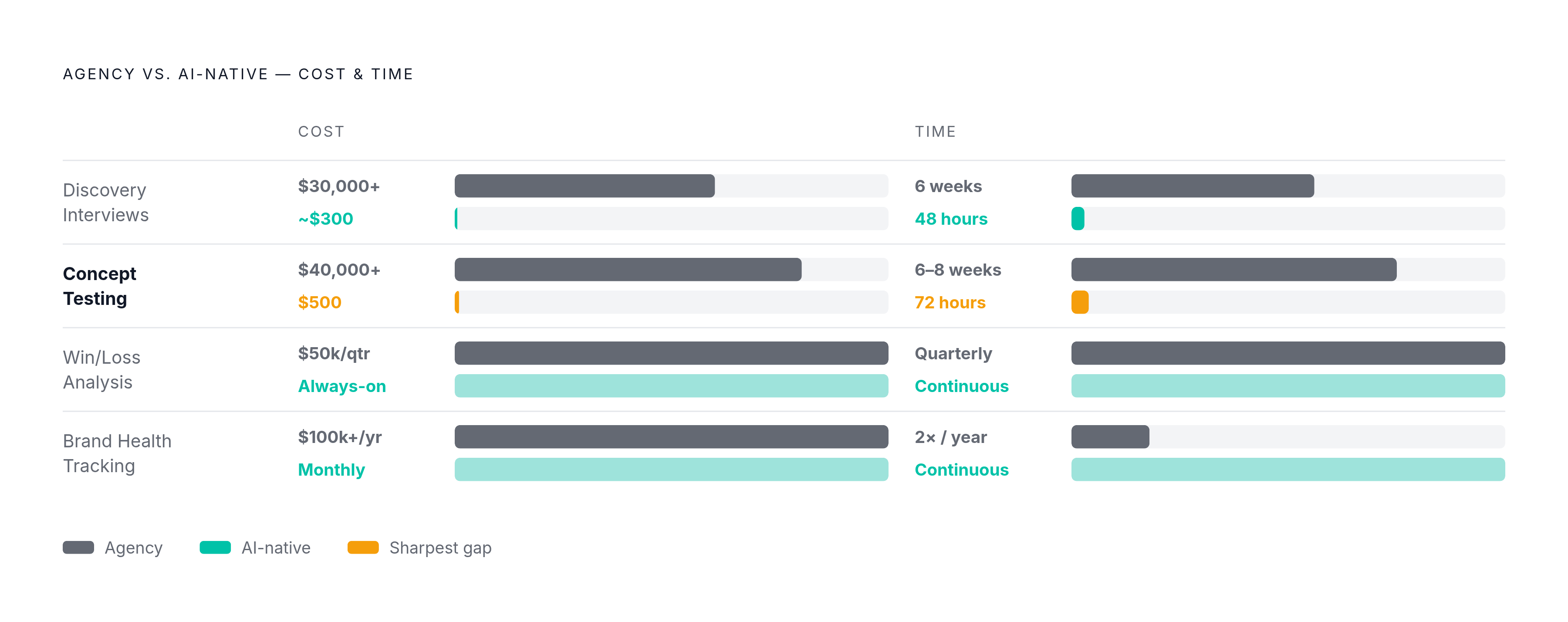
The numbers here are hard to argue with. A traditional agency study runs $15,000 to $50,000. The AI-native version runs a few hundred dollars and takes hours, not weeks.
A 2026 analysis from Koji.so breaks down specific workflows:
- Customer discovery interviews: tens of thousands of dollars and six weeks at an agency, versus a few hundred dollars and 48 hours with AI-native tools
- Concept testing: tens of thousands of dollars and six to eight weeks, versus roughly $500 and 72 hours
- Win/loss analysis: $50,000 a quarter, versus always-on and automated
- Brand health tracking: six figures twice a year, versus a monthly delta that just keeps running
83% of market research professionals say they plan to invest in AI in 2025, and 47% already use it regularly. This isn't the edge case anymore. It's the default setting.
The price collapse does something more interesting than make old work cheaper, though: it changes what's worth testing in the first place. Decisions that never justified a $40,000 study become routine at $500 a pop. You start running research on things you used to just guess about, because guessing used to be cheaper than finding out, and now it isn't.
Agencies can't close this gap by trimming costs. The constraint is baked into the architecture, not the operations. A project-based labor model built around recruiting, fielding, and manual coding can't compress into hours no matter how sharp the team running it is. The 2025 GRIT data shows firms that expanded services or repositioned grew 9.7% and 8% respectively in 2024. Firms that changed nothing grew 1.1%. Adapting pays off, and most firms still aren't doing it.
The panel quality crisis is quietly undermining the agency's most fundamental claim to value
The agency pitch used to be simple: we've got the right people, properly screened, so you don't have to think about it. That promise is coming apart right now. Independent panel audits are flagging fraud rates between 15% and 30% in unmanaged commercial panels. Up to three in ten responses in some of these panels may not come from real people at all.
Two things are driving it. First, professional respondents, sometimes called survey gamers, who've learned exactly how to answer screening questions to get into a study whether or not it's true. Second, AI-generated synthetic identities good enough now to pass basic attention checks. Large language models made faking a respondent profile cheap enough that anybody can pull it off.
The panels taking the worst hit are the high-incentive categories: B2B, healthcare, financial services. Those happen to be the exact segments where agencies have always charged their fattest premiums. And the arms race isn't fair to begin with. Faking a response costs almost nothing. Verifying a real one costs plenty, so panel data now needs active quality checks where it used to run on passive trust. Layer in survey fatigue on top, cold-email response rates sit under 2% in most categories, and you've got a shrinking pool of honest respondents drowned out by a rising tide of invitations.
Agencies charged a premium for panel access. Now they're selling access to a resource they can't reliably vouch for anymore, and that's the fracture that makes hybrid models worth taking seriously instead of writing off as a cheap shortcut. Real human panels paired with synthetic populations, in other words, not one replacing the other.
What AI-moderated interviews actually produce that traditional fieldwork could not
Qualitative depth was always the agency's strongest card: a skilled human moderator pulling out nuance a survey would never catch. Worth checking that claim against what AI moderators can do now, running on the 2024-vintage language models that finally made this reliable.
A well-built AI moderator does more than run a canned follow-up script. It probes on vagueness, on emotional language, on contradictions, feeding a participant's own words back to them. What used to be a three-word survey answer turns into hundreds of words of specific, grounded, example-filled response. An AI moderator also holds a level of consistency human moderators rarely manage. It doesn't lead the witness, doesn't nod or frown, doesn't give one participant more attention than the next. Every person gets the same depth of probing, which is a real edge over human moderators, who vary from session to session no matter how well they're trained.
AI-powered interviewers compress research timelines from weeks or months down to days, and that speed shift is what makes continuous, real-time insight generation possible in the first place.
The deployments back it up. Sweetgreen hit five times its research scale at a third of the cost using Listen Labs. Anthropic ran more than 300 churn interviews on the platform. P&G validated product claims with over 250 male consumers. Microsoft uses Listen Labs for customer interviews. Per the Koji.so analysis, AI interviews generate 4.5 times more insight per engagement than comparable traditional methods.
Here's the catch, though: only 27% of organizations using AI say they're actively working to reduce bias in their AI research workflows. Owning better tools doesn't mean anyone's using them well. There's a real failure mode worth naming too, flagged by MIT Sloan: hand an LLM a persona with no calibration, and it produces, in their words, "the average of everything the model has learned about people who fit that description, a weighted mean wearing a mask." That's a genuine risk with sloppy prompting, and a different problem entirely from what happens with a properly calibrated synthetic panel.
How synthetic consumer panels address the panel quality crisis rather than sidestep it
Synthetic panels get accused of being made-up data, and it's a fair suspicion worth taking seriously before dismissing it. The datasets underneath these panels tell a more complicated story though: historical survey responses, customer reviews, behavioral data, public opinion trends, all calibrated against known population distributions.
That calibration step is everything. Generic GenAI prompts used as a stand-in for real respondents fall well short of reliable parity with actual panel results, nowhere near good enough to trust with real money. Calibrated synthetic panels perform substantially better on concept, pricing, and positioning tests. A 2024 study out of Stanford and Google DeepMind, with 1,052 participants, found AI digital twins replicated human survey answers with 85% accuracy and matched human social behavior with 98% correlation. That's the evidence sitting under the parity numbers, not a sales pitch.
Adoption backs it up too. Industry findings show strong satisfaction rates among research teams actively using synthetic data. According to Koji.so, 69% of market research professionals are already using synthetic data. This is a mainstream tool now, not a fringe experiment a handful of labs are poking at.
Speed is the other half of it. In practice, concept-to-signal cycles that take four to eight weeks with traditional panels compress to hours with calibrated synthetic audiences. And there's a real case that a synthetic panel with known calibration and transparent construction is, in some ways, more auditable than a commercial human panel running a 15 to 30% undetected fraud rate. You know exactly what went into building a calibrated model. You often have no idea who's actually answering your survey.
Where synthetic panels earn their keep: early-stage directional testing, pricing sensitivity, concept screening, market simulation before you commit real budget to fieldwork. They complement human respondent studies rather than replace them. Recruiting and managing a representative sample consumes a significant share of a research project's total time, and synthetic panels erase that cost entirely, for the jobs where they belong.
What the replacement model looks like in practice: continuous, reusable, and built on a behavioral foundation
The agency model was episodic by design. A question comes up, a study gets commissioned, results land weeks later, the engagement wraps, everyone moves on. The model replacing it runs continuously instead.
Instead of recruiting a fresh sample for every project, teams build a behavioral model of their audience once and keep querying it against new decisions indefinitely. Research stops being a one-off cost and starts looking more like a standing asset, something you go back to for a pricing question, a store layout test, a new market entry call, without restarting recruitment and screening from scratch every single time.
The combination that's actually working looks like this:
- A verified human panel for studies that need real behavioral validation, deep emotional nuance, or regulatory credibility
- A calibrated synthetic panel for fast directional testing and high-frequency decision support
- AI-moderated interviews for qualitative depth at a scale no human moderation team could staff
- A shared data layer connecting all three, so nothing gets rebuilt from scratch each time
Always-on research changes how organizations plan around it. Win/loss, brand health, churn signals, concept testing: these stop being periodic events and start being standing capabilities that just run in the background. Global reach turns into a function of panel coverage instead of vendor relationships, instant access to audiences across geographies that used to take weeks of recruitment coordination to pull together.
Some platforms run on this same logic: a verified human panel paired with proprietary synthetic AI agents, used to run interviews, UX tests, and consumer simulations. Whatever the specific vendor, the pattern taking shape looks similar across the field: run AI for initial trend scans, use synthetic panels for directional validation, then bring in human respondent data to triangulate on the decisions that carry real stakes or need longitudinal tracking. These tools work best leaning on each other, not standing alone.
The narrow ground where traditional agencies can still justify their role
None of this means the agency model is dead everywhere. The ground it can still defend has gotten a lot smaller, and a lot more specific.
Complex longitudinal ethnography still needs a human moderator's judgment and physical presence in the room. Regulatory-grade clinical research still needs institutional credibility no platform can manufacture out of nowhere. Politically sensitive stakeholder studies fall in that same bucket, and so does high-stakes qualitative work: executive interviews, expert synthesis for M&A due diligence, public policy research, where the accountability of a named firm carries weight an automated workflow can't replace yet.
The pattern across all of it: what survives is either legally or procedurally required to have a human in the loop, or it demands a level of interpretive judgment clients still won't hand over to a system. Everything else has already started moving, or has already moved.
What's left behind is a narrower, deeper kind of firm, a different shape entirely from the broad-service, project-billed, black-box supplier that defined the category for decades. That version of the business had its run, and it isn't coming back.