AI Agents as Research Participants
AI agents trained on real data can now simulate how specific consumer groups think and answer.
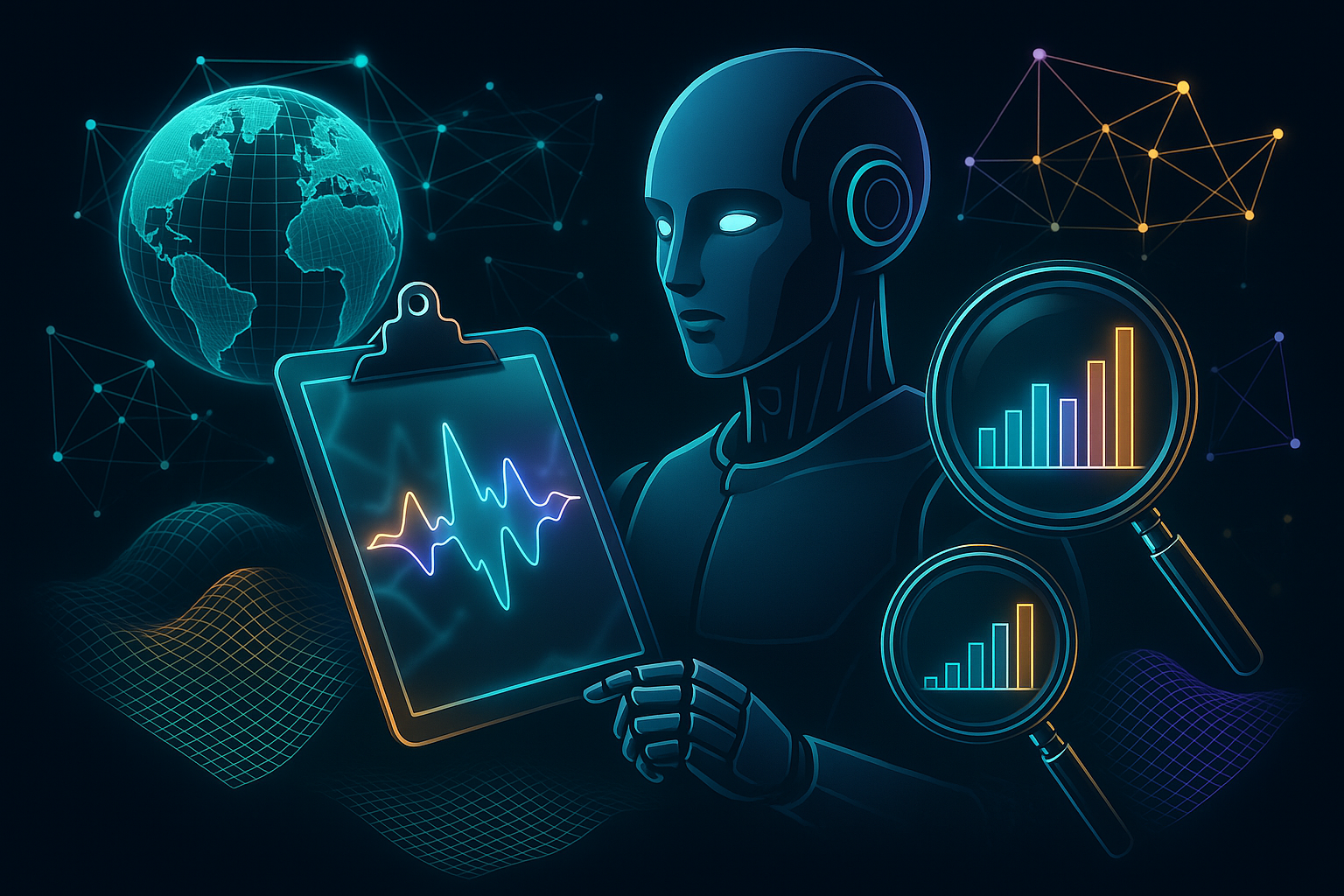
Two roles get lumped together under "AI in research," and most of the confusion starts right there.
Role one is infrastructure. AI moderates an interview, transcribes a session, codes open-ends, sitting between the researcher and a human's input to clean up something a person already said or did. Most research teams picked this up years ago without much fuss.
Role two is participant, and it's a different job. The AI makes up the answer itself, drawing on patterns rather than processing a single human's answer. A synthetic respondent stands in for a real shopper, patient, or executive, answering the way that person might. That's what this piece is actually about.
A synthetic respondent draws on real survey data, purchase records, customer reviews, and public opinion datasets, then gets built to model how a group tends to think and choose. The goal is to reason the way someone would, shaped by patterns across many real answers rather than any single scripted line. The persona is the actual unit of work. Each agent carries demographic traits, a psychographic profile, a behavioral history, some sense of emotional tendency, and when you ask it a question, it reasons from that identity, closer to an actor working from a character's motives than reciting a script.
I'll say the thing now so I don't have to circle back to it later: a synthetic respondent is only as good as what trained it. Thin data, old data, lopsided data, all of it shows up in the answers, and no amount of clever engineering fixes a bad input. I've watched teams learn that the expensive way.
The technical architecture that makes synthetic respondents plausible
Nobody builds a synthetic respondent worth trusting by pointing one language model at a persona sheet and calling it done. The platforms that hold up under scrutiny stack several layers on top of each other, and it's worth walking through why each one matters.
Ensemble routing comes first: queries spread across several models, GPT, Claude, the Llama family, instead of leaning on one. That smooths out the odd quirks any single model brings on its own. Personality grounding comes next, anchoring agents to psychological frameworks (Big Five traits show up a lot) layered with emotional modeling, so the tone stays consistent with whoever the agent is supposed to be.
Then there's retrieval-augmented generation, RAG for short, pulling in outside knowledge as it goes. Fine-tune against something like the U.S. General Social Survey and the answers start reflecting documented attitudes instead of whatever the base model happens to guess that day. Persistent memory matters too, maybe more than people give it credit for. Agents carry behavioral history and past decisions across a session, which lets you run a multi-step simulation instead of one flat question and one flat answer. For a full shopping trip, or a pricing call made under competitive pressure, the better platforms chain agents through a sequence of decision points rather than firing one giant prompt and hoping the output holds together.
The strongest evidence I've seen that any of this works came out of a 2024 study by researchers at Google DeepMind and Stanford. Researchers at Google DeepMind and Stanford built 1,052 generative agents from two-hour interviews with real people, and the agents' answers lined up with those same people's General Social Survey responses. The agents also matched what the real participants said when re-surveyed two weeks later. That second part stuck with me longer than the first, honestly, because it means the agents were tracking something stable about how a specific person tends to answer, not just producing plausible noise on a given day.
This setup does things a static survey can't do structurally, like follow-up probing inside a single session, or agents browsing a virtual shelf and reacting to content and to each other. And since the models retrain as new data comes in, the panel doesn't stay frozen at the moment someone built it.
None of that erases the ceiling, though. An agent simulates the population baked into its training data, full stop, and if you underrepresent a group there, rural consumers, older adults, a specific language community, the agent underrepresents them right back.
How well synthetic respondents actually replicate human responses
Sometimes remarkably well, sometimes not at all. It depends almost entirely on what you're asking, and pretending there's one clean accuracy number papers over that.
PyMC Labs looked at 14 studies run between late 2023 and early 2025. Eighty-six percent showed at least partial success mimicking human responses, half found strong similarity, and only 14% came back with little to none. Solid track record on paper, but "similarity" isn't a single score, it's a range that shifts hard depending on what's being tested.
Structured attitudinal questions, stated opinions, stated preferences, stated purchase intent, that's where synthetic agents do well. Anything leaning on lived sensory experience, emotional memory, or the kind of cultural gut feeling you only get from actually living somewhere, that's where performance drops fast. It's a curve, not a grade, and treating one aggregate number like a universal score misses the point entirely.
Vendors have put out their own numbers, and they cluster in a similar band. Evidenza claims 88% average accuracy across more than 100 head-to-head tests. A Colgate-Palmolive case study run with PyMC Labs found 90% correlation between synthetic and real panels. Lakmoos reported similarity scores above 98% across 20 client studies in 2025. EY found 95% correlation between a synthetic panel and its actual Global Brand Survey of C-suite executives. Take those with some skepticism, since vendors reported them, not neutral outside auditors.
The more conservative, independently reviewed range sits in the high-80s to mid-90s on well-defined attitudinal tasks, and it moves depending on domain. The real question has always been which tasks, and which populations, synthetic respondents are accurate enough for that you'd actually stake a decision on the answer.
Where AI agents as respondents deliver genuine research value
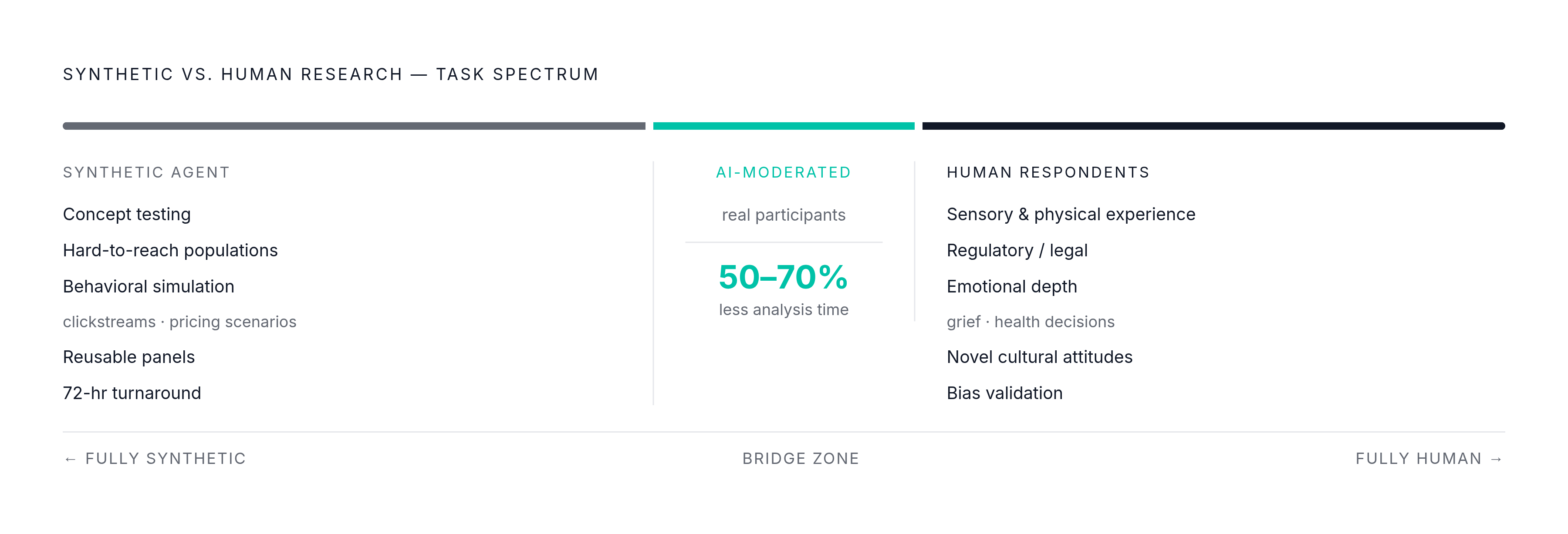
Concept testing before real money moves is the clearest win here. Run a product concept, a messaging angle, a pricing scenario against thousands of synthetic respondents before any live exposure happens at all. A beauty brand could simulate 10,000 Gen Z and millennial French consumers ahead of a skincare launch, agents reacting to simulated influencer content, browsing a virtual shelf, responding to each other's opinions. Nobody needs decimal-point precision here, just a fast directional read without the cost and lead time of recruiting a live panel first.
Hard-to-reach populations are the second strong case, and this one gets underrated. Recruiting pediatricians in rural Japan, or C-suite finance executives, or small-business owners in some niche vertical, can eat months and run thousands of dollars per completed interview. A synthetic panel models those segments right away off existing behavioral and survey data. That matters most early on, when you're still deciding whether a live study is even worth the spend.
Behavioral simulation earns its own mention. Agents can model clickstreams, cart abandonment, reactions to price changes, all without touching real user data, and you can run a thousand pricing scenarios under different seasonal and competitive conditions before a single price actually moves anywhere.
Reusability is the one I think people undersell constantly. Build a synthetic panel once, run it again against the next product question, the next pricing question, the next positioning question. Research starts acting like something you own rather than a one-off project, retraining as fresh data lands instead of sitting frozen at the moment it was fielded. A human panel study, by contrast, is locked permanently to the day it was in the field.
Speed closes the list, and it's a real capability, not a line in a sales deck. Work that used to take three weeks can come back with directional findings in 72 hours. Teams running continuous discovery report release cycles twice as fast, with feature adoption running 30% higher, according to the 2024 ProductBoard Product Excellence Report. That kind of speed changes what a team is even willing to test, because the cost of testing anything drops through the floor. The same logic applies to any reusable synthetic panel: model an audience's behavior once, then point it at whatever question comes up next instead of starting from zero every time.
Where human respondents remain necessary and synthetic agents fall short
The limit that never goes away: a synthetic agent simulates the population it trained on. It can't invent a genuinely new cultural attitude, or a behavior that doesn't already exist somewhere in its data. Ask it about something truly novel and it tends to produce confident, plausible-sounding nonsense, which is worse than saying nothing at all.
Sensory and physical experience is the hardest wall I've run into, personally. No synthetic agent can tell you what a reformulated snack actually tastes like, or how a fabric feels against skin, because it has no mouth and no skin, and more data won't patch that. It's a whole category of experience the thing structurally cannot have, and I don't think that changes with the next model generation either.
High-stakes regulatory and legal work is another line that doesn't move. If a finding needs to hold up as a defensible record of actual human opinion, a legal filing, a regulatory submission, a clinical claim, synthetic data doesn't substitute for human respondents, not partially, not with caveats attached.
Emotional depth tied to lived experience is a real gap too. Grief, a major health decision, financial hardship: an agent can echo the stated attitude around these, but it can't carry the weight, since it's never been through any of it. It repeats what people say about the experience, but it cannot repeat having had it.
Then there's the bias problem, and it's worth stating plainly. Only 27% of organizations using AI actively work to reduce bias in that use. Underrepresent a demographic or region in the training data and a synthetic panel doesn't just miss that group, it can amplify the gap, treating a thin signal like it speaks for everyone.
Hallucination doesn't disappear just because you've dressed it up in research language, either. In 2024, 47% of enterprise AI users admitted to basing at least one major business decision on AI content that later turned out to be made up. Synthetic research carries that same risk, which is exactly why validation checkpoints with real human respondents matter so much. They're what stands between a plausible-sounding answer and an actual fact.
The real question has always been which task belongs to which method.
How to design research that uses AI agents and human respondents together
The sequence that's earned my trust runs like this: synthetic first, human second, then feed what you learned back into the model.
Use synthetic respondents early. Screen concepts, generate hypotheses, figure out which variables are even worth testing on real people, get a rough read on how a population might react before a dollar gets spent on recruitment. Bring in humans next to check the work: confirm the synthetic signal holds in a real population, catch the outliers the model missed, ground the parts of the story that need something embodied or emotional underneath them. Then feed what the humans told you back into the synthetic model, so the panel gets sharper instead of sitting still.
There's a useful middle layer worth naming on its own, and it doesn't get talked about enough: AI-moderated interviews with actual human participants. AI runs the interview, a real person answers, adaptive follow-ups and real-time probing and multilingual support built in. Looppanel found this cuts analysis time by 50 to 70%. Sweetgreen reportedly reached five times the scale at a third of the cost using AI-assisted research approaches. Anthropic ran more than 300 churn interviews on this model, while P&G validated product claims with over 250 male consumers using the same approach. Listen Labs reported 92% participant comfort with AI-moderated interviews, so the human side of the equation turned out not to be the sticking point a lot of people expected going in.
Scale decisions fall out of this pretty naturally: synthetic panels for broad, directional coverage across a lot of segments at once, human panels for depth in whichever segments actually carry the decision.
One habit that's easy to skip and shouldn't be: track where each answer came from. Know which finding came from a synthetic source and which came from a human one, and don't blend the two into a single number without flagging which is which, because that's exactly how a study quietly stops meaning anything. Listen Labs, for instance, recruits from a verified network of 30 million human respondents through Listen Atlas, built so moving from synthetic screening to human validation doesn't mean switching tools halfway through a project.
What practitioners should evaluate when choosing a synthetic research platform
Start with validation, and ask it head-on: how does this platform benchmark synthetic accuracy against real respondents, specifically for your domain, rather than some generic case study pulled from a different industry entirely? An 88%, a 90%, a 98% headline number opens the conversation, but it doesn't guarantee the number transfers to your category or your population.
Ask about training data next, and push for specifics. What real-world datasets built this population, how recent are they, and do they actually cover your target demographic and geography? Or are you extrapolating off a dataset that skews somewhere else entirely?
Check for verified human panel access sitting alongside the synthetic agents. If it's there, you can run the sequenced approach, synthetic first, human validation second, without stitching together separate vendors and losing a week in the handoff.
Global coverage matters in a very practical way too: can you reach hard-to-reach populations and international segments right away, without the usual recruitment lag? That's a test you can actually run yourself, not a line on a features page.
Look hard at reusability. Can a behavioral model built for one study get reused on the next question, or does every study start from zero? That answer decides whether research becomes something your team keeps building on, or a cost you keep paying from scratch every single time.
Weigh speed last, and how much of it runs without a person babysitting every step. High-performing insight suppliers now automate an average of 5.1 project functions using AI, according to Greenbook's 2025 GRIT Report. Ask whether the platform supports that level of automation, or whether an analyst still has to watch over every step regardless.