Consumer Behavior Modeling Approaches in Market Research
Picking the wrong modeling tool wastes time and money on the wrong insights.

I got into consumer behavior modeling because I kept watching smart teams pick the wrong tool for the job, then wonder why the answer felt off. The work itself is simple to describe: you're building formal representations of how people decide what to buy, form preferences, and react to whatever marketing puts in front of them. Data collection gives you the raw numbers. Modeling is what turns those numbers into something a team can actually act on, and the tool you pick for that job matters more than most people think going in.
There are really three reasons anyone reaches for these models. Sometimes you need to explain why consumers did what they did. Sometimes you need to predict what a segment does next. And sometimes you need to simulate a reaction to something that doesn't exist yet, a product, a price point, a market nobody's launched into. Each question sits at a different point in the decision, and each one wants a different tool. The global AI consumer insights market was worth several billion dollars in 2025, on track for over ten billion dollars by 2034. However you feel about market-size numbers, that trajectory says computational modeling isn't a side tool anymore. It's the backbone.
Statistical and econometric models: the foundation every other approach builds on
Regression, linear, logistic, multinomial logit, is the old reliable of this field. It's stuck around for decades for one reason: it attributes behavior to specific variables and tells you how much each one moves the needle.
Conjoint analysis takes that further. It breaks a purchase decision into the weight of individual product attributes, and it's still what I reach for on pricing work and feature trade-off studies. Discrete choice models sit next to it, working out the odds someone picks one option over another under a fixed set of conditions.
What keeps this family around is that you can read it out loud. A coefficient means something you can explain to a stakeholder who's never opened a stats textbook in his life. Build the model right and you can isolate one variable's effect while holding everything else steady, which is the entire point of causal inference. Because the assumptions sit out in the open instead of buried in a weight matrix, these models survive audits and regulatory review in a way black-box systems just don't.
The cost is real, though. You need clean, structured data, an actual theory about which variables belong, and enough history to estimate parameters with confidence. Push these models into nonlinear behavior, high-dimensional interactions, or a category with zero past analogue, and they start to buckle under their own assumptions. But for pricing elasticity, demand forecasting against years of sales history, or a regulatory filing that needs a clean paper trail, nothing beats them. Nothing's come close in the twenty-some years I've been watching this space.
Psychographic and attitudinal segmentation models
Demographics tell you who someone is. Psychographic segmentation sorts people by values, attitudes, lifestyle, and motivation instead of age and income bracket, which gets you a lot closer to why they buy. The usual toolkit runs through cluster analysis on survey-based attitude batteries, factor analysis to collapse dozens of attitudinal questions into a handful of dimensions, and VALS-style typologies that sort people into named lifestyle groups.
This layer catches something raw behavioral data misses completely. Two customers can look identical on paper, same age, same zip code, same income, and behave nothing alike once you know what they actually value. Attitudinal segmentation surfaces that gap. It's often the only method that maps brand perception and emotional pull in a way you can actually act on.
It works best sitting next to something concrete: purchase records, engagement logs, real behavior. Attitudes without behavior are speculation. Behavior without attitudes is a black box; put the two together and each one explains what the other can't.
Here's the catch, and it's a real one. Attitudes drift. A segmentation model built on a 2022 survey can go stale fast once the market shifts underneath it, and you usually don't find out it's stale until the next study blindsides you with numbers that don't match what you thought you knew.
Worth mentioning here: structural equation modeling, SEM, which tests a hypothesized chain of cause and effect between things you can't directly measure, trust leading to perceived value leading to purchase intent, say. A 2025 study in the Journal of Marketing & Social Research used SEM to look at how AI-driven product recommendations, virtual assistants, and social proof cues shape purchase decisions. Decent example of an old statistical method getting pointed at genuinely new digital behavior.
Machine learning methods: what they add and where they trade off explainability for performance
Machine learning splits into a few working families in consumer research. Supervised learning, gradient boosting, random forests, neural networks, handles prediction: churn, purchase propensity, adoption likelihood. Unsupervised learning, clustering and dimensionality reduction, finds segments nobody told it to look for. NLP chews through unstructured text, reviews, social posts, support tickets, forum threads, and surfaces signal a human analyst would take weeks to find by hand. Recommendation systems and collaborative filtering treat preference as a function of what someone's already done.
Where ML earns its keep is in the mess. It handles high-dimensional interactions nobody had to specify ahead of time. It eats text, images, audio, everything a regression model can't touch. And it scores people in real time, which matters if you're trying to catch a churn signal before it shows up in next month's report.
The trade-off is you lose the why. A gradient boosting model spits out a prediction, not a coefficient you can point to on a slide. That's a real problem the second someone in the room asks why, and the honest answer is that the model can't fully tell you. It just knows.
In practice, I see teams running this for early churn detection, catching warning signs before they hit standard tracking dashboards; for sentiment monitoring scattered across TikTok, Reddit, niche forums, dark social; for segmentation that updates itself as new behavior rolls in instead of sitting frozen until the next study cycle. And the money's following the work: 83% of market research practitioners said they put money into AI or ML tooling in 2025.
ML draws its power from precedent, and that's also its ceiling. It can't generate insight about a scenario with zero precedent behind it, no matter how good the model is. That's exactly the gap synthetic simulation was built to fill.
Agent-based and behavioral simulation models
Agent-based modeling, ABM, simulates a population as a set of individual agents, each running its own behavioral rules, bumping into each other and into a simulated environment. Run enough of those interactions and market-level patterns show up that no single agent was programmed to produce: adoption curves, tipping points, the way awareness spreads through a network like a rumor through a office.
That emergence is the whole point of ABM. It lets you ask what happens if a competitor cuts price by some fixed amount, then actually watch that ripple through a simulated market instead of guessing. A regression model was never built to show you that kind of thing.
The catch has always been the rules themselves. Somebody has to decide how each agent behaves, and that decision rests on assumptions that might not hold up once real people get involved. Calibrating agents against actual behavioral parameters takes a deep well of historical data, and running the simulations is computationally heavy and, frankly, a pain to explain to a room of non-technical stakeholders staring at you blankly.
Even with those limits, ABM has found its home: market entry strategy, contagion-style modeling of how a product spreads, retail location planning, store layout work. And it sets up the next section nicely, because LLM-based synthetic panels are, in a real sense, a more refined version of the same idea. Same underlying logic, just trading hard-coded behavioral rules for a learned model of how an actual person thinks.
Synthetic consumer panels: how LLM-based behavioral simulation works
A synthetic consumer panel is an AI-generated group of virtual respondents built to mimic the behavior, preferences, and demographics of a real consumer segment. They're grounded in real-world data, historical surveys, reviews, behavioral logs, public opinion data, then pushed out to answer hypothetical questions no real survey has ever asked.
The commercial systems doing this tend to share a handful of design choices. Ensemble routing shifts between different LLM backends, GPT variants, Claude, Llama, to boost realism and dodge the quirks baked into any single model. Personas get built on established psychological frameworks with some form of affective modeling layered on top. A retrieval-augmented generation layer, RAG, feeds in domain-specific knowledge so the persona stays contextually accurate instead of drifting into generic chatbot filler that could be answering questions about anything. A 2025 MSI working paper puts it plainly: grounding these systems in real psychological theory is what lets them simulate how consumers think, feel, and decide, rather than just producing text that sounds plausible on the surface.
What this buys a research team is real. You can test reactions to a product, a price, a scenario before it exists in any form at all. You can scale to thousands of simulated respondents with zero recruitment lag, no scheduling emails, no no-shows. You can rerun the same calibrated panel against a brand-new question without re-fielding a study, turning what used to be a one-time cost into something reusable. And you get instant reach into global markets, across languages and geographies, without a single vendor negotiation.
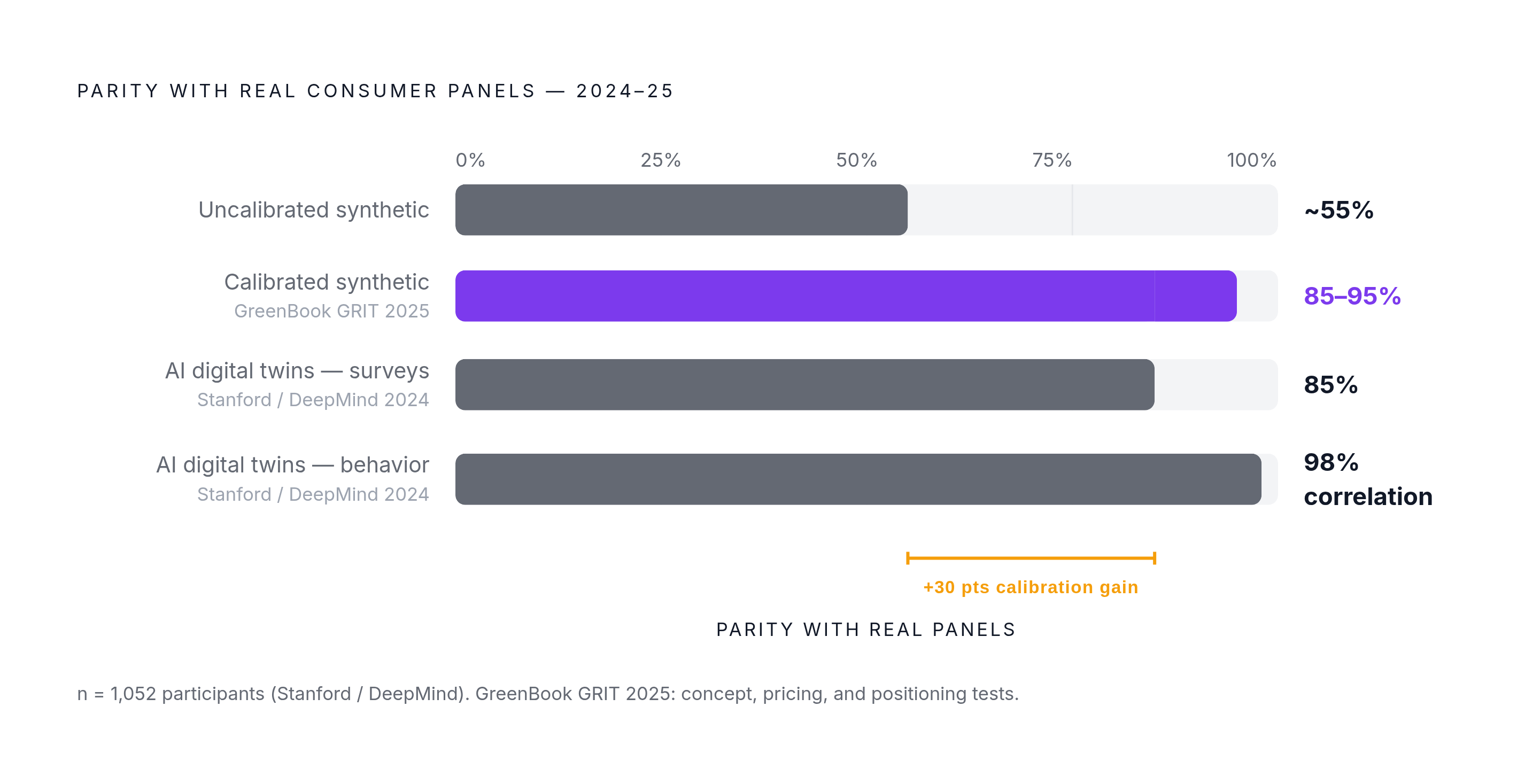
The accuracy numbers backed this up more than I expected the first time I actually saw them laid out. A 2024 Stanford and Google DeepMind study, 1,052 participants, found AI digital twins matched human survey answers at 85% accuracy and matched social behavior patterns at a 98% correlation. Calibrated synthetic panels land at 85 to 95% parity with real panels on concept, pricing, and positioning tests, according to the 2025 GreenBook GRIT report.
Calibration is the piece everything else hangs off of. Send generic prompts to an uncalibrated model and parity drops to around 55%, nowhere close to a usable substitute for real respondent data. That gap between calibrated and uncalibrated isn't rounding error; it's the difference between a research tool and a guessing game dressed up in a nice interface.
Adoption moved fast, faster than I expected honestly. Some platforms built around this workflow run AI-conducted interviews against verified human panels alongside synthetic simulations in the same study. Seda, an automated market research platform that conducts AI-led interviews and synthetic consumer simulations against a panel of verified human respondents across 130-plus countries, is one example of that combined approach. By 2025, 73% of market researchers had used synthetic responses in their work according to Qualtrics' 2025 Market Research Trends Report, and a third of them had done so in the previous 30 days. One more thing worth flagging: these panels can retrain as new real data comes in, so the underlying model of consumer behavior keeps getting sharper instead of going stale the way a fixed segmentation study does the day after fielding.
Where synthetic simulation falls short and what the research literature flags
None of this comes free, and researchers have been upfront about where it breaks. A 2024 Stanford analysis found AI-generated survey responses run suspiciously agreeable, wordier than a real person would ever bother being, and missing the rough edges and contradictions that show up in genuine human feedback. That flattening is exactly what you'd expect from a model that hasn't been calibrated against a genuinely diverse group of respondents.
There's a framing problem too. LLM responses shift depending on how a question is worded, how the options get labeled, even the order they show up in, and that bias can quietly warp synthetic results if nobody's watching for it closely. On top of that, LLMs lean toward whatever views were common in their training data, so output can drift from what the actual population thinks. It's reflecting whatever text the model learned from most, not any deliberate error someone can just go fix.
Strangely enough, the contamination runs the other way too. That same 2024 Stanford analysis found real human survey-takers using chatbots to write their own answers, which pollutes traditional panel data in a way nobody was watching for until it showed up. Good reminder that the line between synthetic and real isn't nearly as clean as it sounds on paper.
And there are things synthetic panels just don't do, full stop. They can't replicate ethnographic observation of behavior nobody's put into words yet. They can't replace the depth that comes out of a real one-on-one interview where a good moderator follows a thread nobody expected. And they're weak in cultural contexts far outside whatever the training data happened to cover.
Calibration against real human data is what keeps synthetic output honest. There's no shortcut around it. The 2025 GRIT findings back that up indirectly: 87% user satisfaction among teams running synthetic data tracks closely with teams that actually did the calibration work instead of skipping it to save a week.
Why the validation gap makes synthetic simulation especially valuable at early stages
Here's a number that should stop anyone mid-sentence: roughly 95% of new consumer products miss their launch targets, and 42% of startup failures trace back to no market need. Both of those failures happen before launch, not after, which is the part people tend to gloss over.
Call it the validation gap. Teams sink engineering time, manufacturing capacity, and go-to-market budget into a bet before they have any reliable read on how consumers will actually respond, mostly because traditional research takes longer than the decision timeline allows for. Something that needs to shape a product roadmap needs an answer this week. Not two months from now.
Speed is where synthetic simulation actually changes the math. Concept-to-signal work that takes 4 to 8 weeks with a traditional panel takes hours with a calibrated synthetic audience, per the 2025 GreenBook GRIT report. That unlocks moves that used to be off the table on any realistic timeline: screening a concept before development money goes out the door, testing price sensitivity across several price points at once, running positioning tests across multiple simulated segments in parallel, even getting an early read on a market you haven't entered yet.
Forrester's research backs up why this matters past the time savings alone: companies running iterative testing hit a 41% higher success rate on new product launches. The lesson isn't that faster research is more convenient, though it is that too. The speed of the feedback loop, more than the precision of any single study, is what actually drives better outcomes.
Unilever is a concrete case here, one I keep coming back to. Folding LLMs into survey design cut questionnaire deployment time by 85%, letting the team run multi-market concept tests in hours instead of weeks. That's not a one-off efficiency win you brag about once and move past. It shows how speed compounds across an entire research program rather than paying off a single time. The bigger shift underneath all of it: research stops being a series of one-off projects and starts working like infrastructure, something a team builds once, calibrates well, and reruns against every decision that comes after.
How research programs use these approaches as complementary layers rather than substitutes
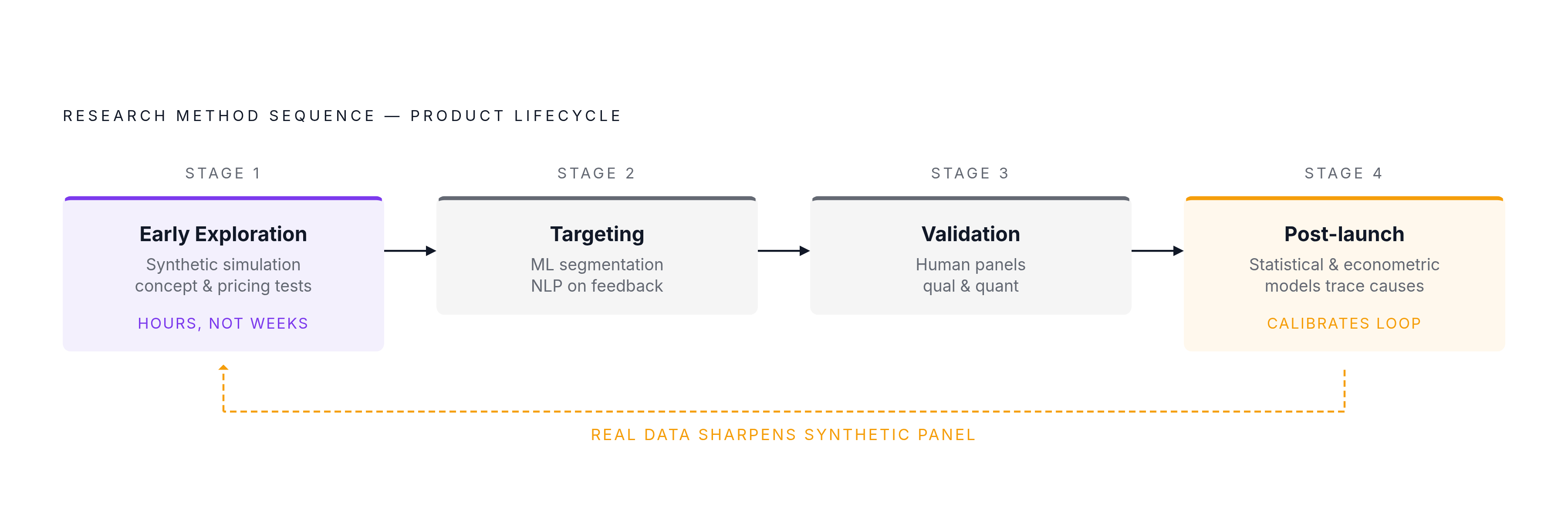
None of these approaches replaces the others, and I'd push back hard on anyone who tells you otherwise. The teams getting the best results treat them as stages laid out along a timeline, not rival options fighting for the same line item in a budget. Early on, synthetic simulation handles fast concept and pricing exploration before anyone commits real money to anything. Further along, ML-driven segmentation and NLP analysis of unstructured feedback sharpen exactly who the targeting should focus on. At the validation stage, real human panels, qualitative and quantitative both, confirm what the synthetic work suggested and catch whatever it missed along the way. After launch, statistical and econometric models take the real behavioral data and trace outcomes back to specific causes, which then feeds straight back into calibrating the next round of simulation.
That loop is what makes the whole system work. Real respondent data trains the synthetic panel; the synthetic panel throws off hypotheses that real respondents then confirm or shoot down. Each stream sharpens the other over time, and neither one works nearly as well alone.
Trouble shows up the moment a team collapses that loop into a single method. Swap every real panel for synthetic data and you lose the diversity and honesty calibration needs in the first place. Lean only on econometric models and you miss the early-stage questions where no historical data exists yet to build one from. Stick to qualitative or attitudinal work alone and you're left with insight that can't scale up to a market-level call.
The industry's already living this shift at the organizational level. By 2026, 78% of Fortune 500 brands had dropped their annual tracking studies for continuous, iterative research instead. That's a change in how the whole operation runs, not a shift in which methodology researchers happen to prefer this year, and it isn't reversing.