Psychographic Attributes in an Ideal Customer Profile
Understanding what drives your customer's decisions matters more than knowing their job title.

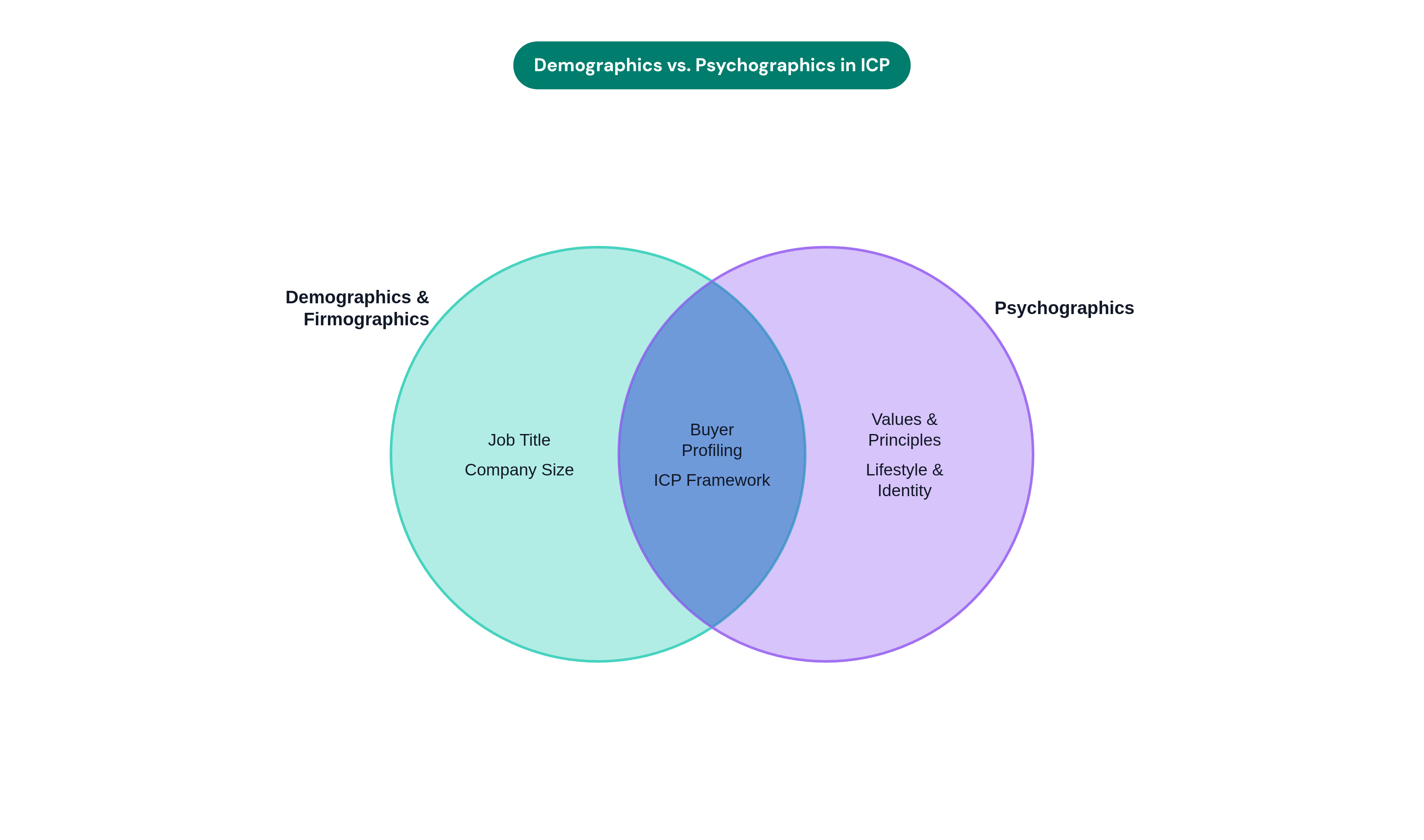
Most ICP frameworks stop at "who." Job title, company size, industry, revenue range, maybe purchase history. Necessary, but nowhere near sufficient. Two companies can look identical on paper, same industry, same headcount, same budget, and behave completely differently as buyers. One moves fast, bets on innovation, decides in a small room. The other requires committee consensus, prioritizes cost containment, and treats every vendor decision as a risk management exercise. Demographics and firmographics tell you the genre. Psychographics tell you the story — and like any good story, the plot only makes sense once you understand what the characters actually want. Organizations that embed psychographic dimensions into a working ICP win more. Those that don't keep writing messaging that resonates with part of the market and alienates another, usually without understanding why.
There are four dimensions worth tracking, and they are distinct enough that collapsing them into a single "personality" bucket destroys most of their utility.
Values are the principles a customer holds about their industry, their role, and what a functional vendor relationship looks like. They determine which of your product claims land and which feel hollow. A customer who prizes transparency responds to open pricing and detailed documentation. One who values partnership is alienated by a high-pressure close, regardless of how strong your product actually is.
Motivations and goals are what the customer is genuinely trying to accomplish, at both the functional and aspirational level. Functional motivation is solving the immediate problem. Aspirational motivation is becoming a different kind of team, leader, or company. Strong ICPs capture both, because they drive different messages at different stages of the buying journey.
Lifestyle and identity describe where your customer goes to learn, who they trust, what format of information they consume, and which professional communities shape their thinking. In a B2B context, this is less about personal habits and more about epistemics: how does this person form beliefs, and who has real influence over them?
Decision-making style captures the process by which a customer evaluates options. How many people are in the room? How long does evaluation typically run? Do they need extensive third-party validation, or do they decide on fit and trust, then rationalize post-hoc? This dimension determines what your sales process actually needs to look like.
Behavioral data tells you what a customer did. Psychographics explain the underlying disposition that made them do it. If you only track the behavior, you will keep misreading the cause.
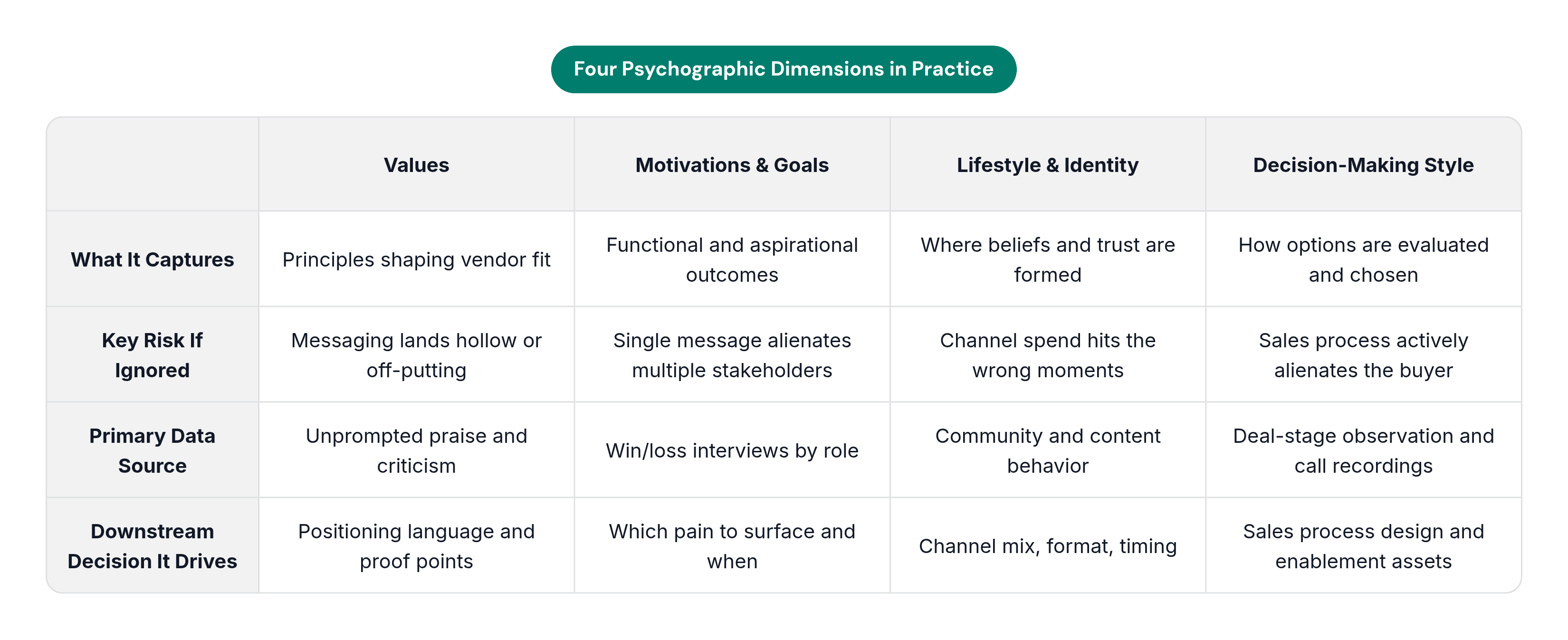
How Values Shape the Customer's Vendor Relationship Before a Sales Conversation Begins
Values operate before a salesperson ever enters the picture. A 2024 survey by EcoVadis and Wakefield Research found that 83% of procurement leaders said ESG criteria influence their vendor selection decisions. That is a filter applied at the front door. If your positioning does not account for what your ICP customers actually stand for, you are losing deals you never knew you were competing for.
The values dimension operates at two levels in B2B. The first is organizational: what the company signals through its public commitments and vendor selection criteria. The second is individual: what the evaluator or champion personally cares about, which does not always align with the official organizational stance. When those two levels conflict, deals stall in ways that are genuinely hard to diagnose. A champion who personally values speed and decisive action can find herself paralyzed inside an organization whose stated values demand exhaustive consensus. Knowing this in advance changes how you support her through that process.
The most reliable way to surface values in research is to listen for what customers praise or criticize without prompting. What people complain about reveals what they actually care about, far more honestly than anything captured in a structured survey. A customer who mentions, without any prompting, that a previous vendor "was never straight with us about roadmap" is telling you that transparency is a core value and that betraying it is disqualifying. That is a design constraint for everything from your sales process to your renewal conversation, not a minor data point to be logged and forgotten.
In practice, values data changes which case studies you lead with, whether you publish pricing, how you frame outreach, and which proof points anchor the conversation. The positioning decisions that feel instinctive are often just values-alignment in disguise. Better to make them explicit.
Mapping Motivations and Goals to the Moments That Drive Purchase Decisions
The most common failure in motivations work is listing something like "efficiency" and treating it as finished. That is not a motivation; it is a category. Motivations are role-specific, stage-specific, and layered in ways that one word cannot carry. Calling "efficiency" a motivation is like calling hunger a meal plan.
A procurement lead's primary motivation is cost control and risk reduction. The end user wants time savings and ease of use. The executive sponsor wants strategic differentiation and the kind of organizational credibility that makes them look good upward. All three are in the same deal. Flatten them into a single motivational statement and you produce messaging that speaks clearly to none of them.
There is also a layer most ICP frameworks ignore entirely: career motivation. Individual buyers are managing their own professional risk alongside organizational risk. A purchase decision that fails reflects on the person who championed it. Psychographic research that surfaces this creates an opening to address it directly in messaging, rather than pretend it does not exist. The implicit reassurance that your product is a defensible choice, not just a functional one, is something buyers feel even when they cannot articulate it. Deals move when that reassurance lands.
Motivations also shift with buying stage. At awareness, the motivation is recognizing that a problem is real and worth solving. At decision, it shifts to proving that this particular choice is the safest, most defensible option available. These require categorically different messages. An ICP that only captures one end of that spectrum produces content that converts at one stage and stalls at the other, and teams reliably blame the channel rather than the message.
Not all pain is equal, either. Knowing which specific pain is top-of-mind for your ICP at a given moment, rather than assuming all listed pain points carry equivalent urgency, is what determines which message opens the door and which one gets quietly archived.
What Lifestyle and Identity Signals Tell You About Channels, Tone, and Timing
Lifestyle signals in a B2B ICP are not about knowing that your buyer runs marathons or prefers audiobooks. They are about understanding where your buyer forms professional opinions and in what format they actually absorb information. A 2023 Demand Gen Report found that 62% of B2B buyers consume webinar content as part of their purchase research. That single behavioral signal is more actionable for content investment decisions than any demographic proxy you could construct.
Community membership is particularly diagnostic. Which professional associations, industry conferences, and online communities does your ICP actually participate in? These are the places where vendor reputations are made or broken before any direct outreach occurs. If your ICP is concentrated in a specific Slack community, a LinkedIn group, or a recurring conference circuit, that is where influence lives.
Tone is an identity signal, not just a stylistic preference. A buyer who identifies as a practitioner, hands-on, technical, appropriately skeptical of vendor claims, needs a different voice than one who identifies as a strategic leader benchmarking against peers and managing upward. Writing the same content for both and hoping it lands is a dependable way to reach neither.
Timing is probably the most underutilized application of lifestyle data. If your ICP travels to three major industry conferences per year, there are windows immediately before and after those events when they are actively processing vendor information and forming comparisons. Demographics tell you who your buyer is. Lifestyle data tells you when they are actually reachable and mentally available. Those are not the same thing, and treating them as equivalent is where a lot of channel investment quietly disappears.
The persistent mistake here is building channel strategy from demographic assumptions rather than observed behavior. Age range as a proxy for LinkedIn usage, for instance, produces a hypothesis. The hypothesis still requires validation against what your specific ICP actually does. The assumption is not the data.
Decision-Making Style as the Psychographic Dimension That Determines Sales Process Design
Decision-making style has the most direct structural consequence of any psychographic dimension. It does not just inform messaging; it determines what your sales process needs to look like from first contact through close.
The data-driven versus intuition-led spectrum is real and consequential. Some buyers need extensive case studies, ROI calculators, third-party validation, and reference calls before they will move. Others decide quickly on fit and trust, then build internal justification post-hoc. The sales process that works for the first group actively alienates the second. Delivering a dense ROI model to someone who already knows they want to work with you communicates, quite clearly, that you do not understand how they think.
Consensus versus autonomous decision-making changes what you give a champion to work with. A champion who needs to build internal coalition support does not just need a great demo; they need a leave-behind deck, a one-pager their finance lead can read without you in the room, and a clear articulation of the implementation risk mitigation story. Handing them only a demo recording and waiting is leaving them without the tools to sell on your behalf.
Risk tolerance shapes the structural design of the offering itself. A risk-averse buyer needs a trial, a pilot, a phased implementation, or a clear exit clause. They are not being obstructionist; they are managing downside the way their disposition requires. A risk-tolerant buyer, conversely, is slowed and sometimes visibly irritated by too many reassurance steps. Moving too cautiously with them signals that you are uncertain about your own product.
Speed of decision is the variable most likely to produce a misread on pipeline health. Some ICPs move quickly because the problem is genuinely acute. Others have long evaluation cycles regardless of urgency, because their internal process structurally requires it. Misreading this dimension produces one of two failure modes: pushing too hard and losing deals that were still in play, or moving too slowly and losing to a competitor who simply read the room better.
In the ICP document itself, this dimension should never be a label. "Analytical decision-maker" communicates almost nothing to the person designing the sales process. A short narrative works: who is typically in the evaluation room, what each stakeholder needs to see, and in what sequence the evidence should be presented. That is the version someone can actually act on.
How to Actually Gather Psychographic Data on Your Ideal Customers
Psychographic data lives in qualitative signals, not CRM fields. The primary sources are customer interviews, win/loss conversations, sales call recordings, support transcripts, and community behavior. None of these require sophisticated infrastructure. They require intentional listening, which turns out to be the harder constraint for most teams.
Customer interviews surface something surveys reliably miss: the language customers use to describe their own motivations. That language is often meaningfully different from the language the company uses to describe its product, and that gap is itself a psychographic finding. If customers consistently describe their problem in terms of organizational trust and internal credibility, and your product is positioned around speed and efficiency, you have a values and motivation mismatch that demographic targeting will not touch.
Win/loss interviews are the most concentrated source of psychographic signal available. Two prospects with nearly identical firmographic profiles who made different decisions almost always differ primarily on psychographic dimensions. The reasons they give for that decision, if you ask genuinely open-ended questions, reveal values, risk tolerance, and decision-making style directly. That data is sitting in your lost deal history, largely unused by most teams.
The practical constraint has historically been scale. A traditional moderated interview runs roughly $487 per conversation, which means most teams can afford enough conversations to form hypotheses but rarely enough to validate them across a representative sample. AI-moderated interviews have changed this materially, running closer to $22 per conversation and enabling the kind of volume, hundreds or thousands of interviews rather than dozens, where psychographic patterns actually become statistically meaningful rather than directionally suggestive. It is not a perfect substitute for a skilled human interviewer, but the coverage it enables is categorically different.
Passive data sources also proxy psychographic dimensions without requiring a direct question. Content consumption patterns, community participation, and product usage behavior all surface signals about values, identity, and decision-making style. They are not a substitute for direct conversation, but they generate useful hypotheses you can then test with real respondents.
One discipline that matters more than most teams realize: psychographic hypotheses generated from internal team assumptions should always be stress-tested against actual customer data. The internal view of "why customers buy" and customers' own account of why they bought diverge with striking frequency. The internal view reflects the product story. The customer account reflects the psychographic reality. Conflating them is where most ICP work quietly goes wrong.
Writing Psychographic Attributes into an ICP So They Drive Decisions Rather Than Sit in a Document
The most common failure in ICP work is not a failure of research; it is a failure of translation. Teams collect genuine psychographic insight and then write it up as vague labels that no one knows how to act on. "Motivated by efficiency." "Values trust." These phrases are not wrong, but they are not operational. Nobody reads them and knows what to change tomorrow. A vague psychographic label is like a map with no street names: technically a map, practically useless.
Specificity is what makes psychographics usable. For each dimension, write a short narrative that describes the observable behavior the attribute produces, not just the trait itself.
Instead of "values transparency," write: "Asks for pricing on the first call; will disengage if they sense information is being managed or withheld until later in the process." Instead of "analytical decision-maker," write: "Requires an ROI model, peer case studies from similarly-sized companies, and a pilot period before signing; has a documented internal approval process with a defined review timeline built into it."
The test is simple: can a salesperson read this and change their behavior tomorrow? If not, it needs more specificity.
Each psychographic dimension should also be explicitly connected to a downstream business decision. Values drive positioning language and determine which proof points to lead with. Motivations determine which outcomes to quantify and which pain to surface first. Lifestyle and identity data inform channel mix, content format, and influencer or partnership strategy. Decision-making style shapes sales process design, the content assets built for each stage, and the pace at which the team advances the conversation. The link between research and action should be unambiguous, because if it requires interpretation it will not be used.
The ICP is also not something you write once. Psychographic attributes shift as markets evolve, competitive landscapes change, and products move upmarket or downmarket. Each of those events typically signals a change in who is actually buying and why. Revisit the psychographic layer whenever win rates shift noticeably, a meaningful new competitor enters, or the product's target segment changes. The teams that treat the ICP as a static document lose fidelity gradually, and then all at once. The teams that maintain it as a living behavioral model are operating with a more precise understanding of why their customers buy, and they build everything outward from that understanding.