ICP Divergence Between Marketing and Product Teams
Marketing and product define the ideal customer differently, harming retention.

Marketing lives inside a feedback loop built from responsiveness. Engagement metrics, ad performance, lead volume, conversion rates: all of these measure whether someone clicked, opened, or filled out a form. Not whether that person was a good fit. A campaign that pulls a broad, responsive audience looks like success by every internal metric, even if few of those leads ever become retained customers. The ICP that emerges from this environment gets shaped by vanity data rather than by the indicators that actually matter: retention, expansion revenue, referral behavior. Retrospective data from existing customers arrives too slowly to influence live campaign decisions, so it gets underweighted. The result is a customer picture optimized for acquisition volume rather than customer quality.
Product's signal environment has its own distortions. Feature requests, support tickets, NPS comments, usage analytics: all of these are weighted toward whoever is loudest or most active. Power users and vocal complainers disproportionately shape the roadmap, and they are not always representative of the ICP. Product's sense of the customer is also filtered through what was technically feasible to build, which does not always align with what the market actually needed. You end up with a customer picture derived from who is already using the product, selected by whatever mechanism marketing used to acquire them, further filtered by which of those users decided to engage.
The incentive asymmetry underneath all of this is what makes the divergence so persistent. A narrow ICP shrinks the addressable audience metric and looks like underperformance in a pipeline review, so marketing rationally avoids it. Building for a well-defined customer requires saying no to requests, which generates internal friction, so product rationally avoids that too. The gap isn't caused by negligence. Instead, it's caused by two teams doing exactly what their incentive structures reward them for doing.
Timeline mismatch compounds everything. Marketing operates on campaign cycles measured in weeks; product operates on roadmap cycles measured in quarters. Neither timeline naturally surfaces the same customer truth at the same moment, which means even when both teams try to coordinate, they're working from snapshots taken at different times under different conditions. This dynamic plays out in planning meetings where marketing brings data from a recent campaign cohort and product brings findings from a user research study conducted months prior, and both teams reason in good faith from genuinely incompatible evidence.
What a demographic ICP misses that a behavioral one captures
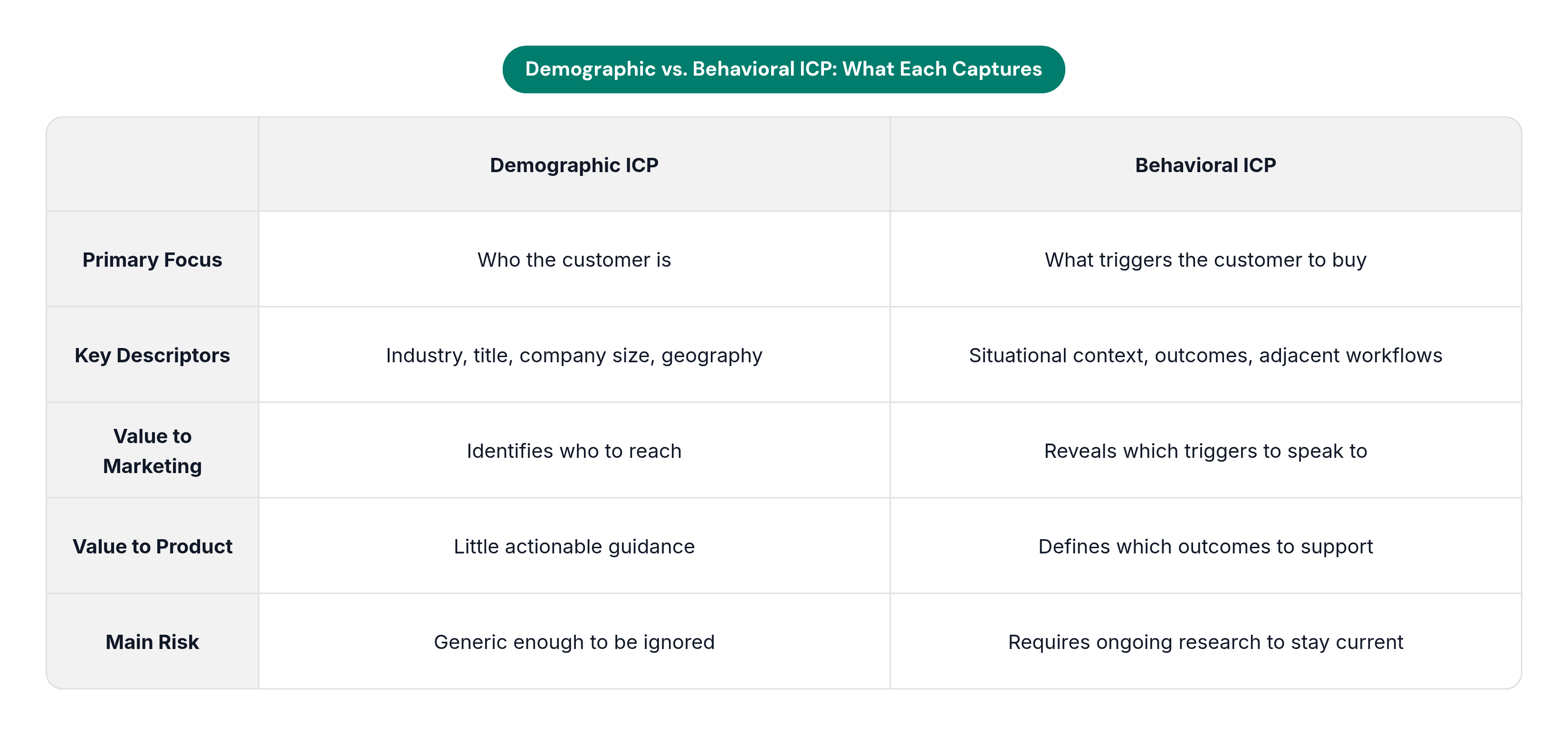
Most ICP documents describe who the customer is: industry, company size, title, geography. The firmographic skeleton. What they omit is the situational context that makes a customer ready to buy, the outcomes they need to achieve, and the specific triggers that made them start looking in the first place.
The behavioral ICP asks fundamentally different questions. What changed in the customer's environment that initiated the search? What does success look like for them in the first 90 days? What adjacent tools or workflows does this product have to integrate with to actually deliver value? These are the questions that determine whether marketing speaks to something real and whether product builds something useful.
A demographic ICP tells you who to reach but tells product almost nothing about what to build or prioritize. A behavioral one, however, creates a shared description both teams can actually act on: marketing knows which triggers to speak to, product knows which outcomes to support.
The copy-paste failure is its own problem. Teams that borrow ICP templates from industry playbooks end up with generic descriptions that no one disputes because no one finds them specific enough to argue with. Because no one argues with them, no one is actually guided by them. The document gets cited in strategy decks and then quietly ignored in every real decision. This pattern can emerge at companies that have a formal ICP process on paper — the document exists and has been reviewed — but existence is not the same as utility.
Defining the ICP solely from the current customer base creates a different trap, particularly for product teams: it assumes the past defines the future. The loudest users in any cohort are often outliers. So building toward them is building toward the edges.
The organizational cost when the pictures stay misaligned
When marketing acquires customers product wasn't built for, the consequences are predictable and measurable. Onboarding friction rises because the product experience doesn't match what the campaign promised. Support load increases as customers struggle to find value. Churn accelerates among the very cohorts marketing is proudest of acquiring. The acquisition metrics look strong right until the retention metrics surface the damage, usually a quarter or two later, and by then both teams have moved on to the next cycle.
When product builds for customers marketing isn't targeting, a different set of problems emerges. Features land without a qualified audience to use them. Marketing can't credibly speak to the roadmap because they don't fully understand who it was built for. Sales pitches a story the product doesn't quite deliver. The disconnect becomes visible to customers before it becomes visible internally, which is the worst possible sequencing.
What makes this genuinely corrosive is the feedback loop it generates. Wrong customers produce wrong feedback, which pulls the product further from the ICP, which makes marketing's job harder, which drives them toward even broader targeting to hit volume targets. Each step in that loop is a rational local decision. The cumulative effect, however, is a system that drifts further from its target with every cycle, and because no single decision looks catastrophically wrong, no one triggers an alarm.
There is a diagnostic that surfaces the gap quickly. Ask marketing and product separately to name the last few customers who were a genuinely ideal fit. If the lists don't overlap substantially, the teams are likely working from misaligned customer pictures. That divergence can be investigated further rather than assumed away.
Why the ICP document itself isn't the problem
Most organizations already have an ICP. It lives in a Notion page, a sales deck, or a strategy document someone assembled during annual planning. The problem is not the absence of a document. It's that the document is static while the customer evolves.
A static ICP reflects who the ideal customer was at the moment it was written, built from a past cohort, filtered through the team that authored it, and immediately beginning to drift from reality the moment it's published. Each team then quietly reinterprets the document in light of their own current signals. The document becomes a shared label for two different underlying pictures. Everyone nods at the same slide in the all-hands and then returns to their desk to use their own version of the customer. The label provides the illusion of alignment while the underlying divergence continues undisturbed.
If the ICP was never grounded in actual customer research to begin with, the problem is worse. A template-borrowed ICP has no empirical anchor to drift from. It is already abstract. Updating it periodically doesn't solve anything structural because by the time the update happens, both teams have been operating on stale assumptions for months and have already made decisions that are difficult to reverse.
What's actually needed is a living source of customer signal that both teams draw from simultaneously, updated continuously, and specific enough that it cannot be reinterpreted differently by different functions. A document is a record. Alignment requires infrastructure, and those are not the same thing.
What continuous customer research looks like in practice for both teams
Continuous research is not the same as more research. It means replacing periodic, agency-dependent studies with always-on signal generation that both teams can access and act on without waiting for a research cycle to close.
The needs of each team are distinct but compatible. Marketing needs fast validation of messaging assumptions, behavioral triggers that indicate buying readiness, and ongoing signal on how the ICP is shifting as the market moves. Product needs outcome-level insight into what jobs customers are actually hiring the product to do, early friction signal before it appears in churn data, and validation that a proposed feature addresses a real ICP need rather than a vocal-user request. The same research system can serve both, if it's designed with both consumers in mind from the start rather than built for one team and shared reluctantly with the other.
The traditional research cycle creates the gap by default. A study commissioned by marketing captures marketing's questions. A study commissioned by product captures product's questions. Neither team sees the other's findings in time to coordinate before decisions are already made. The sequencing is the problem, not the quality of any individual study.
AI-moderated interviews can compress research cycles, making it more feasible to run customer conversations on an ongoing basis rather than as episodic projects. The cost of large-scale qualitative research has decreased enough that running such interviews before a quarterly planning meeting is no longer feasible only for enterprise companies. The key operational change is this: research becomes a provisioned resource that both teams draw on, instead of a gated service that one team owns and the other waits on.
How synthetic consumer panels accelerate ICP alignment without replacing human signal
The validation gap that feeds ICP divergence is, at its core, a speed problem. Both teams form assumptions about the ideal customer without a fast way to test whether those assumptions hold before acting on them.
Synthetic panels are AI-generated personas built from real behavioral data, customer histories, and survey patterns. They let teams interrogate ICP assumptions before fieldwork begins: testing whether a proposed customer description generates different behavioral predictions than the current one, exploring how a new target segment would respond to positioning before a campaign launches, running concept validation against a defined ICP without waiting for panel recruitment. They are not fabricated data. After all, calibrated synthetic panels are constructed from real-world datasets including historical survey responses, behavioral patterns, and customer reviews. The quality of the underlying human data determines their usefulness, which is why the calibration step matters more than the generation step.
A practical framework for using them: synthetic panels work as a primary tool for low-risk, high-iteration decisions like naming and messaging. They work well in a supporting role for medium-risk decisions like packaging and positioning. For high-stakes decisions such as regulated claims or major strategic pivots, they are appropriately subordinate to traditional human testing. The most important limitation for ICP work is that synthetic panels are weakest on genuinely novel products with no behavioral precedent. When the product category itself is new, the underlying behavioral data has no relevant reference point, and correlation with real responses drops sharply.
The right combination is a behavioral model of the target audience built once from real research, then run against new ICP hypotheses continuously. That turns a one-time research engagement into a reusable strategic asset.
Building a shared customer model that neither team can quietly reinterpret
The goal is not agreement on a document. It is a common research infrastructure that both teams draw live signal from, simultaneously and continuously.
That infrastructure has specific requirements. It must be built on behavioral and situational data, not just firmographic descriptions. It must be updated continuously from real customer conversations, not refreshed annually from a vendor study. It must be accessible to both teams at the same time, owned by neither, and not gated behind a research queue that one function controls. And it must be specific enough that disagreements surface as testable hypotheses rather than unresolvable interpretation differences. "Our ICP says customers in this situation prioritize speed over customization; let's test that" is a productive disagreement. "Our version of the ICP says something different than your version" is not. One of those conversations moves a business forward; the other one just moves in circles.
When the model is shared infrastructure rather than a document, the political dynamics shift in a useful direction. Neither team can quietly reinterpret a customer profile that is continuously generating fresh signal. The data settles the dispute, or at least moves it onto empirical ground where it can actually be resolved rather than managed.
Operationally, both teams run their planning questions against the same verified panel and synthetic model before committing to campaign direction or roadmap priorities. A behavioral customer model built once becomes more valuable as new research accumulates. Each study adds to the model rather than replacing it, which means the organization is building compounding institutional knowledge about its customer rather than starting over every planning cycle.
Two teams drawing from incompatible signal environments, with incompatible incentives and incompatible timelines, will produce incompatible pictures of the customer. That is not a personality conflict or a collaboration failure. It is a structural outcome, and it yields to structural solutions.