Building a Reusable Synthetic Audience Model
Treat your synthetic audience model as living infrastructure, not a one-time deliverable.

A synthetic audience model is a set of AI-generated consumer personas built from real audience data: demographics, behavior, attitudes, psychographics, all synthesized into something a team can query like a database. The output is segments and archetypes, things like "urban Gen Z tech enthusiasts" or "risk-averse mid-market IT directors," patterns pulled from data rather than individuals pulled from a list. Most teams still treat this like a report you commission once and file away, and that habit is the single biggest waste of the technology's value.
Get the distinction right first, because two other things get confused with this constantly. A lookalike audience takes a list you already have and finds more people who resemble it; a synthetic model builds behavioral representations from scratch, no seed list required. An anonymized data pool takes real people and strips their names off; a synthetic persona was never a person at all. It's a constructed entity built to represent a pattern in the data.
Commission it, get the readout, move on to the next project: that's the failure mode. A synthetic audience model built well doesn't expire when the deck gets presented. It functions as infrastructure. Query it again in six months for a pricing decision, again next year for a market entry question, again after a competitor launch changes the landscape. Reuse is the entire point, and it's what the rest of this piece is about.
Why the model is only as good as what goes into it
Feed it thin data and it hands back thin answers, dressed up to look confident. A synthetic model never tells you it's guessing, which is exactly what makes thin inputs so easy to miss.
The inputs that actually move the needle, based on how these builds tend to go wrong when one is missing:
- CRM data: purchase history, lifecycle stage, churn signals
- Behavioral data: on-site actions, product usage, content engagement
- Attitudinal data: survey responses, interview transcripts, product reviews already sitting in a shared drive somewhere
- Social listening: the actual words people use, sentiment, what's being said about the category right now
A model trained on one source, demographic data alone, say, encodes whatever blind spots that source carries. And that blind spot doesn't show up once and go away. Every time the model gets reused for a new question, the same gap resurfaces. Nobody warns teams about that compounding cost, but it's the real risk here.
More data types beats more records, full stop. A model built on demographic volume alone, even a mountain of it, underperforms a smaller dataset that blends behavioral, attitudinal, and demographic signals together. Volume isn't depth, and treating it like a substitute is where a lot of budget gets wasted. It's the same lesson that surfaces in most data science work once you push past the pilot stage: more of the same signal plateaus fast, while a second kind of signal keeps paying off.
Human feedback belongs in construction, not bolted on afterward as a sanity check. Platforms like Seda, which pairs AI-conducted interviews with a verified human respondent panel, are built around exactly that sequencing. Real respondent data should calibrate the model before it ever gets deployed. Bayesian validation techniques can surface confidence intervals around synthetic outputs, a level of rigor plenty of traditional surveys never bother to report in the first place.
Before any of this starts, audit what data already exists inside the organization. Skip that step and the model's ceiling gets set by accident instead of by design.
How segments get defined inside the model
A persona and a segment get used interchangeably, and that's sloppy. They're not the same thing.
A persona is a narrative: a page with a name, a stock photo, a quote. A segment inside a synthetic model is a behavioral cluster with attributes a team can query and compare directly. Loosely defined segments hand back averages, which is another way of saying they hand back nothing useful. Precisely defined ones hand back contrast: the actual difference between how one group decides and how another does.
Cluster analysis and generative modeling do the heavy lifting here. They find natural groupings in the data instead of forcing a team to guess segment boundaries ahead of time. Each segment then gets encoded with demographics, psychographics, what drives the purchase decision, common objections, price sensitivity, channel preference.
Professional decision-makers deserve their own line of attention, and this is where the practical case gets clearest. B2B teams can build AI-generated personas for a CTO or a CISO, modeling how that role actually evaluates a vendor and where objections tend to surface. A CISO at a mid-size fintech company, or an IT director weighing a cloud migration, is brutally hard to recruit for a live interview; a synthetic version of that role makes the insight available without months of cold recruiting emails. That opens research that used to be reserved for organizations with the budget to chase down hard-to-reach professionals one email at a time.
Granularity is a design choice, not a default setting. Too few segments and useful variation disappears into an average. Too many and the model turns into a maintenance headache nobody wants to own. The right number matches the decisions the team actually needs to make, nothing more.
Whatever gets defined here becomes the standing panel for every future study. Get it right at construction and it pays off for years. Get it wrong and every new question means re-litigating segment boundaries from scratch.
How validation works before the model is trusted for reuse
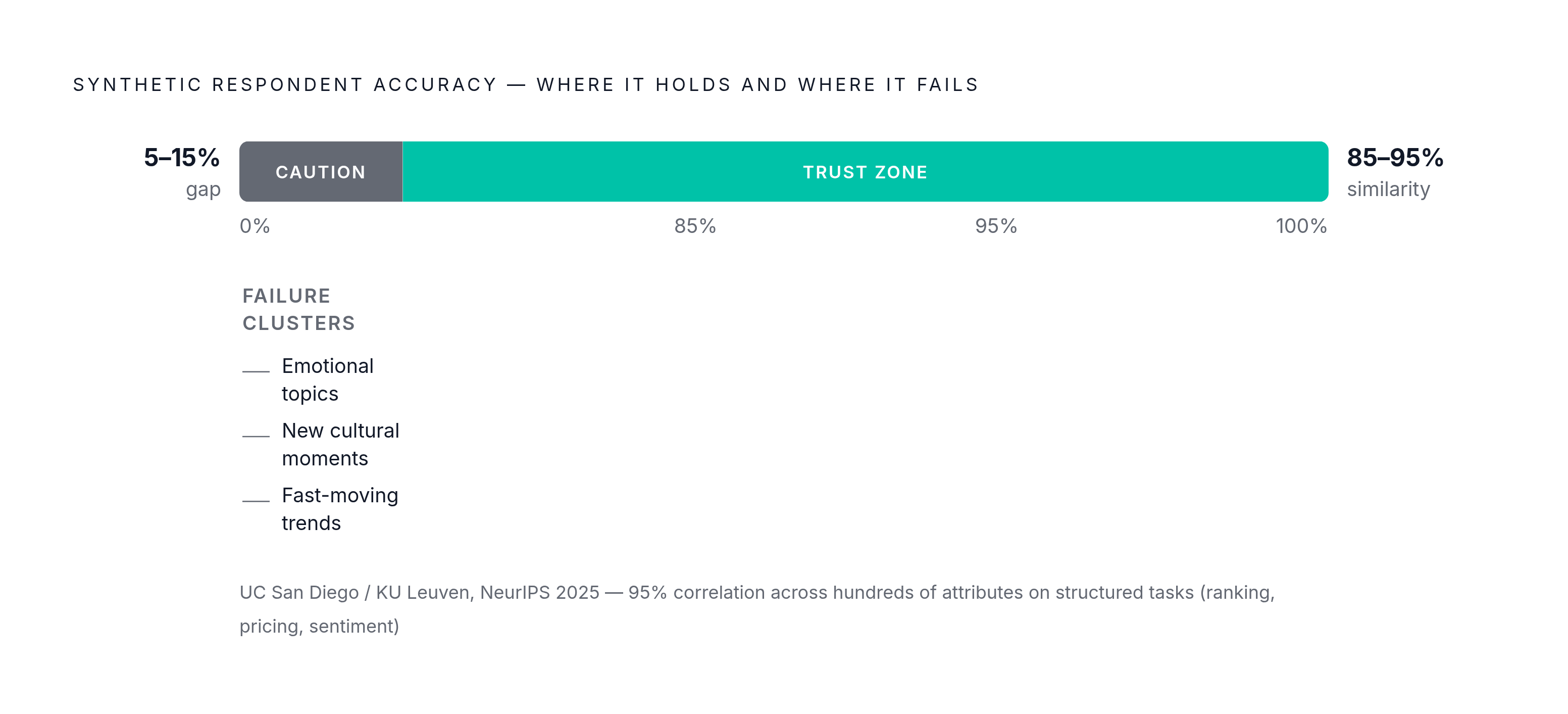
The numbers are worth stating plainly, because they set the boundary of what to trust. Synthetic respondents have hit 85 to 95% distributional similarity to real human samples on structured tasks like ranking, pricing, and sentiment, according to getperspective.ai. Research out of UC San Diego and KU Leuven, presented at NeurIPS 2025, found AI-generated synthetic profiles built from hundreds of attributes reaching 95% correlation with real survey data.
The remaining gap, that 5 to 15% where synthetic and human data diverge, isn't random static. It clusters around emotionally loaded topics, brand-new cultural moments, fast-moving trends the training data hasn't caught up to yet. That's where the model gets shaky, and knowing exactly where it gets shaky is more useful than a clean average would be.
Validation doesn't mean the model nails every question perfectly. It means a team knows precisely where to trust the output and where to bring in real respondents to close the gap. Validation is also front-loaded: clear the benchmark once at construction, and every query after that inherits the trust. The cost doesn't repeat with each new study, which is a big part of why this scales in a way one-off research never could.
Cost is the other half of the argument, and it's worth sitting with the actual numbers rather than the general claim. The agency OLIVER has put synthetic persona research at roughly 20% of the cost of a conventional focus group, with accuracy landing in the 70 to 85% range, per Futureweek's 2025 reporting. Even at the low end of that range, the cost-to-insight ratio changes what continuous research can look like for a team without a bottomless budget.
What the model can be queried against once it is built
Once the model clears validation, it turns into a tool a team can point at almost any question, not just the one it was originally built for.
Product concept testing is the obvious start: run a new feature or a packaging idea past a specific segment and get a directional read before an engineer touches the build. Pricing work goes further, using Conjoint Analysis and Discrete Choice Modeling to simulate how a segment trades off price against features and bundle configurations. Multiple pricing scenarios can run against the same panel, no new recruiting required for each version.
Messaging and creative testing follow the same logic. Put alternate copy or campaign framing in front of the same segment model and see what resonates before a media dollar gets spent. Market entry questions work here too: ask the model how the current product would land with a geography or demographic the team hasn't served yet. UX and usability questions can surface friction points without another round of moderated sessions on the calendar.
The structural advantage sits underneath all of this. A pricing study run in Q1 can be re-run in Q3 after a competitor makes a move, against the exact same panel, which makes the two results directly comparable in a way two separate one-off studies never are. No new recruitment, no new panel setup. The query is the only thing that changes.
The operational difference between a standing model and a research project
Here's the default failure mode, stated plainly: a team builds a model for one project, presents the findings, and closes the file. Nobody queries it again, because nobody owns it once the project wraps. Ownership, not technology, is where this breaks down.
Standing infrastructure needs a few specific things in place. There has to be a named owner: someone in research, product ops, or a growth function with cross-team reach, responsible for keeping the model current. There has to be a documented protocol covering how a team submits a question, what format the answer comes back in, what turnaround to expect. And there has to be a refresh cadence, so new behavioral or survey data gets folded in instead of left to sit while the model quietly drifts.
The cost argument comes down to where time actually goes. Recruiting and managing a representative sample eats up most of a traditional research project's timeline; a standing model removes that overhead from every query after the first one. A 2025 Forrester composite study found one organization spending $2.6 million a year on traditional agency research before shifting to automated approaches, a switch that reframes the model as a single construction cost set against indefinite reuse.
The broader case for continuous research is that the model gets more valuable with time, as teams accumulate comparable data points across studies that one-off projects can never produce. The model gets more valuable with time, mostly because teams get sharper at knowing which questions to ask and how to read what comes back.
Access matters as much as ownership. Lock the model behind one research team and it recreates the old bottleneck under a new name. Open it to product, marketing, and growth, and it starts behaving like infrastructure instead of a gatekept resource.
How the model stays current as audience behavior shifts
Treat it like a living panel, not a fixed report. As new behavioral data comes in, the model gets retrained or fine-tuned to reflect what's actually shifted: preferences, cultural context, market conditions.
A few things should trigger a real refresh: a competitor launch or a macro shift that changes how people decide, a fresh wave of human respondent data that updates the calibration baseline, or detected drift, where synthetic output starts pulling away from real signals like sales numbers, NPS trends, or recurring themes in customer service tickets.
Most queries don't need any of that. Messaging tests, pricing scenarios, feature prioritization work fine against the existing model without a refresh, because the underlying segment structure tends to hold steady even as smaller details shift around it.
The edge that degrades fastest is anything emotional or culturally new, and that's worth remembering before trusting a synthetic read on a topic that broke last week. Sentiment around a brand-new subject isn't something a model update fixes on its own; it needs real respondents brought in directly. One refresh mechanism worth naming: AI-moderated qualitative interviews, where real audience members talk to an AI interviewer and that conversation feeds fresh attitudinal data back into the model. Harvard Business Review's April 2026 coverage points out these systems compress a process that used to take weeks into days, while still catching emotional nuance that a static survey tends to flatten out.
Maintenance works best framed as ongoing hygiene, closer to keeping a CRM clean than commissioning a fresh study every time someone has a question.
Platforms that support reusable synthetic audience models
Some platforms are built for one-off reports, and that shows the moment a team tries to query them a second time and finds nothing left to query.
What actually matters when evaluating a platform, the questions worth asking before signing anything:
- Can it take in multiple data types, CRM, behavioral, attitudinal, not just a demographic profile?
- Does it support segment-level querying, or does everything come back as one flattened average?
- Is there validation tooling built in, benchmarking against real respondents, rather than a black box?
- Is there panel access for calibration, so validation waves don't require a separate vendor relationship?
- Does the model persist between studies, or does it get rebuilt from zero on every engagement?
The market context is worth sitting with. The $150 billion market research industry is being rebuilt around AI right now, with turnaround times collapsing from months down to days. The platform tier that supports reusable models, not just one-off synthetic reports, is exactly where that compression is happening, and it's the tier worth paying for.
A few categories worth evaluating on their own merits, not as interchangeable options. Platforms that combine verified human panels with synthetic AI agents offer the most complete setup for a standing model, since they support calibration against real respondents and ongoing synthetic querying in one place; platforms with verified panels covering a wide range of countries also mean broader segment coverage without a separate vendor negotiation for every market. Tooling that emphasizes Bayesian validation methods leans hard into Bayesian validation and uncertainty quantification, which matters for teams that need statistical rigor behind every synthetic output. c5i's synthetic audience offering fits well for conjoint and discrete choice work, particularly pricing and product configuration questions. Smaller specialist tools, like Atypica.AI, offer a cheaper way in for teams validating an early idea before committing to a full build.
Adoption is moving fast enough that this stopped being an early-adopter bet a while ago. Lyssna's research trends report found that 48% of UX researchers named synthetic users and AI participants as a trend set to shape their field in 2026.
The build-or-buy question comes down to what data a team already has sitting around. Teams with rich CRM, behavioral, and attitudinal data in-house can often build on a general-purpose platform. Teams without that depth are better served by a platform that supplies panel data as part of the build itself, instead of trying to construct a model on a foundation that isn't there yet.