Global Market Simulation Without International Recruitment
AI-generated consumer panels cut global research timelines from weeks to hours.

International recruitment is the bottleneck that slows down global market research, and synthetic consumer panels are starting to remove it. Teams can now model target audiences with AI and get usable signal in hours instead of weeks, without recruiting real people across borders. This piece breaks down how that actually works, how far the accuracy holds up, and where real respondents still matter. Here's the position worth stating plainly: most teams run synthetic panels backwards. They treat them as a cheap swap for fieldwork. In practice they work far better as a filter that makes fieldwork sharper.
Start with where the money and time actually go. Recruiting and managing a representative sample eats up roughly 60% of a research project's timeline, and most of that time is logistics, not thinking. A standard user study runs 6 to 12 weeks and costs somewhere between $25,000 and $65,000. Most of that spend just gets the right people in the room and turns their answers into something a VP will read.
That cost structure was shaky before AI even showed up. Response rates keep dropping, panel fatigue is real (frequent solicitation wears down respondent pools until participation drops off), and GDPR and CCPA have made international respondent data harder to get at cleanly. Companies entering new markets can't sit around for six weeks of fieldwork to find out if a price point lands in Manila or Mexico City. That gap, between how fast global demand moves and how slowly international research delivers answers, is the actual problem. Synthetic panels exist to close it.
What synthetic consumer panels actually are and how they are built
A synthetic consumer panel is a group of AI-generated virtual respondents built to act like a real consumer segment: how it thinks, talks, and answers questions. They're built from real datasets, historical survey responses, customer reviews, behavioral data, public opinion research. The model learns from actual humans first, then generates responses that reflect what that population is likely to say.
A few things separate a well-built panel from a shortcut. Calibration comes first: the panel gets tuned to specific traits (price sensitivity, brand loyalty, sustainability attitudes, cultural context) so the output reflects a defined segment instead of a generic "consumer." Feedback loops come second. As new real-world data comes in, the underlying model gets retrained, so the panel should get sharper over time rather than staying a frozen snapshot from whenever it was built. Validation matters just as much: serious platforms check synthetic outputs against real human data using Bayesian methods that quantify uncertainty and produce confidence intervals, a level of rigor most traditional surveys never bother to report.
These panels run around the clock, can stand in for almost any demographic or psychographic slice a team needs, and produce consistent results in minutes rather than weeks.
Here's the distinction worth being blunt about: typing "act like a 35-year-old consumer in Jakarta" into a general chatbot is improvisation. A calibrated synthetic panel trains on research-grade data and gets checked against real responses; a raw prompt skips both steps and calls the guess an answer. That's the mistake most teams make first, and it's the one that sours them on the whole method before they've given it a fair shot.
For global work specifically, this changes the math. A synthetic panel built for Southeast Asia or Latin America doesn't need a local fieldwork partner, doesn't need a regulatory review for that jurisdiction, and doesn't need a recruitment timeline at all. The audience gets modeled, not recruited.
How accurate synthetic panels are, and where the accuracy breaks down
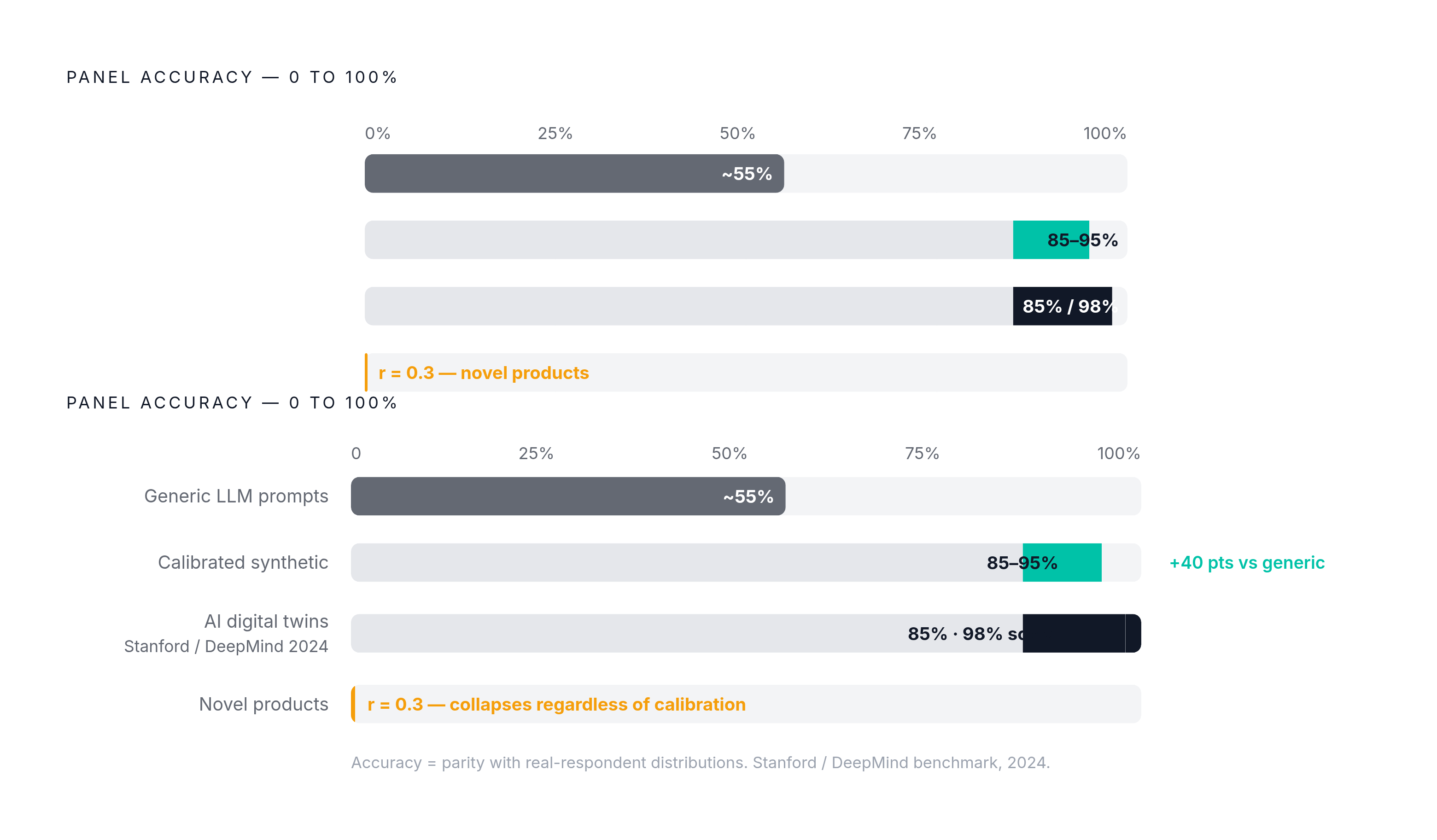
Start with the most rigorous number on record. A 2024 study from Stanford and Google DeepMind, involving 1,052 participants, found that AI digital twins replicated individual human survey answers with 85% accuracy and matched social behavior patterns with 98% correlation. That's an academic benchmark, not a vendor claim, and it sets the ceiling everyone else gets measured against.
Calibrated panels tend to land in the 85 to 95% range for parity with real human panels on concept tests, pricing tests, and positioning tests. Generic prompts to a general-purpose model hover closer to 55%. That gap is the entire argument for calibration: what the model trained on, and how it got checked, is the difference between a research tool and a party trick.
There's a hard limit, though, and it should change how any team deploys this tool. A Marketing Science study found only a 0.3 correlation between synthetic and real responses when testing genuinely novel products, meaning products with no sequel, no prior extension, nothing in the training data that resembles them. Synthetic panels model what's already understood about a population well; they struggle badly with reactions to something that population has never seen before. Line extensions, pricing variants, market entry for a category that already exists somewhere: those get high accuracy. A category-defining invention, something with zero precedent, gets a hypothesis at best, not a prediction. Treating 0.3 correlation as a green light is a mistake with a price tag attached.
One more operational note: these models train on data with a shelf life. Without frequent retraining, a model drifts away from current market conditions. Any team running synthetic panels in a fast-moving category should ask vendors, directly, how often the underlying models get updated, and should walk away from a vague answer.
The specific global research problems synthetic panels eliminate
Traditional recruitment fails most expensively when the target audience is hard to reach: niche professionals, C-suite executives, and small-business owners in emerging markets. These groups can take months to recruit and cost thousands of dollars per respondent, if a research team can even find enough of them.
Synthetic panels sidestep that problem almost entirely, removing much of the recruitment and coordination overhead that makes hard-to-reach segments so costly.
Consider what international recruitment actually involves before a single survey gets answered: negotiating with regional panel providers, checking regulatory compliance market by market, setting incentives that vary by country and currency, translating and back-translating every instrument, working around minimum sample sizes that make small-market research too costly to justify in the first place. Each step adds weeks. Synthetic simulation replaces the whole stack in one move.
For market entry decisions, this opens a sequence that didn't used to exist: model consumer response in a target country before committing to localization spend, a distribution partnership, or a regulatory filing. Test the hypothesis before the money moves, not after.
It also changes how concept screening works across multiple markets. A team can run the same concept against synthetic audiences in ten countries at once and see which ones show enough signal to justify real fieldwork. International research turns into a tiered process: screen wide, then invest narrow, rather than a single choice made once per market. That compression matters most exactly where the old timelines ran longest, in international markets, where recruitment friction used to be the whole bottleneck.
How adoption actually looks across the industry right now
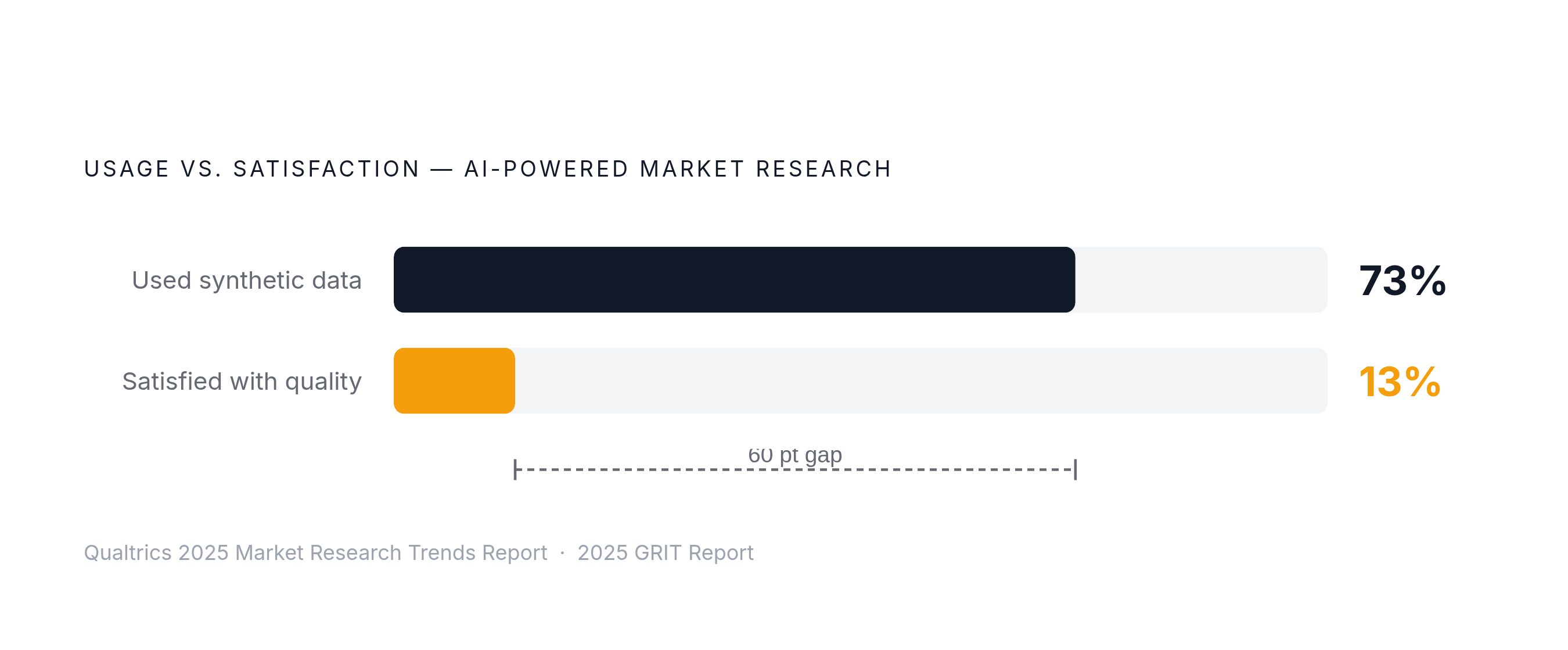
Adoption has already happened. Qualtrics' 2025 Market Research Trends Report found that 73% of market researchers have used synthetic responses at least once, and roughly a third had used them in the past 30 days.
Here's the part that doesn't fit the usual adoption-curve story, though. The 2025 GRIT Report found that only 13% of brand-side researchers reported satisfaction with AI-powered research quality. Usage is high; confidence is not. That gap is the real story here, and it's worth sitting with instead of explaining away.
Most teams using synthetic panels haven't figured out where the method belongs in the process yet, and the dissatisfaction traces back to method, not technology. Teams that use generic prompts instead of calibrated, validated panels get worse results, and that drags the whole satisfaction number down. Meanwhile, teams that understand the difference between a calibrated research panel and typing instructions into a chatbot are almost certainly seeing better outcomes than the aggregate number suggests.
Either way, the market keeps building around this regardless of where satisfaction sits today. Infrastructure investment is running ahead of trust, which is normal for a genuinely new method, and not a reason to wait on the sidelines.
When to use synthetic panels, when to use real respondents, and when to combine both
The real question is sequencing: where does each method earn its place.
Synthetic panels do their best work early and often. Screening concepts across several international markets before fieldwork budget gets committed. Testing pricing sensitivity on incremental variants and tier changes. Testing market entry hypotheses before localization spend. Running fast UX checks during design cycles where speed matters more than final proof. Reaching demographic segments that are slow or expensive to recruit through traditional means.
Real respondents still own certain categories outright, and no amount of calibration changes that. Final validation before a major spend commitment goes out the door belongs to real people. So does anything genuinely novel with no market precedent, where that 0.3 correlation limit applies directly. So does anything tied to grief, trust, safety, or cultural nuance that training data probably underrepresents. And so does any regulatory or audit situation where synthetic data provenance won't satisfy a compliance requirement.
The most effective setup pairs both: use synthetic panels to screen broadly at the top of the funnel, then spend real respondent budget only on the concepts and markets that survive that first pass. That changes what fieldwork is for. Real respondents validate hypotheses that synthetic screening already sharpened, and that sequence beats running real fieldwork on every idea from day one, on cost and on speed both.
There's a longer shift buried in here too. A team that builds a reusable behavioral model of its target audience can run future decisions against that same synthetic population again and again. Research starts acting like a standing asset instead of a one-off project cost.
What to evaluate when choosing a platform for global market simulation
Calibration is the first and most important question, and it isn't close. How was the panel built, and on what data? A generic LLM prompt gets roughly 55% parity with real responses; a purpose-built research model calibrated on a large respondent dataset gets 85 to 95%. That gap is the whole ballgame, and any vendor conversation that skips it is wasting everyone's time.
Qualtrics' synthetic panel, for instance, runs on a fine-tuned LLM trained on more than 200 million third-party global research respondents, and the company reports 12 times better accuracy than general-purpose models. Whether or not a team ends up using that specific platform, it's a useful reference point for what "research-grade calibration" actually looks like at scale.
Beyond calibration, a handful of questions separate serious platforms from shallow ones. Market coverage matters first: which countries and languages are reliably modeled, and what's the underlying training data for each one? Retraining cadence matters just as much: how often does the model get updated with fresh real-world data, and is drift disclosed anywhere, or buried in fine print? Validation transparency is a third filter: does the vendor show confidence intervals and benchmarks against real panels, or just hand over outputs with no accuracy story attached? And hybrid capability rounds it out: can synthetic and real respondents run in the same study, with a clean handoff from screening to validation?
A few names belong on the shortlist, for different reasons. Qualtrics, for research-grade LLM calibration at scale. PyMC Labs, for its rigorous validation methodology and published case studies. And the newer AI-native platforms combining large verified human panels with synthetic simulation in one workflow, such as Seda, which runs AI-conducted interviews against a panel of verified respondents across 130+ countries. The strongest research setups pair more than one of these, treating the choice as a matter of sequencing, not allegiance.
The question worth asking is which decisions can move faster without dropping below the confidence level those decisions actually require. Start the evaluation there, and the rest of the checklist falls into place around it.