Using Synthetic Panels to Validate ICP Assumptions
Conditioning personas on real behavior, not demographics, unlocks reliable ICP validation.

A synthetic panel is not a chatbot doing customer cosplay. Ask a general-purpose language model to "think like a mid-market CFO" and you get plausible-sounding prose — like a fortune cookie written by a consultant. You do not get calibrated behavioral signals. Most teams conflate the two, and that conflation is where the method breaks down before it ever gets started.
What makes a synthetic panel viable for ICP work is conditioning. Argyle and colleagues, writing in Political Analysis in 2023, showed that when a frontier model is conditioned on a real respondent's demographic and contextual backstory, the opinion distributions it generates closely match benchmark survey results. They called it "silicon sampling." The key variable is what the persona actually carries into the simulation. Most teams get this wrong by treating the persona as a demographic label. It is not a label. It is a behavioral model, and there is a real difference between those two things.
A useful synthetic persona carries role context, professional attitudes, brand preferences, workflow patterns, and the specific decision constraints that govern how a real buyer evaluates a product. From that foundation, you build a persona library: the ICP translated into three to seven distinct synthetic segments covering buyer types, user types, and the decision contexts that differ meaningfully between them. Built with care, that library becomes standing infrastructure — a skeleton key that can unlock any assumption, at any stage of the product or go-to-market cycle, without standing up a new research project from scratch.
What comes out is directional. Does this segment recognize the problem this product addresses? Does it prefer this framing over an alternative? How does it rank this feature against others? What happens when it sees this price point next to its current workaround? Structured outputs, readable by anyone on the team, before a single dollar is committed to production or market.
What to Test: The ICP Assumptions Most Worth Pressure-Testing First
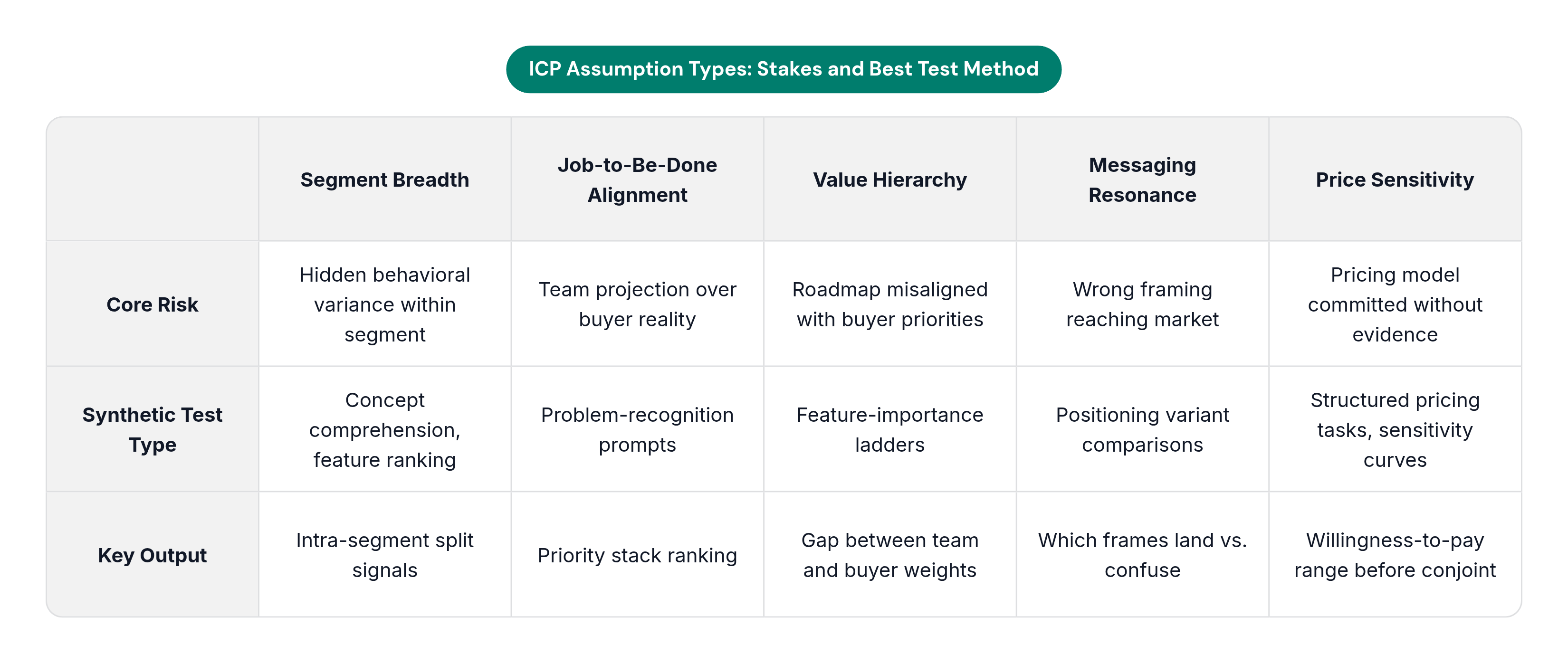
Not every ICP assumption carries equal stakes. Start with the ones whose failure drives the most expensive downstream decisions: product scoping, positioning lock-in, pricing strategy, channel investment. Everything else can wait.
Segment breadth is often where the cracks appear first. An ICP can look coherent on paper, grouping buyers who share firmographic characteristics, while hiding real behavioral variance underneath. Synthetic panels surface that intra-segment variance in ways aggregate personas never do. If a supposedly unified segment splits sharply on a concept comprehension or feature-ranking task, it is telling you something: the segment is not actually unified. That is worth acting on.
Job-to-be-done alignment is the assumption teams most reliably get wrong through sheer projection. The team experienced a problem, built a solution, and assumed the ICP segment experiences that problem in the same way. Sometimes it does. Often the problem exists but ranks low in the segment's actual priority stack, or it manifests differently than the team modeled. Running concept comprehension and problem-recognition prompts against a calibrated persona library tests this assumption before any engineering time is committed.
Value hierarchy is related but not the same thing. The features a team prioritizes in its roadmap often bear little resemblance to what the ICP segment actually weighs as important. Feature-importance ladders and concept preference rankings are strong synthetic use cases precisely because they produce ranked outputs the team can compare against its own assumptions. That gap is frequently the most instructive output of the exercise.
Messaging resonance is the highest-frequency use case. Positioning variants can be run through the full persona library before any creative is produced. The team learns which framing lands, which falls flat, and which reads as confusing rather than compelling, all before media spend enters the picture.
Price sensitivity and willingness to pay follow from there. Synthetic consumers perform reliably on structured pricing tasks. Sensitivity curves can be generated before committing to a pricing model or running more expensive conjoint studies with real respondents. This is not a replacement for pricing research; it is a first filter that sharpens the hypotheses going into that research.
The Super Butcher case, documented by Delve AI in 2025, illustrates what happens when none of this gets tested. The error was not marginal. It was directional. The brand assumed a male-dominated customer base. Synthetic persona analysis revealed a high-value segment of female grocery buyers aged 24 to 54, driven by convenience and family health considerations. The team retooled its digital presence accordingly and saw a 7% conversion rate on in-store purchase emails alongside a 29% improvement in click-through rates. The assumption had been wrong from the start. Nobody had checked.
One constraint deserves plain acknowledgment: truly novel products with no market analogue are a hard limit for synthetic methods. A study published in Marketing Science found only a 0.3 correlation between synthetic and real-respondent results for non-sequel, non-extension products. When the training data contains no behavioral analogue, the model cannot simulate reliable response. That is a ceiling, not an engineering problem to prompt your way around.
Structuring the Validation Workflow: From Assumption to Signal to Decision
The workflow has five steps, and the first one is where most teams lose the value before they ever start.
Translating a vague ICP belief into a testable question is harder than it looks. "We serve mid-market SaaS teams" is not testable. "Does this segment recognize the workflow problem this feature addresses, and does it currently solve that problem with a dedicated tool or a manual workaround?" is testable. Every assumption has to be sharpened to that level of specificity before the panel can return anything useful. Vague inputs produce meaningless outputs that still look confident — which is exactly what makes them dangerous.
Once the question is sharp, configure the persona correctly. Pull the relevant segment from the library and confirm that role context, firm type, decision authority, and relevant professional attitudes are correctly set. A persona misconfigured against the actual ICP segment will produce signals that feel meaningful and are not.
Run a focused stimulus through the panel: concept comprehension, feature ranking, message believability, pricing reaction. One assumption per test. Omnibus panels that bundle multiple questions produce noisy outputs that are hard to act on.
Read for variance, not just averages. The most important output is often how widely the synthetic segment splits on a question, not where the midpoint lands. High variance within a supposedly unified segment is itself a finding: the ICP is concealing meaningful behavioral differences under a single label.
When a synthetic panel result contradicts the team's ICP belief, treat it as a prompt to investigate, not a verdict. Its value is surfacing the question before money is spent.
That cadence changes the relationship between assumption and evidence. A team can run multiple feature-validation or positioning panels per week against the same persona library. That cadence would be financially impossible against real-user research. McKinsey's 2024 research on AI-assisted ICP modeling found that companies using these methods increased pipeline velocity by 22% while reducing wasted outreach by nearly one-fifth. The speed matters, but only because of what accumulates over time: fewer decisions made on unchecked assumptions, and a team that has built the habit of asking what it does not actually know.
Where Synthetic Signals Are Reliable and Where They Mislead
Multiple studies, including Argyle et al. (2023) and a Colgate-Palmolive case with PyMC Labs reporting a 90% correlation, place synthetic panels at roughly 80 to 95% alignment with human panels on stated-preference questions. That range matters as much as the ceiling. Vendor quality varies. Conditioning quality varies. A single accuracy figure obscures more than it reveals.
The strongest use cases map cleanly onto what ICP validation requires most: concept preference rankings, feature importance ladders, price sensitivity curves, message believability ratings, competitive positioning comparisons. These are structured, measurable tasks with clear outputs.
The limitations are specific. Synthetic consumers handle cognitive responses reliably. They are demonstrably limited on emotional texture, cultural subtext, and the group dynamics that shape purchasing behavior in socially embedded contexts. ICP assumptions that hinge on emotional brand attachment or community identity need human validation. There is no synthetic workaround for that.
Novel products represent a hard boundary. The 0.3 correlation finding for truly novel offerings reflects that the model has no behavioral analogue to draw on. That is not a calibration problem.
One comparison worth naming directly: a synthetic panel of many thousands of perfectly balanced personas is not automatically more valid than a carefully recruited human sample of 200. The accuracy benchmarks differ across vendors, conditioning approaches, and question types. Cross-platform comparisons are unreliable without shared validation standards, and vendors have every incentive to avoid establishing those standards. That tension is real and worth holding in mind when evaluating any vendor's accuracy claims.
One finding from the PyMC Labs work runs counter to what most people expect: synthetic consumers showed less positivity bias than human panels, producing wider and more discriminative signals between strong and mediocre concepts. That is genuinely useful for filtering weak ICP-product fits early. It also means the ceiling for strong concepts looks flatter than it actually is; genuine enthusiasm gets underrepresented. You have to hold both of those things at once when reading results, because optimizing for one without accounting for the other will pull your conclusions in the wrong direction.
The clearest operational boundary for ICP work specifically: synthetic panels can immediately simulate hard-to-reach segments, rural specialists, niche executives, senior buyers who rarely respond to surveys. When the assumption concerns how that segment behaves in an emotionally charged or socially complex decision, human respondents must confirm the signal before the team acts on it.
When and How to Calibrate Synthetic Findings Against Real Respondents
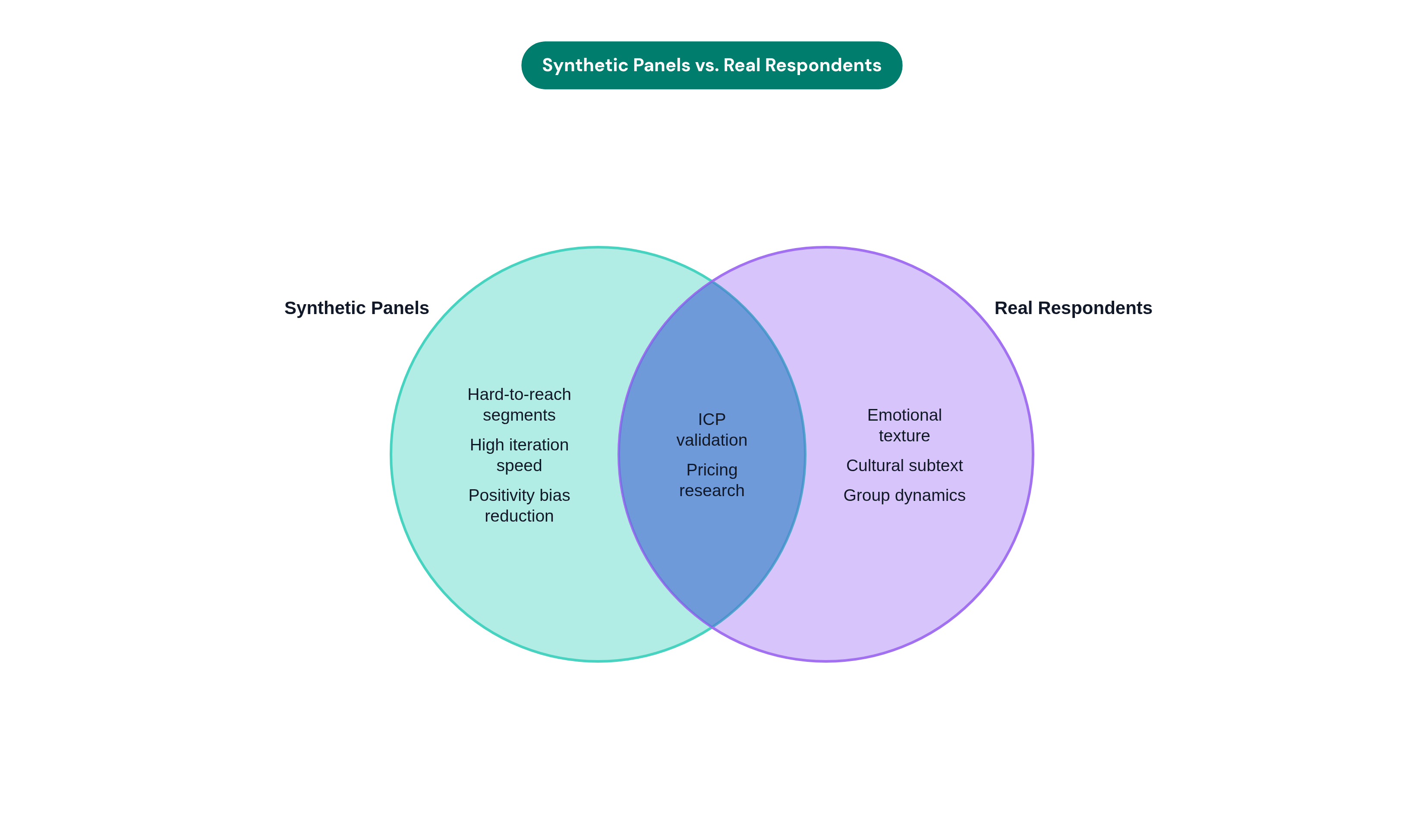
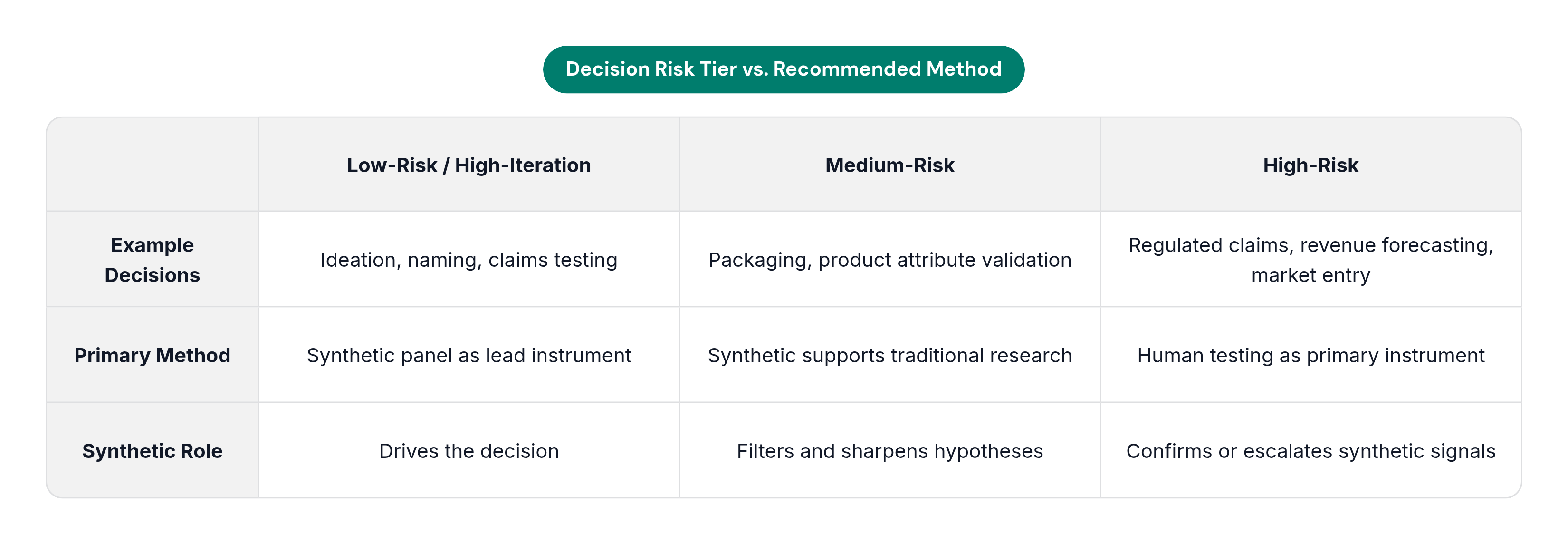
The governing principle is simple: synthetic panels are a fast filter, not a final answer. Use them to eliminate weak assumptions cheaply. Reserve real-respondent research for the assumptions that survive that filter and still carry meaningful risk.
BCG's tiering framework offers a practical decision rule. Low-risk, high-iteration decisions, including ideation, naming, and basic claims testing, can use synthetic panels as the primary method. Medium-risk decisions, packaging and product attribute validation, work best when synthetic panels support rather than replace traditional research. High-risk decisions, regulated claims, revenue forecasting, major market-entry bets, require human testing as the primary instrument. The framework is blunt, but useful precisely because it forces the team to classify the decision before choosing the method.
Two triggers should escalate a synthetic finding to human calibration. First: divergent synthetic signals. When the panel produces high variance or contradicts a strong prior, that is a prompt to spend the research budget on a targeted human study. It is not a signal to act on the synthetic output alone. Second: high-stakes commitment. Before a pricing change, a major feature bet, or an irreversible market-entry decision, confirm the strongest synthetic finding with real respondents. The discipline here is not distrust of the method; it is understanding what each method is equipped to answer.
The cost structure for this hybrid workflow has shifted. According to the Quirk's 2025 Researcher SaaS Report, AI-moderated conversational interviews run at roughly $22 per completed interview. A targeted human calibration study is no longer the weeks-long, $25,000 to $65,000 undertaking of traditional agency research. A product team can commission one when the decision warrants it, without routing through a research department or outside vendor on a multi-month timeline.
Calibration is not a one-time setup. Synthetic panels validated against real-respondent data over time produce more discriminative signals than panels that are never updated. The persona library is an evolving asset. Teams that get the most from it treat calibration as part of the operating rhythm, the same way they treat any other piece of infrastructure that degrades when left unattended.
Turning ICP Validation Into a Repeatable Operational Practice
The structural problem this workflow is designed to solve is that ICP validation, as most teams practice it, is episodic. It happens at a moment of organizational attention, produces a document, and then sits static while the market keeps moving. That document quietly shapes product decisions, pricing calls, and channel investments for the next twelve to eighteen months, often without anyone noticing it has gone stale. The ICP becomes a fossil — perfectly preserved and completely dead.
Gartner projects that by 2026, 70% of B2B companies will use AI-enhanced ICPs for account targeting. The teams that build the practice before it becomes table stakes are the ones that accumulate the learning advantage.
Continuous monitoring changes the trigger logic. Rather than scheduling quarterly ICP reviews and hoping the right questions get asked, AI monitoring can flag when segment conversion rates drop or when a new segment begins outperforming the modeled ICP. The synthetic panel runs against the updated signal, not against last year's assumptions. The feedback loop becomes structural.
The reusability of a well-built persona library is its most underappreciated property. Built once with care and calibrated against real-respondent data, it runs against any future product decision, pricing change, positioning variant, or market entry question. Research stops being a project that gets scoped, budgeted, and delayed. It starts functioning as infrastructure.
The team structure implication follows directly. This kind of validation does not require a dedicated research team or an outside agency. Product managers, growth leads, and UX researchers can run panels directly, collapsing the time between question and signal from weeks to hours. The constraint is no longer budget or access. It is the willingness to articulate assumptions clearly before acting on them — and to make testing the default rather than something that happens when someone gets uncomfortable enough to ask.