Democratization of Consumer Research Access
Cheap AI tools and synthetic panels are reshaping market research strategy, not adoption.

This is no longer a leading-edge story. JP Morgan Chase, citing U.S. Census data, tracked AI adoption among U.S. businesses jumping from 3.7% in 2023 to 17.8% by late 2025. Among researchers specifically, 95% now use AI tools regularly or are experimenting with them, per Qualtrics' 2026 trends report. The divide is no longer between adopters and holdouts — it is between teams with a coherent AI research strategy and teams still improvising one decision at a time.
The cost floor dropped in parallel. Entry-level AI research tooling fell from roughly $50 per month in 2019 to $20 to $30 per month by 2025. For smaller teams, price was the first wall. That wall is essentially gone.
Harvard Business Review's May to June 2025 analysis is worth keeping in your back pocket. Their framing identifies four distinct roles generative AI now plays in market research: accelerating existing data collection, replacing certain practices with synthetic data, filling gaps in market understanding, and creating new data types entirely, including what they call digital twins. That taxonomy is useful because it keeps the conversation honest. AI is doing several things at very different levels of methodological maturity, and conflating them is how teams end up disappointed.
Academic attention is tracking the practitioner surge almost in real time, which is unusual. Research publications on AI and consumer behavior jumped from 14 in 2021 to 45 in 2024. Normally, academic validation lags commercial practice by years. The fact that it is running nearly concurrent here tells you something about how fast the methodological ground is shifting.
The question for most teams is no longer whether to adopt AI-assisted methods. It is how to do it without quietly sacrificing rigor in the process.
What Synthetic Consumer Panels Can and Cannot Reliably Do
Synthetic panels are AI-generated virtual respondents built from real-world datasets: historical survey responses, customer reviews, behavioral data, public opinion trends. They are not fabricated personas. They are calibrated models trained on human data, and that distinction is doing a lot of work.
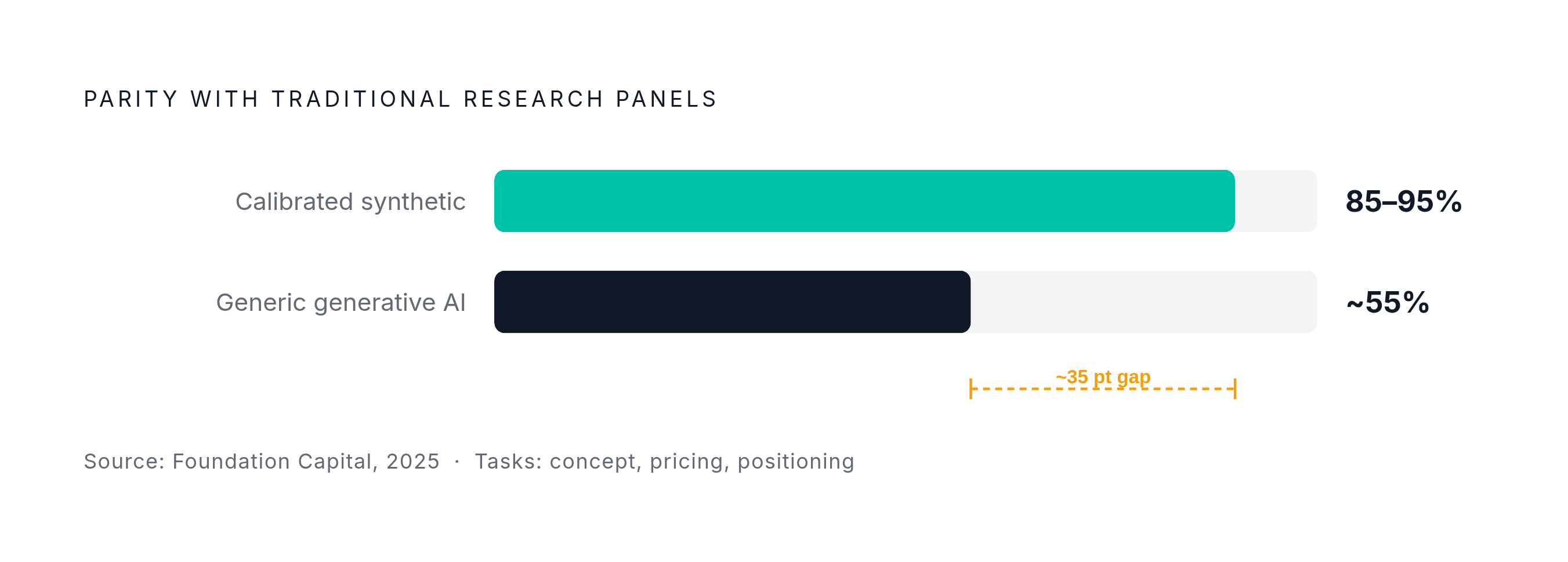
The accuracy split is the most important practical fact in this entire conversation. Calibrated synthetic panels, trained on actual human data rather than generic large language model prompts, reach 85 to 95% parity with traditional panels on concept, pricing, and positioning tasks, per Foundation Capital's 2025 analysis. Generic generative AI prompts sit closer to 55%. That gap is the difference between a research-grade instrument and a sophisticated guess dressed up as one. A 2024 Stanford and Google DeepMind study found 85% accuracy on survey replication and 98% correlation on behavioral tasks. Viewpoints AI generated nearly 20,000 synthetic respondents and replicated 76% of 133 published marketing study results in a matter of hours.
The strong use cases are specific: pricing sensitivity tests, concept screening, positioning evaluation, and hard-to-reach segments. Synthetic audiences can model the viewpoints of CISOs in fintech or IT directors evaluating cloud migration without the logistical nightmare of recruiting them through traditional channels. For segments that are definitionally difficult to access, synthetic modeling offers a credible starting point where previously you had nothing.
The limitation is equally specific — and too often softened. MIT Sloan put it plainly in 2026: when a large language model is given a persona, what it produces is "not an insight, it is a weighted mean wearing a mask." Language models are architecturally inclined to suppress anomalous, outlying data. Qualitative research exists almost entirely to surface those anomalies, because that is frequently where the strategically useful signal lives. BCG reinforces the boundary from a different angle: synthetic panels are poor instruments for radically new product ideas, where there is no historical behavioral data to calibrate against, but strong instruments for predicting pricing impact, gauging product fit, and testing marketing claims against existing categories.
Sixty-nine percent of researchers reported using synthetic responses in the past year. Adoption is real. So is the methodological debate about where the floor is.
Why the Hybrid Model, Synthetic Scale Plus Human Depth, Is Where Rigorous Teams Are Landing
The core logic is simple even if the execution is not. Synthetic panels compress the early phases — screening hypotheses, stress-testing pricing scenarios, identifying which questions are worth pursuing — so that human research time is reserved for problems that genuinely require it.
Arora et al. (2025) and Huang and Rust (Journal of Consumer Research, 2025) both argue that incorporating meaningful human input, including marketer expertise, brand nuance, and actual target consumer characteristics, prevents what they call the "average trap," where AI outputs converge on the predictable and miss what is strategically interesting. Pure-synthetic research, even well-calibrated research, has a structural tendency toward the conventional. Human input is not a corrective to AI's errors exactly; it is a corrective to its inclinations.
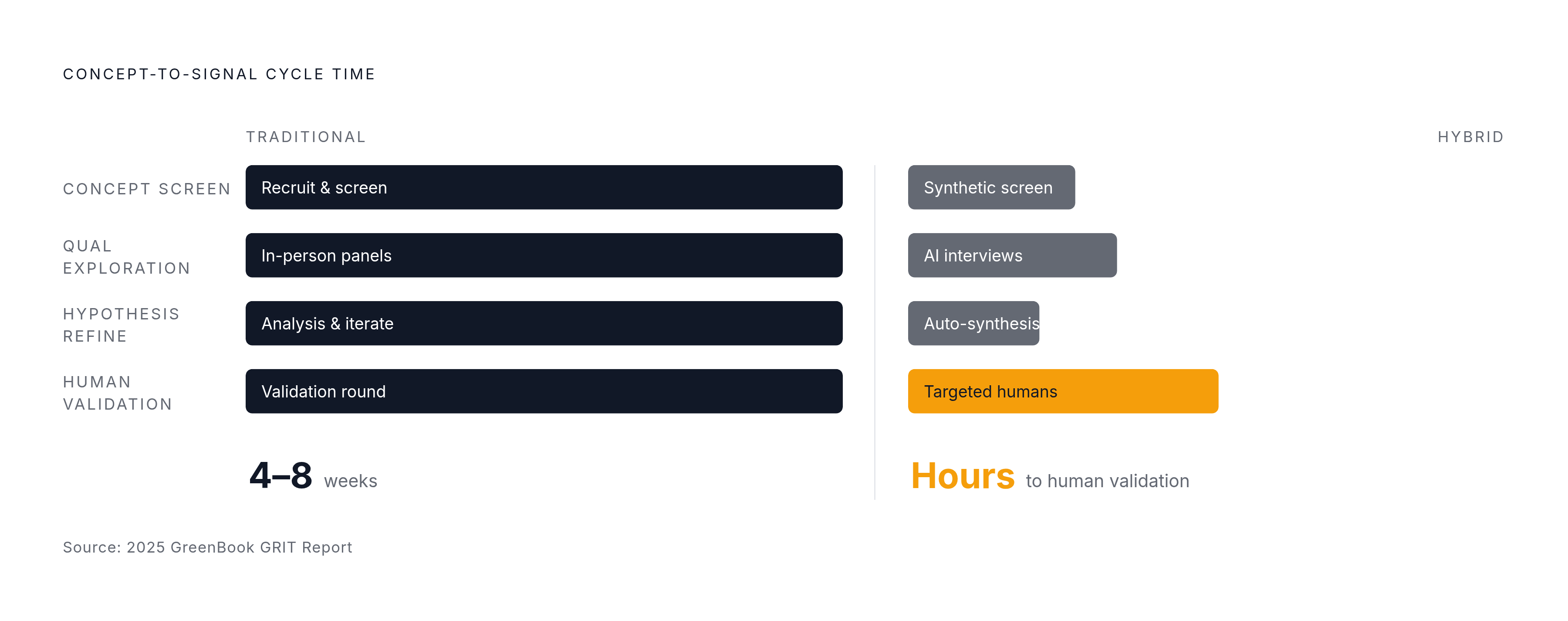
The speed differential changes the math. The 2025 GreenBook GRIT Report puts concept-to-signal cycles at four to eight weeks with traditional panels and hours with calibrated synthetic audiences. That compression means a team can run several synthetic rounds before committing budget to a single human study. Research ROI looks different when the preliminary work costs almost nothing.
Hard-to-reach segments are the clearest illustration of how hybrid logic works in practice. Synthetic modeling gets you a credible starting point. Human validation tells you whether the model captured the segment's actual decision criteria or just its statistical surface. Conflating them is exactly where synthetic-only approaches go sideways.
In practice, this restructures research budgets: instead of one or two large studies, teams run continuous lightweight synthetic loops and reserve qualitative human research for decisions where nuance and genuine surprise are what you are paying for. Deciding when to run synthetic first, when to go straight to human respondents, and when to layer both is where research design becomes strategy.
How AI-Moderated Interviewing Removes the Scale Ceiling on Qualitative Insight
The traditional constraint on qualitative research was human moderator time, full stop. A skilled moderator could conduct five to eight one-on-one interviews per week, with synthesis adding days on top of that. Participant availability was rarely the bottleneck. The researcher was.
AI-moderated interviewing removes that cap while preserving interview-grade depth, then auto-synthesizes transcripts in minutes, per Perspective AI's 2026 analysis. It is the first method that delivers both scale and depth simultaneously, not one at the expense of the other.
The bias reduction argument is underweighted in this conversation, so it is worth stating plainly. Human moderators introduce leading questions without realizing it. They signal approval through tone. They spend more follow-up time with participants who are articulate or engaging and less with participants who struggle to articulate their reasoning, which is sometimes the most important participant in the room. AI moderators ask exactly what the guide specifies, give every participant the same probing depth, and communicate nothing through affect — a consistency that, in certain contexts, is a genuine methodological advantage rather than a consolation prize.
Microsoft's Copilot team used Outset to run AI-moderated UX evaluations that lifted retention 5% and earned a permanent place on the product roadmap. That is qualitative-grade insight produced at a cadence traditional research cannot sustain.
The structural implication is worth sitting with. Qualitative research is no longer the slow, expensive counterpart to quantitative scale. AI moderation makes it a continuous practice rather than a periodic event you have to fight for budget approval to run.
Where Speed and Scale Make the Most Direct Business Impact: Pricing, Product, and Market Entry
Roughly 95% of new consumer products miss their launch targets. Forty-two percent of startup failures cite no market need as the primary cause. Both figures describe a validation gap, not an innovation gap. The ideas are there. The timely signal is not.
Pricing is a strong case because the questions are structured and bounded, which is precisely where calibrated synthetic panels perform best. Willingness-to-pay modeling, price sensitivity ranges, competitive positioning tests: pricing decisions do not hold open for six-week research cycles. They just do not. The AI-driven price optimization market was worth $2.98 billion in 2024 and is projected to reach $11.74 billion by 2034, per industry forecasts. That scale of investment reflects pricing intelligence becoming a continuous operational function rather than a periodic study.
A caveat that is genuinely important: AI learns from historical behavior. That is powerful until you are launching something genuinely new, entering a market you have not touched before, or trying to model willingness-to-pay for a product category that does not yet exist. Historical data has nothing to say about a category with no history. This is precisely where synthetic calibration and human validation together do what neither does alone.
Market entry is where global panel access changes the calculus most visibly. Recruiting local participants in a new geography through traditional agencies can take weeks and carry real coordination costs. Verified global panel access compresses that to hours. Market entry decisions rarely have weeks of runway for recruitment logistics.
The pattern across pricing, product, and market entry is the same. Either the research moves fast enough to inform the decision, or it arrives as a post-mortem.
What Genuine Research Access Looks Like for a Team Operating Without a Research Department
The structural change is not that research got cheaper, though it did. It is that the preconditions for running research changed. A team no longer needs a panel vendor, a moderator, a recruiter, and an analyst working in sequence to produce insight worth acting on. That dependency chain kept credible research locked inside agencies and dedicated research functions. Removing it changes who can run a legitimate study.
Continuous and reusable research replaces the one-time study model. Build a behavioral model of a target audience once and you can run that model against future decisions, pricing changes, feature prioritization, messaging tests, without restarting the process from scratch. The asset persists and the investment compounds rather than resetting.
The practical shape of fast research looks like this: synthetic panels for hypothesis screening, AI-moderated interviews for depth on the questions that actually matter, human panel validation for decisions with high stakes or genuine novelty. Each phase is faster than the previous model's first step alone.
With 24% of designers and 40% of developers using AI during testing, per Figma's 2025 AI report, research is already leaving the research department. Whether it is leaving with methodology or leaving improvised is the actual question. Improvised research produces confident, unsourced conclusions, and that is not an improvement over no research — it is a different category of problem, because at least the absence of data is legible.
The teams for whom this matters most are not necessarily the smallest. Mid-market product and UX teams with real research needs but no agency relationships and no dedicated staff are the clearest beneficiaries of collapsed timelines and accessible tooling. They had the need all along. What they lacked was the infrastructure to act on it. That infrastructure now exists, and you do not need to be a large enterprise or a research-trained team to use it responsibly.