Research Vendor Evaluation Criteria for Modern Teams
Speed, panel quality, and cost now separate AI-native vendors from legacy agencies.

Market research is splitting into two industries that happen to share a name. ESOMAR's Global Market Research Report puts overall 2025 growth at roughly 6.4%, but AI-native methods are the segment driving the industry's fastest growth. Agency-model work, the kind that's run the industry for decades, sits flat or barely above it. Legacy vendors and AI-native vendors aren't fighting for the same clients anymore, and the old RFP questions won't tell you which one you're actually hiring.
Five years ago, a vendor evaluation asked about sample size, turnaround in weeks, moderator credentials, report format. Fair questions, for the time. None of them tell you whether a vendor can turn a study around in a day instead of a month, or whether half its panel is bots clicking through for cash. Product cycles that used to run in quarters now run in weeks, so demand for research climbed right as patience for waiting on it collapsed. That gap, between when a business question shows up and when a traditional vendor can answer it, is where bad decisions get made.
How research speed became a first-order evaluation criterion
A traditional qualitative study, design to final report, takes four to six weeks under normal conditions. Inside a large enterprise, once internal prioritization queues, legal review, and stakeholder sign-off get added, that same study can stretch to six months. By the time the findings land, the product team has usually shipped already, or the market has moved past the question being asked.
AI-moderated platforms attack that timeline by running interviews in parallel instead of one after another. Recruitment, moderation, and analysis now happen inside 24 hours, not four to six weeks. According to Listen Labs, Anthropic ran more than 300 churn interviews using AI moderation, completing work that would have taken far longer through a traditional process. Microsoft gathered customer stories from around the world in a single day, conducting 250 interviews across multiple audiences in a timeframe traditional agencies could not match.
A decision made without research forecloses the value of research that shows up after the decision is already locked in. Teams have always wanted to do the work properly. What kept them from it was a calendar that never lined up with the moment the call actually got made.
Panel quality and fraud prevention: what commodity panels hide inside their sample sizes
A bigger sample sounds safer. It isn't, automatically. Commodity panels carry the problems they've always carried: professional survey-takers clicking through for cash, incentive-chasers who say whatever gets them paid fastest, and now AI-generated answers submitted by fraudulent participants pretending to be real people. Scale doesn't fix any of that. It multiplies it. Every extra respondent pulled from a low-quality pool is one more chance for junk to slide into the dataset.
Vendors that only handle recruitment, or only handle analysis, build a blind spot right at the handoff. A vendor that sources respondents but never touches analysis, or analyzes data it didn't collect, should get asked directly where its accountability starts and stops. That seam is usually where quality quietly breaks down, and nobody notices until the findings don't hold up.
Real quality control looks layered, not single-point: sourcing from verified panels instead of open marketplaces, watching for fraud in real time through video, voice, and device signals during the interview itself, capping how many times one respondent can participate, and bringing in human reviewers for niche or hard-to-reach audiences. Listen Labs runs a verified respondent network of 30 million people across more than 45 countries, backed by a three-layer Quality Guard system and a hard cap of three studies per respondent. That cap is a structural choice that limits how much any single person's answers can skew a dataset, and it's what separates a vendor built for fraud prevention from one that just says the word. It's a structural choice that limits how much any single person's answers can skew a dataset, and it's what separates a vendor built for fraud prevention from one that just says the word.
Conversational depth and emotional signal capture in static surveys
A survey only captures what someone is willing to type into a box. It misses the pause before an answer, the tone that undercuts a five-star rating, the flicker of confusion a respondent never puts into words. Most research tools were never built to notice any of that. Transcripts and self-reported scores are all they were designed to collect, so that's all they collect.
AI-moderated conversational interviews close part of that gap by tracking emotion as the conversation happens, with some platforms drawing on Ekman's model of universal emotions, a framework used in clinical psychology and UX research.
What separates that from a gimmick is traceability. A detected emotion has to tie back to an exact timestamp, an exact quote, and a clear reason the system flagged it. Without that chain, emotion detection is a marketing line dressed up as a feature. A Greenbook reader survey of 1,200 insights professionals found that users on AI-native platforms run 14 times more qualitative interviews per quarter in 2026 than they did in 2023. Volume alone doesn't prove depth, but it does mean the ceiling on how much a team can learn stopped being about time.
Scale and cost economics: what changes when interviews cost $8–$15 instead of $150–$300
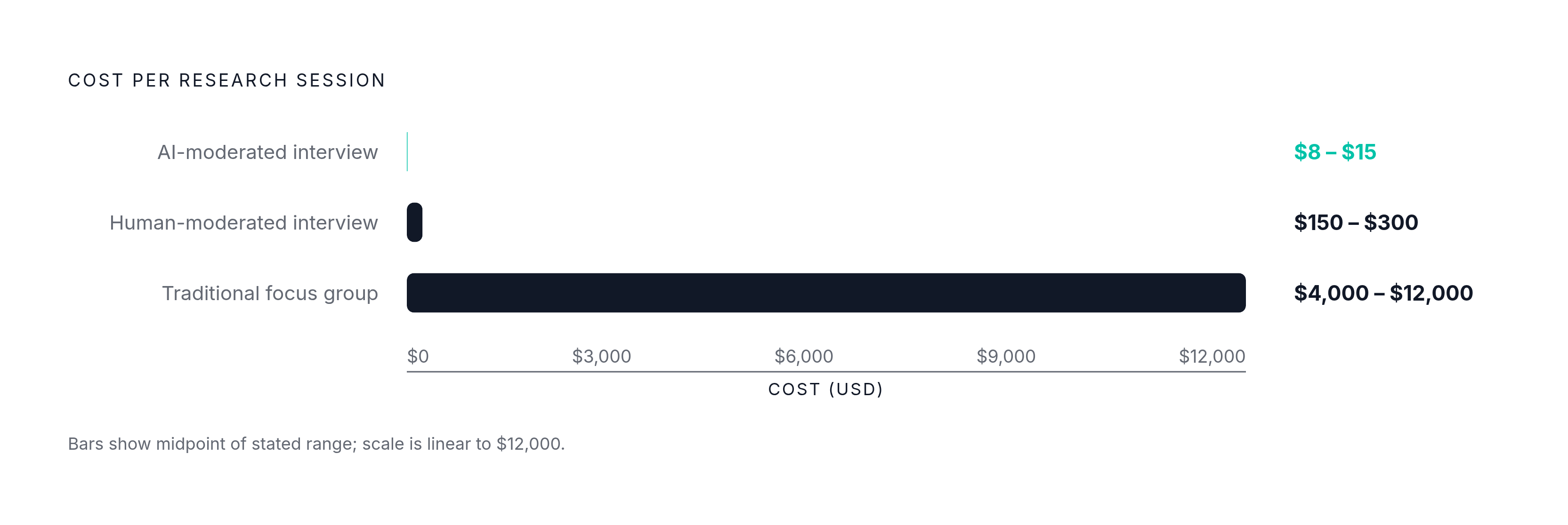
Cost is where the shift gets hard to argue with. A human-moderated interview runs $150 to $300 per session. A traditional focus group runs $4,000 to $12,000 once recruitment, moderation, facility rental, and analysis all get counted. AI-moderated interviews now run $8 to $15 each, a figure with no direct answer for comparison. That is a different category of spend entirely, cheap enough that the math on when to run research changes along with the price. It's a different category of spend entirely, cheap enough that the math on when to run research changes along with the price.
The bigger cost most teams underestimate is in analysis, not recruitment. Human synthesis of qualitative data is slow, prone to bending toward whatever the team already believed going in, and expensive in headcount hours. Platforms that automate the path from raw transcript to finished deliverable cut that cost too, and the real savings appear in analysis time, where human synthesis previously consumed the most headcount hours.
Sweetgreen ran studies at five times the scale for a third of the cost using an AI research platform. Skims tested campaign direction with thousands of consumers overnight, ahead of a global launch, instead of waiting weeks for a read. Once interviews are cheap and fast enough to run before a decision instead of after, research stops being a postmortem. Teams start testing pricing, positioning, and feature priorities before they commit budget, not after they've shipped and have to clean up the mess.
Synthetic consumer panels: capabilities, limitations, and evaluating vendor claims
Synthetic panels are AI-generated respondents built to simulate how a real demographic or psychographic group thinks and behaves. They run around the clock, stand in for almost any audience profile on demand, and return results in minutes instead of weeks. That sounds like a shortcut around the entire recruitment problem. Sometimes it is. Other times, "synthetic" is a label stretched thin over things that behave nothing alike, and the vendors selling it rarely volunteer which one they mean.
Researchers and vendors lump several distinct things under that one word, from synthetic personas and digital twins to simulated conversations, and the differences between them are significant. The only useful question for a buyer is to ask each vendor, specifically, what its synthetic respondents are and how they got built.
Synthetic panels earn their place in a narrow set of situations: reaching audiences that take weeks to recruit through normal channels (CISOs at fintech companies, IT directors evaluating a cloud migration), running early directional tests before committing real fieldwork budget, or war-gaming strategic messaging at a macro level. They do not replace validation against real humans, and any vendor who suggests otherwise is overselling the tool.
Where numbers are published, they look strong. Evidenza reports 88% average accuracy across more than 100 head-to-head tests against real respondents. EY's CMO, Toni Clayton-Hine, reported a 95% correlation between synthetic results and the company's actual annual brand survey of CEOs at firms with over $1 billion in revenue. A Colgate-Palmolive project with PyMC Labs found 90% correlation between synthetic and real survey panels. Those are benchmarks against specific studies, though, not a guarantee that a synthetic panel performs the same way on the next question a team throws at it. Treat every one of those numbers as evidence about one study.
Reusability and continuous research: the difference between a study and a strategic asset
Agency-model research is built to end. A study gets commissioned, delivered, filed, closed. The next question means starting over: new recruitment, new design, new invoice, new wait.
Modern platforms invert that. Build a behavioral model of a target audience once. Then run it against whatever comes up next, a pricing change, a new feature, a market entry decision, without rebuilding recruitment and study design from scratch every time.
The real cost of the episodic model runs deeper than repeated spend. Findings from six months ago become impossible for anyone to find. A persona built for one product launch gets thrown away after. Understanding of the audience lives in a forgotten slide deck instead of a system anyone can query, so nothing accumulates, and every team relearns the same lessons cold. 83% of organizations plan to significantly increase their AI investment in 2026. The teams pulling ahead are treating research as infrastructure that compounds, where last quarter's model becomes an input to this quarter's decision instead of a dead file. They're treating research as infrastructure that compounds, where last quarter's model becomes an input to this quarter's decision instead of a dead file.
Global reach without recruitment timelines: why language and geography access belong in the evaluation
Recruiting across borders the traditional way means weeks of outreach through separate panel vendors in every target market, often with no guarantee the low-incidence segments fill. That's before anyone accounts for translation lag, which quietly distorts meaning on top of the delay.
Anthropic ran 80,508 interviews across 159 countries in 70 languages using AI-moderated research, a scope that would be close to impossible for a team of human moderators working sequentially. Ask any vendor directly whether the AI adapts to how a language is actually spoken in context, or whether it just runs a fixed script through a translator and calls that localization.
Synthetic panels have their clearest advantage in this exact spot. A synthetic model can stand in for a Brazilian Gen Z shopper or a German enterprise IT buyer instantly, with no recruitment queue. Access is the easy part now, genuinely easy. Proving that model reflects how that audience actually behaves is the harder problem, and it's the one vendors tend to skip past.
Analysis output and knowledge management: what happens after the interviews end
Once a platform can run hundreds of interviews in a day, human synthesis becomes the ceiling on what the research can deliver, since reading transcripts one at a time is no faster than it was five years ago. A person hunting for patterns across hundreds of conversations will find less than the data holds, and will find it slower than the interviews took to run.
Leading platforms are moving toward capabilities like generative summaries instead of raw transcript dumps and analysis that ties insight back to a decision someone can act on. Platforms that stop at a dashboard, without tying the insight back to a decision someone can act on, fall short of that bar.
The better platforms cluster themes across hundreds of conversations, flag anomalies, catch the moment someone's words contradict the tone in their voice, and generate a brief ready to hand an executive. Before signing with any vendor, ask how long it takes from the last completed interview to a usable deliverable. Can someone with no research training run the analysis tools directly? Does the platform keep a searchable record across studies, or does every project vanish into its own standalone file the moment it wraps?
A practical evaluation framework: the questions that separate modern vendors from legacy ones
Every point above collapses into a short list of questions to ask before signing anything.
On speed, get the actual time from kickoff to delivered findings, in hours or days, not the vague language of "fast turnaround." On panel integrity, ask how fraud and duplicate respondents get caught, and whether there's a hard cap on how often one person can take part. On depth, ask whether the platform captures anything beyond what a respondent types, and whether every emotional signal traces back to a timestamp and a quote. On cost, ask for the true price per completed interview once analysis time gets folded in.
If synthetic data is part of the pitch, find out which of the five different things "synthetic" can mean is actually being sold, and what validation exists against real respondents. On reusability, ask whether a finished study disappears into a static report or becomes a model that can be queried again for the next decision. On reach, confirm the platform can run in the language and country a target audience actually lives in, without translation lag distorting the answers. And on output, ask whether the deliverable arrives ready for a decision-maker to act on, or whether someone still has to spend a week turning it into something usable.
None of these questions would have made sense on an RFP five years ago. They make sense now because the underlying economics of research changed. How a vendor answers says more about which era it was built for than anything printed in its pitch deck.