Business Cost of Slow Research Cycles
Slow research cycles cost companies up to 5% of annual revenue through delayed decisions.
A November 2025 survey from West Monroe, covering 214 C-suite executives and 1,000 managers, found that 73% believe their organizations lose up to 5% of annual revenue to slow decision-making and delayed execution. Attach that number to a real balance sheet and it stops sounding small: even at the lower end of the revenue range the study covered, a meaningful share of annual revenue is a material loss, and it's lost to a slow decision rather than a bad one. That distinction is the whole argument. Most of the cost sits in what happens around the research, not in the research itself, and almost none of it needs to take as long as it currently does.
Slow research and bad research get treated as the same problem, which is the first mistake worth correcting. Plenty of eight-week studies are methodologically sound, well-sampled, carefully analyzed, and still wrong for the business, because the eight weeks were never free. A question that sits unanswered doesn't just delay one decision; it stalls everything downstream of it, and those stalls compound quietly, the way interest does, until the number is too big to explain away.
What a "research cycle" actually contains and where the time disappears
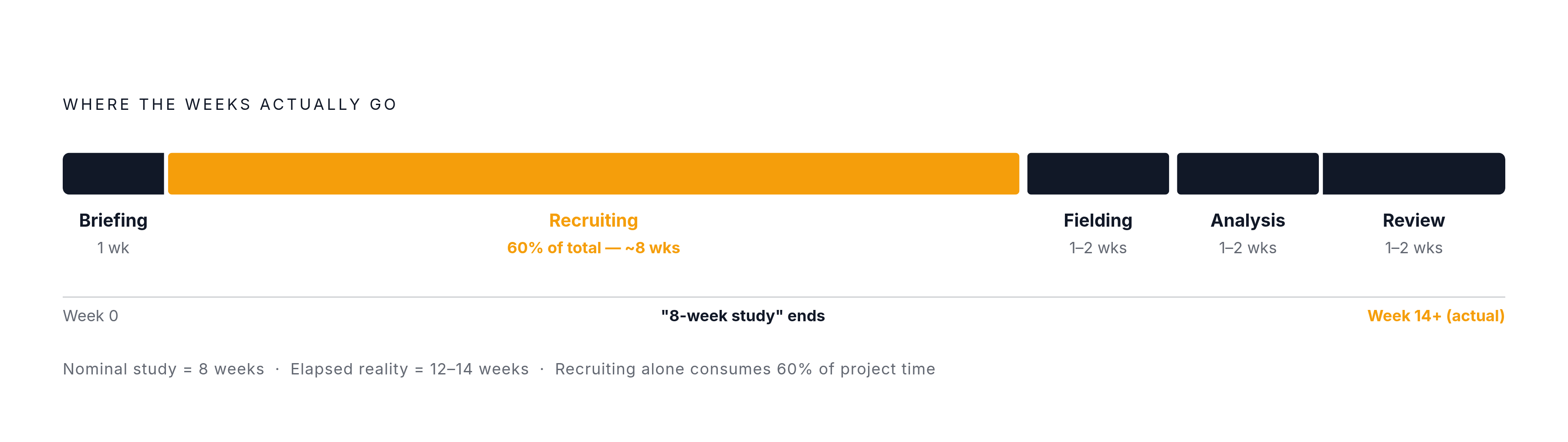
Ask someone how long a research cycle takes, and they'll describe the part that shows up on the invoice: fielding, analysis, a deck. The real cycle includes scoping the question, recruiting the right people to answer it, fielding, analysis, writing the report, then walking that report through whatever internal review sits between "we have an answer" and "we made a decision." Most of the clock lives in the parts nobody puts on a timeline. That's exactly why nobody budgets for them.
Recruiting is the biggest offender. It eats up 60% of a research project's total time, and it's the part least visible to whoever's waiting on results. Per GreenBook, 62% of research professionals report real difficulty recruiting participants for specialized studies. When recruiting fails, it forces compromises, a smaller sample, a looser screener, a population that's close enough rather than right.
None of that counts the phases nobody bills for. Before a study starts, there's an internal briefing process: stakeholders arguing over what question actually matters. After the report lands, there's a second round of debate about what it means and whether anyone believes it. Add it up, and an "eight-week study" routinely reflects twelve or more weeks of real clock time between someone asking a question and someone acting on the answer.
Call this the point-in-time trap. A study is a snapshot, and by the time it's finished, the market it described may have already moved on. The study finishes correct and arrives late, which for most purposes is the same as arriving wrong.
The direct financial cost of traditional research before a decision even gets made
Start with sticker prices, because they run higher than most budget owners expect. A single online survey with a general population audience costs $5,000 to $15,000. A focus group, once recruiting, facility rental, moderation, and incentives get added up, runs $7,000 to $20,000 per group, and most studies need more than one group. Custom quantitative or qualitative projects in 2025 typically land between $25,000 and $65,000. Take that work international and it climbs past $150,000; marketing mix modeling and predictive analytics at global scale can exceed $1 million in total cost of ownership.
Those figures still understate the real cost. A $15,000 survey that takes eight weeks doesn't just cost $15,000. It burns two months of runway during which nothing downstream can move, and that idle time never makes it onto the same spreadsheet as the vendor invoice. Nobody accounts for that cost, and it's usually the bigger one.
The mismatch shows up in how executives feel about the spend. A market this large, growing this fast, while confidence in the return on it keeps falling, points to a delivery model that's broken, not a weak appetite for insight. When the price tag and the payoff stop lining up, the honest read is that research doesn't arrive fast enough to still be true when it lands.
What decisions get made in the absence of timely research
When research takes too long, decisions don't wait for it. They get made anyway: on assumption, on gut instinct, on whoever argues loudest in the room. That's the default outcome whenever a timeline outruns a deadline, and pretending otherwise is how the cost stays hidden.
Research on situational awareness has found that low awareness slows decision speed by 40%, with a direct hit to both revenue and innovation output. That slowdown shows up downstream in expensive, avoidable ways. Roughly 95% of new consumer products miss their launch targets, and separately, 42% of startup failures cite no market need as the primary cause. That second number is a validation failure, plain and simple, and it's exactly the kind of thing timely research exists to catch before the money is spent.
Here's what makes it worse. While research is pending, teams don't sit idle. They build consensus around a direction, start staffing it, start pitching it internally. By the time the study lands, there's already political weight behind a plan, so inconvenient findings get rationalized instead of acted on. That produces a predictable cascade: delayed research leads to products and messaging that miss what customers actually want, which wastes development resources, drags down sales, and erodes trust from there. Ask any product team running quarterly planning against a vendor on a multi-week timeline; this is just Tuesday for them.
How decision speed separates fast-growing companies from stagnant ones
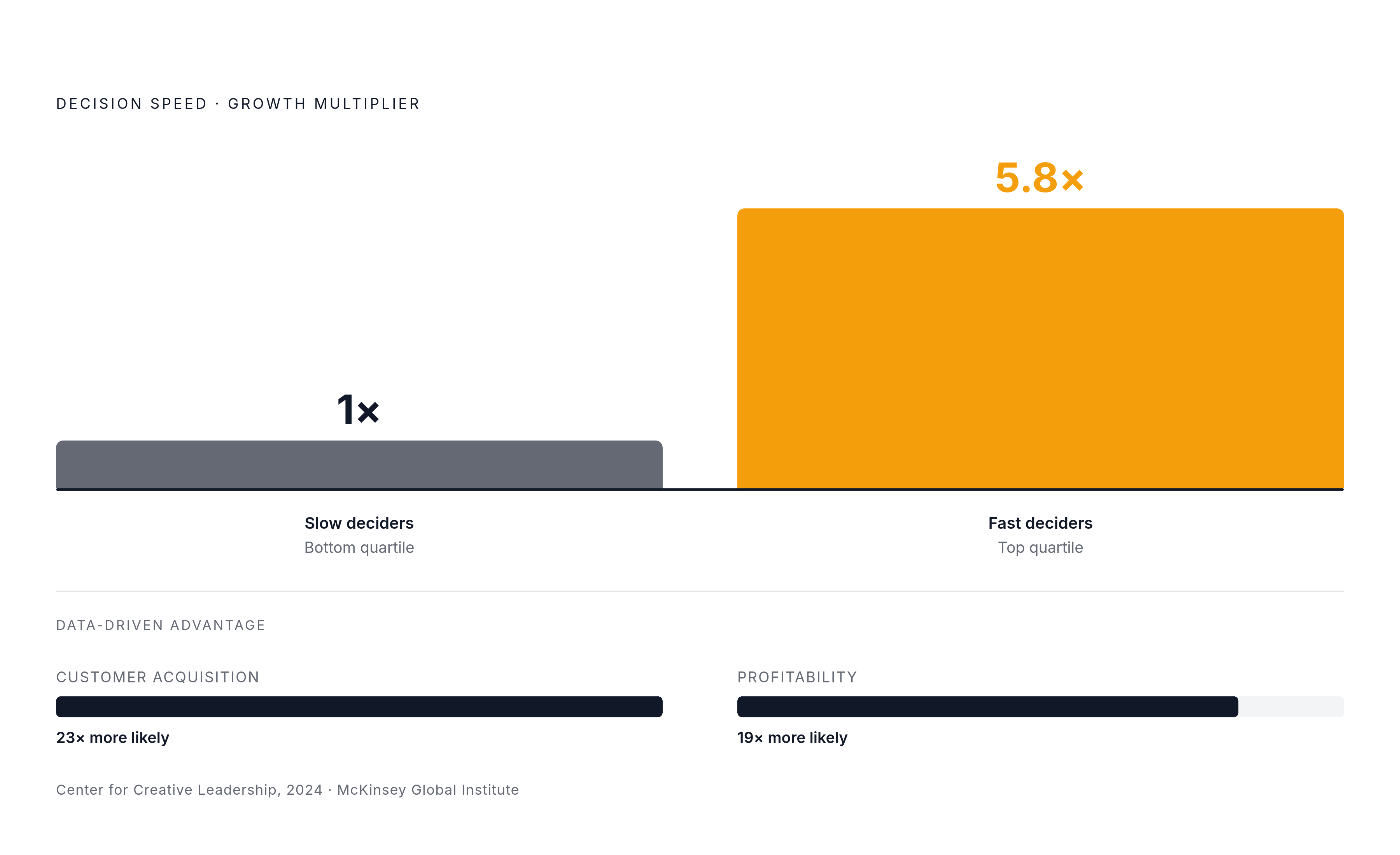
The Center for Creative Leadership found in 2024 that companies in the top quartile for decision speed grew 5.8 times faster than those in the bottom quartile. That's the difference between compounding growth and standing still, and it settles an argument too many organizations still treat as open.
Here's the part most people get backwards: the insight threshold needed to make a confident call sits lower than most organizations assume. The companies winning on speed aren't smarter or better-resourced; they've just figured out that faster access to enough data beats slower access to more data. McKinsey Global Institute's benchmark bears this out at scale. Data-driven organizations are 23 times more likely to acquire customers and 19 times more likely to be profitable than their peers, and that premium goes to companies that act on insight, not to the ones that commissioned the most exhaustive study.
AI is compressing every competitive timeline sitting on top of this: how fast products ship, how quickly markets shift, how fast a window opens and shuts again. Against that backdrop, an executive who won't commit under some uncertainty isn't being careful; he's being expensive. Research agility has stopped being a risk-management checkbox and become a growth input in its own right, and once the problem gets understood as structural rather than a matter of individual discipline, the fix has to be structural too.
Why the traditional research model is structurally mismatched to modern decision cadences
Traditional research methods were built for a slower world: slower product cycles, more stable consumer behavior, quarterly decision gates that gave a study room to breathe. None of those conditions hold at most organizations anymore, and the model never adjusted.
Conventional practice treats speed and quality as a trade-off. Rigorous design takes time, the thinking goes, so squeezing the timeline produces shallow insight. That gets presented as an iron law of research; it's actually an artifact of method, not a fact about the world. The agency model bakes in extra lag on top of it regardless: procurement, scoping calls, proposal rounds, legal review, fielding, reporting. Every handoff between parties adds days, sometimes weeks, before anyone touches the actual question.
Underneath sits a category-level problem worth naming directly. Research gets treated as a project, with a start date, an end date, and an invoice, instead of as infrastructure. Every new question restarts the whole process from zero: recruiting again, scoping again, briefing again. The industry already knows this, which is why 83% of researchers plan to invest in AI for research in 2025. That's not curiosity; it's survival instinct. Running the old method faster doesn't fix a design flaw, and the method itself needs rebuilding rather than acceleration.
What AI-powered research methods actually change about cycle time
AI's real contribution is clearing out the work that never needed a human judgment call in the first place: recruiting, transcription, coding open-ends, first-pass analysis.
Natural language processing and large language models now churn through open-ended survey responses, social comments, and customer service transcripts in a fraction of the time a human team would need, turning weeks of coding work into hours. Predictive behavioral analytics can flag early signs of customer disengagement before they show up in a quarterly report, which shifts research from something that looks backward to something that watches ahead.
Research on synthetic panels has documented that concept-to-signal cycles that take weeks with traditional panels can run in hours with calibrated synthetic audiences. Calibration is the word doing all the work in that sentence. Synthetic panels built on real behavioral models of a target segment hit 85 to 95% parity with real panels on concept, pricing, and positioning tests. Generic GenAI prompts without that calibration sit closer to 55%, and that gap separates AI research as a marketing phrase from AI research engineered to work. A 2024 study out of Stanford and Google DeepMind, run with 1,052 participants, found AI digital twins replicating human survey answers at 85% accuracy and matching social behavior patterns at 98% correlation.
None of this arrives at a premium, either. Available estimates suggest AI can cut traditional research costs by up to 80%, so the speed gain shows up alongside the savings.
Where synthetic panels fit and where they reach their limits
Synthetic consumers, virtual respondents calibrated against real behavioral data, are available around the clock, can represent almost any demographic or psychographic profile requested, and return results in minutes rather than weeks.
They earn their keep in specific places: concept screening, pricing sensitivity, positioning tests, messaging evaluation, churn simulation, and modeling populations that are brutally hard to reach through normal recruiting. Try recruiting C-suite executives in financial services, or specialists in rural markets, through a conventional panel; it can take months, at thousands of dollars per completed interview. A synthetic panel simulates that same population instantly, which is a meaningful part of why 42% of consumer insight leaders, per Forrester, have already put some form of synthetic data to work.
Adoption is running ahead of full confidence, and that gap deserves to be named rather than smoothed over. Synthetic responses beat human ones on a roughly 52-to-48 margin when cost is the deciding factor, which tells you adoption is being driven by economics first, conviction second. Trust hasn't caught up. Only 13% of brand-side researchers reported satisfaction with AI-powered research quality in the 2025 GRIT report. The technology has outrun confidence in it, and closing that gap is a matter of implementation quality, not a flaw in the underlying idea.
There's a real limit worth respecting, too, and it's not a minor caveat. Synthetic panels are trained on patterns; ask one about something truly unprecedented, and there's no pattern to draw from. So the sensible split is synthetic panels for speed, directional signal, and early screening, human panels for the consequential calls and genuinely new territory. Anyone arguing to replace one with the other entirely hasn't run either kind of study. Synthetic models also don't stay static: they retrain as new data comes in, so each cycle gets a little more accurate than the last, turning research into a reusable asset instead of a one-time expense.
What continuous research infrastructure looks like in practice
Most organizations run research on a checkpoint model: a heavy discovery phase at the start of a project, a validation check right before launch, nothing in between. That leaves the longest, most expensive phase, active development, running entirely on assumption. Worth saying plainly instead of hedging around it: that's backwards.
Continuous research flips the order. A behavioral model of a target audience gets built once, then gets run against every future decision that needs it: a new price point, a new feature, a new market, a new message. Research stops being a procurement event and becomes an organizational capability. The operating question changes with it, from "do we have budget to run a study?" to "what do we need to know before we commit to this?"
That shift changes team structure, too. Product, UX, marketing, and growth functions get answers directly, without routing every question through a research team or waiting on an agency's calendar. Platforms combining verified human panels with calibrated synthetic audiences can substantially compress concept-to-decision cycles that previously consumed weeks of calendar time. Geography stops being a delay factor as well: instant access to audiences across many markets, no recruitment timeline or vendor negotiation standing in the way.
The advantage compounds in both directions. Organizations building this kind of continuous capability accumulate a richer behavioral model over time, so every subsequent decision is faster and better grounded than the one before it.
How to calculate what slow research is actually costing a specific organization
The math has four inputs: how long a research cycle typically takes, how many decisions per year get gated on that research, how much revenue rides on each decision, and how likely it is that a faster answer would have changed the outcome.
A simpler proxy works for a quick gut check. If 73% of organizations lose up to 5% of annual revenue to slow decision-making, a company doing $100 million in revenue should assume millions of dollars a year in exposure, then ask how much of that ties specifically to research timelines rather than other bottlenecks. Layer the direct research spend on top. A team running four custom studies a year at substantial cost each, eight weeks per study, spends a significant sum and loses eight months of organizational waiting time, and that's before counting the decisions made on pure assumption during the gaps between studies.
The real ROI question was never the cost of the research itself. It's the cost of the decisions that got delayed, watered down, or made blind while everyone waited. Worth asking plainly: how long does it actually take, from a business question to an answer confident enough to act on? How many product or go-to-market calls in the past year got made without research because there wasn't time to wait for it? What did it cost to redo work that research would have redirected earlier, had it arrived in time?
The shift available right now isn't theoretical. AI-powered research platforms, blending human panels with calibrated synthetic behavioral models, can compress an eight-week cycle down to hours for most directional questions, and that changes the entire calculus around when and how often to ask. The organizations that win the next stretch of competition will be the ones with the shortest distance between asking a question and trusting the answer enough to move on it.