Generative Research with AI Moderation Tools
AI moderators automate the expensive bottlenecks slowing generative research.

Generative research means open-ended, exploratory work: interviews, contextual inquiry, think-alouds, the stuff designed to surface why people behave the way they do rather than confirm a hypothesis you already had. The method has never been the problem. What broke it was the pipeline sitting underneath it, and AI moderation tools are now rebuilding that pipeline piece by piece, which is why generative research is turning from an occasional luxury into something teams can run constantly.
Here's the sequence that used to strangle it: recruit, schedule, moderate, transcribe, code. Each step waits on the last. Nothing runs in parallel. Recruiting alone eats up roughly 60% of a project's total time, before anyone's even asked a question, and online survey response rates have dropped to an average of 44% globally, which means more outreach for fewer usable participants. The Insights Association's Industry Pricing Study puts the all-in cost of a single traditional moderated interview at $487. Run that at n=200 and fieldwork alone costs $97,400. So generative research gets rationed: done rarely, capped at tiny samples, cut the moment a timeline gets tight. Teams end up committing to product and design decisions before they understand the behavior they're designing for. It's an infrastructure failure. That's an infrastructure failure, and it's exactly what AI moderation was built to fix.
What an AI moderator actually does during an interview
An AI-moderated interview is an automated, adaptive conversation. A conversational agent asks questions, listens to the answer, and decides what to ask next, then codes the response in real time. Aaron Cannon, co-founder of Outset, describes it simply: using artificial intelligence to autonomously run a dynamic conversation with a participant.
The word that matters there is adaptive. A static survey moves to question four no matter what you said in question three. An AI moderator doesn't. It generates a follow-up based on what the participant actually said. Conveo's data shows more than 70% of final insights come from these AI-driven follow-ups. The script is the floor, not the ceiling.
The difference becomes clear in practice: when a participant mentions a specific product or behavior, a static survey moves on regardless. An AI moderator generates a follow-up based on exactly what was just said, the kind of probe a fixed question flow would never produce.
Three things separate this from a glorified chat survey. Depth of probing, first: adaptive and contextual instead of a pre-set flow. Modality, second: voice and video instead of text boxes. That matters more than it sounds like it should, because voice responses run 4 to 5 times longer than typed survey answers, and participants share roughly 20 times more words than they would typing the same answer. Analysis, third: clustering and coding happen automatically as the interview runs.
Behind the scenes, while interviews are still coming in, the platform is auto-transcribing, tagging sentiment, clustering themes, and flagging anomalies. Conveo puts a number on the old way of doing things: 90% of manual qualitative research tasks can be automated.
Because it's asynchronous, participants record on their own schedule. Hundreds of interviews can go out overnight. The scheduling bottleneck, historically one of the worst parts of the whole process, mostly disappears.
What it still can't do matters just as much. An AI moderator doesn't know your company, your product's history, or what your stakeholders are actually trying to decide. Contextualizing findings and connecting them across a research program stays a human job.
Whether participants actually open up to an AI moderator
The concern with any of this is obvious: will people actually tell an AI the truth? Conveo's data says yes, more than they tell a human. 83% of respondents report feeling more candid with an AI moderator than with a person, and 93% rate the interview experience 4 out of 5 or better, with an average of 4.3 out of 5 and an NPS around 65.
Part of this comes down to social desirability bias. People soften answers when a human's sitting across from them, even over video. Take the human out of the room and that pressure eases. AI probes generate 3.5 times more content than static surveys, which is a direct measure of how much deeper people go when nobody's nodding along waiting for a particular answer. The asynchronous format helps too. No one's rushing to fill dead air. Participants answer when they're ready, and that tends to produce more considered responses instead of whatever comes out first.
A real tension exists, though. The same absence of a human relationship that reduces social pressure might also cap how far someone goes on genuinely sensitive or painful topics. Some disclosures need a person on the other end. That's a real trade-off, not a dismissible one, and method should be weighed against topic before assuming AI moderation is right for everything.
None of this loosens the ethical bar. Questions still need review for bias and potential harm before they go out, whether a human or an AI delivers them. If anything, moving faster and wider means that review has to catch bias and potential harm before questions go out, not after. And if participants really are more forthcoming, thematic saturation might arrive sooner than teams expect, but that's a reason to sharpen guide design up front.
The real cost and speed gains, and where they depend on conditions
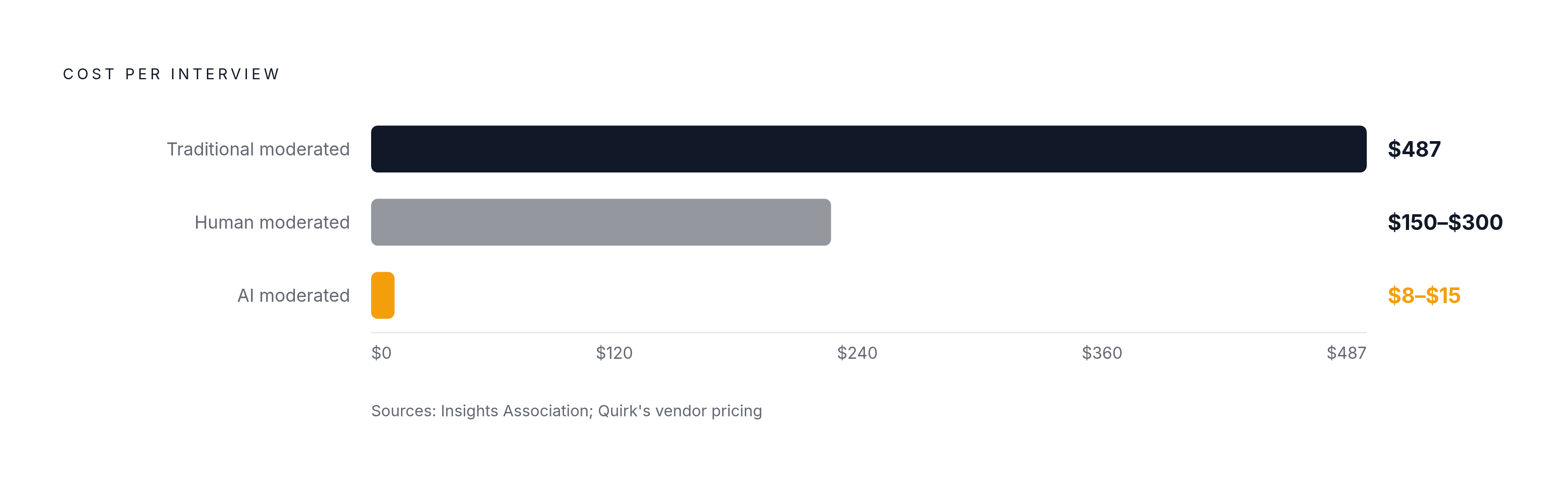
The math here is stark: AI-moderated qualitative interviews now run $8 to $15 per completed interview, according to Quirk's vendor pricing coverage, against $150 to $300 for a human-moderated equivalent. Set that beside the Insights Association's $487 all-in figure for a traditional moderated interview and the gap becomes structural. It's structural.
Nestlé, a Conveo customer, reports an 81% cost reduction using AI-moderated research. Conveo itself claims its platform delivers insights 100 times faster and at 75% lower cost than traditional qualitative methods. Sample sizes are moving accordingly: the median qualitative sample size for AI-moderated studies now stands at 312, up from 17 in 2022. That's an 18-fold increase in three years, and it lines up with 83% of market research practitioners investing in AI in 2025. Turnaround has gone from months to days.
Where do the savings actually come from? Scheduling overhead disappears. Transcription and coding run automatically instead of by hand. Fieldwork happens asynchronously, so there's no moderator logging hours per session.
But some of this depends on conditions holding. Guide quality still determines insight quality. A poorly designed set of probes run at scale just produces a much larger volume of shallow data, fast. Per-interview cost drops. Cost per usable insight might not. Ipsos and other research agencies have adopted these tools while pairing them with experienced human researchers for interpretation and strategic read, which is a reasonable model for anything high-stakes. Human8, a global consultancy, deploys AI within what it calls a secure walled garden so client data stays confidential, a real consideration for anyone handling sensitive consumer information.
The bigger caveat sits outside the tooling. The bottleneck was rarely the time it takes to produce the research artifact. It's the decision-making structure sitting around it. Teams that buy fast research tools without restructuring how approvals happen will find the same old delays waiting on the other side, just with better transcripts.
The AI-moderated research platforms available in 2025 and what distinguishes them
Evaluating a platform means looking at adaptive probing depth, modality support (voice and video versus text only), how much of the analysis is automated, panel access, compliance posture, and whether it extends into synthetic simulation alongside live interviews.
Outset runs adaptive, conversational interviews at scale, with the AI interviewer building each next question from the participant's last answer rather than following a fixed script.
Conveo is video-first and asynchronous, with real-time probing and automated output: highlight reels and slide decks that link every insight back to a time-stamped video clip. It claims 100 times faster delivery and 75% lower cost than traditional methods, backed by the Nestlé case above, and has raised $50 million to build out its consumer understanding infrastructure.
Discuss blends human-led and AI-led moderation inside a single workflow, useful for teams that don't want to pick one mode exclusively.
UserTesting is built for enterprise, combining unmoderated testing, moderated live sessions, and AI-powered analysis, with a participant panel spanning more than 60 countries.
A handful of others round out the 2025 field, each worth a look depending on priority: Userology, Heard, and UserEvaluation show up regularly in roundups of top AI-moderated tools for UX teams. Yazi, Listen Labs, Tellet, Glaut, Yasna, Reveal AI, and Propane appear on lists of the best AI-moderated interview tools. Userlytics stands out for its proprietary ULX Benchmarking Score, a 360-degree UX measurement across 18 attributes and 8 constructs, plus automated sentiment analysis, video analysis tools, multilingual transcription, and Its Enterprise plan starts as low as $34 per session with unlimited seats.
Across all of them, a few capabilities separate a serious tool from a gimmick: pattern recognition and automatic clustering of open-ended data, an analysis process transparent enough that researchers can actually validate what the AI concluded, and GDPR/CCPA compliance with end-to-end encryption.
No platform wins on every axis. Some are built for depth of probing, some for enterprise compliance, some for panel reach, and a growing number are built to extend past live interviews into synthetic simulation entirely, a category with its own terms to understand.
How synthetic consumer panels extend AI-moderated research beyond live fieldwork
A synthetic panel is a group of AI-generated virtual respondents, built from real-world data: historical survey responses, customer reviews, behavioral data, public opinion trends. The goal is to simulate how a real consumer segment would behave or respond, without a live person in the loop.
This isn't a replacement for talking to actual humans. Synthetic panels answer directional questions fast; live AI-moderated interviews then confirm and deepen whatever the simulation surfaced. The two work in sequence.
What synthetic panels do that live fieldwork structurally can't: they model reactions to a product that doesn't exist yet, a hypothetical scenario with nothing to show a participant. They return preference rankings, believability ratings, and price sensitivity curves in hours rather than weeks, giving a directional read before anyone commits to full human fieldwork. And they can evolve as new data comes in, updating to reflect shifting culture and preference over time instead of freezing a moment in time the way a one-off study does.
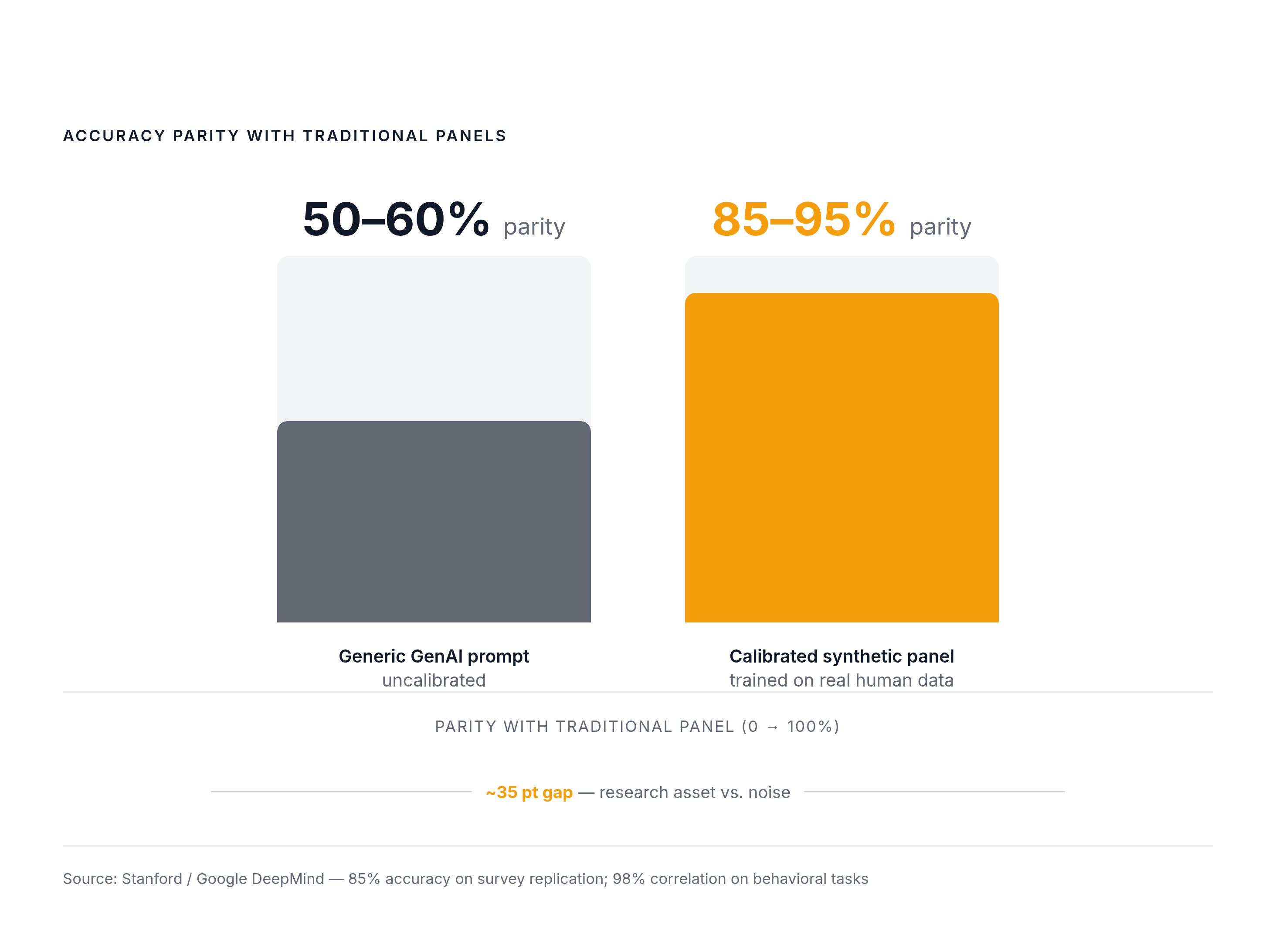
Accuracy depends entirely on calibration. Panels trained on real human data hit 85 to 95% parity with traditional panels on structured concept and pricing tasks. A Stanford and Google DeepMind study found 85% accuracy on survey replication and 98% correlation on behavioral tasks. But an uncalibrated, generic GenAI prompt asked to play consumer is only 50 to 60% parity. That gap, between a properly trained synthetic panel and someone typing "pretend you're a 34-year-old shopper" into a chatbot, is the entire difference between a strategic research asset and noise dressed up as data.
Adoption is already well underway: 69% of market research practitioners report using synthetic data in their work, and 87% of research teams actively using it report satisfaction with the results, per GRIT findings. Bayesian validation techniques can now attach confidence intervals to synthetic insights, a level of rigor most traditional surveys never bothered to report in the first place.
The strategic shift is to build a calibrated behavioral model of a target audience once and run it against every future decision that comes up, instead of paying for a fresh study each time a question arises. That turns research from a recurring line-item into something closer to a permanent asset, which is a genuinely different relationship to have with a research budget.
How to run an AI-moderated generative study without common failure modes
The process runs in several steps, and skipping any of them is usually where things go wrong.
Start by adding project details, including the actual goal of the study, the deadline, and whatever context participants need before they can respond meaningfully. Skip this and the AI moderator has nothing to orient its probing around.
From there, program the interview script. Build out the core questions and prompts, and take advantage of any AI feedback the platform offers on the script before it goes live, since a weak script produces a weak study no matter how good the moderation technology underneath it is. Guide quality is still the ceiling. Speed and scale don't fix a bad question, they just multiply it across a few hundred participants overnight instead of twenty over three weeks.