Survey Method Data Collection in B2B SaaS Research
Trigger-based research catches signal at the right moment, not just any moment.

Most B2B research programs get the fundamentals backwards. Teams argue over which survey tool to buy, when the actual skill is knowing which instrument to fire at which moment. CES, CSAT, NPS, and in-depth interviews each measure a different thing, and firing the wrong one at the wrong time doesn't just waste a send. It comes back as noise that gets mistaken for signal, which is worse than no data.
Start with the account math, since most programs skip it. A typical B2B purchase runs through 20 to 30 people, not one, yet the standard feedback program only ever hears from whoever signed the contract. That's procurement, usually, not the person fighting with the product every day. A single survey sent at a single moment catches one role's mood at one point in time, and that's a snapshot of somebody's Tuesday, not a read on account health.
Add the noise this creates. The average person with an inbox sees 15 or more survey invites at this point, and B2B buyers get hit twice over: once by consumer brands, again by every vendor they've ever signed with. Response rates for cold-email consumer surveys sit below 2% in most categories. A survey with no tie to a real customer moment just reads as spam. Fixing that means matching the instrument to the moment, on a schedule built around triggers instead of a calendar habit.
What CES, CSAT, NPS, and in-depth interviews measure, and where each instrument breaks
Four tools, four jobs, and mixing them up is where most research programs quietly go sideways.
Customer Effort Score measures friction on one specific task: how hard was it to do the thing the customer just tried to do. It's sharp right after a support ticket closes, during an onboarding step, or at a feature adoption gate, while the friction is still fresh. Sending it without a trigger attached stops it from measuring a transaction. It just measures whatever mood the person happened to be in that day.
Customer Satisfaction Score checks in on a specific deliverable, such as a professional services handoff, an onboarding milestone, or the close of an escalation. It answers one question, did this thing meet expectations, and it breaks two ways. Teams use it as a stand-in for loyalty, which is NPS's job, not CSAT's. Or they send it before the customer has had time to form an opinion.
Net Promoter Score belongs to relationship-level sentiment: willingness to recommend. It works well around 60 to 90 days post-onboarding, and again near renewal. Sending it too early, before the customer has felt real value, makes the score just a first impression wearing a verdict's clothes. Sending it too late, after churn risk has already hardened, makes it confirm a decision instead of catching one in time to act. NPS mostly tracks the customer's relationship with the vendor, not the end user's daily relationship with the product, and treating those as the same thing explains how a rising NPS score coexists with a product nobody enjoys using.
In-depth interviews are the odd one out. It moves slowly and qualitatively, making it the only method built to capture the why behind whatever numbers the other three spit out. They earn their cost before a big feature bet, during a churn post-mortem, or when building out personas and pricing assumptions. Where they break is scale: running interviews across a large population costs too much time and money to work as a continuous channel. They're built for depth, and asking them for volume is a waste of the format, full stop.
Mapping each method to the customer journey stage where it produces signal
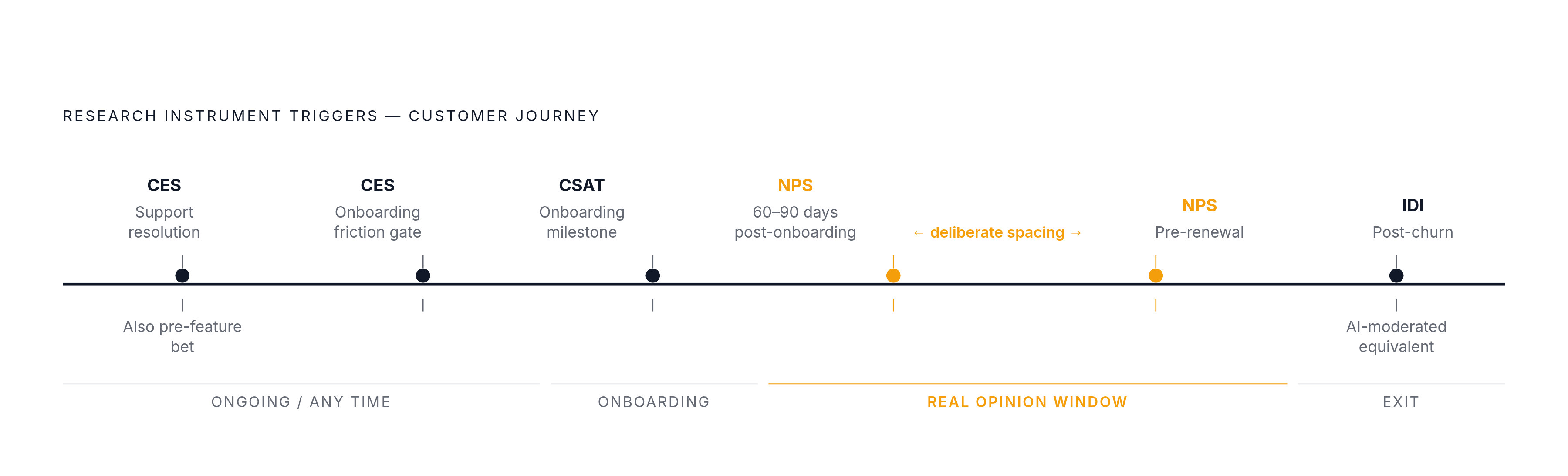
Placing these four on a timeline produces a workable cadence almost by itself.
CES fires automatically on support resolutions, catching friction while it's still raw. CSAT lands right after onboarding milestones, checking whether the product delivered on what sales promised. NPS goes out once the customer has had enough runway to form a real opinion instead of a knee-jerk reaction, typically well into the post-onboarding period. A second NPS run hits ahead of contract end, early enough that a Detractor response can get acted on before renewal talks start.
Timing changes what the same instrument actually measures. A CSAT sent the moment onboarding wraps and the identical CSAT sent six months into a rocky implementation aren't comparable data points, even on the same three-question form. The instrument stayed fixed. The signal moved underneath it.
Interviews slot in at the two ends of the timeline where numbers can't carry the weight alone. Before committing product or engineering resources to a direction, qualitative conversations surface the assumptions worth testing before real money gets spent. After a churn event, interviews get answers a survey never will: a churned customer tends to open up in conversation in ways that a text box rarely invites. Pricing that felt off. A competitor with a sharper pitch. A promise that didn't land.
None of this is a rigid template. Onboarding length, contract cycles, and product complexity all shift the exact days around. What survives across all of it is simple: match the instrument to the moment, not to a quarterly habit.
Building a suppression and routing framework so the cadence does not create fatigue
More triggers means more chances to double up on the same customer, so a suppression rule matters as much as the cadence itself. A 14-day window between any two survey touches keeps requests from stacking on top of each other. That's a hard rule, not a nicety, and teams that treat it as optional end up training customers to ignore every request that follows.
Response rates for B2B SaaS swing wide, from roughly 4.5% up to 39.3%. That gap comes down to design quality, timing, and channel fit. Not luck.
Every response needs a name attached to it, someone whose job is following up with a Detractor or escalating a bad CES score. Skipping that step turns the whole program into a filing cabinet nobody opens. A survey with no owner on the other end is just data collection wearing a nicer name.
Channel matters too. SMS and in-app cards have gained ground on email because shorter formats and tap-to-answer interfaces cut response friction close to zero. In-product surveys specifically catch signal without pulling the customer out of their workflow, filling the gap between what behavioral analytics shows (what users actually do) and what interviews explain (why they do it).
How declining response rates and panel fraud are changing what "good data" means in B2B research
Response rates are dropping across the board, but that's the smaller problem. The bigger one is what comes back when people do respond.
Independent audits of unmanaged commercial panels have flagged fraud rates between 15% and 30%, and AI-generated respondents who pass basic attention checks are one of the fastest-growing slices of that number. Straight-lining on rating scales, five-word non-answers on open text: the response arrives, technically. It just doesn't carry anything usable.
Response rate is a lagging indicator at this point. Response quality is the real measure, and it's much harder to track, since a completed survey looks identical on a dashboard whether a real person spent two minutes on it or a bot clicked through in four seconds. The difficulty of reaching a whole buying committee stacks on top of that, so even a strong response rate from one contact still leaves most of a 20-to-30-person account completely unheard.
Where AI-moderated interviews fit into a B2B SaaS research cadence that surveys cannot saturate
This shift arrived early, by a wide margin. The Insights Association has tracked growing acceptance of AI-moderated interviews, and by recent accounts the method has gained ground far faster than early projections suggested.
What makes AI-moderated interviews useful is what they do that a static survey structurally cannot. They follow up on a vague answer in real time, running a probe a fixed-form survey has no way to ask. They synthesize across hundreds of conversations and hand back patterns instead of a pile of individual transcripts. And they run continuously at low marginal cost, working as a standing intake channel instead of a study commissioned once a quarter.
The bottleneck has moved downstream, to synthesis. In one survey, a large majority of researchers named AI-assisted analysis, not AI-generated content, as the single most impactful trend in the field. Getting people to talk was never the hard part. Turning what they said into a decision fast enough to matter always was.
In a working cadence, this runs alongside NPS, CSAT, and CES. Surveys carry the quantitative signal. AI interviews carry the explanation underneath it. A Detractor NPS response can trigger a short AI-moderated follow-up automatically, digging into the root cause while the sentiment is still fresh. The marginal cost of running a standing AI-moderated interview panel has dropped sharply compared with what a traditional research engagement would have required.
When synthetic consumer panels are a legitimate addition to the B2B research stack
Synthetic panels earn a real place in B2B research, but only for specific jobs. Pushing them past that scope makes the accuracy fall apart fast.
Hard-to-reach roles, a senior security executive at a fintech company, an IT director mid-way through a cloud migration decision, can be modeled instantly instead of chasing calendar time from people who don't have any to spare. Used as a screening layer, synthetic panels help refine concepts, iterate on messaging, and pressure-test trade-offs before real budget goes into fieldwork. Speed is the entire draw, and it's a real one.
Vendor benchmarks back that up, for known categories. Evidenza reports 88% average accuracy across more than 100 head-to-head tests. An EY CMO study found 95% correlation between synthetic responses and its own Global Brand Survey of C-suite executives. Lakmoos posted similarity scores of 98% or higher across 20 client benchmark studies run in 2025. A study from Colgate-Palmolive with PyMC Labs found 90% correlation between synthetic and real survey panels.
Taking the same approach outside familiar territory, though, causes the numbers to collapse. A Marketing Science study found only a 0.3 correlation between synthetic and real responses for genuinely novel products, the kind nobody has lived with yet. No lived experience with a thing means no reliable synthetic opinion about it, and that's not a data gap that better prompting fixes. A 2026 comparison checking a nationally representative human survey against LLM-imputed responses on single-answer questions found a mean absolute error of 14.5 percentage points. Synthetic output doesn't forecast market demand, doesn't determine willingness to pay, and has no business standing in for real people on a decision with real money behind it.
The split that actually holds up: synthetic panels at the front of the process, for screening and exploration, human panels and interviews at the back, for validation and anything high-stakes. Bayesian validation methods help here too, putting an actual confidence interval around synthetic output instead of treating it as gospel.
Building a research cadence that produces continuous signal rather than quarterly snapshots
Volume is forcing this shift on its own. The median B2B SaaS company ran 6 customer research projects in 2025. In 2026, that number hit 25, roughly a 4x jump in a single year. Once the cost and calendar time of running a study collapse, teams stop rationing research the way they used to.
The old quarterly model can't keep pace with that math. A study commissioned at the start of a planning cycle tends to land after the decision it was meant to inform has already been made. Product teams move on sprint cycles measured in days. Research that takes weeks to turn around is structurally out of sync with that clock, no matter how sharp the findings are once they finally land.
A continuous cadence looks different in practice. CES and CSAT fire automatically off product events and support tickets, no campaign launch required. NPS runs on each customer's own tenure and renewal date instead of a single company-wide blast. AI-moderated interviews sit open as a standing intake channel rather than a periodic project. Behavioral data, session recordings, support tickets, feature usage logs, all feed into the same insight surface as the survey data, so a team reads what customers say right next to what they actually do.
Tooling is catching up, slowly. 62% of B2B SaaS product teams plan to consolidate their research tools in 2026, largely because every handoff between a transcription tool, a storage system, and an analysis platform loses something in translation. Leave the stack fragmented, and PMs end up rebuilding that connective tissue by hand in spreadsheets, which defeats the point of moving to a continuous cadence.