Recruiting Respondents for AI-Moderated Studies
Recruiting the right participants is more critical than the AI itself.

AI-moderated research now sits at the center of how a lot of teams gather qualitative data, and the recruitment work behind it is what makes the whole exercise hold up. Backlinko's report puts the figure at 47%, with researchers worldwide reporting regular use of AI in their work at a rate that's crossed into mainstream territory. That's not a niche tool anymore. But speed only helps when the right people are already lined up before the AI moderator asks its first question, and most teams underbuild that lineup.
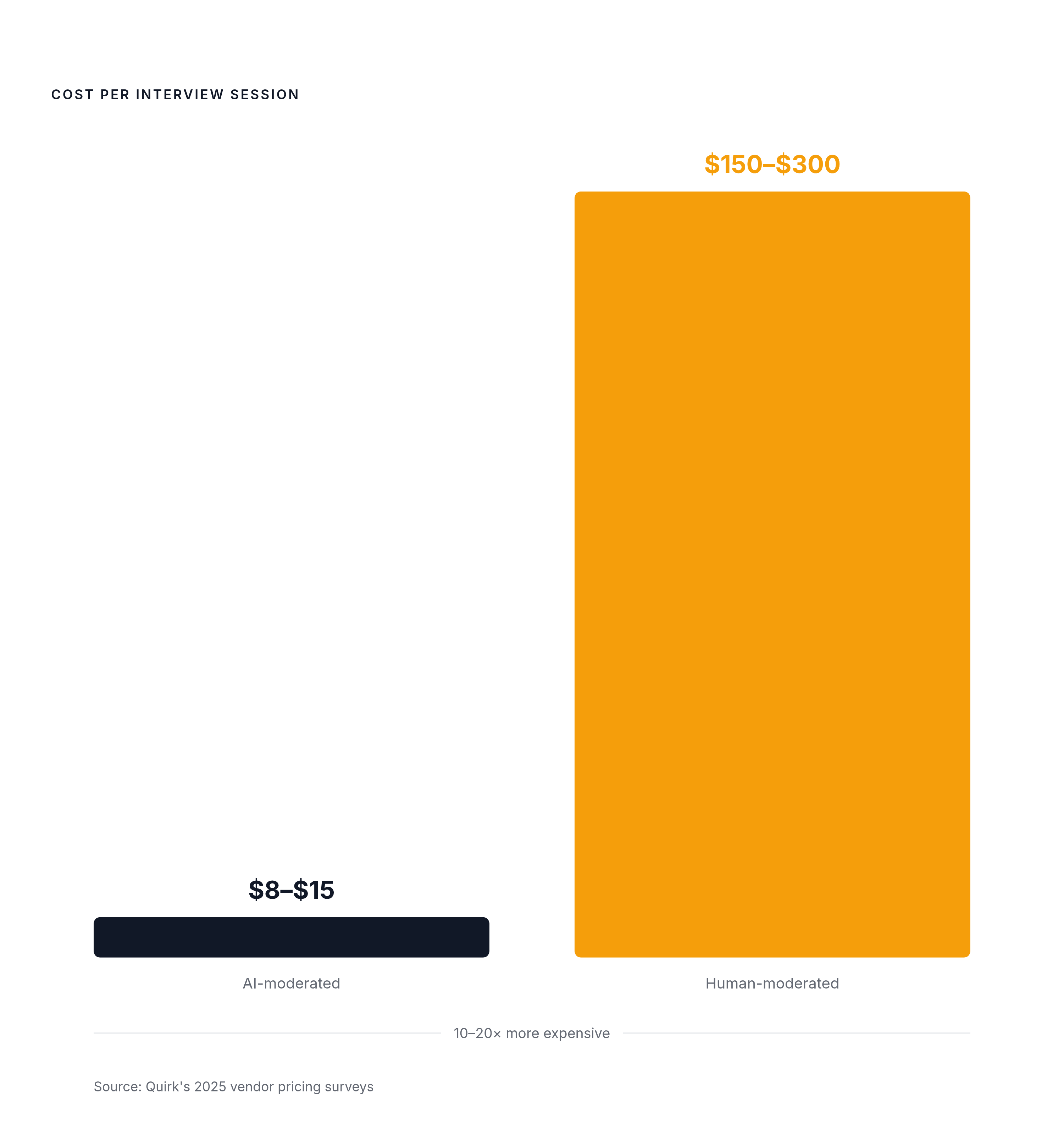
The pitch is compelling on paper. AI-moderated interviews can compress a research cycle that used to take weeks down dramatically, with the per-interview cost dropping to somewhere between $8 and $15, compared to $150 to $300 for a human-moderated session, according to Quirk's 2025 vendor pricing surveys. That's a real gap, not a rounding error. But none of it matters if the twenty people you interview aren't the twenty people you needed. Recruiting for this format isn't the same job as recruiting for a survey or a traditional focus group. The adaptivity, the asynchronous pacing, the sheer scale AI moderation runs at, all of it breaks the old recruitment playbook in specific, fixable ways. This piece covers four of those breakpoints: panel quality and fraud, screener design, audience specification, and where synthetic panels genuinely help versus where they don't. And to get ahead of the obvious misconception: the AI handles the conversation. It does not handle who gets invited into it.
How AI-Moderated Studies Differ From What Participants and Recruiters Expect
AI-moderated research means a conversational agent runs the interview itself, adaptively, probing and following up and coding responses as they come in. That's a different animal from a static survey with some branching logic bolted on.
Three structural differences change what recruitment has to account for. First, depth of probing carries the weight of the whole study. Conveo's platform data shows more than 70% of the final insight in these studies comes from AI-driven follow-up questions, so a participant who gives one-word answers doesn't just produce a thin transcript, they drag the whole session down in a way a lazy survey response never would. Second, modality changes the data itself. Voice responses run four to five times longer than typed answers, and AI probes overall generate 3.5× more content than static survey fields. Someone who's uneasy on camera, or who trips over spoken sentences, produces a fundamentally different kind of data than someone who's comfortable talking it out. Third, the asynchronous structure means people respond whenever they want, which quietly reshapes who finishes the study and who bails halfway through.
83% of respondents say they feel more candid with an AI moderator than a human one. That's a real advantage. But it only shows up if participants know what they're walking into. Someone who's surprised by a talking AI mid-interview doesn't lean in, they check out. So the screener and consent flow need to set format expectations directly: "you'll be interviewed by an AI that asks follow-up questions based on what you say." That's not a footnote. It belongs right next to the eligibility questions.
A skilled human researcher tops out around 12 to 15 interviews a week. AI removes that ceiling and runs hundreds at once. Which means the recruitment pipeline has to be built for that volume from day one, not scaled up gradually the way teams used to build toward a traditional fielding schedule.
The scale of the fraud problem in commercial panels and why AI studies are especially exposed
Independent panel audits put fraud rates in unmanaged commercial panels somewhere between 15% and 30%. Nearly a third of responses in some panels come from people who shouldn't be there. That alone should rule out sourcing from an unvetted panel for any study where depth of response is the whole point.
The environment makes it worse. The average internet-connected consumer now gets fifteen or more survey invitations a month, and response rates on cold-email consumer surveys have fallen to low single digits in most categories. That mismatch, too many invitations chasing too little attention, has bred a class of professional survey-takers who've gotten good at gaming screeners.
AI-moderated studies get hit by two specific fraud vectors. One is AI-generated responses: someone produces text that sounds plausible and passes quality checks while carrying no genuine behavioral signal. The other is straightforward screener gaming: respondents memorize the "correct" answers to qualifying questions and pass regardless of whether they're actually eligible. The State of User Research Report finds that 62% of research professionals already say recruiting for specialized studies is hard, and the harder a segment is to reach, the stronger the incentive to fake your way into it.
The damage compounds differently depending on format. In a survey, one fraudulent respondent adds a bit of noise to an aggregate number and gets diluted by sample size. In a small qualitative study, even a single fraudulent respondent carries outsized weight and can distort the themes that emerge from synthesis in ways a larger survey sample would dilute. Fraud control isn't a cleanup task for the end of the study. It has to get engineered into sourcing and screening before a single interview starts.
Panel sourcing: what separates a verified panel from a commodity one
Panels aren't interchangeable, and the choice between a verified, curated panel and an open-enrollment commodity panel is probably the single most consequential sourcing call a research team makes.
Verified sourcing looks like this in practice. Participants come exclusively from panels that verify identity at enrollment, not just at some point downstream. Matching happens on behavioral and intent signals, actual demonstrated past behavior, rather than relying on whatever someone claims about themselves in a demographic field. Frequency caps matter too: limiting a respondent to three studies a month structurally kills off the repeat-respondent problem that quietly rots commodity panels even when each individual response looks clean on its face. And real-time monitoring during the session itself, AI watching video, voice, content, and device signals all at once, catches the fraud attempts that slip past the initial screener.
Credible panels stack multiple fraud-mitigation layers at enrollment and during fielding, combining technical checks, behavioral monitoring, and attention traps to catch respondents who shouldn't be there.
Scale matters here because it enables better matching. A panel of 30 million verified respondents spread across 45-plus countries has enough depth to match people on real behavioral signals instead of falling back on demographic proxies as a stand-in.
Teams generally choose from three sourcing paths. A platform-managed panel is fastest, but it puts the quality burden on the vendor, so vet that vendor hard. Self-recruiting from an existing user base costs less and gets you high relevance, but it still needs quality guardrails applied, not skipped because "these are our own users." Bringing in an outside panel provider gives flexibility, but the same fraud controls need to apply no matter where the participants came from. On speed: platform-based recruitment can deliver participants within a business day, versus 14 or more days for a DIY build. That speed is only worth anything if the panel underneath it is clean.
Screener design for AI-moderated studies: what changes and what commonly goes wrong
A screener for an AI-moderated study has two jobs: qualify eligibility, and set expectations for the format itself. Most teams design for the first job and skip the second entirely, then wonder why participants drop off mid-interview.
A few design principles hold up here. Skip leading questions, since they're exactly how professional survey-takers learn the "right" answer to give. Favor behavioral questions over attitudinal ones: "how many times in the last 30 days did you..." beats "do you consider yourself someone who..." every time, because it's harder to fake a specific number than a self-image. Build in at least one red herring or consistency check, a question with a verifiable answer that someone faking eligibility is likely to get wrong. State the format outright in the screener or consent step: "this study uses an AI interviewer that asks follow-up questions, and you'll speak your answers aloud on camera." And screen for communication style, not just eligibility. Someone who can't hold up their end of a multi-turn spoken conversation undercuts the entire reason the format exists.
AI co-pilot tools can now turn a plain-language brief into structured screener logic in seconds, which is genuinely useful, but the research lead still has to sit down and check it for gaming vulnerability before it goes live. Nobody should skip that review just because the draft came out fast.
Running a pilot phase pays for itself here. Fifteen to thirty pilot interviews will surface comprehension problems and unexpected drop-off points before the study goes wide. If a meaningful share of pilot participants misread a question, that question needs a rewrite before scaling up, full stop. And on the flip side: the State of User Research Report finds 54% of researchers say time-to-recruit is a real struggle, and a screener that's over-engineered to narrow too aggressively is a common cause. The goal is precision. It's not maximum restriction for its own sake.
Audience specification: translating a business question into a recruitble segment definition
The gap between "who we want to talk to" and an actual recruitble segment definition is where a lot of studies quietly go wrong, long before the first interview ever happens.
Behavioral and intent signals beat demographic proxies for matching purposes. "Purchased a B2B SaaS product with a contract value above some threshold in the past 12 months" recruits a sharper, more relevant group than "a manager at a mid-sized tech company" ever will.
A complete audience spec has several layers stacked on top of each other. There's the firmographic or demographic baseline, the outer filter. Then a behavioral qualifier, what someone's actually done, not what they claim to do. Then the decision-making role, especially in B2B contexts, where buying authority, evaluation input, and end-user status are genuinely different populations that shouldn't get lumped together. Add a recency criterion, since relevant experience from three years ago isn't the same as relevant experience from last month. And finally, exclusions: competitors, internal employees, agency contacts, anyone whose presence would quietly warp the findings.
Quota design needs to get settled early, too: does the study need proportional representation, or deliberate oversampling of some minority segment? AI matching can execute either approach, but only if the specification says so explicitly up front. In multi-market studies, set per-country quotas and language requirements at the brief stage, not after fielding has already started. Platforms offering native multilingual moderation across 100-plus languages can run one unified study spanning several markets without spinning up separate fieldwork cycles for each.
Before recruitment opens, run one alignment check comparing the one-sentence research question, the decision it's meant to inform, and the audience definition to confirm they match up. Most of the "we talked to the wrong people" regret that appears after a study wraps traces straight back to a mismatch nobody caught at this stage.
Recruiting hard-to-reach segments: niche B2B buyers, low-incidence populations, and when synthetic panels fill the gap
Segments below 1% incidence, enterprise decision-makers, healthcare workers, engineers in narrow specializations, don't come out of standard panels reliably or fast. A straightforward study targeting one of these groups routinely takes six to twelve weeks and can cost a substantial sum just to get participants recruited and sessions run.
Speed is a frequently cited driver for teams adopting AI in research. But that argument falls apart fast when the recruitment step alone eats months and thousands of dollars per respondent before the AI moderator even opens its mouth.
Two responses have emerged. One is a dedicated recruitment operations team, humans reviewing behind the automated sourcing layer, that specifically handles sub-1% segments instead of punting them out to an external vendor. The other is synthetic panels: systems built to simulate the behaviors, preferences, and demographics of real consumer segments, trained on real-world data including historical survey responses, behavioral records, and public opinion trends.
Adoption has moved fast. Adoption has spread quickly, with many consumer insight leaders rolling out some form of synthetic data, and vendor-reported usage figures suggest the majority of market researchers have tried synthetic responses at least once. Accuracy numbers from vendor-run studies are in a similar range, though they're not directly comparable to each other. Vendor-run accuracy studies and published case studies report high correlations between synthetic and real panels in tested categories, though results vary by context and are not directly comparable across providers.
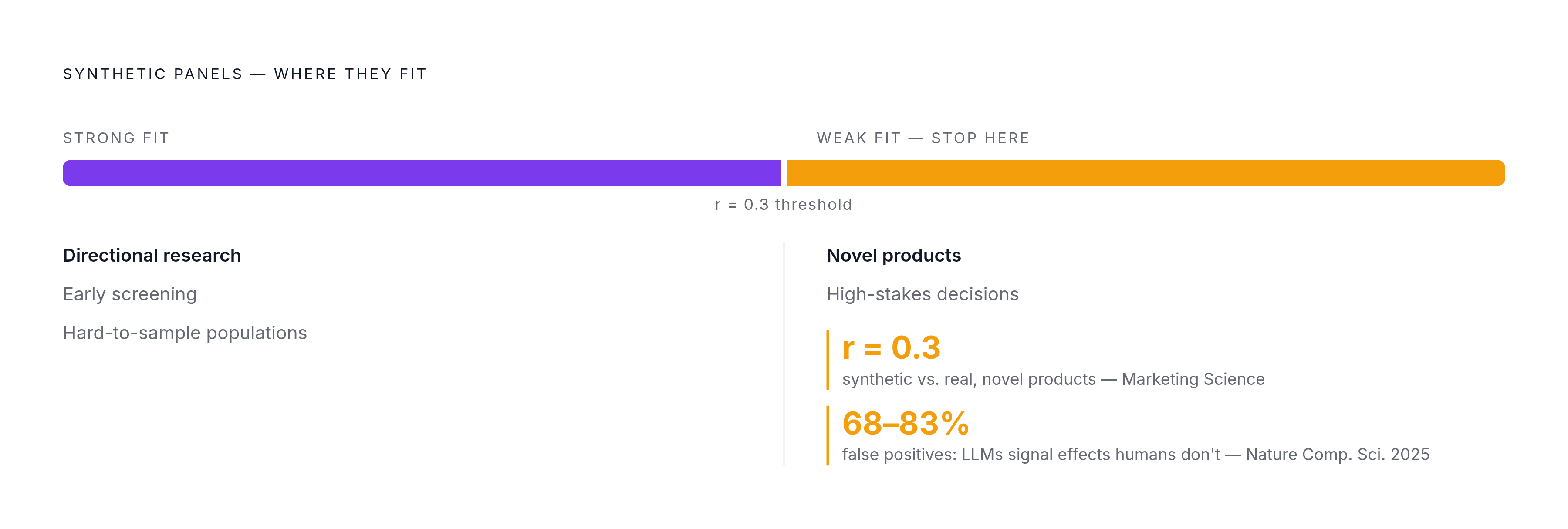
But there's a real limit here, and it matters. A Marketing Science study found only a 0.3 correlation between synthetic and real responses for genuinely novel products, ones with no predecessor anywhere in the training data. That tracks: a synthetic respondent has no lived experience with something it's never encountered, so it's guessing by analogy, and the guess breaks down fast. A 2025 Nature Computational Science study adds a sharper warning, finding that LLMs consistently produce larger effect sizes than the original human studies they're compared against, and generated statistically significant effects in 68% to 83% of cases where the human research found nothing. That's not noise. That's a systematic bias, and it misleads a team if nobody's watching for it.
So the honest positioning is this: synthetic panels are a strong complement for directional work, early screening, and reaching populations that are otherwise nearly impossible to sample. They are not a stand-in for real respondents when the stakes are high or the product is something the world hasn't seen a version of yet. The sane workflow uses synthetic panels to scope a question and pressure-test assumptions before committing real recruitment budget, then brings in actual respondents to validate the decisions that carry the most weight.
Platforms that combine recruitment and AI moderation in one workflow
Teams generally face one operational choice: stitch together a stack, separate recruitment platform, separate AI moderation tool, separate analysis layer, or use one platform that handles all three end to end. Fragmented stacks introduce handoff delays at every seam, and those delays eat straight into the speed advantage that is the reason to run AI moderation.
A handful of platforms now cover recruitment and moderation together. Listen Labs runs study design, recruitment from a verified network of 30 million respondents across 45-plus countries (Listen Atlas), AI-moderated video interviews, real-time fraud detection through a feature called Quality Guard, emotional signal capture, and automated deliverables, all in one pipeline. It also runs a dedicated recruitment operations team for sub-1% incidence segments. Reported enterprise users include Microsoft, Sweetgreen (which scaled research five times over at a third of the cost), Anthropic (over 300 churn interviews), and P&G (over 250 interviews validating male consumer segments).
Conveo takes a similar end-to-end approach, covering study design, recruitment through partner panels, AI-moderated video and voice interviews, analysis, and insight sharing, aimed at consumer insight and market research teams. Its case data shows delivery speeds up to 100 times faster and costs roughly 75% lower than human-moderated sessions, with automated theme detection built into the interview pipeline itself.
Outset.ai leans toward UX and product teams, with AI-moderated interviews that include screen sharing and Figma integration, built for prototype and concept testing. It's noted for handling sensitive topics carefully and for flexible scheduling that fits around how product teams actually work.
Each platform solves the handoff differently, but the underlying logic is the same across all three: recruitment and moderation living in one workflow means fewer places for quality to leak out between steps.
Sources
- AI‑Moderated Research in 2025: Framework, ROI Benchmarks, and Best Tools | Conveo
- AI Moderation for Market Research: Enterprise Guide
- Best Research Participant Recruitment Platforms in 2026: The Complete Buyer's Guide
- outset.ai
- The Future of Market Research with AI: 2026 Trends That Will Reshape the Industry
- userintuition.ai