Behavioral Segmentation Examples Across Consumer Categories
How three shopping archetypes reveal which customers are worth keeping.

Retail is where the logic of spending tiers becomes most visible, and the imbalance is almost always starker than people expect. A small share of customers drives a disproportionate share of revenue. The practical question is what to do about it.
Three purchase-behavior archetypes show up reliably across retail categories. The discount-first shopper: high volume, present during every promotion, nearly absent the rest of the time. This customer looks valuable in a promotional week's revenue report and looks expensive everywhere else. The behavioral data question worth asking is whether any of them ever graduate to full-price buying. Some do. Most don't. The ones who do are worth investing in; the ones who never will are worth understanding but not subsidizing indefinitely.
Then there is the deliberate researcher. This customer reads multiple reviews, compares options across tabs, and takes longer to convert. The consideration cycle is longer, but the conversion confidence is higher. They are less likely to return items, less likely to need post-purchase reassurance, and more likely to become a repeat buyer if the first experience meets expectations. They are persistently undervalued in models that weight recency and frequency over purchase intent signals, which is a structural blind spot worth correcting.
The third is the seasonal or occasion buyer. Spikes in activity around holidays, back-to-school windows, or other calendar moments define their relationship with the brand. Outside those windows, they are functionally dormant. The insight here is not that they are low-value; it is that the margin for engaging them is narrow, and missing the window means waiting a full cycle to try again.
Channel behavior layers onto all three archetypes and frequently refines which segment a customer truly belongs to. An in-store shopper and an app-first shopper can have identical purchase frequency while representing entirely different behavioral profiles. That distinction matters when you are deciding where to invest in loyalty incentives versus where to protect margin.
Benefits-Sought Segmentation in Beauty and Skincare
In beauty, the same product category contains buyers with entirely different benefit priorities. A moisturizer section includes customers motivated by anti-aging, acne control, brightening, hydration, and ingredient purity, often all at once, often without any visible demographic difference between them. Sephora's "Shop by Concern" navigation is not a UX nicety. It is a direct implementation of benefits-sought segmentation: the entire interface is organized around the segment type, not the product format. That is a meaningful strategic choice, and it signals how seriously the category takes benefit differentiation as a commercial reality.
What this reveals about demographic assumptions is worth dwelling on. A 22-year-old and a 55-year-old can share a hydration segment. A 30-year-old and a 60-year-old can both be in a "clean ingredients" segment. Benefits-sought segmentation regularly cuts across the demographic variables that marketers default to, which is part of why it is more actionable. It tells you what the customer actually needs, not what her age cohort is assumed to need.
The values-alignment dimension in beauty deserves its own treatment. Clean ingredients, cruelty-free certification, sustainable packaging: these are not positioning adjectives. They are a benefit segment with real purchase influence. Escalent's 2026 consumer trends report puts the share of consumers willing to pay more for products aligned with their values at over 40%. That figure should be verified against the published report before use, as the 2026 date suggests it may be a projected or forthcoming publication.
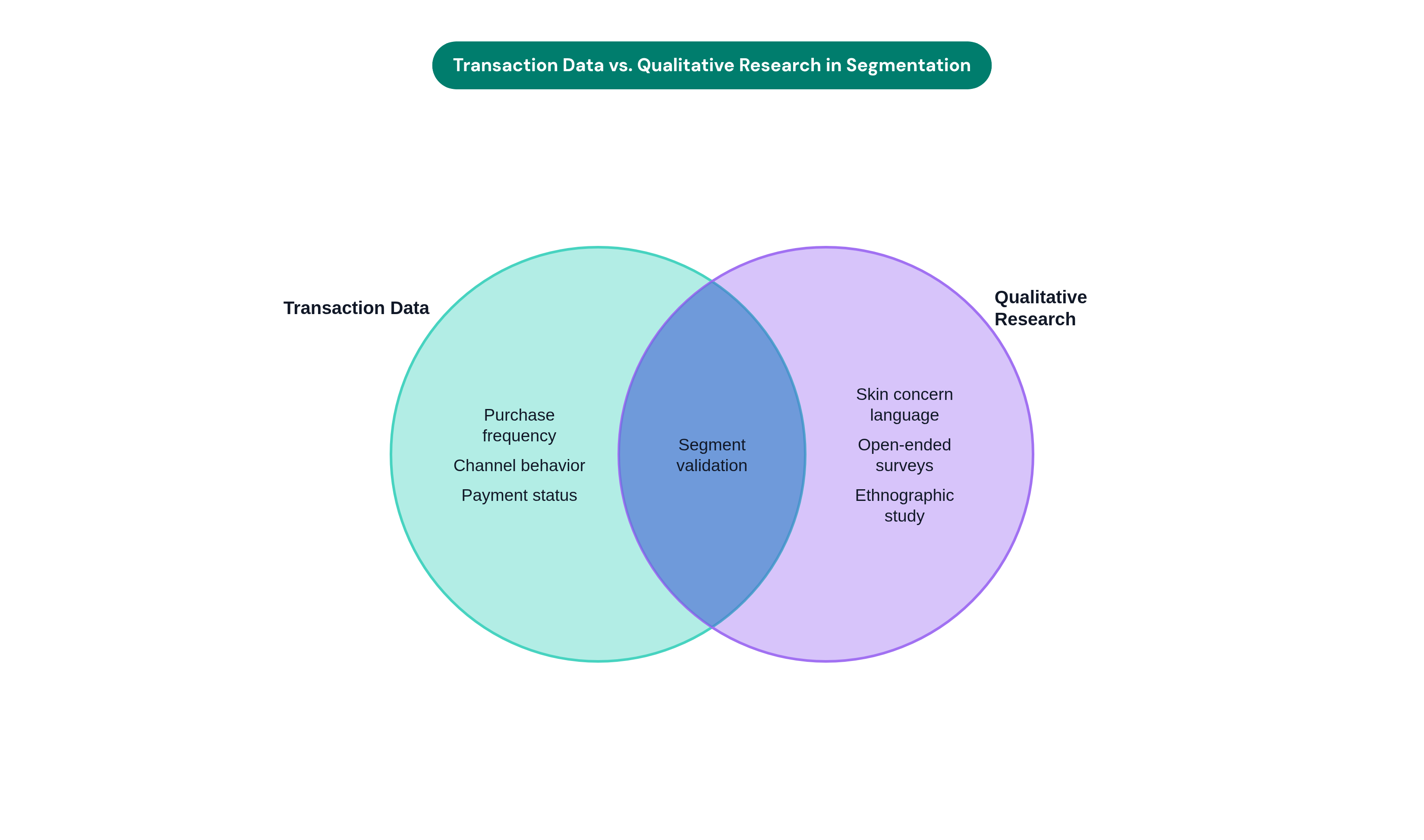
The structural challenge is that the benefits are often latent. Customers do not always articulate them at the point of purchase, and transaction data alone will not surface them. Someone who buys a vitamin C serum every three months does not signal in that transaction whether she is buying for brightening, for antioxidant protection, or because an influencer she trusts recommended it. That distinction matters enormously for how you message to her next. Surfacing latent benefits requires qualitative research: interviews, open-ended survey language, ethnographic observation of how people talk about their skin concerns in their own words. Transaction data is the starting point, not the answer.
Occasion and Timing Segmentation in Grocery and Food
Grocery purchase behavior is among the most occasion-saturated of any consumer category. The weekday top-up shop, the Sunday weekly stock-up, and the post-work "dinner tonight" trip each represent different basket compositions, different price sensitivities, and different levels of openness to suggestion. What makes this particularly complex is that the same person often behaves as three different shoppers depending on which occasion is in play. Demographic segmentation cannot capture that. Occasion segmentation can.
The occasion taxonomy in food extends beyond trip type. Seasonal cooking occasions like grilling season and holiday baking represent predictable volume spikes. Life-stage occasions, a new baby in the household, a kid heading off to college, represent durable behavioral shifts that can persist for years. Health-driven resets, most visibly in January, represent short windows of high purchase intent where the right message at the right moment can establish new category habits. Miss that window and you are waiting twelve months.
Timing of communication matters as much as timing of purchase. Per GetResponse's 2024 Email Marketing Benchmarks, timezone-matched delivery achieves a 45.07% open rate and a 9.76% click-through rate against overall benchmarks that fall considerably lower. A grocery retailer who identifies a "Thursday evening meal-planner" segment and delivers recipe suggestions or offer notifications at the moment of relevance is performing measurably better than an undifferentiated blast.
Food brands also use occasion segmentation for new product development. A snack positioned for "desk lunch" is targeting a different occasion, a different decision context, and a different competitive set than the same product positioned for "after-school." The product is identical. The segment is not.
One limitation worth naming directly: occasion segments are among the most time-sensitive of all segment types. A segment defined by a pandemic-era occasion, online grocery delivery as a primary shop, has contracted significantly as behavior normalized. Occasion segments must be refreshed, not assumed static, because the occasions themselves evolve with the cultural and practical context that generates them.
Loyalty and User-Status Segments in Subscription and Retail Contexts
The standard loyalty ladder runs from non-user through first-time buyer, occasional buyer, repeat buyer, and brand advocate. Most marketers know the ladder. Fewer actually use it to differentiate their messaging with meaningful precision.
First-time and occasional buyers need social proof before committing further. Reviews, testimonials, and "bestseller" signals do real work here because this segment is still in the process of building purchase confidence. Discounting can accelerate a first conversion but rarely builds the kind of commitment that survives the next competitive promotion.
Repeat buyers respond to exclusivity and recognition. They are not looking for a discount they could find on a coupon site. They want evidence that the brand sees them as more than a transaction. Early access, member-only content, personalized acknowledgment of their history with the brand: these are the levers that deepen commitment at this stage. Advocates need something different still, enablement more than marketing. Referral tools, community access, early product previews. The job with an advocate is to give them the mechanisms to convert their enthusiasm into acquisition on the brand's behalf.
In subscription contexts, whether streaming, SaaS, or meal kits, user status maps directly onto churn risk in a way that payment status alone will not reveal. The "subscribed but not engaging" segment is the highest-priority retention problem in almost every subscription business, and it is invisible to any model that only monitors payment continuity. A customer who is paying but not logging in, not consuming content, not using features, has already made a psychological exit. The cancellation, when it comes, is administrative. The decision happened weeks or months earlier, and the behavioral signals were there the whole time.
Mailchimp's approach of targeting feature-specific emails to users who have actually interacted with that feature illustrates how loyalty-plus-behavior segmentation works at its best. It is not just about where someone sits on the loyalty ladder. It is about which specific product elements they have demonstrated engagement with, and meeting them at exactly that point. The "light user who hasn't churned yet" is often the most under-researched segment across categories. They haven't complained or left. But they are not committed, and identifying them before the churn signal becomes unambiguous is where behavioral data creates the most preventable value.
Predicted Behavior Segments in CPG and Financial Services
Predicted behavior segments use past behavioral signals to forecast future actions: likelihood to repurchase, propensity to upgrade, churn probability, cross-sell readiness. The data requirements are higher than for descriptive segment types, and so is the commercial leverage when the model is right.
In CPG, Starbucks' Deep Brew is the clearest brand-level example operating at scale. It tailors offers based on time of day, weather, and individual purchase history, a live predicted-behavior engine processing millions of data points simultaneously. The output is not a segment in the traditional sense; it is a personalized offer that reflects a prediction about what a specific customer is most likely to want and act on right now. Amazon's Dash Replenishment takes the logic further: zero-click commerce, where the prediction that a customer will run out of a product is acted on without waiting for the customer to signal intent. The prediction becomes the transaction.
In financial services, predicted behavior segmentation drives product timing in ways that are difficult to replicate with demographic logic. When to surface a mortgage offer, when to flag a customer as ready for a wealth management conversation, when churn risk is elevated enough to trigger a retention outreach: these are timing problems that predicted behavior models are specifically built to solve. Knowing a product is relevant is the easy part. Knowing when the customer is ready to hear about it is where the model earns its keep.
Telstra uses synthetic customers specifically for churn prediction and pricing sensitivity testing before real-world rollout. The implication is significant: prediction-based segments are increasingly being built and stress-tested in simulation before deployment, which compresses the time between hypothesis and activation. That capability will become more common across categories as synthetic research methods mature.
The key tension with predicted behavior models is data freshness. A customer who has changed life circumstances, a new job, a new city, a meaningfully different income, is systematically mis-segmented by a model that has not received fresh signals. The model predicts based on who the customer was. Monitoring for behavioral drift and establishing data refresh cadences is not a technical nicety; it is how you keep the model from becoming quietly wrong in ways that accumulate before anyone notices.
How Channel-Engagement Behavior Creates Segments That Cut Across Categories
Channel-engagement segmentation groups customers not by what they buy but by where and how they interact: app-first, in-store-dominant, email-responsive, social-influenced, voice or chat-native. This segment type cuts across every other behavioral category and directly determines what form of outreach will actually reach a given customer.
The cross-category implication is practical and persistently underweighted. A customer who holds high loyalty status in the purchase-behavior model but only engages through one channel is unreachable through any other, regardless of how well the message is targeted. Spend directed at the wrong channel is not just inefficient. It is invisible to the customer it was meant to reach.
In retail, app users and in-store shoppers represent meaningfully different segments even when their purchase frequency is identical. The app user is more responsive to flash sales and push notifications. The in-store shopper responds to staff recommendation and in-aisle placement. Neither is more valuable categorically; they are differently valuable, and the activation approach must reflect that.
In beauty, social-influenced buyers, those driven by TikTok discovery or user-generated content, require different creative formats and influencer strategies than search-driven buyers who arrive via "best moisturizer for dry skin" queries. The search-driven buyer has already named her benefit; the social-influenced buyer lacks one until a piece of content creates it. The channel tells you something about the customer's decision process, not just her communication preference.
In financial services, customers who engage primarily through the mobile app carry different service expectations and different churn signals than branch-dominant customers. A branch customer who suddenly shifts to app-only behavior is signaling increasing autonomy from the relationship. That behavioral drift frequently presages a move to a competitor, and it is legible in the channel data before it appears anywhere else.
The practical implication for media mix decisions is that channel segmentation data should operate at the segment level, not just the campaign level. Varying the creative while keeping the channel constant is optimization. Varying the channel to match where each segment actually lives is segmentation.
What the Category Examples Reveal About Segmentation as a Research Problem
The through-line across all these categories is consistent: the segment types are the same, but the signals that reveal them are category-specific. Benefits-sought segmentation in skincare surfaces through qualitative language about skin concerns. In financial services, it surfaces through product-feature usage patterns. The segment type is identical; the research method required to find it is not. That is where segmentation projects most commonly stall, not in the framework, but in the failure to recognize that the framework requires category-specific translation.
Transaction data alone rarely reveals the full segment picture. Occasion, benefits sought, and loyalty status all require either behavioral tracking, what someone clicks, browses, and ignores, or direct qualitative research into what they want and why. The behavioral record tells you what happened. It does not reliably tell you why, or what the customer will do when circumstances change.
The cost of poor segment-to-experience matching is real, even when it is not directly measurable. When content is generic where it could be specific, when an email speaks to the wrong concern, when an offer lands in the wrong channel at the wrong moment, customers notice even if they cannot articulate it. The dissatisfaction accumulates quietly and expresses itself in churn, in reduced engagement, in the slow erosion of brand preference.
The Kellanova UK case from 2025 is instructive in the most concrete way possible. A clean-room pilot combining purchase data with attitudinal insight at the segment level produced a 9% sales lift among price-sensitive shoppers and a 36% increase from loyal buyers. Neither outcome was visible from purchase data or attitudinal data alone. The lift emerged from matching the right insight type to the right segment. That is the research design implication, not just the marketing one. These figures should be verified against a published source before use, as no citation is provided.
What this implies for researchers is that the question is not simply which segments exist. The prior question is: which behavioral signals in your specific category most reliably surface each segment type? That question cannot be answered by assumption. Occasion segments can expire. Predicted behavior models can drift. By the time traditional research surfaces a segment insight, the condition that defined it has sometimes already shifted. That is the structural tension that makes behavioral segmentation research time-sensitive in a way that demographic research simply is not.
How to Identify Behavioral Segments in Your Own Category Without Starting From Scratch
Start with the segment type that is most decision-relevant for the immediate problem you are trying to solve. Retention problem: start with loyalty and user-status segments. Channel spend allocation: start with channel-engagement segments. Product positioning or new product development: start with benefits-sought segments. Promotional calendar efficiency: start with occasion and timing segments. The instinct to build a comprehensive segmentation model from the beginning is understandable and usually wrong. Comprehensive can wait. Actionable cannot.
Before fielding any new research, audit the behavioral data you already have. Purchase transaction logs, email engagement data, app event streams, on-site search queries, support ticket language: these sources collectively contain more segment signal than most organizations have extracted from them. Search queries in particular are underused. When someone types "moisturizer that won't clog pores" or "savings account with no minimum balance," they are telling you exactly which benefit segment they belong to, without being asked. That is primary research that has already been collected and is sitting in a database somewhere.
Where data runs thin, in early-stage categories, new markets, or hard-to-reach populations, synthetic consumer panels can stand in for real respondents at the hypothesis-generation stage before committing to full fielding. A 2024 study involving 1,052 participants, conducted by researchers at Stanford and Google DeepMind, found that AI digital twins replicated human survey responses with 85% accuracy (Argyle et al., 2024, "Out of One, Many: Using Language Models to Simulate Human Samples," published in Political Analysis). That is a viable accuracy range for directional segment hypothesis testing, not a replacement for validation on genuinely novel concepts, but something that meaningfully compresses the time between question and directional answer.
The categories that move fastest, beauty, food, CPG, benefit most from treating segments as living hypotheses rather than fixed annual outputs. A segment defined in January will need revision by March if the behavioral signals that defined it have shifted. Continuous segmentation does not mean perpetual instability; it means treating the segment map as something that is updated as evidence accumulates, rather than as a deliverable that gets filed and referenced for the next eighteen months.
The sequence, in practice: hypothesize segments from existing behavioral data, validate the most strategically important ones with real respondents or calibrated synthetic panels, a workflow that platforms like Seda, an AI-powered market research tool that conducts interviews and UX tests with verified human respondents across 130+ countries and auto-synthesizes findings into structured reports, are built to support at the speed behavioral segmentation actually requires, assign customers to segments in the CRM or activation layer, measure whether segment-specific treatments outperform undifferentiated approaches, and iterate. The goal is not an exhaustive segmentation map. It is the smallest number of actionable segments that explain the most variance in how your customers behave and what they need. That constraint is not a concession to limited resources. It is what makes segmentation useful rather than merely interesting — because a segmentation model that sits on a shelf is just a very expensive way to organize a file cabinet.