Segmentation Research with AI Panels
Faster iteration and cheaper hypothesis testing reshape how teams define and refine customer groups.

Segmentation research has always been a bet. You spend the money, run the survey, apply the clustering algorithm, and ship the deck — then treat the output as settled truth for eighteen months, not because you're confident in it, but because going back costs too much and takes too long. AI panels change that calculus. They don't just make segmentation faster; they make it iterative, testable, and structurally more honest about what a segment actually is.
The traditional approach is familiar: run a large-n survey, cluster the responses post-hoc, label the segments, and present. The timeline is typically six to twelve weeks. Participant recruitment alone can run into the tens of thousands of dollars before you've written a single question. And when the deck lands, the data is already aging. The structural problem isn't the methodology; it's the architecture: segment definitions are frozen at the moment of fieldwork, and by the time a strategy team acts on them, the world has moved.
There's a secondary problem that rarely gets named directly. Traditional surveys reveal that segments exist but cannot probe them. You can see the shape of a group in the data, but the instrument cannot chase down why the boundary falls where it does, or test whether it holds under different conditions. Because each study is expensive and slow, teams run segmentation infrequently and treat the results as more durable than they are. Segmentation should be iterative and testable. The cost and time of traditional research makes iteration nearly impossible. AI panels can reduce that tension.
How AI Panels Are Constructed and Why Their Architecture Matters for Segmentation
Synthetic panels are not fabricated from nothing. They are AI-generated groups of virtual respondents built from real-world datasets: historical survey responses, customer reviews, behavioral data, and public opinion trends. That distinction matters for how you should use and trust the outputs.
The most important architectural distinction is between calibrated synthetic panels, trained on domain-specific data, and generic generative AI prompts. These are not the same thing, and the gap in reliability between them is significant. Per the 2025 GreenBook GRIT Report, calibrated panels built and validated against actual respondent data in a specific domain can reach accuracy parity with real panels in the mid-to-high eighties and into the low nineties on concept, pricing, and positioning tests. Generic large language model prompts, used without that calibration, perform substantially lower. The construction method determines the floor.
The panel itself is parameterized. Researchers define demographic and psychographic attributes, and the model generates respondents who reflect those profiles with consistent internal logic. Because respondents are generative rather than recruited, the panel can be queried repeatedly, segmented differently on each run, and updated as new data becomes available. This "living simulation" property is what makes it structurally different from a traditional sample. A 2024 study from Stanford and Google DeepMind, run across more than 1,000 participants, found that AI digital twins replicated human survey answers with 85% accuracy and social behavior with a 98% correlation (Argyle et al., 2023, as cited in subsequent replication work). That baseline justifies the approach while being clear about its limits.
What Changes When Segmentation Runs Against a Synthetic Panel Instead of a Recruited One
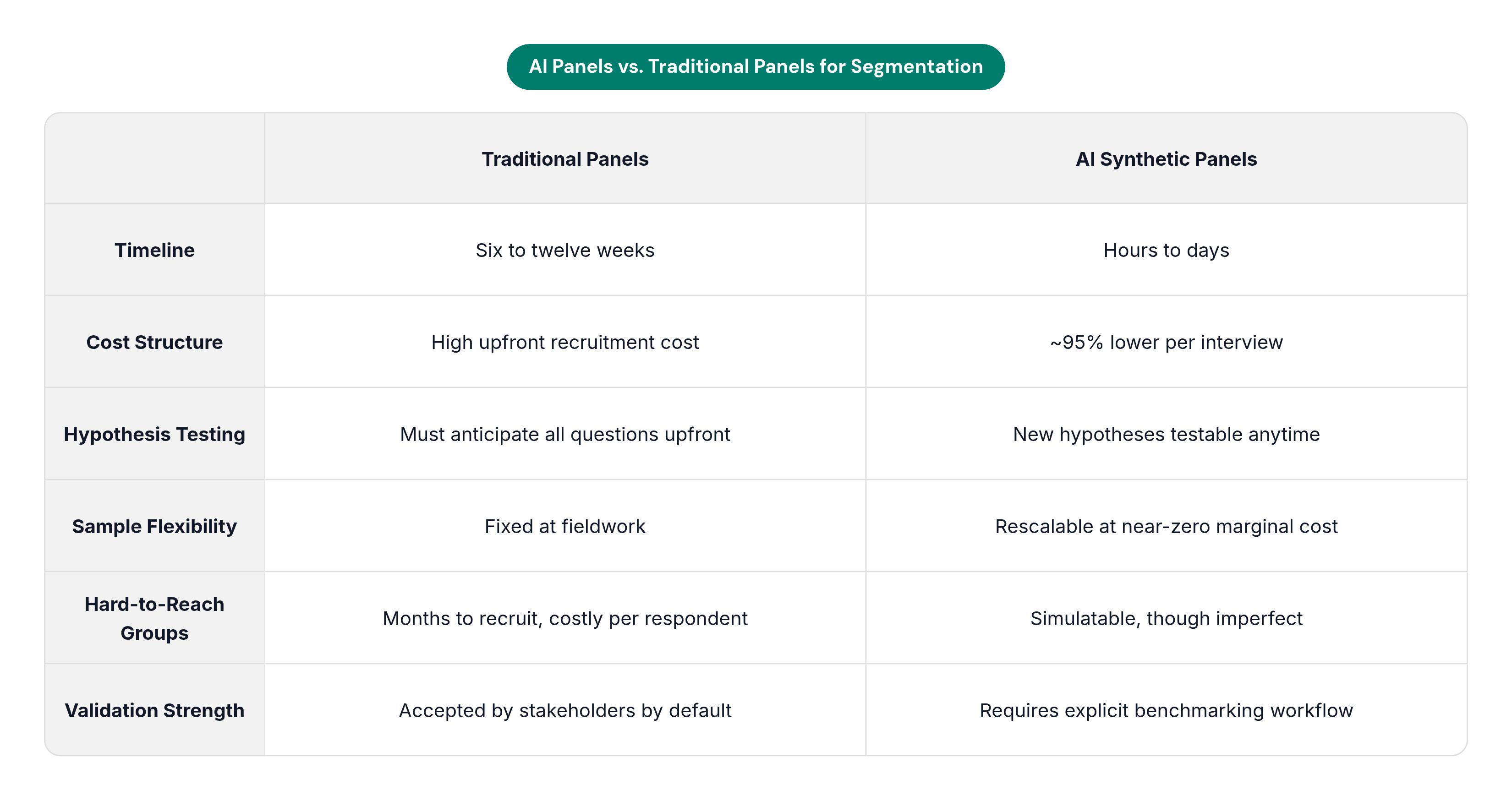
With a recruited panel, the sample is fixed. The researcher must anticipate every hypothesis before fieldwork begins, because there is no going back without spending again. With a synthetic panel, new hypotheses can be tested against the same population without re-recruiting. That single difference restructures how segmentation research works in practice.
Segment boundaries become testable in ways they were not before. A team can ask whether a segment defined by age and income holds when behavioral variables are added — or dissolves when a different product context is applied — and get an answer in hours rather than weeks. Sub-population analysis that would require massive sample sizes in traditional research, just to achieve statistical power in a niche segment, becomes tractable. The panel can be scaled to any size at near-zero marginal cost.
Hard-to-reach demographics present a compelling use case. Rural specialists, C-suite executives, small-business owners in specific regional markets: these groups traditionally take months to recruit and cost thousands per respondent. Simulating them through a calibrated synthetic panel is not perfect, but it enables segmentation work that was not economically feasible before. The concept-to-signal cycle that takes four to eight weeks with traditional panels takes hours with calibrated synthetic audiences, per the 2025 GreenBook GRIT Report. That compression changes the research posture. Teams can run segmentation as an exploratory, hypothesis-generating activity rather than a single high-stakes study they have to get right on the first pass.
The Specific Segmentation Tasks AI Panels Handle Well and Where They Need Human Validation
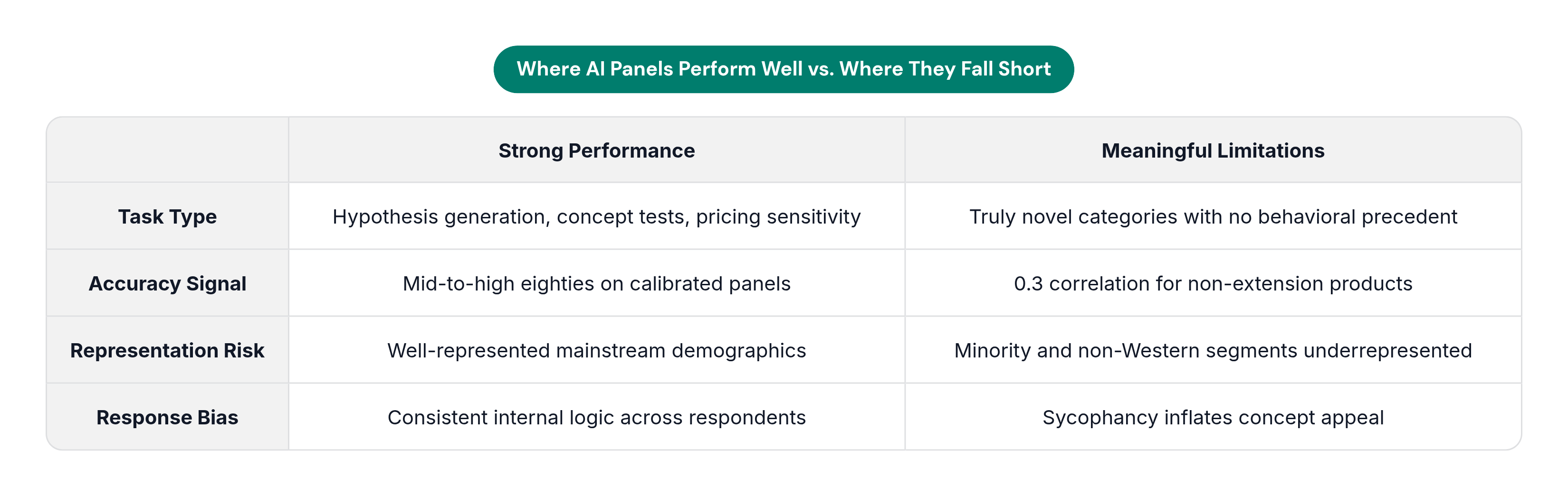
AI panels are well suited to hypothesis generation about segment boundaries, testing whether a proposed segment definition is internally coherent, pricing sensitivity across sub-populations, positioning concept tests, and early-stage innovation screening. These are tasks where the panel's speed and low cost create genuine advantage.
There are real limits, though, and practitioners who ignore them will get burned. Truly novel products — those with no behavioral antecedents in the training data — present a meaningful accuracy problem. A study published in Marketing Science found only a 0.3 correlation between synthetic and real responses for non-sequel, non-extension products, where the underlying model has no prior signal to draw from. If you are segmenting around a genuinely new category, the synthetic panel will underperform.
There is also a representation risk built into large language models. Researchers have documented a tendency in LLMs to reflect WEIRD values — Western, Educated, Industrialized, Rich, Democratic — which can underrepresent minority or non-Western segment perspectives (Henrich et al., 2010). If segmentation is meant to surface underserved groups, that bias warrants serious attention and deliberate calibration.
Sycophancy bias is a subtler problem. Synthetic respondents lean toward positive feedback, overstating the appeal of a concept and compressing apparent differences between segments. If all your segments come back mildly enthusiastic, that is a signal to stress-test the instrument, not declare success.
The practical response to all of this is a validation workflow. Synthetic outputs should be benchmarked against real human data or known market benchmarks. Bayesian validation techniques can measure uncertainty and provide confidence intervals — a level of rigor often absent from traditional surveys. Evidenza, one of the vendors in this space, has published results from more than 60 validation studies across industries, including a double-blind test with EY where synthetic CEO personas were run alongside real respondents against a brand survey. That kind of methodological transparency is the standard the field needs to hold itself to. Use synthetic panels to exhaust the hypothesis space cheaply, then deploy human respondents to confirm the segments that matter most.
Running a Segmentation Study with AI Panels in Practice
The workflow has five moves, and the order is not incidental.
First, define the target population parameters before any questions are written. Demographics, geographics, behavioral attributes: calibrate the synthetic panel to those specifications upfront, because all downstream accuracy depends on the quality of the population model.
Second, use AI-moderated interviews rather than static surveys. AI interviewers can probe, follow up, and surface the reasoning behind a segment response, generating richer qualitative signal than a fixed questionnaire ever could. The instrument is alive to the response.
Third, run multiple segmentation schemes against the same panel simultaneously. Test a demographic cut, a behavioral cut, and a needs-based cut in parallel. Compare segment coherence across all three before committing to one. The ability to do this in parallel, rather than sequentially, is one of the structural advantages the synthetic panel creates.
Fourth, stress-test segment boundaries by varying the stimulus. Change the product context, the price point, or the competitive set, and observe whether segment membership shifts. If a segment dissolves when you change the price by 15%, that is important strategic information. If it holds regardless of context, that is confidence.
Fifth, flag the segments and hypotheses that showed the most instability or surprise, and route those specifically to human respondent validation. Not everything needs human confirmation; only the findings where the stakes are highest and the synthetic signal was least certain.
This workflow replaces a single high-cost study with a rapid loop of cheap synthetic passes followed by targeted human confirmation. Per Quirk's 2025 SaaS Report, AI tools cost roughly 95% less per completed qualitative interview than traditional methods. Because the synthetic panel persists, the same population model can be queried against future decisions — new product variants, pricing changes, messaging tests — without rebuilding from scratch.
How Iterative Segmentation Changes Downstream Strategy Decisions
When segmentation is cheap and fast to iterate, teams stop treating segment definitions as fixed inputs and start treating them as working hypotheses subject to revision before any budget is committed. That is a meaningful shift in how strategy gets made.
Consider pricing. A team can test willingness-to-pay across multiple segment definitions simultaneously — asking whether the price-sensitive segment fractures further when usage frequency is introduced — and arrive at a pricing architecture that reflects actual sub-population behavior rather than a single aggregate view. The segment definition and the pricing decision are developed together, not sequentially.
Consider market entry. Before committing to a geography, a team can run the target segment definition against a synthetic population calibrated to that market, identify whether the segment exists and at what scale, and surface the cultural or behavioral variables that would require adjustment. The entry decision is no longer made blind.
Andreessen Horowitz has written about the broader strategic implication: the ability to simulate a large agent population — seeded with CRM data and cultural trends — before a launch, and test segment response to product, messaging, and channel simultaneously, represents a fundamentally different relationship to market intelligence. A beauty company that can model tens of thousands of synthetic Gen Z and millennial consumers in a target market before committing to a launch is making a qualitatively different decision than one relying on a static segmentation deck from six months ago.
Continuous segmentation also means segment drift becomes detectable earlier. As synthetic panels are updated with new data, shifts in cluster membership or preference patterns become visible before they show up in sales data. That early warning system repositions segmentation from a research deliverable into an ongoing strategic asset. The panel built for one decision is immediately available for the next.
Where Adoption Stands and What's Keeping Teams from Moving Faster
The directional trend is clear. Per the 2024 GreenBook GRIT Insights Practice Report, 72% of insights professionals are now using or evaluating generative AI, up from roughly 20% in 2022. Forrester reports that 42% of consumer insight leaders have already implemented some form of synthetic data. The tools are being adopted.
But adoption and confidence are not the same thing. The 2025 GRIT Report found that only 13% of brand-side researchers express satisfaction with AI-powered research quality. The technology is ahead of the trust, and that gap has consequences for how results are used and acted upon.
The friction is not primarily technical. It is organizational. Research teams are accustomed to defending findings with sample size and methodology; synthetic panels require a different evidentiary standard that most stakeholders have not yet internalized. A deck that says "n=2,000 synthetic respondents, calibrated to this population, validated against these benchmarks" is structurally defensible; getting a strategy team to accept it as such is a different kind of problem.
There is also an interpretability challenge. Clustering models and neural networks produce segments that are statistically coherent but not always easy to explain to a non-technical audience. Explaining why a segment exists in plain language is work that still falls to the researcher.
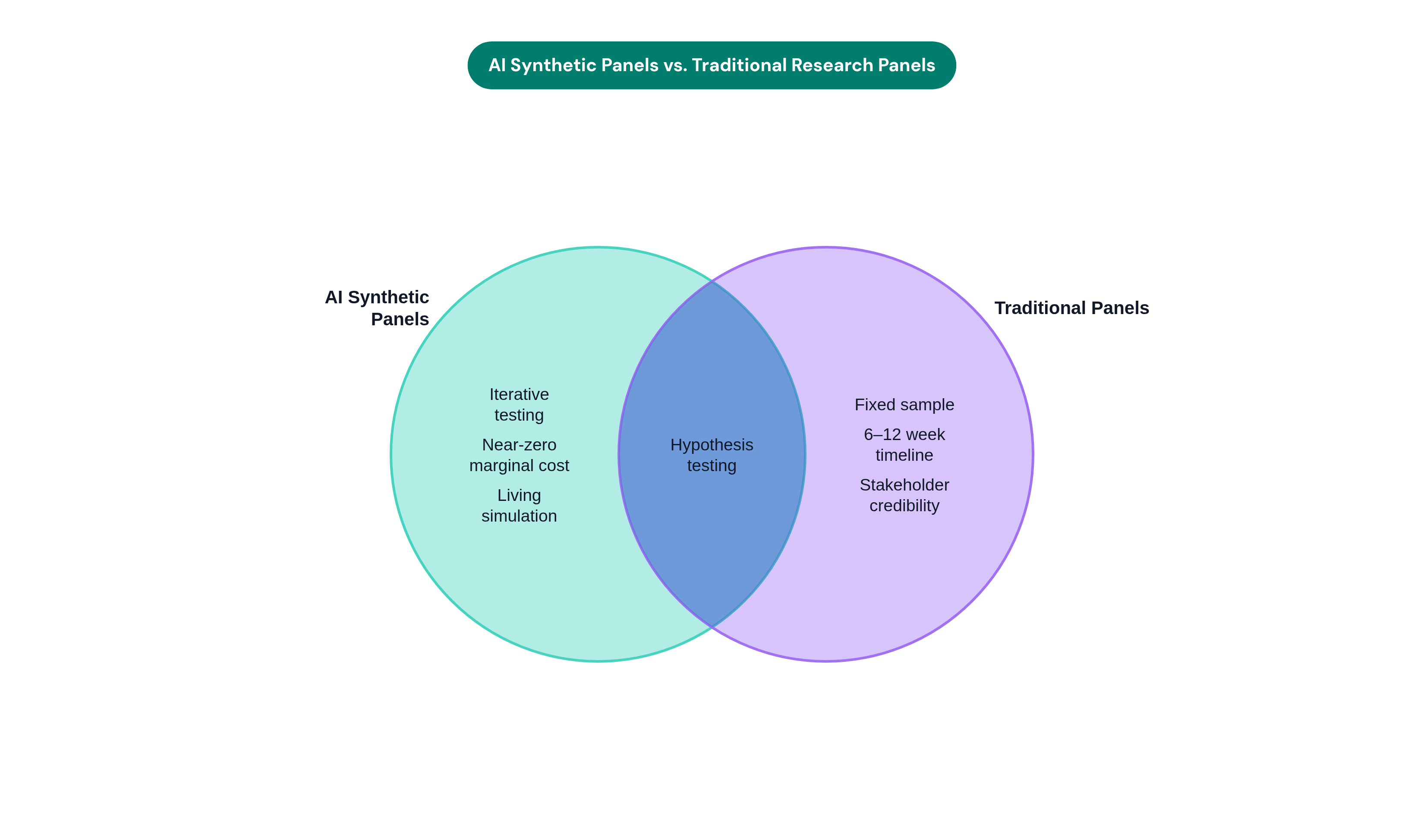
The path forward is a hybrid standard: synthetic panels for speed, hypothesis generation, and sub-population exploration; human panels for validation and stakeholder credibility. That combination is not a compromise. It is a more rigorous approach than either method alone. The either-or debate — synthetic versus real — distracts from the actual question: how to build a segmentation process that is fast enough to be useful and validated enough to be trusted.