When Fast Research Is Risky
Skipping rigor shortcuts saves time now but costs money later in wrong decisions.

Fast research isn't the problem. Research that trades away the wrong things to get fast, that's the problem. Balancing moving quickly with moving slowly is the real challenge. It's which trade-offs are safe to make and which ones quietly wreck the decision three months downstream.
Tech companies cut roughly 152,922 jobs in 2024 and another 122,549 in 2025, per Layoffs.fyi, with UX research teams at Meta, Amazon, Microsoft, and Google absorbing notable cuts. Meanwhile 66% of organizations reported rising demand for research in 2026, according to Maze's Future of User Research Report. More requests, fewer hands. That's not a math problem teams can solve by working harder. Companies didn't decide they needed less research. They decided to do the same amount with fewer people, and speed stopped being a strategic choice. It became a survival tactic. That context explains the shortcuts. It doesn't make them safe.
What "rigor" actually means in a fast-moving research workflow
Rigor gets confused with slowness constantly, and that confusion costs teams real money. Rigor has four separable properties. There is a clear objective, a sample that represents the right population, outputs checked against reality, and findings someone can actually act on.
Each piece can survive or die on its own. Under speed pressure, they die in a predictable order.
Scope goes first. Pragmatic Institute's guide to AI market research names defining the objective, before picking any tool, as a critical first step in the process. It's also the first step teams skip when they're rushing, because opening a tool feels like progress and writing a clear question does not.
Validation goes second. That's the check on whether an output reflects what's actually happening, not what someone assumed going in. Skip it, and a wrong assumption just gets a fresh coat of data on top of it.
Sample breadth goes third. Under time pressure, teams reach for whoever answers fastest, not whoever the decision actually affects.
None of this is really about speed versus polish, and that's the confusion worth killing. A fast, methodologically sound study beats a slow, beautifully designed one every time. Speed and rigor aren't opposite ends of one dial, they're two separate axes. The job is moving fast on one without sliding backward on the other.
The four shortcuts that actually create dangerous blind spots
Shortcut 1: Skipping the "why" and trusting the dashboard alone. Analytics show what users did. They don't show why. Optimize a metric without understanding the behavior driving it, and a team can improve a number while making the actual experience worse. Research on UX decision-making backs this up directly: teams that lean too hard on product analytics risk fixing the wrong thing, just faster than before.
Shortcut 2: Treating research as a launch gate instead of an ongoing habit. Heavy discovery at the start, one validation pass right before launch, nothing connecting the two. That gap is where assumptions quietly pile up. Each wrong assumption that goes undiscovered narrows the options a team has left by the time the problem finally surfaces.
Shortcut 3: Recruiting whoever's easiest instead of whoever's representative. A handful of vocal customers, an internal team, or a convenience panel pulled from an email list fills the gap instead. Fast to assemble, unrepresentative by construction. GreenBook's GRIT research (via neuroflash) puts "no market need" as the cause behind 42% of startup failures, a number that traces back, at least in part, to decisions built on signal that was never representative to begin with.
Shortcut 4: Taking AI output as fact instead of as a hypothesis to check. This is the shortcut that does the most damage, because it looks like rigor while it's actually the absence of it. Thomson Reuters found in 2025 that 73% of practitioners name inaccurate AI responses as their top concern, and Nearly half of enterprise AI users in 2024 admitted to making at least one major business call based on content that turned out to be hallucinated. Without a validation step, hallucination rates on financial tasks have been estimated to run 15 to 25%, and firms report multiple significant AI-driven errors per quarter, with single incidents costing anywhere from $50,000 to $2.1 million.
The clearest public example: Google's Bard confidently stated a fact that wasn't true, in a promotional video meant to show off the tool. Alphabet's market cap dropped by roughly $100 billion, the stock falling 8 to 9% almost immediately. The failure was never really the AI's invention. It was the missing human check between the output and the decision built on top of it.
Why synthetic panels are fast without being the shortcut people fear, and where they still require discipline
Synthetic panels get lumped in with the shortcuts above, and that's just wrong. A synthetic panel is an AI-generated persona built from real datasets: historical survey responses, behavioral data, customer reviews, public opinion trends. Not data invented out of thin air.
The speed difference is stark enough to change how a team plans a quarter. A concept-to-signal cycle that takes 4 to 8 weeks with a traditional panel can run in a matter of hours with a calibrated synthetic one, according to the 2025 GreenBook GRIT report.
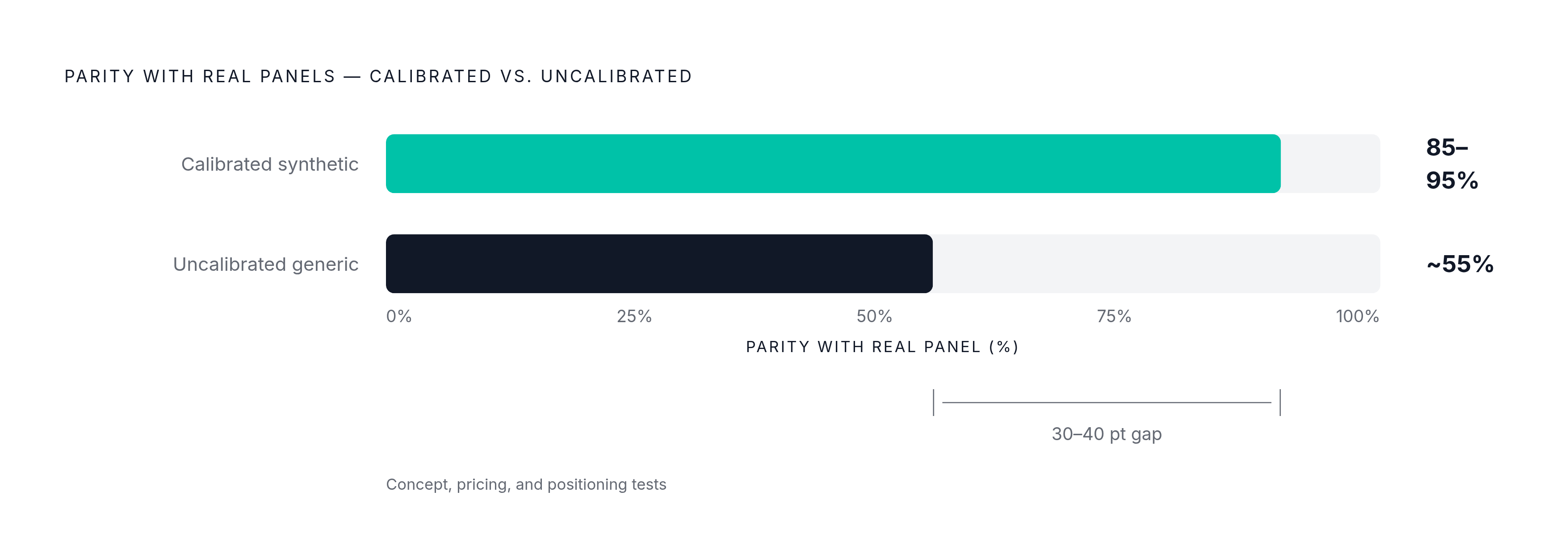
The accuracy case holds up too, within limits. A 2024 study from Stanford and Google DeepMind, running 1,052 participants, found that AI digital twins replicated individual survey answers with 85% accuracy and matched aggregate social behavior with 98% correlation. Strong numbers, but they hinge on one word: calibration. Calibrated synthetic panels reach 85 to 95% parity with real panels on concept, pricing, and positioning tests. Generic prompts run through an off-the-shelf model, with no calibration step, sit closer to 55%. That gap is the entire difference between a research tool and a guessing machine, and it's the detail most teams skip past when they buy the pitch.
Adoption backs the trend anyway. Qualtrics' 2025 Market Research Trends Report found 73% of market researchers have used synthetic responses at least once, a third within the past 30 days. GRIT's 2025 findings put user satisfaction among teams using synthetic data at 87%.
None of that removes the discipline requirement. Calibration against real human data has to happen before deployment, not after. Bayesian validation techniques, per research from PyMC Labs, can measure the uncertainty in a synthetic output and flag when it's drifting from expected patterns. Outputs still need benchmarking against known market data or prior experimental results. And synthetic panels still don't belong in high-stakes, genuinely novel, or emotionally loaded contexts, situations where the behavioral pattern in question simply isn't in the training data yet.
There's a less obvious argument for synthetic panels too, one that has nothing to do with convenience. Recruiting and managing a representative human sample eats up a large share of a project's time. Response rates keep declining. GDPR and CCPA compliance keeps getting messier. Panel fatigue is a real, structural problem, and synthetic panels answer it for principled reasons, not lazy ones.
What the AI customer service failure rate teaches research teams about trust without verification
Qualtrics' 2026 Consumer Experience Trends Report, based on more than 20,000 consumers surveyed across 14 countries in Q3 2025, found that nearly one in five people who used AI for customer service got nothing useful out of it. That's a failure rate almost four times higher than for AI use generally. And a substantial share of AI-powered customer service deployments got pulled back or reworked entirely because of reliability failures, failures that earlier validation might have surfaced before launch.
Air Canada's chatbot is the case everyone points to, and for good reason. It quoted a customer an incorrect fare, and the airline was ordered to pay the passenger more than US$800. The legal fallout and the reputational hit both dwarfed whatever a basic validation check would have cost.
The pattern in both cases is identical. Speed was the goal, validation got treated as optional, and the resulting error became something the customer had to deal with directly. Research teams face the same failure mode, just with a longer fuse. An unvalidated AI-generated insight that feeds into a pricing call, a feature cut, or a market-entry decision creates the exact same error. It just doesn't surface at a customer touchpoint. It surfaces months later, when reversing the decision costs far more than checking it would have.
Trust erodes fast once this happens. Qualtrics' 2026 report found 53% of consumers now name misuse of personal data as their top concern when a company automates interactions with AI. Once broken, that kind of trust doesn't come back through a policy update, it takes structural change. Speed saves time on the front end of a decision. An unvalidated output that turns out wrong spends that saved time back, with interest, on the back end.
The process changes that let teams move fast without sacrificing validity
Fix the objective before touching the tool. Pragmatic Institute's guide is specific here. The goal, the exact research questions, the boundaries of scope, and the method all get defined before any AI or synthetic tool opens. A vague question fed into a fast tool produces a fast answer that's still wrong. Speed was gained. Insight wasn't.
Match the method to how reversible the decision is. A copy variant test or an early-stage feature prioritization call can tolerate a lighter, faster method, because getting it wrong costs little to fix. A pricing architecture change, a market-entry decision, a major product pivot, none of those should skip validated, human-grounded research, no matter how tight the deadline feels.
Use synthetic panels for scale, real respondents for the anchor. Run calibrated synthetic panels for fast concept screening and iteration, then confirm with a real-respondent benchmark study before committing real resources. Platforms offering verified human panels across multiple markets remove the false choice between speed and a representative sample, since instant access replaces weeks of recruiting. AI-moderated interviews that actually probe and follow up, rather than static survey forms, generate richer qualitative signal too: research suggests it can generate significantly more insightful responses. Depth doesn't have to be the trade-off for speed.
Build validation in parallel, not as a gate at the end. Run the real-respondent benchmark study while the synthetic exploration is still happening, instead of waiting until the end to check the work. McKinsey's State of AI survey found organizations now actively manage an average of four AI-related risks, up from two in 2022. The organizations actually maturing in their AI use are the ones building the safeguard into the process, not bolting it on afterward.
Make research continuous instead of a one-off event. A behavioral model of a target audience, built once, runs against new decisions indefinitely. That turns a single research investment into something closer to permanent infrastructure, and it closes the gap between discovery and launch where assumption-driven decisions otherwise pile up unchecked.
How to recognize when your team is moving fast in the right way
Fast research that keeps its rigor intact looks a specific way, and the markers are easy to check. The objective got written down before any tool opened. The sample matches the population the decision will actually affect, not whoever was easiest to reach on short notice. Every AI output got checked against at least one real-world data point before it informed anything. The method's weight matched the stakes: light for reversible calls, heavy for the ones that are hard to undo. Research happens continuously between launch gates, not only at them.
Fast research that's quietly traded away its validity has its own tells. The question got defined after the data already came back. The sample is whoever answered a Slack message or clicked a convenience panel invite. The AI output got treated as a finding instead of a hypothesis that still needed checking. And the last real research study happened back at the start of the project, with nothing since.
Faster research without sacrificing rigor means research that earns the speed it's claiming, not research that borrows against it. Research via neuroflash found that 95% of new consumer products miss their launch targets, a number that already has the cost of moving fast without rigor baked into it. Teams that build the infrastructure for continuous, validated, synthetic-plus-human insight spend far less time reversing bad calls than teams that skip validation just to ship on schedule. The teams actually winning on speed worked out how to keep validity in the loop. They didn't cut it out to save a week.
Sources
- AI-Powered Customer Service Fails at Four Times the Rate of Other Tasks
- Harnessing AI for Market Research: A Guide to Best Practices and Pitfalls | Pragmatic Institute
- The State of AI: Global Survey 2026 | McKinsey
- journals.sagepub.com
- The 2026 State of Customer Research Hiring: Why Teams Cut Researchers and Bought AI
- pymc-labs.com