Pre-Commitment Consumer Testing Frameworks
Catch product failures before tooling costs by testing concepts with real consumers first.

Somewhere between 70% and 80% of new consumer products fail in their first year. That number has a recurring cause behind it: teams commit resources before testing whether real people wanted, understood, or would pay for what got built.
That gap has a name in the research world: pre-commitment testing. Most teams skip it not because they're lazy, but because their process never builds in a checkpoint that forces the question before the money's already spent. Closing that gap costs time and budget upfront. It costs far less than finding out after production is paid for and the launch date is locked.
What pre-commitment consumer testing actually is, and what it is not
Pre-commitment testing means putting an idea, a piece of messaging, a package design, a feature, or a price in front of target consumers before spending real money on production or launch. The word "pre-commitment" is doing the actual work in that sentence: the test has to happen while the decision can still be reversed cheaply, before the tooling is ordered, before the ad budget is booked.
It is not a post-launch survey. Those measure what already happened, useful for plenty of things, useless for deciding whether to launch in the first place. And it's not five people in a conference room voting on which concept they personally like best. Expert opinion is not consumer judgment, no matter how senior the experts are.
Here's where most teams get it wrong: they treat this as one gate that happens once, right before launch, then never again. That wastes most of the value. The teams that get the most out of this kind of testing run it as a loop through the whole development process, not a one-time toll booth.
One thing separates useful tests from useless ones: what you actually ask. "Do you like this idea?" is close to worthless. People are polite, and approval ratings run high whether or not anyone would actually buy the thing. Better questions probe behavior: would you seek this out, would you pay for it, would you switch away from what you use now. Those are harder to answer with a friendly shrug.
Who answers matters just as much. Testing only with a brand's existing fans gets you exactly the flattering feedback you'd expect. Skeptical audiences, or people outside the category entirely, tell you whether a concept can actually break into new territory, which is usually the whole point of launching something new.
In a standard product development sequence, pre-commitment testing lives at the concept-testing gate. That's the point right before any serious build cost gets locked in. Miss that window, and every fix afterward costs more.
The four framework types and when each one applies
Frameworks aren't interchangeable tools you grab at random. The question that always comes first is what decision needs to get less risky, and how hard would it be to undo if the answer's wrong. Four categories cover most of the ground, and picking the wrong one wastes the whole exercise.
Concept testing belongs at the earliest stage, before a prototype or a production line exists. Its job isn't measuring approval, it's figuring out which concepts resonate, why, and with which audience segments. It earns its keep when there are multiple directions on the table and only enough runway to chase one, or when the concept targets a segment the team hasn't sold to before. The output is a ranked list of concepts along with the reasons behind the ranking.
Pricing research usually runs in two stages, using two methods that ask different questions and shouldn't get treated as interchangeable. The Van Westendorp Price Sensitivity Meter asks four open-ended questions (too cheap, good deal, expensive, too expensive) to map an acceptable price range and find where perceived value peaks and resistance drops. Gabor-Granger works differently: it shows people specific price points and measures willingness to buy at each one, producing a demand curve.
These aren't competing methods. They're sequential ones, and mixing up the order wastes both. In practice, the two methods routinely produce figures that look mismatched but aren't in conflict: one maps perceived fairness, the other maps purchase intent at fixed prices. Gabor-Granger has a known blind spot, though. It ignores competitors, and respondents tend to understate what they'd really pay. Straight "how much would you pay" questions are notoriously unreliable for the same reason, so most practitioners avoid asking them directly.
UX and usability testing kicks in once there's a prototype, before the design or interface gets locked. People liking how something looks matters less than whether they can finish the task in front of them. Task-based testing quantifies completion rates and where people drop off. A/B testing compares design variants on a metric like conversion, though it can't tell you why one variant won without qualitative follow-up. Session recordings capture real interaction patterns, and AI-assisted tagging now makes it practical to review those recordings at scale. Testing across countries raises the stakes further: language differences and local cultural norms can make feedback easy to misread if nobody accounts for them.
Market entry simulation applies before committing to a new geography, channel, or customer segment that requires serious investment. It models demand, price tolerance, competitor behavior, and channel fit using real signals: customer demand data, competitive activity like branded search spikes or shifts in discounting, macroeconomic indicators, logistics costs, regulation, digital engagement. It's most valuable when the decision is expensive and hard to walk back, such as a new regional footprint, a distribution deal, or a category extension into unfamiliar territory.
How the speed of research became a framework variable in its own right
Depth and speed used to be locked in a tradeoff that decided which frameworks teams could actually afford to run. A rich qualitative concept test could eat 4 to 8 weeks. Pricing studies ran on similar timelines. Most of that time wasn't spent analyzing data, it was spent recruiting a representative sample, which historically eats up roughly 60% of a traditional research project's schedule.
When a framework takes two months to return an answer and the business decision can't wait two months, the framework doesn't get skipped because it's flawed. It gets skipped because the clock ran out first.
That's changing fast. According to the GreenBook GRIT Report, speed is a central driver behind teams adopting AI-accelerated research methods. Concept-to-signal cycles that used to take 4 to 8 weeks with traditional panels can return results in hours using calibrated synthetic audiences. That value compounds once testing runs fast enough to actually inform a decision before it's locked in, rather than confirming one after the fact.
GreenBook also found that 62% of market researchers used multi-modal research methods in 2024, up from 47% in 2022. Blended approaches aren't an emerging trend anymore, they're already the default. "We don't have time to test this" used to be the most common excuse for skipping pre-commitment testing. It's losing ground fast, and it's getting harder to say with a straight face.
Where synthetic panels fit into the pre-commitment stack, and where they don't
Synthetic panels are AI-generated respondents built from historical survey data, customer reviews, behavioral data, and public opinion trends. They're not fabricated out of nowhere, they're built to mirror how real market segments actually behave. What makes them genuinely useful for pre-commitment testing is their ability to react to products, prices, or positioning that don't exist yet: scenarios where recruiting real humans is hard simply because there's nothing real to show them.
Calibration is the whole ballgame here, and skipping it is the mistake to avoid. A 2024 study from Stanford and Google DeepMind, covering 1,052 participants, found that AI digital twins replicated human survey responses with 85% accuracy and matched social behavior patterns with 98% correlation. Calibrated synthetic panels generally land in the 85% to 95% range for parity with real panels on concept, pricing, and positioning tests. Generic, uncalibrated GenAI prompts, by contrast, sit closer to 55%, barely better than a coin flip on some measures. The underlying technology isn't what separates a useful panel from a useless one. Calibration is.
Adoption is already mainstream. Qualtrics' 2025 Market Research Trends Report found 73% of market researchers have used synthetic responses at least once, and roughly a third had used them within the past 30 days. The GreenBook GRIT findings put user satisfaction at 87% among research teams actively using synthetic data.
Synthetic panels earn their place in specific spots: screening a wide field of concepts fast before committing human-panel budget to the finalists, exploring pricing ranges before running a formal Van Westendorp or Gabor-Granger study with live respondents, and simulating market entry in regions where recruiting real people takes weeks and local behavioral data already exists in the training set.
They fit poorly in usability testing, where the real signal is hesitation: a confused pause, a wrong click corrected halfway through. Real people, recorded on video, still catch what no transcript captures. The same caution applies to high-stakes final validation before an irreversible commitment. Calibrated synthetic panels narrow the field of options. Real respondents confirm the final call, and that division of labor shouldn't get blurred just because the synthetic option is faster.
The industry still argues over platforms racing toward speed with synthetic data versus platforms insisting real participants are the only credible foundation. That framing misses the point: it's not a contest with one winner. What actually closes the gap is Bayesian validation, which measures uncertainty and produces confidence intervals around synthetic outputs, so a result comes with a sense of how much to trust it rather than a flat, unqualified number.
The hybrid model: combining synthetic and human respondents at each stage
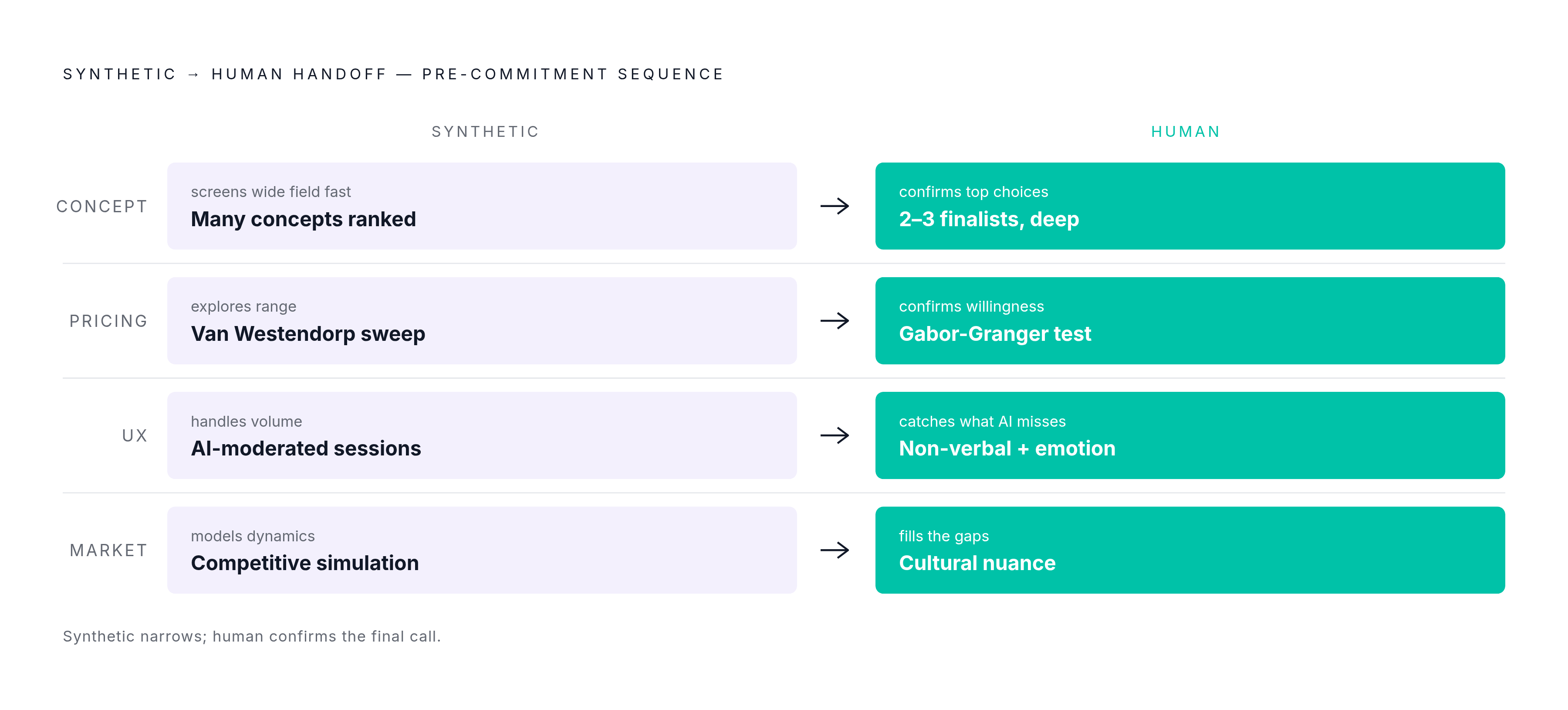
Research published in the Journal of Consumer Research in 2025 by Arora and colleagues makes a straightforward case: using large language models as research collaborators works because humans and LLMs bring complementary skills, not because one replaces the other. Separate 2025 research from Huang and Rust found that folding in 20% to 30% human insight, marketer judgment, brand nuance, specific knowledge of the target audience, helps avoid what they call the "average trap," where AI-generated analysis drifts toward generic patterns and loses whatever made a specific audience distinctive.
The 2024 GRIT Report found 61% of insights professionals already use AI or predictive analytics in their work. So the real question is how to bring AI into the process. It's how to sequence human judgment and synthetic speed so each does what it's actually good at, and getting that sequence backwards is where most hybrid efforts go wrong.
A practical sequence looks something like this across the four framework types:
- Concept testing: synthetic panels screen a wide field of ideas fast, human panels go deep on the two or three finalists that survive
- Pricing: synthetic audiences explore the Van Westendorp range quickly, human respondents confirm actual willingness to pay at specific Gabor-Granger price points
- UX testing: AI-moderated sessions and pattern detection handle volume, human observation catches the non-verbal and emotional signals AI still misses
- Market entry: AI simulation models competitive dynamics and demand, in-market human research fills in cultural and behavioral nuance no dataset fully captures
Synthetic panels aren't static either. They can get retrained as new data comes in, reflecting shifts in culture and preference over time, which turns what used to be a one-off study into something closer to a living simulation that sharpens with each real touchpoint. Skip the retraining, and a synthetic panel calibrated on last year's behavior starts quietly drifting from this year's market without anyone noticing until the numbers stop lining up.
Making pre-commitment testing continuous rather than episodic
Most organizations still treat pre-commitment testing as a project. It gets commissioned before a specific launch, runs its course, then sits idle until the next launch comes along. In the gap between the two, assumptions pile up unchecked, and nobody notices until the numbers come in low.
Build a standing behavioral model of the target audience instead. Do it once, from real respondents, calibrated against known benchmarks, then run any new decision against it. A pricing change, a new feature, a market entry, a shift in messaging: none of it requires starting recruitment from scratch. That changes the underlying economics. Instead of paying a one-time cost for every single decision, a business builds one foundational audience model that gets more valuable every time another decision runs through it.
McKinsey's State of AI 2025 survey found that 88% of organizations now regularly use AI in at least one business function, up from 78% the year before. Most large organizations already have the infrastructure to run continuous testing. The gap is that it's still used mostly after launch instead of before commitment. The internal metrics are shifting too: "moderator hours per study" is fading as a way research teams measure capacity, replaced by something closer to "studies per researcher," with AI moderation doing the heavy lifting underneath. More studies can run in parallel without adding a single headcount.
None of this works responsibly without regular benchmarking of synthetic outputs against real human data, and Bayesian validation is what supplies the confidence intervals that make acting on synthetic results reasonable instead of a leap of faith. Platforms built to support both verified human panels and calibrated synthetic agents, with access to global panels, make this continuous model something a lean team can actually run without hiring a full research department to do it.
The real test of whether a team has closed the validation gap is whether it goes beyond a slide about being "customer-centric." It's whether a study ran before the last product launch and produced evidence the team acted on, and whether anyone can pull up a live model of the target audience and get an answer before the next big decision gets made, not after.