Same-Day Consumer Insight Workflows
Speed in research requires strict discipline, not just faster tools.

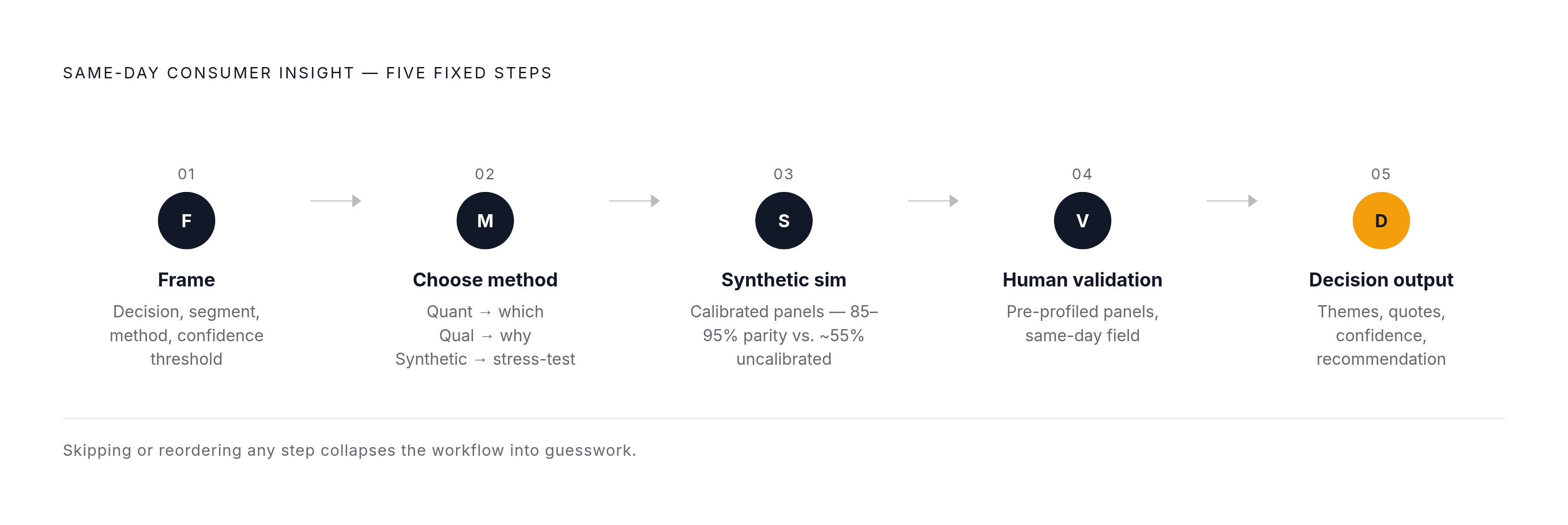
Same-day consumer insight is a workflow, not a shortcut. Treat it like a speed hack, and a team ends up with fast answers to the wrong question, delivered with the same false confidence a six-week study would carry. The sequence is fixed: frame the question tight, pick the method that fits the clock, run synthetic simulation before a dollar goes toward human fieldwork, then validate with real people only where it actually counts. Skip a step to save an afternoon, and the whole workflow collapses back into guesswork with better formatting.
Traditional qualitative research runs 3 to 5 weeks and costs $4,000 to $12,000 per 90-minute focus group session. Roughly 60% of that calendar goes to recruiting and managing a sample, not to answering hard questions. The delay is logistics, not intellectual difficulty: finding people, scheduling people, waiting on people. That's the fixable part. It's also the only part worth fixing.
Three of the top five market research firms today are technology companies, not research shops that bolted on software after the fact. That's the tell. The supply chain underneath consumer research already changed shape, whether or not every team noticed. What follows is how to use that shift without cutting the corners that actually matter, and which corners those are.
What "same-day" actually means as a research standard and where it applies
Same-day speed doesn't fit every question. Treating it as a universal upgrade is the biggest mistake in this whole space, and it's an easy one to make because speed feels like progress regardless of what it's attached to. Fast answers to the wrong problem still get presented with six-week confidence. That's how bad decisions get made quickly instead of slowly, which is worse, not better.
Some decisions are built for compression: concept screening before development budget gets committed, pricing sensitivity checks, message testing ahead of a launch, feature prioritization for sprint planning, an early read on whether a market's worth entering at all. These have a clear yes/no or rank-order shape, so they don't need six weeks of fieldwork to get a directional answer. Asking for six weeks anyway isn't rigor. It's institutional habit dressed up as caution. If a leadership team can't say what decision the research will drive, no amount of speed fixes that problem.
Other work genuinely doesn't compress, and no tooling changes that math. Longitudinal brand tracking needs time to pass, by definition. Ethnographic research needs sustained observation, not a snapshot taken once and generalized. Regulatory-grade clinical studies run on timelines set by law, not convenience. Anyone selling same-day speed as a substitute for a phase-three trial is selling something false, and worth walking away from immediately.
Coca-Cola's innovation work with Dig Insights shows what a compressed cycle looks like when it's done right. Day one reviewed existing category research. Day two generated new ready-to-drink coffee concepts and tested them before the next session. By day three, stakeholders walked into a workshop with region-specific findings already in hand. Three days, a real business decision, no shortcuts on the thinking, just a different allocation of time. Knowing which class of decision sits in front of a team is step zero, before anyone opens a tool.
Step one: framing the question so it can be answered in hours, not weeks
Slow research is rarely a slow-tools problem. It's a badly scoped question that forces a redesign halfway through fielding, once someone realizes the instrument can't answer what leadership actually wants to know. That redesign is where the weeks go, and it's avoidable almost every time, which makes it the most frustrating kind of delay.
A question ready for same-day treatment has three things going for it. It's specific enough to produce a decision, not just a data point. It maps cleanly onto a known method (a concept test, a MaxDiff exercise, a usability session, an open-ended interview) instead of demanding a custom instrument built from scratch. And it names the audience segment tightly enough to screen for without burning the morning on qualification.
The failure modes are worth naming directly, because they repeat across nearly every stalled project. Asking "what do customers want?" instead of "which of these three features do customers in segment X value most?" Mixing exploratory goals and confirmatory goals into a single instrument, so it ends up doing neither job well. Leaving the audience definition fuzzy, which turns screener design into its own side project nobody budgeted time for.
Tools like Quantilope's quinn can turn a plain-language prompt into a full survey flow, including advanced methods like MaxDiff and Conjoint. But the prompt only produces something usable if the framing behind it holds up, and no drafting tool fixes a bad question. Sloppy framing in, sloppy instrument out, no matter how sharp the tool is on the output side.
One template does most of the work here: state the decision at stake, name the segment, name the method, set the confidence threshold needed to act. Miss any one of those four and the question isn't field-ready yet. Teams that write this down before opening any tool move faster than teams that jump straight to instrument design. The gap between the two isn't small, and it shows up every single time.
Step two: choosing the right method for the question and the time budget
Three broad categories of AI research tool exist right now: qual-at-scale interview platforms, automated quantitative survey builders, and feedback synthesis tools. They answer different questions, full stop. Treating them as interchangeable is the single most common mistake in this whole process. Picking a tool because a team already has a login for it, instead of because the question demands that method, is how fast research produces useless output dressed up as insight.
Qual-at-scale platforms like Outset.ai and Perspective AI are built for the "why" behind a preference: the concern nobody thought to screen for, the way a message lands emotionally rather than logically. The AI probes in real time, asks unscripted follow-ups, and synthesizes across thousands of simultaneous sessions. Outset.ai stays built for last-minute research needs, so fielding latency runs close to zero. Listen Labs has compressed qualitative timelines that used to run 4 to 6 weeks down to under 24 hours. Anthropic ran more than 300 user interviews in 48 hours on the platform and surfaced churn drivers at a pace its prior process couldn't match.
Automated quantitative tools, like Quantilope's quinn, handle concept screening, pricing sensitivity, feature prioritization, and brand tracking inputs. Once the question is framed well, quinn generates the survey flow, advanced methods included, mostly on its own.
Synthetic consumer simulation, covered next, is for early screening before fieldwork starts, for stress-testing assumptions, for running more scenarios than any real panel could cover in a single day. It doesn't replace human validation. It's a filter that runs before human validation, and getting that order backward wastes the entire advantage speed was supposed to buy.
Sending a quantitative survey when the real question needs qualitative depth produces data fast, sure, but it can't answer the decision either way it comes back. Speed without the right method attached isn't a workflow. It's noise that arrived quickly. Pick by the question, not the login: need to know which option wins, use quant. Need to know why, use AI-moderated qual. Need to stress-test an assumption before spending on either, run synthetic simulation first.
Step three: using synthetic consumer simulation to front-load the insight cycle
Synthetic panels are AI-generated respondents built from real-world data: historical survey responses, customer reviews, behavioral data, public opinion trends. Nothing here gets invented out of thin air. Panels get calibrated to specific profiles (price sensitivity, brand loyalty, sustainability attitudes) so a team gets a usable early read before a single human respondent is recruited.
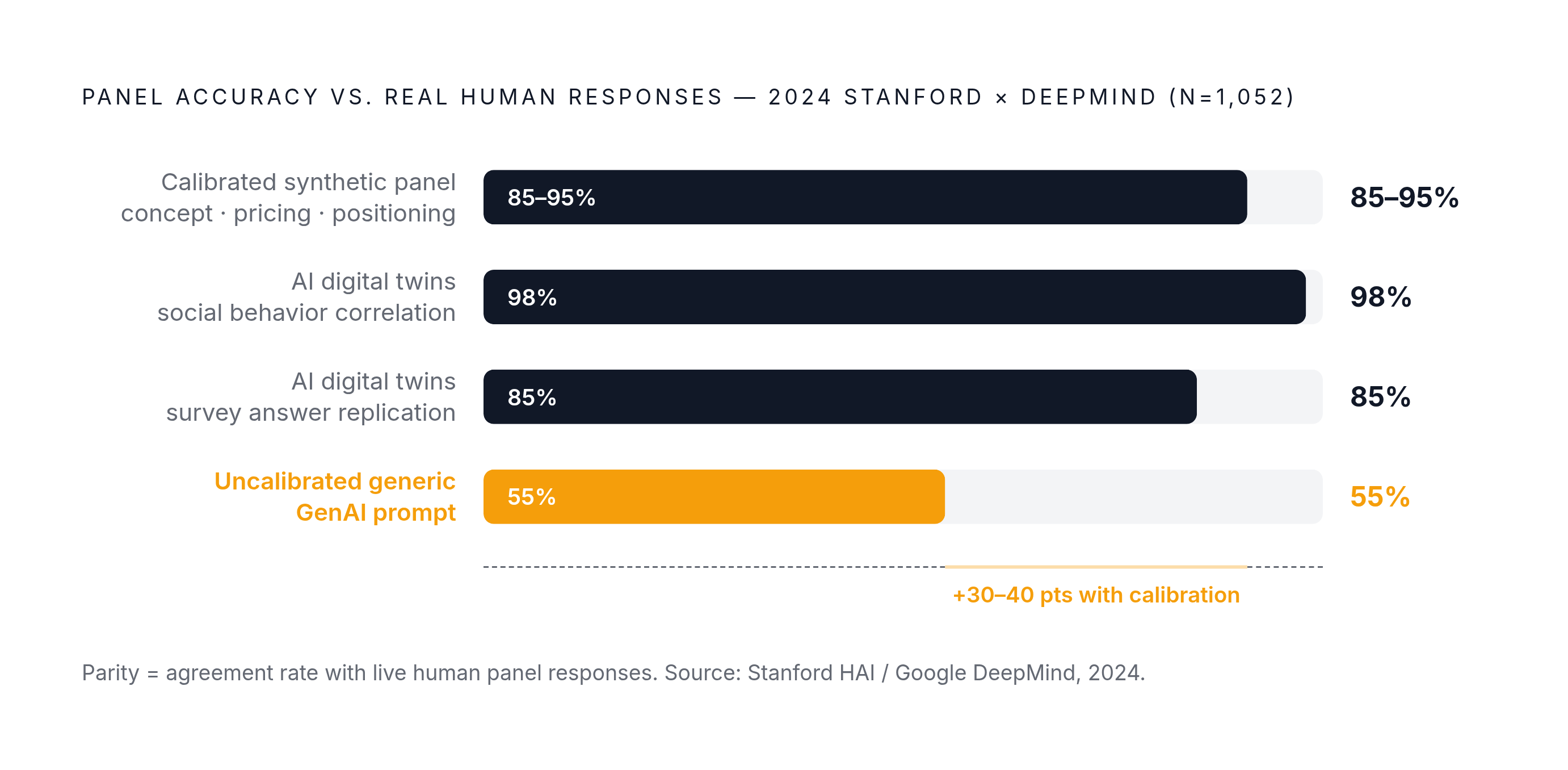
The accuracy question deserves a straight answer, because skepticism here is fair and often earned. A 2024 study from Stanford and Google DeepMind, with 1,052 participants, found AI digital twins replicated human survey answers with 85% accuracy and matched social behavior patterns with 98% correlation. Calibrated synthetic panels hit 85 to 95% parity with real panels on concept, pricing, and positioning tests. Generic, uncalibrated GenAI prompts land closer to 55%. That's not a rounding error. It's the entire gap that makes calibration mandatory, not optional, and treating it as optional is exactly where teams get burned.
Here's the specific failure mode: an uncalibrated model used as a stand-in for consumers piles up responses in the middle of the scale and avoids the extremes, a pattern real human respondents don't show. Skip calibration, and the synthetic data flattens out exactly where a real market has sharp edges, defeating the entire point of running the panel in the first place. Calibration solves it. Skipping the step to save time is the actual risk here, not the method itself, and teams that blame synthetic panels for bad reads are usually the ones that skipped this part.
The workflow logic follows directly from that math. Run synthetic simulation first, screen out the weak concepts, then field human studies only against whatever survives that cut. That sequence is the actual mechanism behind compressing a 4-to-8-week cycle into hours, not a marketing phrase attached to the process after the fact. Synthetic panels run 24/7, can represent almost any demographic or psychographic slice, and return results in minutes. The recruitment bottleneck, the one eating 60% of a traditional project's timeline, disappears at this stage entirely, and cost drops right along with it.
Step four: fielding human respondent studies fast when validation requires real people
Synthetic simulation narrows the field to real candidates. Human studies confirm the signal and add depth simulation can't reach on its own. Neither replaces the other, and they run in sequence, never as substitutes for each other. Skipping the human step to save a day is the wrong trade almost every time a real budget decision is on the line. It's the corner speed-obsessed teams cut when they shouldn't.
Recruitment remains the biggest time cost in traditional research, but pre-profiled, pre-verified panels remove most of it. Work that used to take weeks to recruit can get staffed in a single day, using agile panel access built on consumers already profiled before the study starts.
Speed at scale only holds up if panel quality holds up alongside it, and this is where a lot of "fast" research quietly breaks. The risks are specific: professional survey-takers who answer everything regardless of fit, synthetic responses leaking into a human panel by mistake, repeat respondents skewing results as sample size grows. The protections worth checking for are just as specific: real-time behavioral monitoring during sessions, hard caps on how often one person can join a study, matching based on behavior and intent rather than self-reported demographics alone. Listen Labs' Quality Guard runs continuous behavioral monitoring during AI-moderated video interviews, with participant comfort in those sessions measured at 92%.
P&G validated product claims with more than 250 male consumers on a compressed timeline. Skims validated campaign direction overnight with thousands of high-income buyers. Large-sample human validation is entirely same-day compatible, provided the panel infrastructure underneath it is built for that speed rather than retrofitted onto it. Emotional intelligence layers, reading tone of voice, word choice, micro-expressions, surface things a transcript or a star rating never will. That matters most when the decision hinges on how people feel rather than what they claim to think. On the back end, AI tools that turn raw interview footage into a finished report in a fraction of the time close out the last manual delay left in the chain.
Step five: synthesizing findings into a decision-ready output before the day ends
Fielding a study in two hours means nothing if the analysis takes three days afterward. That's the cost most teams don't see coming until they've already paid it. Manual analysis of qualitative data is slow, subjective, and prone to confirmation bias: the researcher finding what they expected to find, because that's what people do under time pressure whether they mean to or not.
AI synthesis tools now move from raw transcripts to structured findings (themes, emotional signals, ranked results) in minutes instead of days. A genuinely decision-ready output has a specific shape, and every report should get held to this bar. It answers the original question from step one directly, not adjacent to it. It shows the evidence behind that answer: verbatim quotes, ranked scores, behavioral signals, each one traceable to a specific moment in the data rather than summarized into a vague impression. It states a confidence level and names what's still unresolved instead of faking certainty it doesn't have. And it closes with a recommendation, or a short set of options the team can act on immediately, not a pile of observations someone else has to turn into a decision later.
Traceability is what makes an output presentable to a room full of stakeholders who weren't in the room for fielding. Every finding needs a timestamp, a verbatim quote, and the reasoning connecting the two, not a black-box summary asking people to take the conclusion on faith. AI-powered research tools now get used across marketing, product, sales, customer success, and leadership, not just by research specialists, so the output has to be readable by someone with zero research training. Back to Coca-Cola: by day three, stakeholders had results collected only hours earlier, because synthesis was built into the workflow from the start rather than bolted on at the end.
How to build the workflow as a repeatable team capability, not a one-time sprint
A same-day study run once is a tactic. It turns into something durable only when the audience model behind it gets reused instead of thrown away the moment the deck gets presented.
Build a behavioral model of a target audience once, and a team can run that synthetic panel against any future decision, indefinitely, without paying the recruitment cost again. Research turns into a standing asset instead of a line-item cost paid out fresh on every project. Synthetic consumers can evolve too: as new data comes in, models get retrained to track shifts in culture, preference, and market conditions, closer to a living simulation of the market than a fixed dataset quietly aging out of relevance.
Research also isn't confined to specialists anymore, and treating it that way is the second big mistake teams make once they've fixed their framing problem. Cross-functional teams now run their own studies directly, and the workflow described here is built to work without a dedicated research analyst standing between the question and the answer. A few conditions make that repeatable instead of accidental: a shared question-framing template any team can grab before opening a tool, a pre-configured synthetic panel calibrated to the company's core segments, standing access to a verified human panel for validation, and an agreed format for synthesis so findings land in a form decision-makers can use without translation.
The shift from occasional research pushes to continuous discovery builds organizational learning over time, since each study's audience model and findings accumulate instead of getting discarded after one meeting. That compounding effect is the actual payoff, not the speed of any single study.
The teams moving fastest aren't the ones with the flashiest tool stack. They're the ones that built the discipline first: tight question framing, correct method sequencing, synthetic screening ahead of human validation, and a synthesis process that turns fieldwork into a decision before the day is over.
Sources
- Faster, Smarter, Cheaper: AI Is Reinventing Market Research | Andreessen Horowitz
- How Gen AI Is Transforming Market Research | Columbia Business School
- Which AI Platforms Are Best for Consumer Insights?
- VTS-Guided AI Interaction Workflow for Qualitative Business Insights
- sloanreview.mit.edu
- uxpsychology.substack.com
- askrally.com
- symar.ai