Research Bottlenecks in Agile Product Teams
Agile teams make dozens of decisions per sprint, but research still moves on waterfall timelines.

Research bottlenecks in agile product teams don't come from a lack of headcount or budget. They come from an architecture problem: the research function was built for waterfall-era product cycles, where teams waited weeks for data before making a call. Agile flipped that sequence. Decisions now happen constantly, inside two-week sprints, but the research process underneath it never changed shape to match. Most teams are still trying to run a multi-week study inside a sprint window, and that math simply doesn't work.
How the mismatch plays out inside a sprint
A single sprint generates dozens of small decisions. Which feature gets scoped down, what the button copy says, how a flow handles an edge case, which trade-off gets prioritized when two features compete for the same two weeks. None of these wait for permission.
Research can only shape a sprint if it lands inside that sprint's window. Findings that show up a week after a decision got locked in aren't late, they're irrelevant, because the decision already happened and the team already moved on to the next one.
The ratio is the real problem: one researcher supporting twenty product team members, each making dozens of calls a quarter, is not a workload issue that better prioritization fixes. It's structural. No amount of triage software changes the fact that one person cannot generate evidence at the speed twenty people generate decisions.
So teams fall back on what's available: gut feel, deference to whoever argues loudest in the room, or shipping first and hoping the analytics dashboard flags a problem after launch. Each of those choices adds to what's become known as research debt, decisions made without evidence that eventually need to be revisited, usually after the cost of being wrong has already landed on a roadmap or a revenue line.
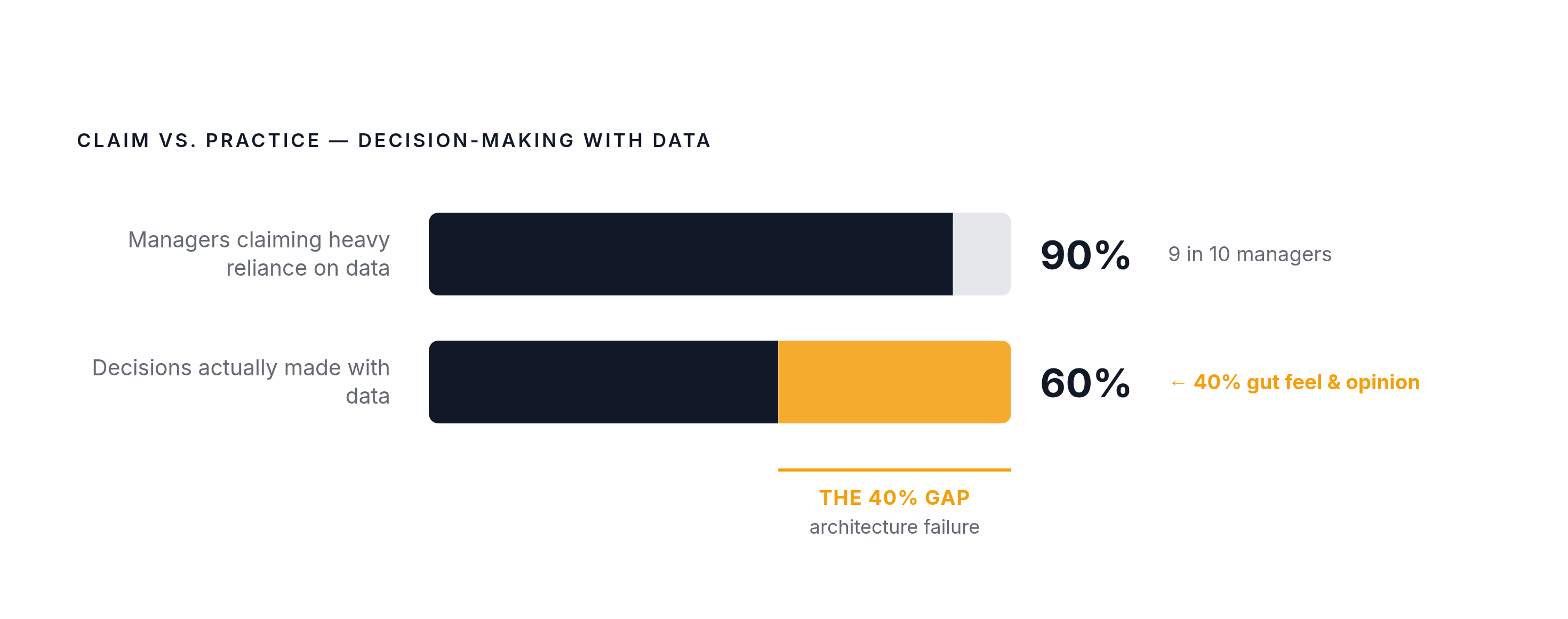
One survey result captures the gap cleanly: nine out of ten managers across product, innovation, marketing, and brand teams say they're heavily or totally reliant on consumer insight and data. Only three out of every five actual decisions get made with that data behind them. That two-fifths gap isn't a motivation problem, and it's worth being direct about that. Teams want the input. The system underneath them can't deliver it on the clock they're working on, so the gap gets filled with something else, usually opinion wearing the costume of a decision framework.
What agile teams are actually doing with AI to close the gap today
AI adoption inside research teams has climbed fast, and most teams now fold some form of it into their process: analyzing data, automating transcription, drafting study plans, generating interview questions.
All of that is useful. None of it touches the architecture, and this is the part most teams get wrong when they call it transformation. These are compression moves, taking a task that used to take a week and cutting it to a day. The workflow itself, intake request, vendor or team assigned, study run, findings delivered, stays exactly the same shape it always was. A faster version of a broken sequence is still a broken sequence.
The bigger opportunity sitting mostly untouched is using AI to read through qualitative material teams already have piled up but never get around to synthesizing: support tickets, app store reviews, feedback form text, past interview transcripts. That's a mountain of signal most teams sit on because manually coding it takes too long to be worth doing, so it just accumulates instead.
Lightful, a London-based company building tech for nonprofits, shows what happens when a team treats AI as part of the sprint rather than a side project. In 2023 the company put together a cross-functional "AI Squad" that worked in daily agile iterations and folded prompt design into its Scrum cycle as a deliberate part of the process, not an afterthought. The team built an AI Feedback tool, using GPT-4 partway through development, that gave nonprofit users three tailored suggestions with explanations every time they drafted a social post.
When a stronger model became available mid-build, the team swapped it in without disrupting their ongoing cadence. Because the cadence was already agile, upgrading the model was routine rather than a project. The lesson that mattered most: AI output is only as good as the prompt design behind it, and prompt design takes real domain knowledge. A generic prompt gets you a generic answer, every time, no matter how good the underlying model is.
That's the pattern across most early adopters right now. AI speeds up the analysis step. Research is still treated as something that happens in discrete bursts, one project at a time, so the architecture problem hasn't actually moved. Speed without a shape change is just a faster version of the same bottleneck.
Synthetic consumer panels as a structural answer, not a shortcut
Synthetic panels are groups of AI-generated virtual respondents, built from real data, historical survey answers, behavioral logs, customer reviews, public opinion trends, not made up out of thin air. A synthetic panel is a model trained on real human patterns, not a text generator improvising opinions on command, and that distinction is the whole ballgame.
What changes structurally is the wait. There's no recruiting phase, no scheduling sixty interviews across time zones, no waiting for a panel provider to fill a quota. The panel exists and answers instantly, against nearly any question a team can frame.
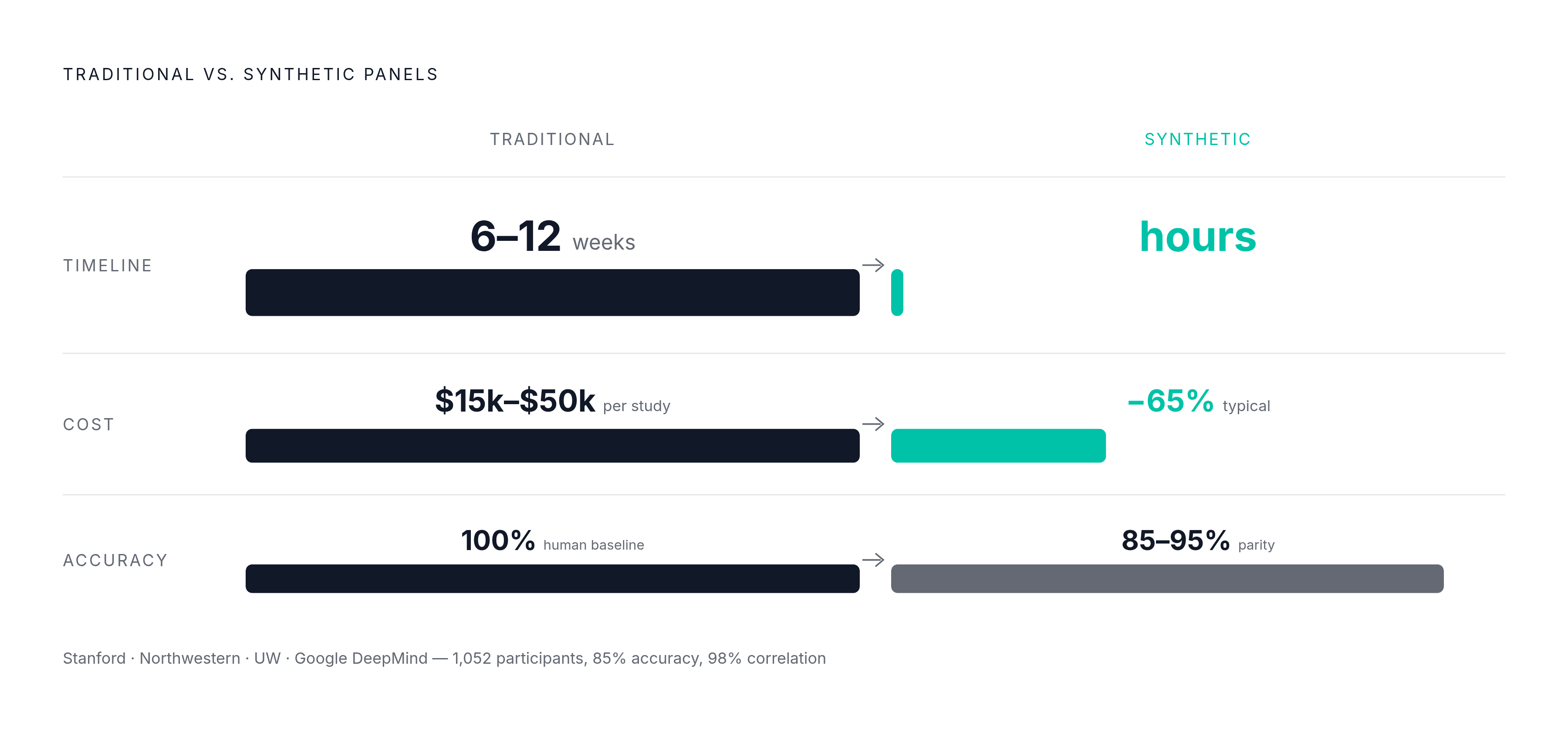
Where a traditional user study routinely takes six to twelve weeks, a calibrated synthetic panel can return signal in hours, according to the 2025 GreenBook GRIT report. A joint study from Stanford, Northwestern, University of Washington, and Google DeepMind researchers, testing 1,052 participants, found that AI-generated "digital twins" matched real human survey answers with 85% accuracy and lined up with real social behavior patterns at a 98% correlation.
Calibration is the part that makes or breaks this, and skipping it is the single biggest mistake a team can make here. Panels that go through proper calibration land in the 85 to 95% range for parity with real human panels on concept, pricing, and positioning tests. Generic, uncalibrated prompts sitting on top of a general-purpose model fall well short of that range, and treating those two setups as interchangeable is how a team ends up with confident, wrong data. Calibration is an essential step. It's the entire difference between a valid research tool and a guess dressed up as a chart.
Synthetic panels also do something traditional panels structurally cannot: model reactions to a product that doesn't exist yet, or a hypothetical price point, or a launch scenario nobody has lived through. Traditional panels can only tell you what people remember feeling about something that already happened. And because these models retrain as fresh data comes in, the panel gets sharper over time instead of going stale the moment a one-off study gets filed away and forgotten.
None of this replaces judgment. Treating an LLM's output as a stand-in for an actual human response without checking it is the failure mode worth naming directly. Bayesian validation techniques, which produce a confidence interval around a synthetic finding rather than a flat number, give teams a way to see how much to trust a given result, a level of rigor most traditional surveys never bothered to report in the first place.
The cost and access case for synthetic panels alongside human respondents
Traditional agency research runs $15,000 to $50,000 per study. At that price, only high-stakes decisions get research budget, and everything else runs on instinct by default, not by choice. That's a filter created by cost, and it quietly decides that most of the small, frequent calls making up daily product work never get tested at all.
In one 2025 industry survey, researchers said they'd favor synthetic data over human responses by 52% to 48%, with cost reduction cited as the specific driver. Separately, industry reporting has found companies adopting AI market research tools cutting research timelines by as much as 80% while trimming costs 60 to 70%.
Recruiting alone eats up more than 60% of a typical research project's timeline, before a single interview even gets analyzed. Add panel fatigue, falling response rates, and privacy rules like GDPR and CCPA tightening what data can even be collected, and the friction compounds fast. Synthetic panels sidestep all three at once: there's no recruitment step to fatigue, no response rate to decline, and no personal data to protect, because none got collected from a live person in that instance.
Geography used to be a gate too. Testing a concept with audiences in six countries meant six vendor relationships and six recruitment timelines running in parallel, each with its own delays. A synthetic panel calibrated on those markets removes that gate entirely.
None of this argues for replacing human respondents, and anyone pitching it that way is overselling the tool. Synthetic panels for frequent, lower-stakes directional questions. Human respondents for validation and for the moments where nuance, tone, and lived context actually decide the outcome. Some research infrastructure already reflects that split directly: platforms offering verified human panels at scale, some running past 30 million respondents across 45-plus countries, alongside synthetic AI agents, letting a team run both modes from one system instead of juggling separate vendor contracts for each.
What continuous research looks like when the architecture actually fits agile
Continuous discovery means research runs as a standing practice built into the product cycle, not a project that only starts once someone raises a hand and asks for it. The appeal is the ability to turn insight into a decision more often than a project-based model ever allowed.
Research work is spreading out across the team, and that shift is the real story here, not the tooling. Designers and product managers are increasingly running their own quick studies alongside dedicated researchers, rather than filing a request and waiting in an intake queue. One 2026 industry report on UX trends found that the share of organizations where research counts as essential to strategy at every level of the business nearly tripled in a year, moving from 8% in 2025 to 22% in 2026.
The way these organizations track success changes too. Instead of counting completed studies, they track decisions influenced, rework avoided, and whether velocity held steady while the research still got done.
A handful of methods fit naturally inside a sprint window. Guerrilla usability tests with three to five participants pulled together fast. Unmoderated remote sessions where participants work through tasks on their own time. Analytics review that mines behavior data the team already has sitting in a dashboard. Quick synthetic panel runs for directional pricing or concept questions.
PepsiCo's work on Cheetos shows the hybrid model at enterprise scale, and it's a cleaner example than most case studies get. Domain experts set the objectives, then AI ran extensive virtual trials to align product attributes more closely with consumer preferences, a combination that contributed to a 15% increase in market penetration. Human judgment picked the question worth asking. The machine handled the volume no human team could run manually.
The direction this is heading: UX testing built directly into CI/CD pipelines as an automatic checkpoint, the same way automated tests already gate code before it ships. Research stops being a separate department people request time from and starts acting like infrastructure running quietly in the background of every release.
The organizational conditions that determine whether faster research actually changes decisions
Faster research delivery doesn't help if the insight lands on the wrong desk at the wrong moment. Speed solves the timing problem only if the organization has a way to route that insight to whoever's making the call, and most don't, which is why so many AI research rollouts stall out after the pilot phase.
The Lightful lesson generalizes past that one project: AI research tools need real research literacy behind them to produce anything useful. They cut the operational cost of running a study. They do not remove the need for someone on the team who actually knows how to ask the right question, and no amount of model quality substitutes for that.
Research debt piles up fastest when a team has the tools but never builds the habit. Running one synthetic panel study is a nice efficiency win, nothing more. Building a calibrated behavioral model of a target audience that the team can query again and again, for pricing, for messaging, for a new market entry, is the actual structural fix. One is a task. The other is an asset, and confusing the two is how a team ends up with a pile of one-off wins and no compounding advantage.
That distinction changes what people do day to day. Researchers shift from running one-off studies to maintaining the model and interpreting what it produces. Product managers pick up enough research fluency to run a directional question themselves without waiting on an analyst. Decisions start getting logged against the specific insight that shaped them, building an actual institutional record instead of a folder of slide decks nobody opens again.
A McKinsey survey found 65% of organizations regularly using generative AI somewhere in their work, and most of them are stuck at the efficiency stage: using AI to do the old workflow faster rather than replacing the workflow itself. That's the trap. The teams that move past it, into continuous, model-based research, are the ones whose advantage compounds instead of resetting with every new project.
Every team building product this way eventually has to answer one question honestly. Is research something turned on only when someone asks for it, or a standing capability built to see the next question coming before anyone's had to ask it out loud?