Measuring Research Quality in AI-Led Studies
AI-led research requires measuring consistency differently than human moderation does.

Human moderator consistency gets evaluated through inter-rater reliability: would two moderators code or probe a session the same way? That metric doesn't translate to AI interviewers. The failure modes aren't just different in degree. They're different in kind — like trying to measure a fever with a ruler — and measuring the wrong thing gives you false confidence.
The dimensions you actually need to evaluate are distinct enough that conflating them will obscure real problems. Does the agent pursue follow-up questions with equal persistence whether a participant gives a two-sentence answer or a two-word one? Does the agent shift its register across demographic groups without changing the actual substance of what it's asking? Are semantically similar questions being delivered in ways that introduce systematic response differences through word order, framing, or emphasis? Miss any of these and your consistency picture is incomplete, but the trouble is each one requires a different audit approach.
Several platforms now handle the full interview loop from recruiting through follow-up within a single automated system. That integration is efficient, and it also concentrates risk. A well-designed question can still be delivered inconsistently if the warm-up interaction primes participants differently before they ever reach it. Consistency has to be evaluated end-to-end, not just at the question level.
The practical consistency check is manual but manageable. Sample a random subset of transcripts across demographic cells and audit for probing depth and question drift. You don't need every session. A meaningful fraction will surface systematic patterns, and those patterns are what you're actually looking for.
One variable that gets consistently underweighted is participant comfort. Not as a satisfaction metric but as a data quality variable. Low comfort produces defensive, shallow responses that look like data but are artifacts of the interaction — garbage dressed up in a spreadsheet. At least one platform in market reports participant comfort levels in the low 90s across AI-moderated sessions. That figure is worth requesting from any vendor you're evaluating, and worth tracking against your own fielded studies, because if it drops, your data quality is dropping with it whether or not your analysis flags it.
When you find inconsistency, the instinct is to delete the affected sessions. Resist that. Inconsistent sessions are diagnostic. They show you exactly where the agent's logic needs refinement. Flag them, document them, treat them as calibration input rather than contamination.
The Validity Problem Specific to Synthetic Responses
Synthetic response validity is not the same as accuracy, and conflating the two is where research programs quietly go wrong. A synthetic panel can be internally consistent, statistically clean, and systematically wrong about the population it was built to represent. All three at once.
The training data artifacts embedded in leading large language models are reasonably well-documented at this point. Research from Columbia and Stanford found that leading LLMs express opinions more characteristic of liberal, well-educated users, with measurably less representation of people over 65 or those with more religious worldviews. This isn't a prompt engineering problem you can clever your way out of. It's a function of what text the models were trained on. Acknowledging it is not a criticism of the technology; ignoring it is a methodological failure.
A 2024 Vanderbilt study identified additional validity threats that compound this. Synthetic respondents showed less variation than their human counterparts, their responses were more sensitive to question wording than human respondents are, and their answers weren't stable across a three-month period. Together, these mean synthetic validity is a moving target rather than a baseline you establish once and trust.
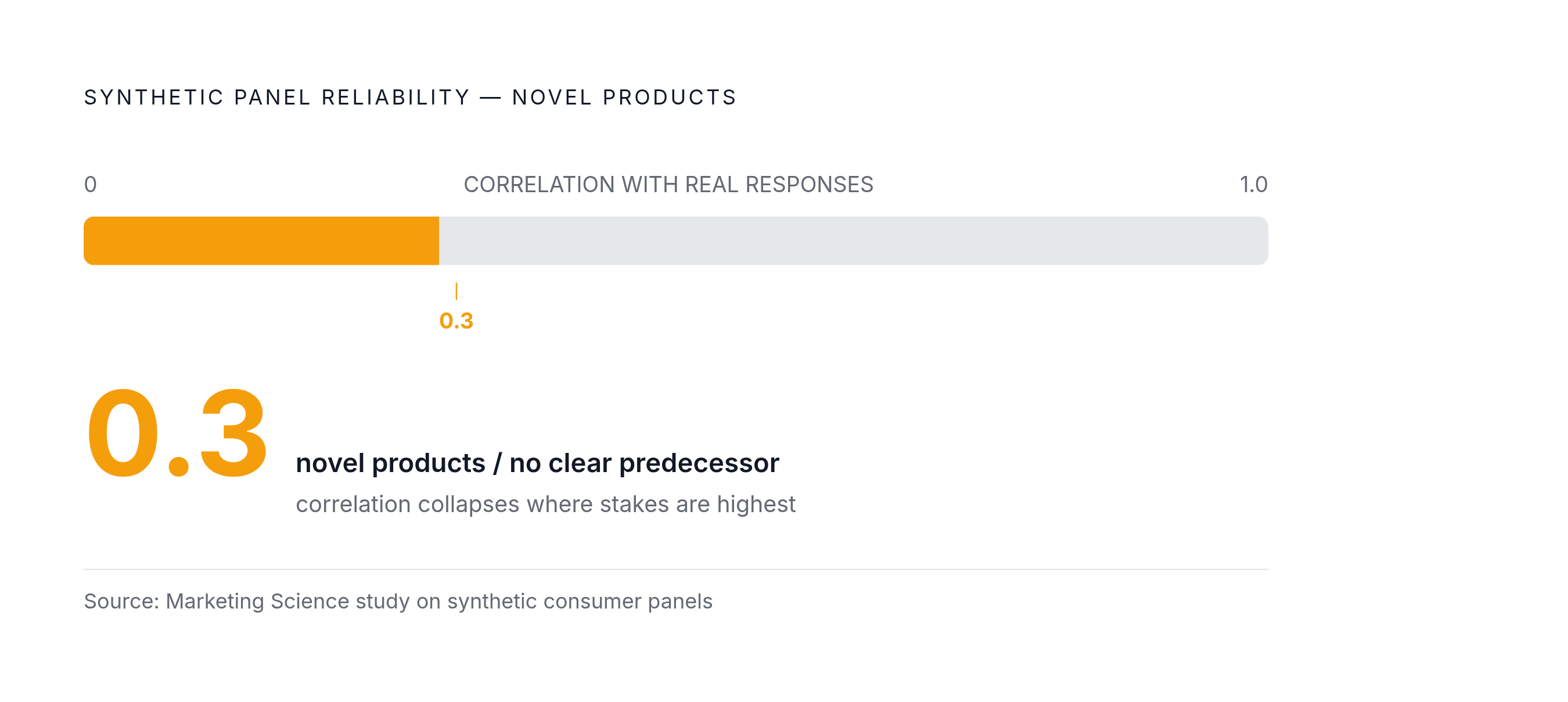
The sharpest validity risk is for genuinely novel products. A study published in Marketing Science found only a 0.3 correlation between synthetic and real responses for products with no clear predecessor. Synthetic panels perform worst precisely where business stakes are highest. That finding should recalibrate how confidently teams deploy synthetic research for innovation-stage decisions. Not as a reason to abandon the method, but as a reason to be honest about when it needs reinforcement.
Before fielding a synthetic study, three questions need affirmative answers. Has this question type demonstrated parity with real respondents in prior research? Does the synthetic population model reflect the actual demographic spread of the target market, or does it default to the over-represented groups in the training data? Has the model been calibrated against real respondent data in this specific category?
Validity isn't binary, and the goal isn't a clean pass-or-fail verdict. A study that communicates its confidence range and known limitations is genuinely more useful than one that presents synthetic outputs as equivalent to a fully representative human panel. The transparency is the quality signal.
How Calibration Determines Whether a Synthetic Panel Is Research-Grade
Calibration is the process of benchmarking synthetic outputs against real human data to measure deviation and refine model behavior. It's the operational difference between a research-grade synthetic panel and a generic large language model with demographic instructions appended to the prompt — the difference between a tailored suit and a costume from a bin.
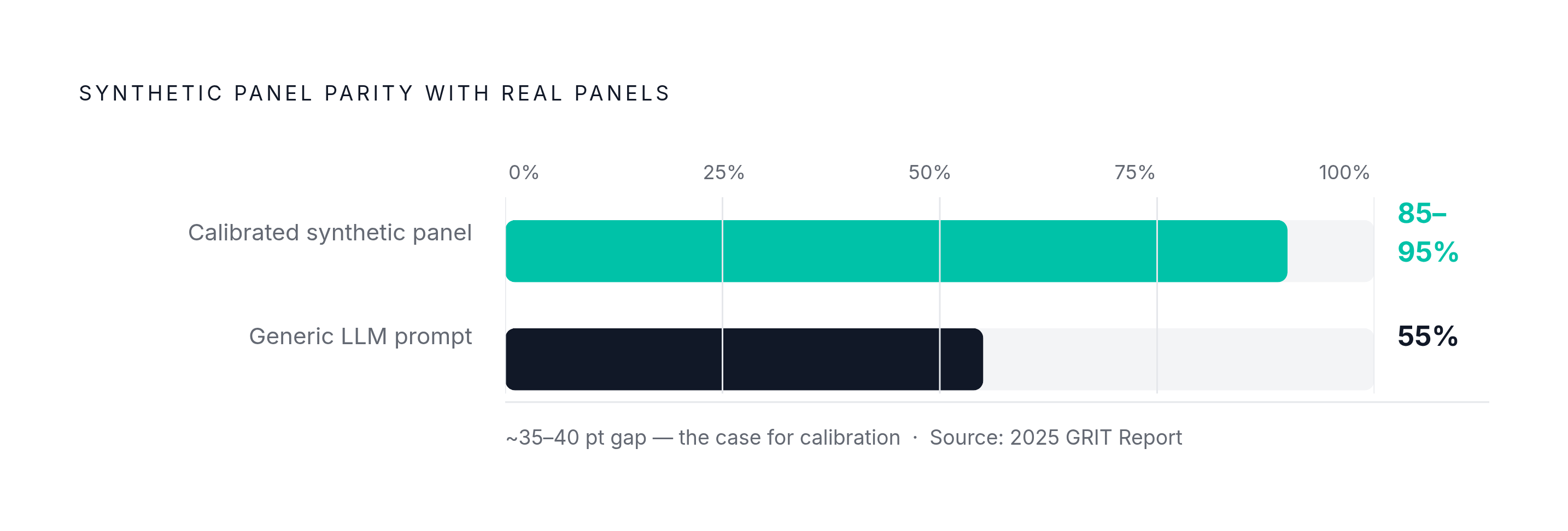
The performance difference is quantifiable. Per the 2025 GRIT Report, calibrated synthetic panels reach parity with real panels in the range of 85 to 95% on concept, pricing, and positioning tests. Generic prompts without calibration sit closer to 55%. That gap is too large to treat calibration as optional.
A structured study from Stanford and Google DeepMind, conducted with over a thousand participants, found that AI digital twins replicated human survey answers with 85% accuracy and social behavior with even higher correlation. But only when built through structured calibration against real respondent data. Not out of the box. That distinction matters more than the accuracy figure itself.
Different calibration methods solve for different problems, and knowing which problem you have is part of the work. Bayesian validation measures uncertainty and produces confidence intervals, the kind of transparency that static surveys rarely provide. Continuous feedback loops retrain models as new real-world data becomes available, so panels reflect genuine shifts in preference rather than crystallizing around a historical baseline. Ensemble routing, which dynamically shuffles between models during a study, addresses single-model bias that calibration alone cannot fully correct.
The questions to ask vendors are specific. What is the calibration baseline for this panel? When was it last updated? What is the known accuracy range for this specific question type? A vendor who is evasive on any of these is telling you something useful about the quality infrastructure behind their product.
Calibration is not a setup cost you incur once and forget. A panel calibrated on pricing research in one year needs recalibration before running positioning work in a market that has shifted meaningfully. Programs that treat calibration as ongoing maintenance rather than a one-time step are the ones that actually build warranted confidence in their synthetic panels over time.
Representativeness at Scale and Why More Responses Can Produce Worse Results
With human panels, sample size imposes natural constraints on how far a biased sample can distort results. Budget and logistics prevent you from fielding a hundred thousand interviews with any single population. With synthetic panels, you can run that volume in hours, which means a biased population model doesn't get diluted by scale. It gets amplified to statistical significance. The output looks more certain while becoming more wrong — like a compass that points south with exceptional precision.
This is the counterintuitive scaling risk that traditional quality frameworks weren't designed to catch. The relevant question isn't whether the sample is large enough. It's whether the underlying population model is grounded in real behavioral data from the actual target segment.
Hard-to-reach demographics represent both the clearest opportunity and the clearest risk. You can simulate a panel of C-suite executives in financial services or early adopters in an emerging category in hours rather than months. The fidelity of those simulations depends entirely on whether the underlying personas were built from real behavioral data, not demographic assumptions or majority-group training data projected onto a label.
The data intensity required for genuinely high-fidelity persona grounding is substantial. A dataset published in Marketing Science in 2025, built to ground digital twins in real human behavior, required answers to over 500 questions per individual across more than 2,000 participants. That's a useful benchmark for what "representative" actually demands, and a useful frame for skepticism when vendors describe their persona grounding in vaguer terms.
The representativeness questions worth pressing before any synthetic study: What real-world data was the target persona grounded in, and how recent is it? Does the synthetic population's demographic distribution reflect the actual target market, or the training data's default skew? Are low-prevalence but strategically important segments explicitly modeled, or will they get absorbed into majority-group weighting?
Scale is a quality lever only when the population model underneath it is sound. Applied to a flawed model, scale converts a manageable error into a very expensive one, and the particularly pernicious part is that the error presents as certainty.
Designing Studies So Quality Can Be Measured, Not Just Assumed
Quality in AI-led research is not a post-hoc audit. It's a design input. Teams that treat it as the former consistently find quality failures after consequential decisions have already been made.
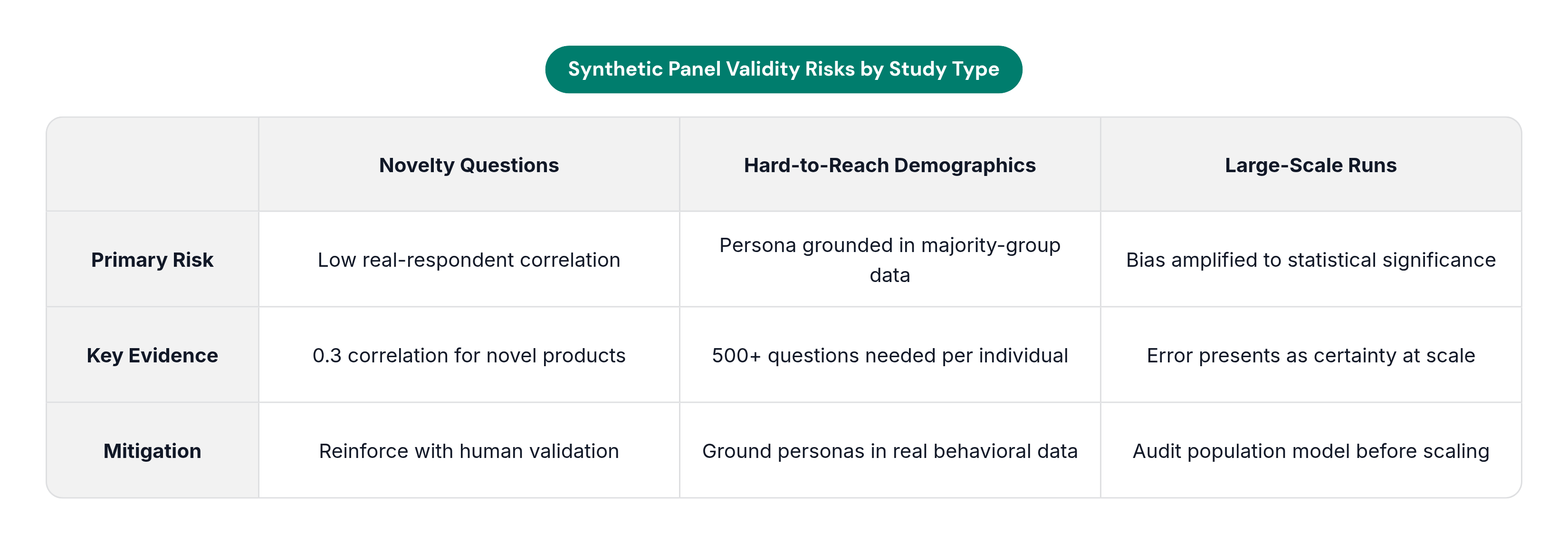
Pre-study quality specification starts with a specific, uncomfortable question: what is the acceptable confidence range for this particular decision? A go or no-go pricing call requires tighter bounds than early-stage concept screening, and those aren't interchangeable standards. After that, identify which quality variables carry the highest risk for this study type. Novelty questions carry validity risk. Hard-to-reach demographics carry representativeness risk. Large samples run at speed carry consistency risk. Then define the validation trigger before you field anything: the real-human benchmark that will confirm or challenge the synthetic findings.
The economics now make mixed-method design genuinely feasible. Per Quirk's 2025 vendor pricing surveys, AI-moderated qualitative interviews run at $8 to $15 per completed interview; human-moderated equivalents run $150 to $300. That cost structure means a validation sample of real respondents alongside every synthetic study is a practical option, not a luxury. Synthetic panels handle scale and speed in screening; AI-moderated interviews with real respondents pressure-test findings before high-stakes decisions get made.
Build the consistency audit protocol at the design stage. Decide what fraction of transcripts will be reviewed, and set probing depth benchmarks, before the study runs. Specifications established after fielding will be calibrated to what the data produced rather than what the decision required. That's a subtle but meaningful difference in what you're actually measuring.
The research brief is a quality document, not just a scope document. It should specify the quality criteria the study must meet alongside the questions the study must answer. A brief that only articulates research questions leaves quality management implicit, which means it will be inconsistent across studies and invisible during review.
What Ongoing Quality Monitoring Looks Like When Research Is Continuous
A synthetic panel that accurately reflected a market in one quarter will not necessarily reflect it twelve months later. That's not a flaw unique to synthetic research; it's a property of any instrument that isn't being continuously maintained. What makes it harder with AI-led programs is that the compression of concept-to-signal cycles, now running in hours rather than weeks, makes it easier to field studies and harder to notice the point where quality has quietly degraded.
Scheduled calibration review, with quarterly as a reasonable default, benchmarks synthetic panel outputs against fresh real-respondent data on a cadence that predates decay rather than responding to it. Decision outcome tracking logs what the study predicted and what actually happened, for every synthetic study that informed a product or pricing decision. That ground-truth feedback loop is what builds warranted confidence over time. Anything short of it is belief operating as evidence. Drift detection flags when synthetic responses on a stable question set begin to shift, because that shift is more likely to signal model drift than genuine market change.
The operational constraint is speed. Teams that can run dozens of synthetic studies in the time it previously took to run one will find it difficult to staff manual quality review at the same pace. The answer isn't more analysts reviewing more transcripts. It's standardized quality checklists applied consistently, converting quality management from a per-project cost into an organizational capability that scales with the program rather than against it.
The most credible quality argument a research team can make is a longitudinal record of how well their synthetic panels predicted real-world outcomes. Traditional agency-dependent research rarely produced that record because studies were episodic and outcomes were almost never systematically tracked against predictions. Teams that instrument their AI-led programs this way accumulate an evidentiary base that no single calibration report can replicate, and that record is the difference between a synthetic panel that's convenient and one that actually earns trust.