Synthetic Consumer Panel Vendors Compared
AI-powered panels are reshaping market research, and vendor choice matters now.

Synthetic Consumer Panel Vendors Compared.
Navigating the synthetic consumer panel market
Gen AI–powered simulation tools are expected to disrupt the $140 billion market research industry in 2026, and that scale of disruption makes vendor selection consequential, not cosmetic Synthetic Consumers in Market Research - A Practical Guide (2026) — P… valueaddvc.com.
Money is pouring in fast. Some analysts think synthetic data could make up more than half of all market research inputs by 2027 Synthetic Consumers in Market Research - A Practical Guide (2026) — P… valueaddvc.com. Lock into the wrong vendor now, and a team ends up running the wrong infrastructure right as the category matures around it.
Nearly every vendor in this space claims the same three things: accuracy, speed, scale. Fine. But those claims aren't where the real differences live. The differences that actually matter come down to methodology, not marketing copy, and this piece walks through four dimensions: how a vendor grounds its panel in real human data, how it validates that panel, whether it fits the specific use case at hand, and what its pricing model reveals about its underlying architecture.
Synthetic panels and the terminology confusion that costs buyers clarity
"Synthetic" gets used as a catch-all, and that's part of the problem. Buyers who treat those as interchangeable end up evaluating the wrong thing entirely, comparing a vendor built for one of these against a vendor built for another.
Strip away the branding, and there are really three technically different objects sold under "AI consumer panel." The weakest is a generic large language model given a persona description and nothing else to ground it. A step up from that is an LLM conditioned on a static demographic profile, better but still shallow. Neuroflash's methodology guide identifies the only version with a defensible methodology behind it as a multi-respondent simulation system where each virtual respondent is anchored to real human calibration data and checked against a real benchmark.
PyMC Labs' 2026 practical guide splits the category even further. Synthetic respondents are general-purpose. Synthetic consumers are tuned specifically for purchase behavior. Digital twins keep updating continuously from live or historical data streams. Human simulacra are built for academic and social-network modeling. Each of these carries a different bar for evidence and fits a different job.
That distinction shapes which vendor category a team should even be choosing from before evaluation starts. A team that needs purchase-intent modeling and ends up buying a social contagion simulator hasn't picked the wrong vendor, it's made a category error before vendor selection even started. Get clear on which object is actually needed, then start comparing vendors within that lane. Qualtrics' Market Research Trends report identifies multiple distinct objects behind the word "synthetic" (synthetic personas, synthetically-derived insights, simulated individual-level data, digital twins, and simulated conversations), and buyers who don't distinguish these will evaluate the wrong thing.
The philosophical split that divides the vendor market
A divide in worldview, not features, produces the terminology confusion. Two camps operate on fundamentally different assumptions about where synthetic answers should come from.
Grounded simulators, Simile and Listen Labs among them, insist a simulation has to be rooted in real human data from the start. They interview real people or ingest their behavioral data directly, then build models that answer future questions on those individuals' behalf. Pure synthetic generators, Aaru being the clearest example, build AI populations from public and proprietary data without partnering with real individuals directly. That approach buys scale and lower cost, but the path from an actual human being to the synthetic answer on the screen gets longer and harder to audit.
Then there's a third lane: hybrid platforms like Qualtrics Edge Audiences, Toluna HarmonAIze, and YouGov (through its Yabble acquisition) that bolt a synthetic layer onto an already-established real-panel infrastructure. The human panel supplies the grounding, and the synthetic layer supplies the scale on top of it.
None of this is academic. Grounded simulators tend to offer validation chains a buyer can actually trace, but they cost more and take longer to stand up. Pure synthetic generators deploy faster and cheaper, but they push more of the calibration burden back onto the buyer. BCG's 2026 guidance cuts straight to the real question here: it's not whether a tool "uses AI," it's what the chain looks like between a real human data point and the synthetic answer that appears in the dashboard.
Dimension one: how a vendor grounds its panel in real human data
Grounding is where methodology either holds up or falls apart.
Vendors show their hand on this dimension pretty clearly once you look closely. Simile trains its agents on qualitative interviews taken from real, named individuals, real human data at the individual level, and it traces back to the Stanford and Google team behind the 2023 generative-agents research; its client list includes CVS Health, Deloitte, Gallup, and Wealthfront. Aaru assigns demographics to AI agents and surveys them in place of actual people, a population-level simulation without direct individual grounding, and one of its own cofounders has publicly told clients to approach the results with distrust, evelance.io reports.
Evidenza, founded by former LinkedIn B2B Institute people (Peter Weinberg as co-founder, Jon Lombardo as former Head of Research), validates against Dentsu's proprietary panel data and against EY's Global Brand Survey of C-suite executives, using real-panel benchmarking as its grounding mechanism. Lakmoos takes a different route entirely, building a neuro-symbolic architecture that makes its reasoning auditable step by step, which suits regulated industries that need to show their work.
So what should a buyer actually ask for? Push every vendor to name the data source, state how many data points sit behind each persona, and explain how often the calibration layer gets refreshed, because BCG's 2026 research flags outdated training data as one of the core risks baked into this category. Hybrid platforms that pair a real human panel with synthetic respondents, Qualtrics Edge and Toluna HarmonAIze among them, carry a natural edge here: the real panel keeps feeding fresh calibration data into the system on an ongoing basis. A panel built on millions of real, verified respondents spanning diverse markets is simply working from a stronger foundation than one frozen around a static historical dataset. Calibration source data is the first building block of a credible panel, and the neuroflash methodology guide shows a platform anchoring 68 to 255 data points per twin from a one-million-plus real-profile pool is in a different methodological league than a system prompting a generic LLM with three demographic fields AI Consumer Panel Methodology for Brand Positioning (2026). Qualtrics Edge Audiences benchmarks against 25+ years of proprietary survey data, using institutional real-data depth as grounding. Minds offers persistent, calibrated personas on EU-hosted GDPR-native infrastructure, showing that grounding includes compliance architecture, not just data depth.
Dimension two: validation methodology and how to interrogate it
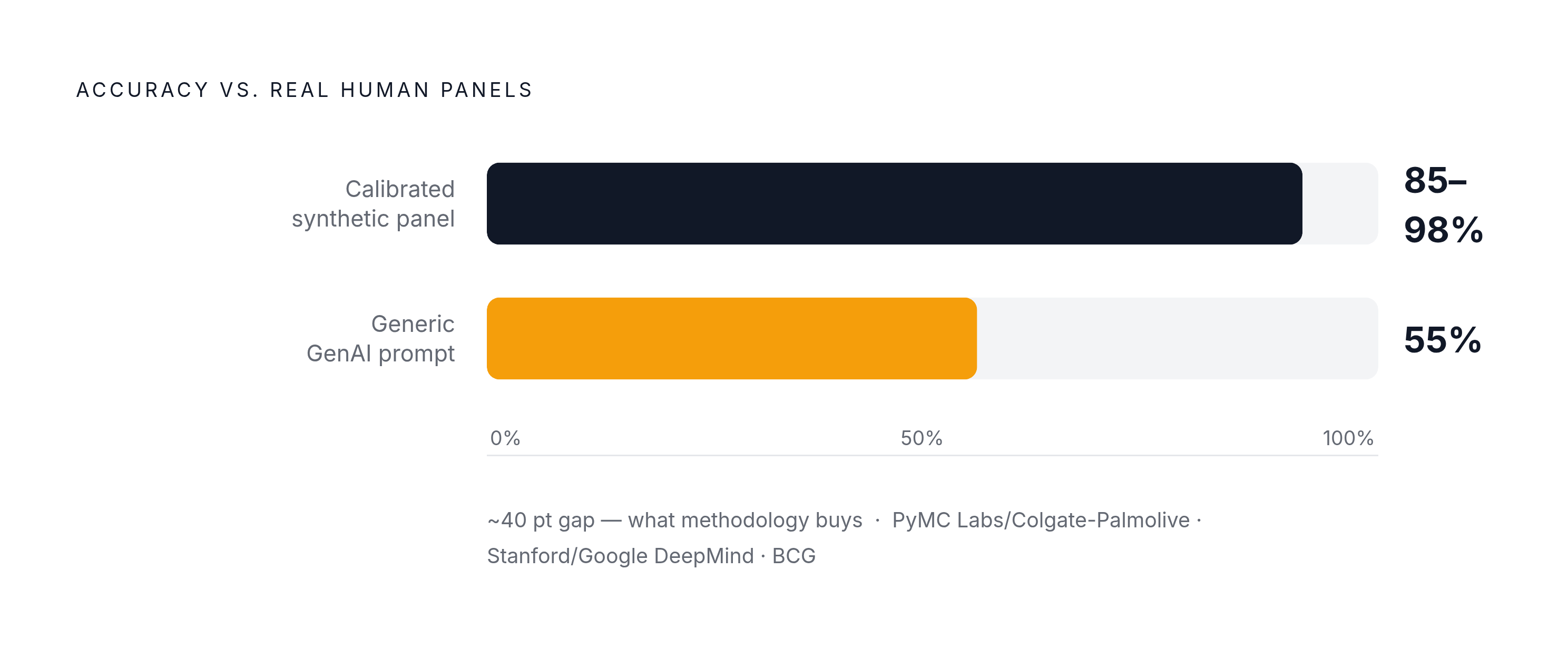
Start with the number worth pressure-testing: neuroflash's research puts calibrated synthetic panels in the 85 to 98% accuracy range against real human panels on concept, pricing, and positioning tests, while generic GenAI prompting is closer to 55% AI Consumer Panels: The 2026 Buyer's Guide | FishDog AI Consumer Panel Methodology for Brand Positioning (2026). Methodology, not which AI model sits underneath, produces that gap. It's entirely a function of methodology.
A handful of public benchmarks give buyers something solid to compare vendor claims against. A peer-reviewed study run by PyMC Labs with Colgate-Palmolive, covering 57 surveys and 9,300 human responses, found LLM-based panels matching human purchase intent at 90% test-retest reliability with no fine-tuning involved getminds.ai aimultiple.com. A separate Stanford and Google DeepMind study, run across 1,052 participants, found calibrated AI agents replicating human survey answers at 85% accuracy AI Consumer Panel Methodology for Brand Positioning (2026). BCG's own conjoint analysis work found synthetic panels predicting real-world consumer choices for a new beverage at 92% accuracy once fine-tuned.
Vendor-reported numbers deserve a more careful read, since validation methods aren't standardized across the industry. Lakmoos reports similarity scores above 98% across 20 client benchmark studies run in 2025 AI Consumer Panels: The 2026 Buyer's Guide | FishDog. Aaru reports roughly 90% correlation to real-world research through its EY partnership work getminds.ai. Qualtrics Edge Audiences benchmarks against its 25-plus years of proprietary survey data but hasn't published specific accuracy figures.
Neuroflash's 2026 guide lays out six signals to demand from any vendor before trusting an accuracy claim at all: data sources, disclosure of uncertainty, replicability, sample size, parity with real data, and an audit trail. Miss even one of those six, and an accuracy number is closer to a slogan than a finding.
BCG's research also flags a failure mode that's easy to miss entirely: confirmation bias, where synthetic respondents infer what the researcher is hoping to hear and quietly produce data that confirms it. Ask directly how a vendor's system guards against that. And before trusting synthetic output at real scale, BCG recommends running paired studies: pick two or three categories, run a synthetic panel study alongside a solid human panel study, and back both against a behavioral check, an in-market A/B test, a conjoint validation, or a sales pilot.
The single most underused question in vendor evaluations might be the simplest one: which prompt produced which answer, for which respondent. A vendor that can't produce that audit trail is selling a dashboard, not a methodology. It's selling a dashboard.
Dimension three: matching the vendor to the use case, not the other way around
BCG's 2026 framework sorts use cases into tiers by how much weight synthetic panels can actually carry. Low-risk, high-iteration work, ideation, naming, basic product claims, is where synthetic panels can stand in as primary research. Medium-risk work, packaging selection, product attributes, is where synthetic panels support rather than replace traditional research. High-risk territory, regulated claims, forecasting, keeps synthetic subordinate to actual human testing. And there are places synthetic panels shouldn't go at all: culturally sensitive topics, or anywhere the training data is thin.
PyMC Labs' 2026 guide notes that synthetic consumers are genuinely strong at structured reasoning, ranking, pricing, sentiment analysis, but still fall short modeling emotional nuance, cultural context, and group dynamics. Synthetic consumers being strong at structured reasoning, ranking, pricing, and sentiment analysis but falling short on emotional nuance, cultural context, and group dynamics is a boundary to plan around. It's a boundary to plan around.
Matching vendor to job gets a lot clearer once the use case is named specifically, and FishDog's 2026 Market Map offers a useful starting map. For consumer brand research, FishDog carries the broadest validation and Simile the deepest agent architecture. For B2B enterprise marketing, Evidenza's B2B Institute pedigree and its Synthetic CMOs feature show up in client work with BlackRock, Microsoft, and JP Morgan. For UX and product testing, Synthetic Users runs conversational, AI-moderated interviews and surveys and has been named a leader in AI-powered synthetic user research by Gartner, while Uxia serves faster design-iteration loops ahead of human usability testing, though it's less built for broad strategic work.
Management consulting and private equity work leans toward Aaru, through its EY and Accenture partnerships, and Evidenza, for board-ready output. For social media prediction and message virality, Artificial Societies (Societies.io) runs networks of 200 to 3,500 interconnected AI personas built from real-world social behavior data, and it's the only purpose-built option here for modeling social contagion aimultiple.com. Regulated industries point toward Lakmoos and its neuro-symbolic explainability. Existing Qualtrics customers looking to bolt on survey augmentation have Qualtrics Edge Audiences as a $100,000-plus add-on fish.dog. And for full research operations, blending real respondents, synthetic respondents, AI moderation, and a cross-study knowledge base, Listen Labs turns studies around in roughly 24 hours and includes fraud detection alongside its Mission Control knowledge base, priced as custom enterprise contracts.
Some platforms get labeled "synthetic" when they're actually running AI-moderated interviews with real human participants. Outset.ai fits this description, primarily real-participant interviews with AI moderation, though it also offers a Digital Twins feature that simulates those same real participants for later follow-up questions. Listen Labs combines both approaches directly.
The question that should anchor every use-case decision: does the vendor's validation data actually come from studies matching the category, the decision type, and the respondent population in question. A vendor validated heavily on FMCG work doesn't automatically transfer to B2B SaaS, and assuming it does is its own kind of category error. Tools built for a single study differ from platforms built to run a foundational behavioral model against any future decision, one is a one-time purchase, the other is closer to a standing strategic asset.
Dimension four: scalability, cost structure, and vendor architecture signals in pricing models
Pricing in this market is mostly a black box. Simporter's analysis found only 1 of 10 AI consumer panel vendors publish rates at all, and that opacity is itself a signal: contracts here are bespoke, negotiated one enterprise deal at a time.
What figures do exist paint a wide range. Simile's enterprise contracts run from $150,000 up to several million dollars a year, and the company raised a $200 million Series B at a $2 billion valuation on July 30, 2026, a 20x jump from its $100 million Series A just five months earlier, a trajectory that shows the company is building for enterprise, not for self-serve teams Top 7 AI Consumer Insights Tools for June 2026. Getminds.ai's 2026 reporting puts Aaru's contracts in the six-to-seven figure range annually, with implementations running as full enterprise projects taking weeks to months to stand up. Evidenza runs a high-touch, professional-services model, closer in feel to a research consultancy with an AI engine bolted on than to a self-serve software product, and it hasn't published pricing.
Qualtrics Edge Audiences runs $100,000-plus as an add-on for existing Qualtrics customers, which only pencils out financially for teams already inside the Qualtrics ecosystem fish.dog. Synthetic Users charges per interview with no per-seat fees and offers a 7-day free trial, a genuinely accessible entry point for teams without deep research budgets. Minds offers a free tier with team workspaces on EU-hosted, GDPR-native infrastructure, another low-barrier, compliance-minded option.
The pricing model itself tells a buyer something about how the vendor expects its product to be used. Per-study or per-interview pricing charges for discrete research events, one at a time, which nudges buyers toward restraint rather than continuous use. Unlimited-study annual pricing, the model FishDog runs on, is built the opposite way, rewarding teams that treat research as an ongoing habit rather than a series of one-off projects. Enterprise bespoke pricing comes with real setup costs and drawn-out negotiation timelines, and Aaru is explicit that its own implementations take weeks to months, a pace that doesn't sit well with fast-moving product or UX cycles that need answers in days, not quarters. FishDog charges $50–$75K/year for unlimited studies, an architecturally significant structure that rewards high research cadence and continuous use fish.dog. Simporter prices from $15,000 one-time for its Starter plan up to $60,000/year for annual plans, reflecting a CPG-specific rather than general-purpose focus 10 Best AI Consumer Panels Providers for Consumer Brands in June 2026 Top 7 AI Consumer Insights Tools for June 2026.
Sources
- AI Consumer Panel Methodology for Brand Positioning (2026)
- Want Consumer Insights Faster? AI Can Help. | BCG
- Synthetic Consumers in Market Research - A Practical Guide (2026) — PyMC Labs Blog
- 10 Best AI Consumer Panels Providers for Consumer Brands in June 2026
- Top 7 AI Consumer Insights Tools for June 2026
- AI Consumer Panels: The 2026 Buyer's Guide | FishDog
- Best Synthetic Market Research Tools: 2026 Review | Minds
- Platforms and Providers for AI-Powered Synthetic Market Research