Closed-Loop Feedback Systems in B2B SaaS Products
Most B2B SaaS feedback tools only collect signals without closing the loop on them.

A detractor at a mid-size account scores a product a 3 out of 10. The response lands in a dashboard somewhere. No one gets assigned to it, no one reaches out, and three months later the account quietly churns. The data existed the entire time. Nobody closed the loop on it.
This is the pattern behind most failed feedback programs in B2B SaaS. Teams assume they have a collection problem, so they buy another survey tool, add another channel, or redesign the questionnaire. None of that touches the actual failure, because capture was never the missing piece. Closed-loop feedback is a four-stage process, and most tools sold under that name only handle the first stage. They collect. They don't close anything.
That gap between collecting feedback and acting on it carries a direct commercial cost. CustomerGauge research found that companies that don't close the loop increase churn by a minimum of 2.1% every year. Adding more collection channels without fixing follow-through just produces more unactioned signal sitting in more dashboards.
The four-stage architecture every closed-loop system must complete
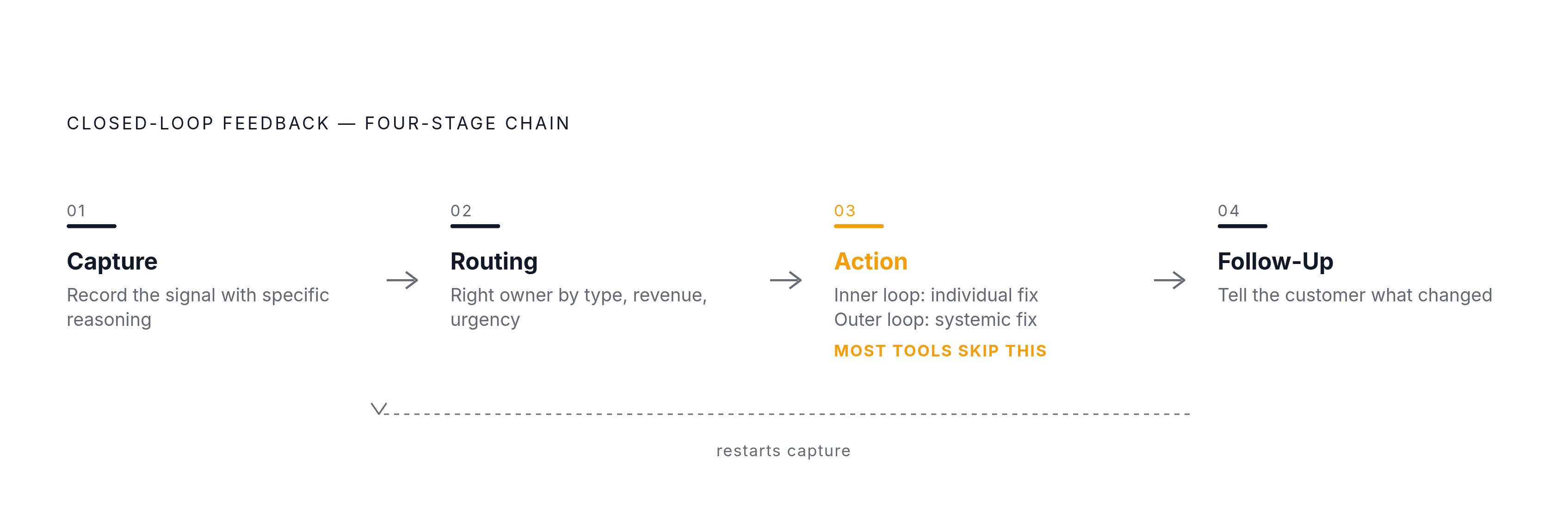
A closed-loop feedback system has four stages, and all four have to connect for the loop to actually close. Picture it as a chain, not a circle: capture feeds routing, routing feeds action, action feeds follow-up, and follow-up is what reconnects the chain back to the customer, which is what starts the next round of capture. A tool that handles fewer than all four stages is a collection tool with a closed-loop label stuck on it.
Stage 1 is capture: recording the signal itself. This stage sets the quality ceiling for everything that comes after it. A score with no reason attached leaves every downstream stage guessing at what actually went wrong.
Stage 2 is routing: getting the signal to whoever can act on it. Three different signals, three different owners.
Stage 3 is action: someone actually changes something. Two kinds of action happen here at once. The inner loop handles individual resolution, fixing the one customer's specific problem. The outer loop handles the systemic fix, the pattern across many accounts that justifies a product change. Both have to work together.
This is the stage that turns a one-way broadcast into an actual two-way conversation, and most feedback tools skip it.
The inner loop and outer loop distinction matters more in B2B than almost anywhere else, because most feedback tooling on the market is built for the outer loop. Individual notification, telling the one customer who complained that their complaint led to a fix, remains a persistent gap in nearly every platform.
B2B also introduces a wrinkle that consumer feedback models never had to solve: feedback needs aggregation at the account level, not just the individual respondent level. CustomerGauge's Account Experience framework, built around Measure, Act, and Grow, puts Act at the structural center holding the other two together. Action has to be designed on purpose; it isn't a side effect of measuring something.
Why capture quality sets the ceiling for everything downstream
Most loops break before they even start, at the capture stage. A number alone can't carry a reason, and without a reason, nothing downstream can work correctly.
Picture a CSM who receives a static NPS score of 3 with no comment attached. The only option left is to email the customer and ask what went wrong, which delays the entire loop by days and often never gets a reply.
Conversational capture solves this at the source. Instead of a static widget that records a number and stops, an AI interviewer follows up in the moment: "What's the main thing that would have made this a 9?" The answer comes back as a quoted sentence. Platforms like Seda that run AI-led interviews rather than static surveys can capture that specific reasoning in real time, so the detractor's feedback reaches the right owner with enough detail to actually close the loop. A vague complaint like "it's just clunky" gets probed until it turns into something a team can act on, like "the export button is buried three menus deep." A quoted, specific reason drives a fix; a bare score just sits in a report waiting for someone to interpret it.
The stakes of getting this wrong are higher in B2B than almost anywhere else. A misrouted signal from a high-revenue account, sent to product when it belonged with customer success, doesn't just waste time internally. It signals to that account that nobody is paying close attention, which is close to the worst message a vendor can send a six-figure customer.
Channel breadth compounds the problem. A capture system that only listens on one channel creates blind spots, and those blind spots break routing before routing even has a chance to work.
How routing breaks the loop in B2B SaaS teams
Routing is where most B2B feedback loops actually stall, and it's rarely because teams lack rules for routing. It's because those rules are built around scores instead of causes, and they almost never factor in account revenue as a priority signal.
Picture a detractor score of 2 coming in from a small account that pays a few hundred dollars a month, and the same score coming in from a top-ten account worth seven figures a year, a structural mismatch no generic rule can resolve. A generic routing rule can't tell the difference, and a high-value detractor often ends up sitting in a general support inbox for a week before anyone notices.
Revenue integration, linking feedback to account value so teams act on the most important clients first, is one of three capabilities that separate real B2B feedback infrastructure from a repurposed consumer survey tool. Signal-type routing is another: pricing objections need to go to revenue, product bugs need to go to engineering, onboarding frustration needs to go to customer success. A routing system that dumps everything into one queue turns urgent signals into generic backlog.
Urgency detection closes the gap further. A customer flagging a billing bug in a survey comment at 9pm is already cooling toward churn if that comment sits unseen for three days. Real-time alerts get the signal to the right team before the customer escalates or quietly starts evaluating alternatives.
B2B routing also has to aggregate feedback at the account level. Tools built around individual respondents, the kind most consumer survey platforms assume, simply can't do this.
None of it matters without an SLA attached. An alert that reaches a CSM with no due date and no escalation path produces the same outcome as no alert at all: a signal that technically got routed and still never got acted on.
The action gap: why feedback reaches the right person but still produces no change
Feedback can be captured well and routed correctly and still die at the action stage, because it arrives as a disconnected artifact, a case number, a ticket, a line in a dashboard, instead of something plugged into the product backlog, the renewal workflow, or the roadmap where real decisions happen.
Feedback lives in one system, usually a survey platform or a CRM, and decisions live in another, usually Jira or a roadmap tool or a renewal playbook. Closing that gap requires manual translation, someone copying context from one system into another, and under deadline pressure that translation step is the first thing teams skip.
Inner loop action and outer loop action need different infrastructure. Inner loop work means resolving the individual case, updating the account record, drafting the follow-up message, and that's customer success work. Outer loop work means aggregating signals across many accounts, spotting the pattern, and reprioritizing the roadmap, and that's product work. Most teams never design either workflow explicitly. Feedback arrives and sits there until someone decides which kind of action it even calls for.
Request-to-shipped linking connects a feedback item directly to a Jira ticket or a release status, fixing this gap. The best version of this links at intake, the moment the feedback comes in, rather than retroactively, so a status change on the engineering side can trigger a customer notification automatically instead of relying on someone remembering to close the loop by hand.
Eaton Corporation reduced its closed-loop process from four months to 48 hours using CustomerGauge.
There's a newer risk working against all of this: the democratization of research. When designers, product managers, and marketers all gather customer feedback independently, using their own tools and their own channels, the signals rarely connect. CustomerGauge research establishes a specific time threshold beyond which a follow-up loses most of its retention value. Closing the loop promptly retains the account; closing it late means the fix arrives too late to matter.
Why Follow-Up Closes the Loop
Follow-up closes the loop in the literal sense: going back to the customer to confirm their input was heard and telling them what changed as a result. If this stage is skipped, the first three stages produce no customer-facing outcome. The fix might be real, but if the customer never finds out about it, it generates zero loyalty.
The numbers back this up directly. The follow-up itself generates that loyalty lift, beyond the underlying fix sitting behind it.
The customers who bother to report a problem or request a feature are the most engaged segment of any B2B account base. Roughly one in 26 unhappy customers actually complains. Ignoring the one customer who did speak up, after the team already shipped a fix for the exact thing they complained about, damages the single most valuable relationship signal in the account.
An automated "thank you for your feedback" message is only an acknowledgment that a submission was received. Genuine follow-up tells the customer specifically what changed because of what they said, naming the thing that shipped and tying it back to their original comment.
Timing is part of the mechanism, not a detail around the edges of it. The identical message sent a month later reads as an afterthought, even though the underlying fact, the feature shipped, hasn't changed.
Follow-up only works if the first three stages were built correctly. It requires knowing who asked for what, when they asked, and whether the resulting work has shipped, and none of that information exists unless capture preserved the requester's identity, routing assigned a real owner, and action linked the ticket back to the original request. Follow-up is the payoff that the other three stages were built to produce, and skipping it wastes the work that went into all three.
There's a commercial upside tucked into this too. Teams that skip follow-up lose that expansion window along with the loyalty lift. The cost of skipping this stage shows up once in retention and once in missed revenue.
The tools built to keep all four stages connected in B2B SaaS
The real distinction between feedback platforms has nothing to do with whether they're labeled "enterprise" or "lightweight." It comes down to whether a platform treats capture, routing, action, and follow-up as one connected system, or whether it handles one or two of those stages well and leaves the rest to manual process.
Seda sits closest to the capture end of this architecture, because capture is the stage that sets the ceiling for everything else. The distinguishing capability is that its AI doesn't just record an answer. It probes, follows up, and synthesizes findings into a structured report without requiring a human analyst to sit in the loop. For B2B teams trying to fix the capture stage specifically, that distinction matters: a quoted, specific reason beats a bare number every time, because routing and action both depend on knowing the cause, not just the score.
Teams weighing how to build out the rest of the architecture generally choose between a few broad approaches. Some lean on their CRM's native survey and case-routing features, which handle capture and basic routing reasonably well but leave action and follow-up to manual tracking in spreadsheets or Slack threads. Others adopt a dedicated customer experience platform built around the Measure, Act, Grow model, which tends to handle account-level aggregation and revenue-weighted routing more capably, built for B2B account structures from the start. A smaller number of teams try to stitch together point solutions, one tool for surveys, another for support tickets, another for roadmap tracking, which usually recreates the exact translation gap that breaks the action stage, since nothing connects the systems automatically.
The inner loop, the personal follow-up that reconnects a customer with what actually happened after they spoke up, is where most of these approaches fall short, and the reason traces straight back to capture. Genuine two-way follow-up needs real context to work from, not just a broadcast message. When capture includes verbatim reasoning instead of a bare score, the team drafting the follow-up has something concrete to point back to, which is what rebuilds confidence in a high-value account: showing them that their specific comment led to a specific change, not a generic thank-you.
No single tool on the market today fully automates all four stages end to end. The architecture closes the loop. The tool just has to get out of its way.