Ethnographic Research Methods Adapted for Digital Consumer Contexts
Ethnography's core methods work online when you drop the physical location and keep the depth.
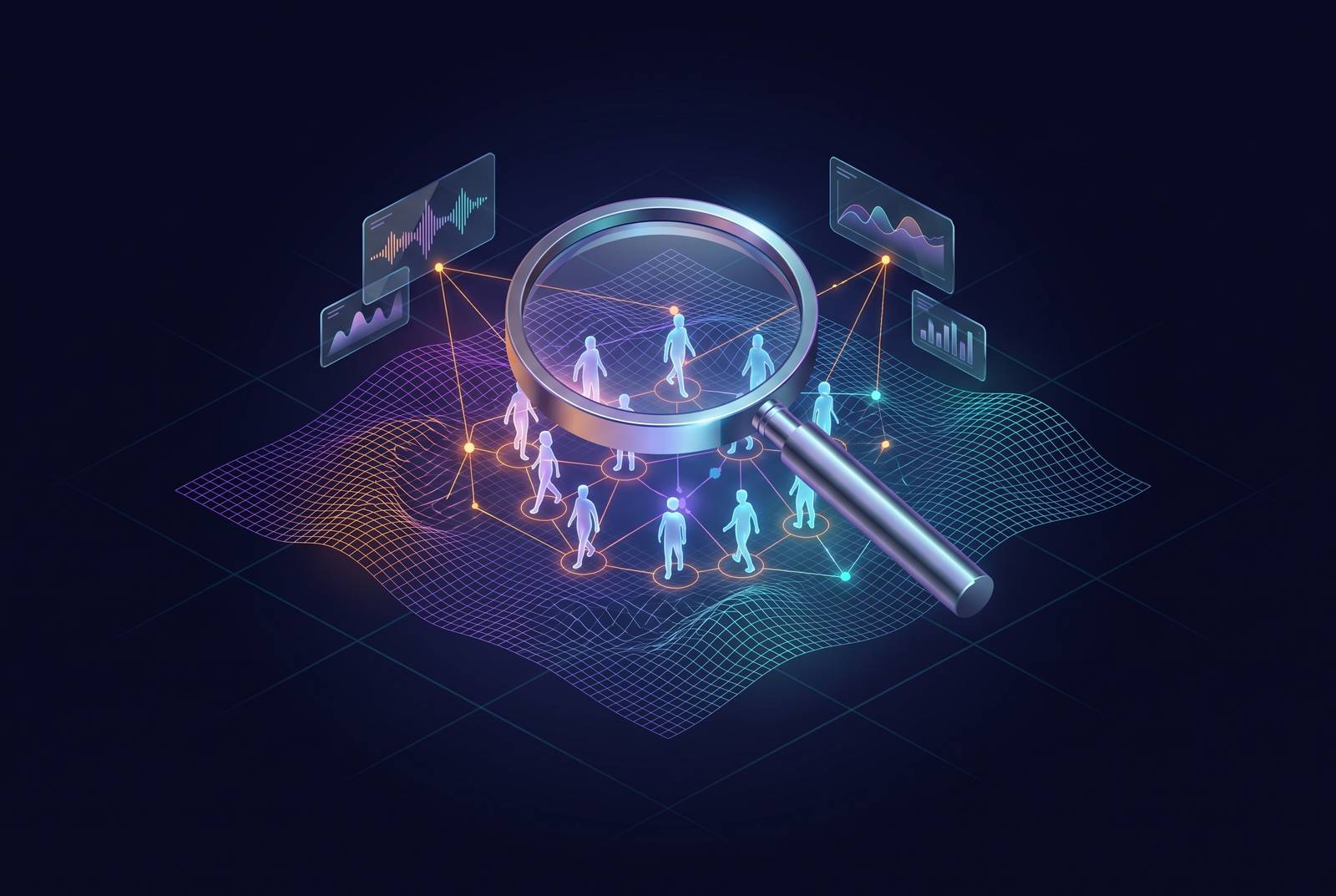
Ethnography rests on three habits, and none of them require a researcher to be standing in a room. The third is thick description, a term built on the idea that recording behavior alone tells you little. The meaning underneath it is what matters: the intent, the hesitation, the contradiction between what someone says and what they do.
"Digital ethnography" gets misused constantly, usually as a stand-in for online surveys. That's a mistake, and a costly one, because a survey breaks all three commitments at once. And it returns thin, flattened answers instead of the layered picture ethnography is built to produce. None of that is a digital problem. It's a survey problem, and surveys have always had it, online or off.
The real work is figuring out what each of those three commitments looks like once the delivery mechanism changes. Context shifts from a physical location, a market stall, a living room, a factory floor, to a digital habitat: a checkout flow, a social feed, a messaging thread, a community forum. The researcher's job doesn't change. Watch people act where they actually act, instead of moving them somewhere else to ask about it. Each of the sections that follow takes one of these three commitments and works through what it looks like once it moves online.
The physical fieldwork assumption was always a proxy, not the point
Physical presence in classical fieldwork was never valuable just for its own sake. It mattered because it got the researcher close enough to real behavior that the act of studying it wouldn't distort it. That's the actual goal: unfiltered behavior, observed without the subject performing for an audience. Presence was just the tool available at the time to reach that goal.
Digital environments can often get closer to that goal than a researcher with a notebook ever could. That's the Hawthorne problem in action: people change their behavior the moment they know they're being observed, and a formal interview room is one of the most self-conscious settings a person can be placed in. Passive digital observation sidesteps that distortion. The one thing physical fieldwork did that digital research has to work to recover is serendipity, the odd detail or unplanned behavior a researcher stumbles onto simply by being present and paying attention over time. That's exactly the gap emergent AI-driven questioning is built to close, and it's a gap no static survey can touch.
Translating contextual observation: behavioral analytics and passive digital field sites
Entering someone's natural environment, digitally, means putting instruments into the places people already spend their time: product interfaces, checkout flows, online communities, and watching what happens there without interrupting it. Behavioral analytics tools do this at a scale no single researcher could manage by hand. Heap, for example, uses autocapture to log every user action automatically, so analysis can happen retroactively instead of requiring the researcher to decide in advance what to track. Its AI layer can flag where users get stuck in a flow and compare behavior across segments, say new users against returning ones, surfacing patterns a human watching one session at a time would likely miss.
What this gives researchers that a physical fieldworker never had is coverage. The ethnographic principle being honored here is fidelity to context: behavior gets captured where it actually happens, not reconstructed from memory afterward in a debrief. Behavioral data has a specific limit. Behavioral data shows what people did, not why they did it, and that's precisely the gap the next method is built to close.
Translating emergent questioning: AI-moderated interviews that probe rather than poll
The core idea behind emergent questioning is that the most useful thing a participant says is usually something the researcher didn't think to ask about. A good instrument has to be able to follow that thread, wherever it leads. A static survey can't do this by design. Every question is fixed in advance, and any follow-up is either missing entirely or just as scripted as the question before it. That's why surveys, run at any scale, tend to produce thin, flat answers instead of real insight.
AI-moderated interviews work differently. The mechanism is a real qualitative conversation, run at quantitative scale, not a survey with a chatbot attached to it. The feature that matters most is the follow-up itself: when someone says something unexpected, the AI pursues it with a question built for that specific answer. Paired with emotional-intelligence analysis, these systems can pick up conversational depth and emotional signal that even a human-moderated transcript often misses.
Scale here isn't working against depth, it's working for it. Running the same adaptive instrument across a few thousand conversations turns a theme that might only show up in one interview out of twenty into an obvious, countable pattern. The underlying commitment hasn't changed: the instrument bends to match the participant's reality, instead of forcing their answer into a shape decided in advance.
Translating thick description: multi-signal capture and layered behavioral data
Clifford Geertz's original idea of thick description was never just about recording what someone did. It meant capturing the web of meaning wrapped around the act: the context, the intent, the hesitation, the contradiction, and especially the gap between what a person says and what they actually do. That gap is where most research methods fall apart, and multi-signal digital capture is designed to catch it.
Emotional-intelligence analysis, as one method, reads three signals at once: tone of voice, word choice, and subconscious micro-expressions, picking up emotional nuance that a plain transcript loses. Every emotion gets quantified per question and per concept, and each label traces back to an exact timestamp, a verbatim quote, and the AI's reasoning for flagging it. That turns thick description into something closer to an auditable record than an analyst's personal summary of what they think they saw.
Behavioral analytics supplies the action layer: session recordings, heatmaps, funnel drop-off, show what a person actually did, which can then be compared against what they said they'd do in conversation. With all three principles now mapped to their digital equivalents, the next question is how a researcher actually sequences them in a real study.
Diary studies and longitudinal observation in digital research communities
Classical ethnography was never a single visit. Researchers lived in the field for months, sometimes years, because behavior changes across time and circumstance in ways no single session can reveal. That temporal depth is one of ethnography's most valuable features, and it's also one of the hardest things to fake in a one-hour interview or a one-time survey.
Digital diary studies keep that depth intact by asking participants to record their behavior, their reactions, and the context around them as events happen, in their own environment, over days or weeks at a time. The researcher's notebook effectively moves from their own hands into the participant's. The resulting record keeps the in-the-moment quality that makes ethnographic material valuable in the first place: the participant captures a decision as they're making it, rather than trying to reconstruct it from memory two days later in a debrief call, by which point most of the real detail is already gone. The principle stays the same as it always was. Behavior tracked across time and in natural settings is simply more reliable than behavior people report after the fact, and digital tools have finally made that kind of longitudinal observation something that can run at real scale.
Synthetic consumer panels in an ethnographically informed research design
Synthetic consumer panels have one narrow job inside an ethnographically grounded research plan. They narrow down which questions are worth putting to real people. They are not built to answer those questions on their own. The closest classical equivalent is a literature review or early hypothesis-building before fieldwork begins: a researcher uses what's already known to guess where the interesting terrain probably is, then walks into the field ready to have those guesses overturned by what actually turns up.
Synthetic panels work best on structured tasks, ranking concepts, testing price sensitivity, profiling segments, where the space of possible answers is bounded enough that a language model has solid training signal to draw on. If a group is slow or expensive to recruit through normal channels, say specialist professionals or hard-to-reach demographics, a synthetic panel can produce a quick simulated first pass, giving a research team something to work from before it commits to a full fieldwork recruitment effort. The practical consensus among researchers running these studies points toward a hybrid design: use the synthetic panel to cut down the range of options first, then check the surviving candidates against real participants observed in actual context.
The limit here matters and shouldn't get blurred. Synthetic panels narrow focus, but they don't finalize decisions, so research teams still need direct feedback from real participants along with qualitative methods to surface motivations and emotions that a simulation can't fully anticipate. Real people reveal needs a model was never trained to predict, which is simply the ethnographic principle re-stated in new terms: thick description depends on real subjects who are still capable of surprising the researcher.
Sequencing the methods: a practical framework for digital ethnographic research
A digitally transposed ethnographic study is a sequence, where each phase's findings shape the questions the next phase asks. The first step is defining the behavioral habitat: figuring out exactly where the target consumer acts in relation to the research question, which platform, which flow, which community, so the researcher knows where to look before looking at anything. This step replaces the old decision of which physical field site to walk into.
From there, the work moves into passive observation: you use behavioral analytics or other passive monitoring to build a baseline understanding of what's actually happening before you ask a participant a single question. This mirrors an ethnographer's early weeks in the field, spent watching before speaking, and it produces a map of where behavior clusters, where it breaks down, and which surprising patterns deserve a closer look. Those patterns then feed directly into the third phase, emergent conversational inquiry, where AI-moderated interviews run with participants drawn straight from that same habitat, built to pursue the unexpected threads the observation phase turned up. The output here is the thick descriptive material, layered emotional, verbal, and behavioral signal, that actually explains the patterns observation alone could only point to. These interviews can return results in under 24 hours, fast enough to inform decisions on a weekly product cadence.
For decisions that hinge on how behavior changes over time, the fourth phase extends selected participants into a diary study or an ongoing research community, capturing change across multiple episodes. This produces a kind of temporal depth no single-session method can reach, and it meaningfully raises confidence in any conclusion about sustained behavior. The final phase, before any of this gets turned into a product or market decision, runs the emerging conclusions against a synthetic panel to test whether they hold up across a broader simulated population and to flag which segments still need direct validation with real participants. The output is a refined, prioritized list of findings, each carrying an explicit confidence level: which conclusions hold steady across segments, and which still need more real-participant evidence before anyone commits real resources behind them.
The structure only works if each phase can overturn what the phase before it concluded. This is an iterative sequence, not a straight line, and a researcher has to be willing to step back to an earlier phase whenever the findings come back ambiguous. The strongest insight tends to come from blending methods that capture both opinion and action together: moderated conversations reveal the reasoning behind a choice, unmoderated studies bring scale, and behavioral data shows what people actually did regardless of what they said they'd do.
What this framework requires researchers to hold onto
Moving ethnographic work into digital contexts asks a researcher to protect exactly three things. Observe behavior in its native setting instead of pulling participants out of it to ask about it later. Keep letting participant responses reshape the inquiry instead of forcing them through a fixed instrument built before any data came in. Keep producing layered, evidence-rich description instead of settling for thin, decontextualized data points because they were faster to collect.
What can be released without losing anything: the idea that closeness to a subject requires being physically present, the belief that only a human moderator can ask a good follow-up question, and the habit of treating every study as a one-off engagement rather than part of an ongoing body of field knowledge. That last point carries a real structural advantage. The setup cost gets paid once, and after that, the fieldwork can scale without the cost climbing in proportion.
A researcher should keep asking, on every study, which of the three commitments is actually being honored right now, and which one is quietly being swapped out for something faster but thinner. A fast AI-moderated interview that adapts to what the participant says honors emergent questioning. A static survey that just gets analyzed by AI afterward does not, because the limitation was never in the analysis step, it was built into the instrument itself. Behavioral analytics that capture action in real context honor contextual observation. A retrospective self-report survey doesn't, no matter how carefully the questions were written. The discipline was never in the tool.